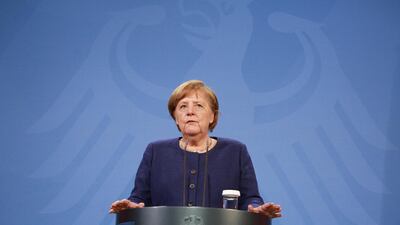
A fitting coda to Angela Merkel’s long period in power in Germany is the increasing confidence of the refugees who found a safe haven in her country after 2015.
More than 1 million migrants are assimilating into what is, by both population and economic heft, Europe’s biggest state. The first pioneers are even emerging on the political scene.
Making a contribution to the shape of politics is a big part of the immigrant journey. In Germany, breaking into politics has historically been very hard for immigrants.
Germany has accepted millions of refugees in the past decade. EPA
When the first surge of migrants into Europe took place after the rise of ISIS, Ms Merkel took what was hailed as a bold stance.
"We can do this," she declared. "Wir schaffen das." At the time, it was seen as a reference to the capacity of the German economy to absorb the costs and burdens of a whole new strata of society.
It has since become clear that she foresaw a full scale embrace of the new German citizens.
This started almost immediately with dignified housing solutions and naturalisation advice. All new arrivals were provided with German language training. There was also technical training to prepare people for the demands of German employers.
Conversion rules were established to convert professional qualifications, such as those for doctors, to German standards.
The outcomes have been pretty smooth for a country that has in real time been buffeted by populism. The far right reemerged big-time. Radicalised extremists are proliferating, not just in street gangs but within some security services.
The German Parliament has been transformed, with a far-right party, Alternativ fur Deutschland, holding the position of the official opposition.
But the political march to the extremes appears to have stalled. Analysts are now seeing signs of how resilient the centre ground is, and that Germany's migrants are finding their voice.
The latest research shows the moderate “people’s parties”, especially Mrs Merkel’s Christian Democratic Union, are strongly backed by new German citizens.
Polling for the Konrad Adenaeur Foundation, a think tank tied to Ms Merkel’s party, has found that support for the party from foreign-born voters has risen above 40 per cent. As recently as 2015, only 17 per cent of Turkish-born voters expressed support for the CDU. The Adenauner Foundation has found that the figure is now 53 per cent.
According to population data, there are 13 million foreign-born voters in Germany, the highest number in absolute terms outside the US.
There has been a benefit to Ms Merkel’s party in voters of all stripes, including migrants, appreciating the country’s handling of the Covid-19 pandemic.
Posters calling for "No more Morias", referring to the Moria refugee camp on the Greek island of Lesbos which burned down, are hung on a tree on February 18, 2021 in Berlin's Kreuzberg district. AFP
Germany's political march to the extremes appears to have stalled
Germany has effectively responded to the healthcare strains resulting from the spread of the virus.
It has now rolled out a vaccination campaign that Ms Merkel wants to see reach 10 million jabs a week by the summer.
Viola Neu, the researcher behind the CDU data on migrant voting patterns, told the Wall Street Journal that she sees the trend as a process of "normalisation". Migrants are acting according to their values and personal preferences and are not tied to the group.
Aspiring politicians see politics as a way of changing society but also displaying their own sense of the country’s destiny. Timur Husein, the son of self-identified "left-wing" immigrant parents, is the CDU leader in Berlin’s central district of Kreuzberg. Mr Husein came to national attention when he fought a campaign to keep the names of Prussian generals on local streets.
His political awakening came when he saw that left-wing students were burning their education certificates, something that stuck in his mind because he and his parents had struggled to get an education.
Many migrants are entrepreneurs often share the centre-right values of low taxes and progress up the social ladder while disdaining social debates or a preoccupation with identity-focused policy tests.
The involvement of politicians from a migrant background is not limited to the centre-right. The upcoming 2021 general election in Germany is the second vote since Tareq Alaows crossed in a dingy to Europe. But if he is elected for the Green Party, Mr Alaows will make history as the first Syrian refugee to have a voice in making German laws and regulation.
The 31-year-old says there are many voices and high-profile debates but no one to talk about the refugees themselves. He recalls how living in a gymnasium in 2015 with dozens of others inspired him to get involved politically.
The Green Party is a coming force in Germany. The climate agenda is just the foundation stone of its concepts of a more inclusive type of politics. The lesson from both aspiring politicians is that their outlook was tested in personal moments that proved life-changing.
It is notable also that the mainstream parties are ready to change and absorb people with formative experiences outside the German stereotype.
Politics has needed a rebirth since the tumult that swept Europe with the first mass influx of refugees in 2015. Ms Merkel is giving way to new successors, but her long-term impact may yet be seen in the cohort of those who came into politics when she was on her way out.
Damien McElroy is the London bureau chief at The National

RESULTS
Bantamweight:
Zia Mashwani (PAK) bt Chris Corton (PHI)
Super lightweight:
Flavio Serafin (BRA) bt Mohammad Al Khatib (JOR)
Super lightweight:
Dwight Brooks (USA) bt Alex Nacfur (BRA)
Bantamweight:
Tariq Ismail (CAN) bt Jalal Al Daaja (JOR)
Featherweight:
Abdullatip Magomedov (RUS) bt Sulaiman Al Modhyan (KUW)
Middleweight:
Mohammad Fakhreddine (LEB) bt Christofer Silva (BRA)
The government has taken an increasingly tough line against companies that fail to pay employees on time. Three years ago, the Cabinet passed a decree allowing the government to halt the granting of work permits to companies with wage backlogs.
If wages are 10 days late, the new measures kick in and the company is alerted it is in breach of labour rules. If wages remain unpaid for a total of 16 days, the authorities can cancel work permits, effectively shutting off operations. Fines of up to Dh5,000 per unpaid employee follow after 60 days.
Despite those measures, late payments remain an issue, particularly in the construction sector. Smaller contractors, such as electrical, plumbing and fit-out businesses, often blame the bigger companies that hire them for wages being late.
The authorities have urged employees to report their companies at the labour ministry or Tawafuq service centres — there are 15 in Abu Dhabi.
TOUCH RULES
Touch is derived from rugby league. Teams consist of up to 14 players with a maximum of six on the field at any time.
Teams can make as many substitutions as they want during the 40 minute matches.
Similar to rugby league, the attacking team has six attempts - or touches - before possession changes over.
A touch is any contact between the player with the ball and a defender, and must be with minimum force.
After a touch the player performs a “roll-ball” - similar to the play-the-ball in league - stepping over or rolling the ball between the feet.
At the roll-ball, the defenders have to retreat a minimum of five metres.
A touchdown is scored when an attacking player places the ball on or over the score-line.
MATCH INFO
Uefa Champions League, last-16, second leg (first-leg scores in brackets):
PSG (2) v Manchester United (0)
Midnight (Thursday), BeIN Sports
Mercer, the investment consulting arm of US services company Marsh & McLennan, expects its wealth division to at least double its assets under management (AUM) in the Middle East as wealth in the region continues to grow despite economic headwinds, a company official said.
Mercer Wealth, which globally has $160 billion in AUM, plans to boost its AUM in the region to $2-$3bn in the next 2-3 years from the present $1bn, said Yasir AbuShaban, a Dubai-based principal with Mercer Wealth.
“Within the next two to three years, we are looking at reaching $2 to $3 billion as a conservative estimate and we do see an opportunity to do so,” said Mr AbuShaban.
Mercer does not directly make investments, but allocates clients’ money they have discretion to, to professional asset managers. They also provide advice to clients.
“We have buying power. We can negotiate on their (client’s) behalf with asset managers to provide them lower fees than they otherwise would have to get on their own,” he added.
Mercer Wealth’s clients include sovereign wealth funds, family offices, and insurance companies among others.
From its office in Dubai, Mercer also looks after Africa, India and Turkey, where they also see opportunity for growth.
Wealth creation in Middle East and Africa (MEA) grew 8.5 per cent to $8.1 trillion last year from $7.5tn in 2015, higher than last year’s global average of 6 per cent and the second-highest growth in a region after Asia-Pacific which grew 9.9 per cent, according to consultancy Boston Consulting Group (BCG). In the region, where wealth grew just 1.9 per cent in 2015 compared with 2014, a pickup in oil prices has helped in wealth generation.
BCG is forecasting MEA wealth will rise to $12tn by 2021, growing at an annual average of 8 per cent.
Drivers of wealth generation in the region will be split evenly between new wealth creation and growth of performance of existing assets, according to BCG.
Another general trend in the region is clients’ looking for a comprehensive approach to investing, according to Mr AbuShaban.
“Institutional investors or some of the families are seeing a slowdown in the available capital they have to invest and in that sense they are looking at optimizing the way they manage their portfolios and making sure they are not investing haphazardly and different parts of their investment are working together,” said Mr AbuShaban.
Some clients also have a higher appetite for risk, given the low interest-rate environment that does not provide enough yield for some institutional investors. These clients are keen to invest in illiquid assets, such as private equity and infrastructure.
“What we have seen is a desire for higher returns in what has been a low-return environment specifically in various fixed income or bonds,” he said.
“In this environment, we have seen a de facto increase in the risk that clients are taking in things like illiquid investments, private equity investments, infrastructure and private debt, those kind of investments were higher illiquidity results in incrementally higher returns.”
The Abu Dhabi Investment Authority, one of the largest sovereign wealth funds, said in its 2016 report that has gradually increased its exposure in direct private equity and private credit transactions, mainly in Asian markets and especially in China and India. The authority’s private equity department focused on structured equities owing to “their defensive characteristics.”
The new speaker of Iraq’s parliament Mohammed Al Halbousi is the youngest person ever to serve in the role.
The 37-year-old was born in Al Garmah in Anbar and studied civil engineering in Baghdad before going into business. His development company Al Hadeed undertook reconstruction contracts rebuilding parts of Fallujah’s infrastructure.
He entered parliament in 2014 and served as a member of the human rights and finance committees until 2017. In August last year he was appointed governor of Anbar, a role in which he has struggled to secure funding to provide services in the war-damaged province and to secure the withdrawal of Shia militias. He relinquished the post when he was sworn in as a member of parliament on September 3.
He is a member of the Al Hal Sunni-based political party and the Sunni-led Coalition of Iraqi Forces, which is Iraq’s largest Sunni alliance with 37 seats from the May 12 election.
He maintains good relations with former Prime Minister Nouri Al Maliki’s State of Law Coaliton, Hadi Al Amiri’s Badr Organisation and Iranian officials.
Crops that could be introduced to the UAE
1: Quinoa
2. Bathua
3. Amaranth
4. Pearl and finger millet
5. Sorghum
The specs
Engine: Dual 180kW and 300kW front and rear motors
Ministry of Interior Ministry of Defence General Intelligence Directorate Air Force Intelligence Agency Political Security Directorate Syrian National Security Bureau Military Intelligence Directorate Army Supply Bureau General Organisation of Radio and TV Al Watan newspaper Cham Press TV Sama TV
Qosty Byogaani
Starring: Hani Razmzi, Maya Nasir and Hassan Hosny
Name: Thndr Started: 2019 Co-founders: Ahmad Hammouda and Seif Amr Sector: FinTech Headquarters: Egypt UAE base: Hub71, Abu Dhabi Current number of staff: More than 150 Funds raised: $22 million
Practitioners of mindful eating recommend the following books to get you started:
Savor: Mindful Eating, Mindful Life by Thich Nhat Hanh and Dr Lilian Cheung
How to Eat by Thich Nhat Hanh
The Mindful Diet by Dr Ruth Wolever
Mindful Eating by Dr Jan Bays
How to Raise a Mindful Eaterby Maryann Jacobsen
The biog
Date of birth: 27 May, 1995
Place of birth: Dubai, UAE
Status: Single
School: Al Ittihad private school in Al Mamzar
University: University of Sharjah
Degree: Renewable and Sustainable Energy
Hobby: I enjoy travelling a lot, not just for fun, but I like to cross things off my bucket list and the map and do something there like a 'green project'.
Lexus LX700h specs
Engine: 3.4-litre twin-turbo V6 plus supplementary electric motor
