
The announcement that the US aims to pull thousands of troops out of Iraq and Afghanistan by November has more to do with President Donald Trump’s desire to win re-election than it does with any tangible improvement in the overall security situation.
Mr Trump has made no secret throughout the course of his presidency of his desire to tackle America’s involvement in “endless wars” that have cost the American taxpayer, according to the President’s estimate, around $7 trillion – money that he believes could be better spent on improving the lives of ordinary Americans.
Indeed, Mr Trump’s “America First” policy has already seen Washington announce a number of premature troops withdrawals, such as the decision to abandon the Kurds in northern Syria and the removal of significant numbers of American forces in Afghanistan before the long drawn-out negotiations with the Taliban had been concluded.
So this week's announcement by US Marine General Frank McKenzie, the commander of US Central Command, that Washington intends to make significant reductions to its troop strength in both Iraq and Afghanistan in time for November's US presidential election is entirely in keeping with Mr Trump's promise.
This will mean that American forces in Iraq will reduce from their current level of around 5,200 troops to around 3,000, while in Afghanistan troop levels are expected to fall to around 4,500.
In an attempt to justify the move, Gen McKenzie said the reductions were a reflection of the Trump administration’s confidence in the ability of US-trained Iraqi security forces to tackle any future threats the country might face.
As for Afghanistan, Gen McKenzie said that maintaining a force of around 4,500 would be sufficient to protect American interests in the region. “We don’t want to be an occupying force in this country,” he explained. “But we do have strategic interests, vital interests, that compel us to be certain that these entities, such as Al Qaeda and ISIS, can’t be guests there to attack the United States.”
Obtaining guarantees from the Taliban, the extremist movement that originally allowed Al Qaeda to establish bases in Afghanistan, that the country will no longer be used by militants to launch attacks against the US, such as the September 11 attacks in 2001, has been one of the central demands of the negotiations aimed at bringing the country’s long-running civil war.
But while Taliban negotiators have intimated that they are willing to commit themselves to such an undertaking in return for Washington ending its military involvement in the country, the negotiations between the US and the Taliban have stalled over the vexed issue of releasing an estimated 5,000 Taliban fighters from being held by the Afghan authorities.
The Afghan government of President Ashraf Ghani was initially excluded from the negotiations when an outline deal was agreed in March, and the Afghan government’s qualms about releasing Taliban fighters accused of launching attacks against Afghan security forces meant it was reluctant to meet the group’s demands, thereby prompting a new round of violence throughout the summer.
-
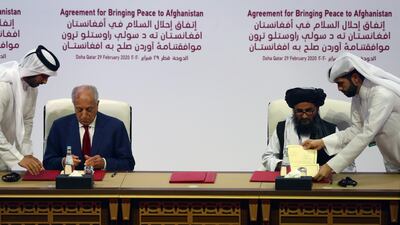
Mullah Abdul Ghani Baradar, the leader of the Taliban delegation, signs an agreement with Zalmay Khalilzad, US envoy for peace in Afghanistan, at a signing agreement ceremony between members of Afghanistan's Taliban and the US in Doha, Qatar February 29, 2020. Reuters -
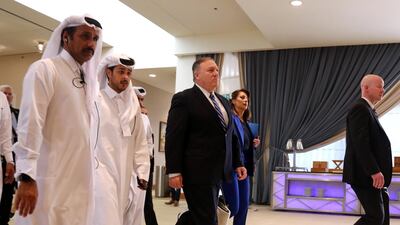
US Secretary of State Mike Pompeo walks ahead of the signing of an agreement between members of Afghanistan's Taliban delegation and the US government in Doha, Qatar. Reuters -

Members of Afghanistan's Taliban delegation speak to the media ahead of an agreement signing between them and US officials in Doha, Qatar. Reuters -
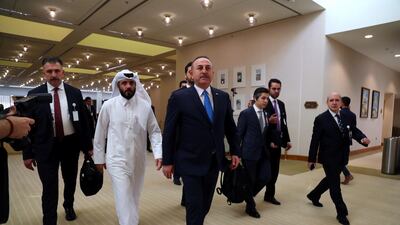
Turkish Foreign Minister Mevlut Cavusoglu walks ahead of the signing of an agreement between members of Afghanistan's Taliban delegation and the US government in Doha, Qatar. Reuters -
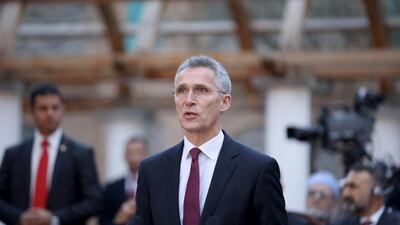
NATO Secretary General Jens Stoltenberg attends a joint press conference with Afghan President Ghani and US Secretary of Defence Mark Esper on the declaration of a peace deal to be signed between the US and the Taliban, at the presidential palace in Kabul, Afghanistan. EPA -
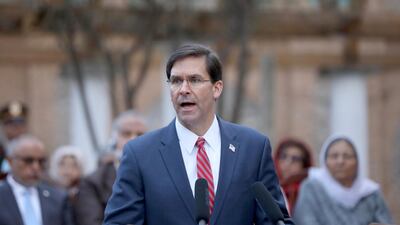
US Secretary of Defence Mark Esper attends a joint press conference with Afghan President Ghani and NATO Secretary General Stoltenberg on the declaration of a peace deal to be signed between the US and the Taliban, at the presidential palace in Kabul, Afghanistan. EPA -
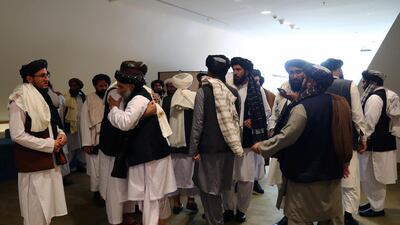
Members of the Taliban delegation gather ahead of an agreement signing between them and US officials in Doha, Qatar. Reuters


Under pressure from Washington, though, the US finally persuaded the Afghan authorities to release the majority of Taliban captives, thereby paving the way for the Afghan government to participate in the peace talks for the first time.
Announcing a significant reduction in the number of American troops at a critical stage in the negotiations therefore represents a significant gamble on the part of the Trump administration. Indeed, concerns that the US might be sacrificing its national security interests simply to achieve Mr Trump's desire to end Washington's overseas military involvement has already provoked controversy when former defence secretary James Mattis resigned over the issue in late 2018.
Taliban leaders have long believed that Washington will eventually tire of its long-standing military commitment to Afghanistan which, at the time of the US-led coalition’s attempt to bring stability to the country, saw in excess of 100,000 American troops based there.
The fact that the Trump administration's priority now is to reduce America's military presence will certainly raise fears among the Afghan authorities that Washington is abandoning the country to an uncertain fate at the hands of the Taliban. It is a similar story in Iraq, where the recently formed government of Prime Minister Mustafa Al Kadhimi is still finding its feet after more than a decade of misrule.
-
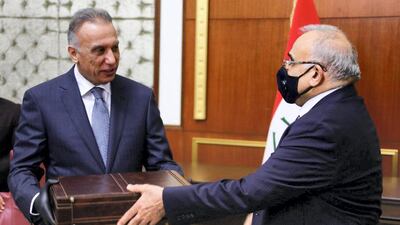
Former Iraqi Prime Minister Adel Abdul Mahdi hands over to new Prime Minister Mustafa Al Kadhimi in Baghdad, Iraq, May 7, 2020. Reuters -
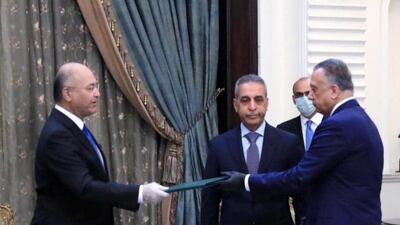
Iraq's President Barham Salih instructs newly appointed Prime Minister Mustafa Al Kadhimi in Baghdad, Iraq April 9, 2020. Reuters -
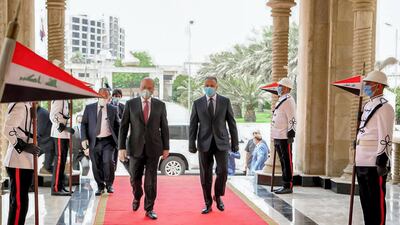
President Barham Salih receiving Prime Minister Mustafa Al Kadhimi at Salam Palace in the capital Baghdad, while both clad in masks due to the Covid-19 pandemic on May 28, 2020. AFP -
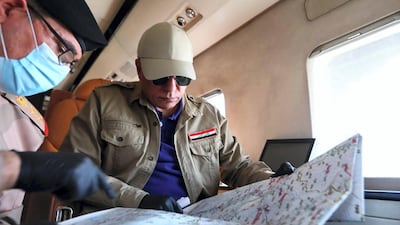
Prime Minister Mustafa Al Kadhimi looks at a map aboard a plane on the way to the northern city of Kirkuk for an official visit on June 2, 2020. AFP -
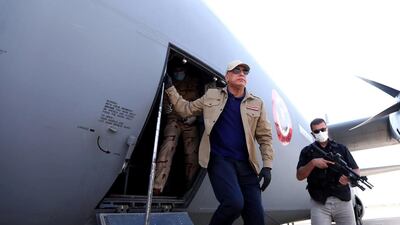
Prime Minister Mustafa Al Kadhimi arriving in Kirkuk for an official visit on June 2, 2020. AFP -
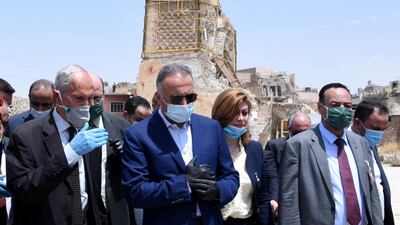
Prime Minister Mustafa Al Kadhimi visits the Great Mosque of al-Nuri in the Old City area, on the west side of Mosul city, northern Iraq, 10 June 2020. EPA -
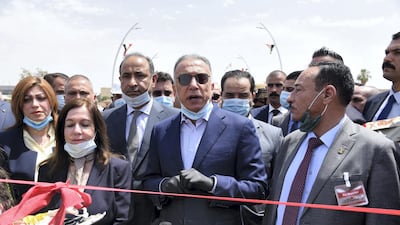
Prime Minister Mustafa Al Kadhimi speaks during the reopening ceremony of a bridge which connects East and West Mosul, northern Iraq, 10 June 2020. EPA -

Iraqi Prime Minister Mustafa Al Kadhimi visits and offers condolences to the family of the late former government advisor and political analyst Hisham al-Hashemi, who was killed by gunmen, in Baghdad, Iraq July 8, 2020. Reuters -

Iraqi Prime Minister Mustafa Al Kadhimi talks to prisoners during his visit in the central investigation prison in Al-Muthana airport in Baghdad, Iraq July 30, 2020. Reuters -
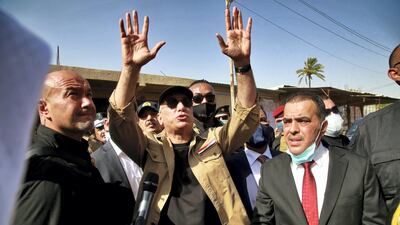
Iraqi Prime Minister Mustafa Al Kadhimi speaks to locals in Tarmiyah, Iraq July 20, 2020. Reuters -
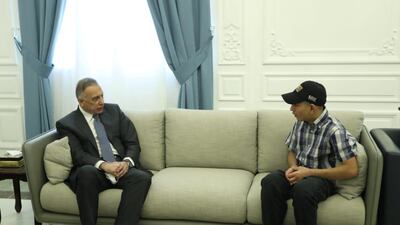
Iraqi Prime Minister Mustafa Al Kadhimi meets with Iraqi teenager Hamid Saeed, who was mistreated by members of security forces, after he was released from jail in Baghdad, Iraq August 3, 2020. Reuters -
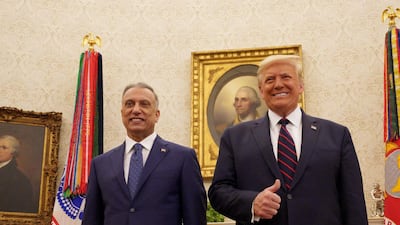
US President Donald Trump receives Iraq's Prime Minister Mustafa Al Kadhimi in the Oval Office at the White House in Washington, August 20, 2020. Reuters -
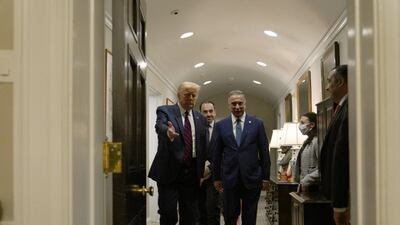
US President Donald Trump receives Iraq's Prime Minister Mustafa Al Kadhimi in the Oval Office at the White House in Washington, August 20, 2020. Reuters -

US President Donald Trump receives Iraq's Prime Minister Mustafa Al Kadhimi in the Oval Office at the White House in Washington, August 20, 2020. Reuters -
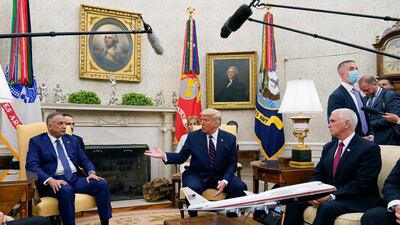
President Donald Trump meets with Iraqi Prime Minister Mustafa Al Kadhimi in the Oval Office of the White House, Thursday, August 20, 2020, in Washington. AP Photo -

Iraq's Prime Minister Mustafa Al Kadhimi arrives to the southern city of Basra late on August 22, 2020, accompanied by security forces' commanders in a surprise visit. AFP -
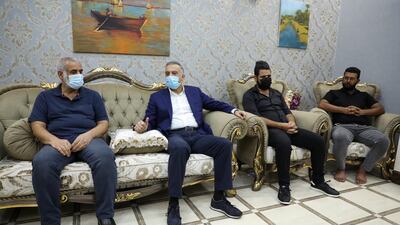
Iraqi Prime Minister Mustafa Al Kadhimi visits and offers condolences to the family of Reham Yacoub, a female activist who was killed by unidentified gunmen, in Basra, Iraq August 22, 2020. Reuters -

Iraqi Prime Minister Mustafa Al Kadhimi, center, speaks to journalists during his visit to Basra, Iraq, Saturday, August 22, 2020. AP Photo -
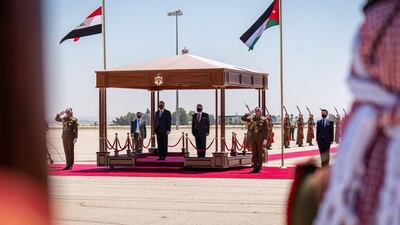
King Abdullah II of Jordan and Iraqi Prime Minister Mustafa Al Kadhimi in the official welcoming ceremony held at Queen Alia International Airport ahead of the trilateral meeting in Amman, Jordan, 25 August 2020. EPA -
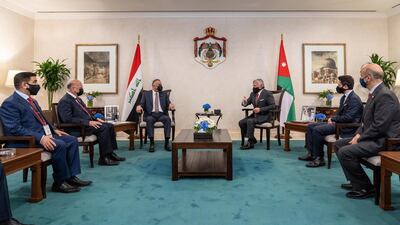
King Abdullah II of Jordan and Iraqi Prime Minister Mustafa Al Kadhimi talking ahead of the trilateral meeting in Amman, Jordan, 25 August 2020. EPA


Apart from battling Iran’s malign influence in Iraqi politics in recent years, Mr Al Kadhimi is committed to ending the corruption and sectarianism that have characterised the running of successive governments since the overthrow of former dictator Saddam Hussein in 2003.
Iraq’s security forces are also having to contend with a revival of ISIS activity in the country in recent months, a challenge that is not helped by the fact that Iran’s continued support for proxies in Iraq and neighbouring Syria is making the task of defeating ISIS immeasurably more difficult.
Speaking during an online discussion hosted by the US Institute of Peace last month, Gen McKenzie conceded that Iran’s continued meddling in the Middle East was “an impediment to the enduring defeat of ISIS". He also warned that ISIS continued “to aspire to regain control of physical terrain” in Iraq and Syria. “Without sustained pressure, they have got the potential to do so in a relatively short period of time,” he said.
Consequently, while Mr Trump’s primary focus is winning November’s election, reducing Washington’s military presence in the Middle East could ultimately prove to be counter-productive in terms of defending Washington’s vital long-term interests.
Con Coughlin is a defence and foreign affairs columnist for The National

