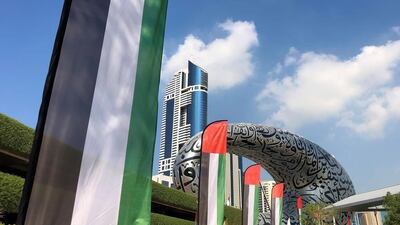
As we enter the year-long celebrations of the 50th anniversary of the formation of the UAE in December 1971, I have been pondering over my memories of those years, from 1975 onwards and my thoughts on the future.
One of the most remarkable features of the Emirates is how it has not just survived, but thrived. There have been ups and downs, of course. No country can escape those, especially one which, like the UAE, is so intimately bound to the global economic cycle because of its important oil and gas industry. So we have seen slumps, as well as booms. But for the most part, the country has steered a consistent path, even as its population has grown from around 250,000 at the time the federation was created to more than nine million today.
While the economy is now recovering from the Covid-19 pandemic, those of us who remember previous setbacks, such as the collapse of oil prices in the 1980s, have confidence in the UAE's ability to move forward once more.
Sheikh Zayed, Founding Father of the UAE, being briefed by Dr Farouk El-Baz, right, who was a part of America's Apollo programme. Dubai Media Office
The extraordinary extent of the acceptance of mutual coexistence amongst the UAE’s multinational population is also, in my view, something well worth remembering. This country has always welcomed people of other cultures and other faiths, of course, as anyone with a knowledge of local history can explain. This is not, though, a static process. During my years here, I have seen people arrive, become a part of the fabric of life in the Emirates and play their part in the development of community and country.
All that has taken place against a background of rapid and peaceful social and economic change that has meant that the UAE today, in terms of its urban centres, at least, is almost unrecognisable when compared to 1971. The amazement of former residents who return after a decade or two away is almost palpable.
The contrast with many of the other countries within the broader Middle East region is sufficiently sharp as to need no description.
Looking back, I give thanks that, at its birth, the UAE was endowed not just with financial resources, but with political leadership – not least that of the late Sheikh Zayed, the Founding Father – that had the wisdom to chart the course that we have followed.
What, though, can that tell us about the half-century that lies ahead?
The pace of technological progress is such that it is, I think, nearly impossible to imagine how society will look 50 years from now. How will the increasing adoption of artificial intelligence change lives, both at work and elsewhere? If advances in health care mean that the lives of most become longer, how will we adapt not just to that, but to the presumably inevitable population growth that will follow? How will the nature of travel and other communications change? What will be the key aspects of our economy, and of the economies of our present and future partners? How will our governmental system evolve to ensure the continuation of an effective two-way process of dialogue and interchange between the state and the people? How will we tackle the environmental challenges posed by climate change and the need to devise sustainable ways of exploiting natural resources before it is too late? How can we preserve the key elements of our heritage?
A 50th year celebration message of the forming of the UAE on a Dubai Metro station off Sheikh Zayed Road. The UAE's past and its future are inextricably linked. Antonie Robertson / The National
The ability to innovate and to adapt is fundamental to the UAE's successes and to overcoming challenges
For these, and for many other questions, I have no answers – merely further questions.
If, however, we look back half a century, either by recalling our own memories or by learning from those of others, a not dissimilar set of questions emerges.
Over the past 50 years, the UAE has dealt with those through a process that has involved not just careful planning but also a willingness to recognise that all plans may be liable to change as circumstances change. The ability to innovate and to adapt in pursuit of long-term goals has been fundamental both to the successes that the UAE has achieved and to the overcoming or circumventing of unexpected challenges. That ability is still evident today, as is the ability to dream.
There can be no guarantees that we will reach the targets that we now set ourselves, or, indeed, that those targets will still exist.
The same was true, of course, of the targets set back in 1971. Some have fallen by the wayside as priorities change. Others have been overtaken by changing events. What has remained, however, has been a sense of optimism, a belief that the underlying goal of creating a better society not only remains relevant but is achievable, even if the routes towards it may evolve.
Looking back, that optimism has been evident throughout our history. That is something truly worth celebrating in our anniversary year and a noble goal to set our sights on in the years ahead.
Peter Hellyer is a consultant specialising in the UAE’s history and culture

Four reasons global stock markets are falling right now
There are many factors worrying investors right now and triggering a rush out of stock markets. Here are four of the biggest:
1. Rising US interest rates
The US Federal Reserve has increased interest rates three times this year in a bid to prevent its buoyant economy from overheating. They now stand at between 2 and 2.25 per cent and markets are pencilling in three more rises next year.
Kim Catechis, manager of the Legg Mason Martin Currie Global Emerging Markets Fund, says US inflation is rising and the Fed will continue to raise rates in 2019. “With inflationary pressures growing, an increasing number of corporates are guiding profitability expectations downwards for 2018 and 2019, citing the negative impact of rising costs.”
At the same time as rates are rising, central bankers in the US and Europe have been ending quantitative easing, bringing the era of cheap money to an end.
2. Stronger dollar
High US rates have driven up the value of the dollar and bond yields, and this is putting pressure on emerging market countries that took advantage of low interest rates to run up trillions in dollar-denominated debt. They have also suffered capital outflows as international investors have switched to the US, driving markets lower. Omar Negyal, portfolio manager of the JP Morgan Global Emerging Markets Income Trust, says this looks like a buying opportunity. “Despite short-term volatility we remain positive about long-term prospects and profitability for emerging markets.”
3. Global trade war
Ritu Vohora, investment director at fund manager M&G, says markets fear that US President Donald Trump’s spat with China will escalate into a full-blown global trade war, with both sides suffering. “The US economy is robust enough to absorb higher input costs now, but this may not be the case as tariffs escalate. However, with a host of factors hitting investor sentiment, this is becoming a stock picker’s market.”
4. Eurozone uncertainty
Europe faces two challenges right now in the shape of Brexit and the new populist government in eurozone member Italy.
Chris Beauchamp, chief market analyst at IG, which has offices in Dubai, says the stand-off between between Rome and Brussels threatens to become much more serious. "As with Brexit, neither side appears willing to step back from the edge, threatening more trouble down the line.”
The European economy may also be slowing, Mr Beauchamp warns. “A four-year low in eurozone manufacturing confidence highlights the fact that producers see a bumpy road ahead, with US-EU trade talks remaining a major question-mark for exporters.”
The number of asylum applications in the UK has reached a new record high, driven by those illegally entering the country in small boats crossing the English Channel.
A total of 111,084 people applied for asylum in the UK in the year to June 2025, the highest number for any 12-month period since current records began in 2001.
Asylum seekers and their families can be housed in temporary accommodation while their claim is assessed.
The Home Office provides the accommodation, meaning asylum seekers cannot choose where they live.
When there is not enough housing, the Home Office can move people to hotels or large sites like former military bases.
Nigel Farage told Reform's annual conference that the party will proscribe the Muslim Brotherhood if he becomes Prime Minister. "We will stop dangerous organisations with links to terrorism operating in our country," he said. "Quite why we've been so gutless about this – both Labour and Conservative – I don't know. “All across the Middle East, countries have banned and proscribed the Muslim Brotherhood as a dangerous organisation. We will do the very same.” It is 10 years since a ground-breaking report into the Muslim Brotherhood by Sir John Jenkins. Among the former diplomat's findings was an assessment that “the use of extreme violence in the pursuit of the perfect Islamic society” has “never been institutionally disowned” by the movement. The prime minister at the time, David Cameron, who commissioned the report, said membership or association with the Muslim Brotherhood was a "possible indicator of extremism" but it would not be banned.
Skoda Superb Specs
Engine: 2-litre TSI petrol
Power: 190hp
Torque: 320Nm
Price: From Dh147,000
Available: Now
UAE currency: the story behind the money in your pockets
