

Turkish President Recep Tayyip Erdogan sought to signal a softening in his foreign policy stance this past weekend.
First, he called Saudi Arabia's King Salman to discuss bilateral ties following several months of tension, that included popular calls for the boycott of Turkish products. The next day, he contradicted months of his own anti-European posturing and policies.
“We don't see ourselves anywhere but in Europe,” he told his ruling Justice and Development Party (AKP). “We envisage building our future together with Europe.”
It would be wise to view this sudden shift with great scepticism. The plight of Turkey’s Jewish community, in particular, underscores the deeply rooted, extremist Islamist nature of Turkey’s leader.
Jews have a long history in Anatolia and Eastern Thrace. When Sephardic Jews were expelled from Spain in 1492, the Ottoman Empire welcomed thousands of them. By 1500, Istanbul, the Ottoman capital, was more than 10 per cent Jewish.

I lived for years in Karakoy, a lively neighbourhood of Istanbul situated along the Bosphorus and named for the thousands of Turkish-speaking adherents of Karaism, a branch of Judaism, who settled there long ago. At the start of the 20th century, as many as 300,000 Jews lived in the fast-shrinking Ottoman Empire, with about a third of them in a crescent stretching from Izmir to Thessaloniki, in modern-day Greece.
The Republic of Turkey, founded in 1923 by Mustafa Kemal Ataturk as a secular state, helped save thousands of Jews from the Holocaust. But it also witnessed a series of pogroms against Jews, as well as Christian Greeks and Armenians, with particularly harsh spasms in 1934 and 1955. In the republic’s first three decades, more than 60,000 Jews emigrated from Turkey to Palestine.
Extremist terrorists killed 22 Jews in an Istanbul synagogue in 1986, unsettling the community. Yet by 2000, the 23,000 Jews who remained in Turkey felt largely at home. Many even identified as Turkish first, according to Dr Hay Eytan Cohen Yanarocak, a Turkish-Jewish researcher at Tel Aviv University.
Things changed after Mr Erdogan took power. His political mentor was Necmettin Erbakan, head of the Islamist movement Milli Gorus, or National Vision. Erbakan drew from the Muslim Brotherhood, which has been anti-western and anti-Semitic since its founding nearly a century ago in Egypt. Mr Erdogan left to launch the AKP in 2001 and became prime minister two years later. In those early days, he served as the West’s poster child for Islamic democracy, pointing toward a “Turkish model” as he strengthened the rule of law to prepare for Turkey’s bid for accession to the EU.

Slowly, Mr Erdogan returned to his Islamist roots, highlighted by a series of political confrontations with Israel. During Israel's 2006 war with Lebanon, Mr Erdogan began to criticise Israel heavily. In 2009, Mr Erdogan frequently clashed with Israel's then president, Shimon Peres, and stormed out of that year's World Economic Forum in Davos. Then, in 2010, came the Mavi Marmara affair: Israeli commandos boarded a humanitarian ship that sought to break Israel's blockade over Gaza, and killed nine Turkish nationals as well as a Turkish-American.
Thousands of Turkish protesters attempted to overrun the Israeli consulate in Istanbul.
Jewish shops were boycotted. Turkey’s predominantly pro-government newspapers filled with anti-Semitic vitriol, and Turkish Jews started streaming for the exits. By 2012, just 17,000 of them remained.
“For Turkish Jews it was like a slap in their face,” Dr Yanarocak says.
Turkey’s small Armenian and Greek communities may have experienced a similar awakening during this period if early 20th-century traumas – a genocide of Armenians and a massive population exchange of Greeks – had not already made them painfully aware of just how unwelcome they were.

Turkish Jews might have also seen it coming. Back in the 1970s, when Mr Erdogan was head of a National Vision youth group, he wrote and played the lead role in a theatre production about Islamists facing an evil, Jewish-led conspiracy. And it was his 1999 stint in prison, for publicly reading an Islamist poem, that shot him to national power.
Since the Arab quartet of Saudi Arabia, the UAE, Bahrain and Egypt started to boycott Turkey’s ally Qatar in 2017, mainly due to Doha’s links to the Muslim Brotherhood, Mr Erdogan has leaned in. Two years ago he said Jews in Israel kick women and children when they are on the ground. His government has boosted financing for Islamists in Libya, Syria and across Europe. The day after the UAE and Bahrain agreed in August to normalise relations with Israel through the Abraham Accords, Mr Erdogan welcomed the leaders of Hamas to Istanbul.
Part of this is pandering to conservative Turkish voters as AKP support sags, but it’s also part of Mr Erdogan’s Ottoman-inspired vision of a new pan-Islamism. “Since 1947, Israel has been free to do what it likes in this region,” he said in 2018, arguing that in-fighting had limited the influence of Muslim-majority states. “This reality can be undone...if we unite.”
-
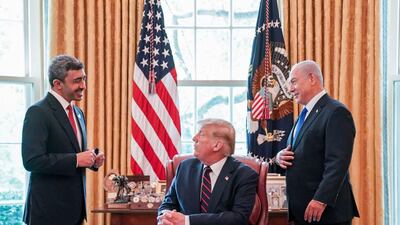
Sheikh Abdullah bin Zayed, UAE Minister of Foreign Affairs and International Co-operation, speaks to Donald Trump, US president at the time, and Israeli Prime Minister Benjamin Netanyahu in the Oval Office in September 2020. Ministry of Foreign Affairs and International Co-operation -
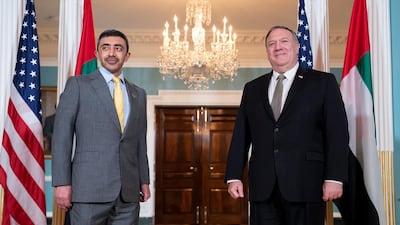
Sheikh Abdullah bin Zayed, UAE Minister of Foreign Affairs and International Co-operation, meets Mike Pompeo, US secretary of state at the time. Wam -
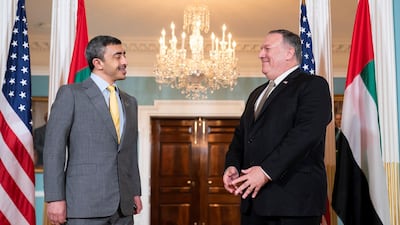
Sheikh Abdullah and Mr Pompeo in Washington. Wam -
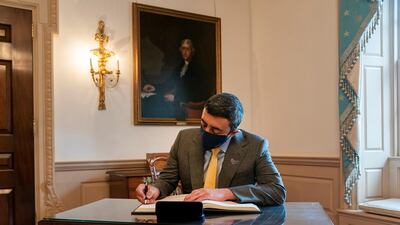
Sheikh Abdullah visits Washington in September last year. Wam -
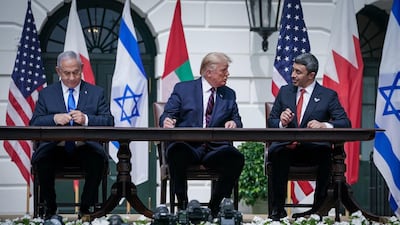
Sheikh Abdullah, UAE Minister of Foreign Affairs and International Co-operation, US President Donald Trump, centre, and Israeli Prime Minister Benjamin Netanyahu sign the Abraham Accord at the White House South Lawn. MOFAIC -
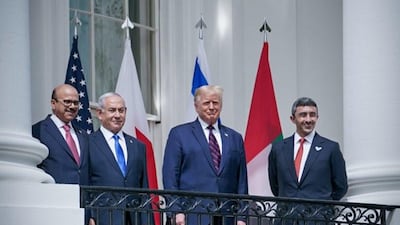
Sheikh Abdullah and, from left, Bahrain's Foreign Minister Abdullatif Al Zayani, Israeli Prime Minister Benjamin Netanyahu and US President Donald Trump at the White House. MOFAIC -
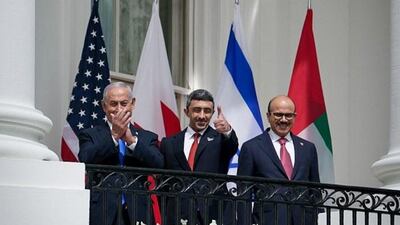
Sheikh Abdullah, Mr Al Zayani and Mr Netanyahu at the White House during the Abraham Accord signing ceremony. MOFAIC -
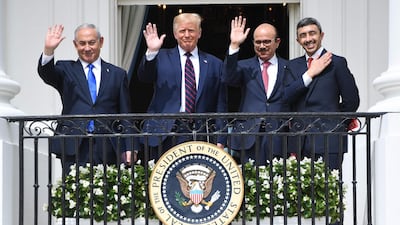
Sheikh Abdullah and, from left, Mr Netanyahu, Mr Trump and Mr Al Zayani wave from the Truman Balcony at the White House. AFP -
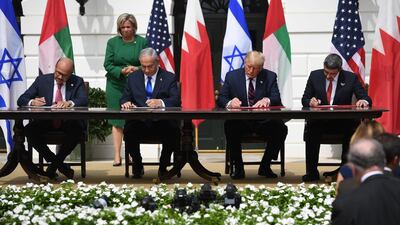
Sheikh Abdullah and, from left, Mr Al Zayani, Mr Netanyahu and Mr Trump sign the Abraham Accord. AFP -
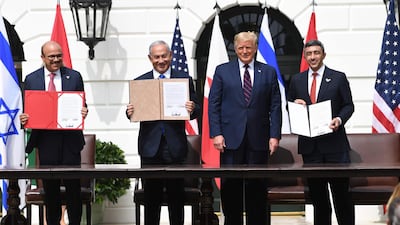
Sheikh Abdullah and, from left, Mr Al Zayani, Mr Netanyahu and Mr Trump after the signing ceremony. AFP -
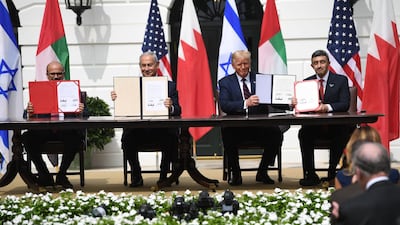
Sheikh Abdullah and, from left, Mr Al Zayani, Mr Netanyahu and Mr Trump after the signing ceremony. AFP -
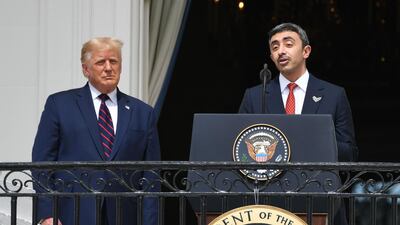
Sheikh Abdullah speaks from the Truman Balcony at the White House during the signing ceremony of the Abraham Accord. AFP -
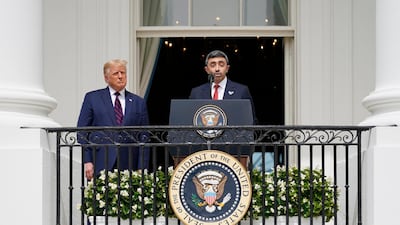
Sheikh Abdullah speaks as Mr Trump looks on before the signing of Abraham Accord on the South Lawn of the White House. AP -
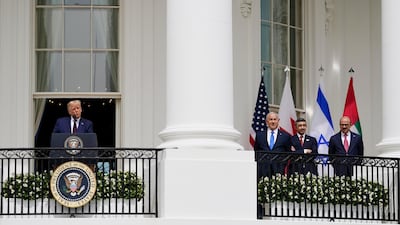
Sheikh Abdullah looks on from the White House as Mr Trump speaks at the Abraham Accord signing ceremony, also attended by Mr Al Zayani and Mr Netanyahu. AP -

Sheikh Abdullah bin Zayed, UAE Minister of Foreign Affairs and International Co-operation, Israeli Prime Minister Benjamin Netanyahu, left, and Bahraini Foreign Minister Abdullatif Al Zayani stand on the Blue Room Balcony during the signing ceremony. AP -
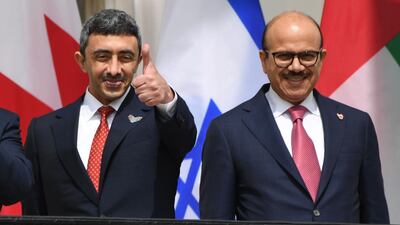
Sheikh Abdullah and Mr Al Zayani shortly before participating in the signing of the Abraham Accord. AFP -
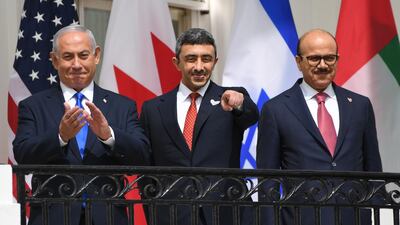
Sheikh Abdullah, with Mr Netanyahu, left, and Mr Al Zayani at the signing of the Abraham Accord on the South Lawn of the White House. AFP -
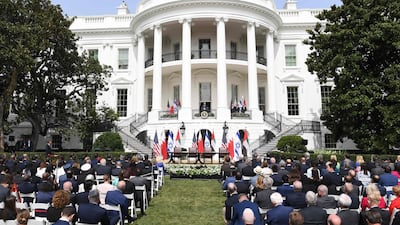
US President Donald Trump speaks from the Truman Balcony at the White House during the signing ceremony of the Abraham Accord. AFP -
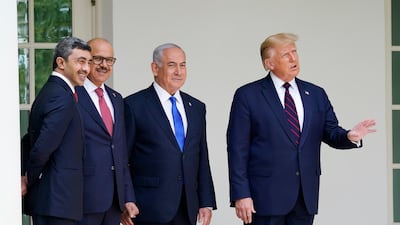
President Donald Trump walks to the Abraham Accord signing ceremony at the White House with Sheikh Abdullah bin Zayed, UAE Minister of Foreign Affairs and International Co-operation, Israeli Prime Minister Benjamin Netanyahu, and Bahrain's Foreign Minister Abdullatif Al Zayani. AP -
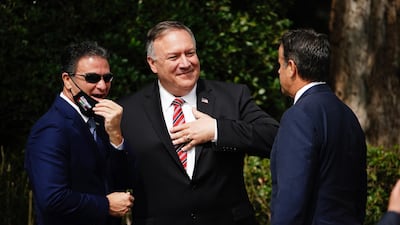
US Secretary of State Mike Pompeo arrives at the White House to attend the Abraham Accord signing ceremony hosted by President Donald Trump. EPA -
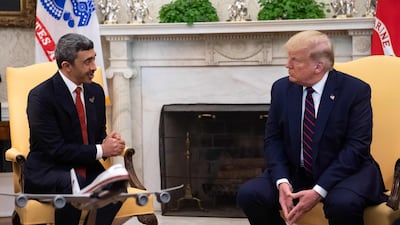
Sheikh Abdullah bin Zayed, UAE Minister of Foreign Affairs and International Co-operation, meets US President Donald Trump in the Oval Office of the White House before the signing of Abraham Accord. AFP -
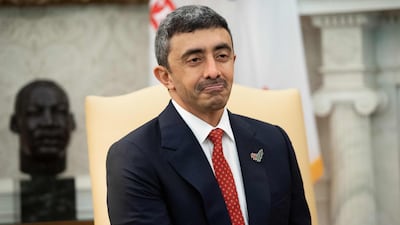
Sheikh Abdullah bin Zayed, UAE Minister of Foreign Affairs and International Co-operation, in the Oval Office. AFP -
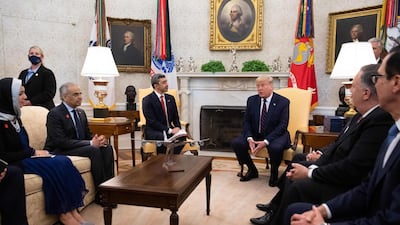
Sheikh Abdullah bin Zayed, UAE Minister of Foreign Affairs and International Co-operation, meets US President Donald Trump in the Oval Office of the White House. AFP -
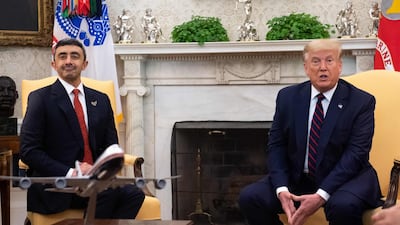
Sheikh Abdullah with Mr Trump in the Oval Office. AFP -
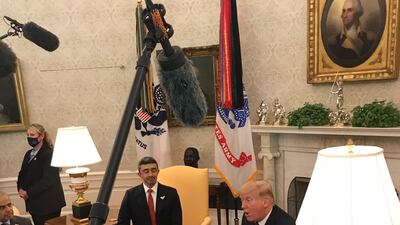
Sheikh Abdullah bin Zayed, UAE Minister of Foreign Affairs and International Co-operation, with by President Donald Trump at the White House. Mustafa Alrawi / The National -
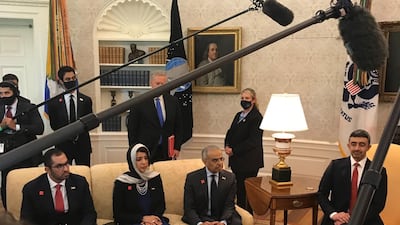
The UAE delegation led by Sheikh Abdullah bin Zayed, Minister of Foreign Affairs and International Co-operation, with US President Donald Trump at the White House. Mustafa Alrawi / The National -
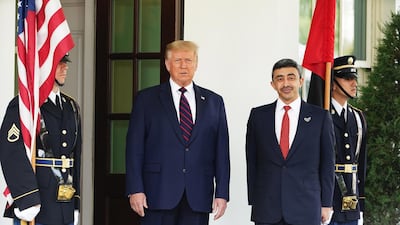
Sheikh Abdullah bin Zayed, UAE Minister of Foreign Affairs and International Co-operation, is welcomed to the White House by US President Donald Trump. EPA -
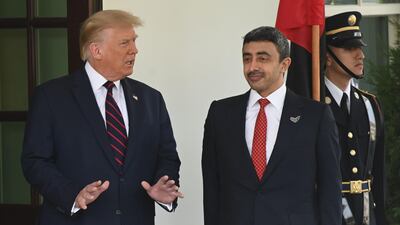
Sheikh Abdullah and Mr Trump outside the White House. AFP -
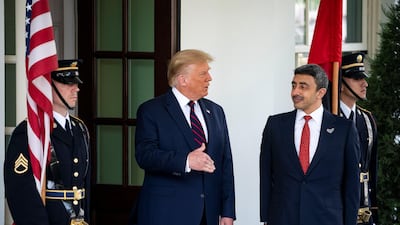
Sheikh Abdullah bin Zayed speaks to Mr Trump after arriving at the White House. Reuters -
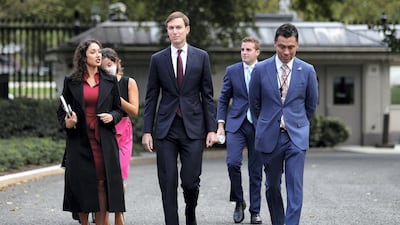
White House Senior Adviser Jared Kushner walks away following a television interview on the North Lawn at the White House in Washington. Reuters -
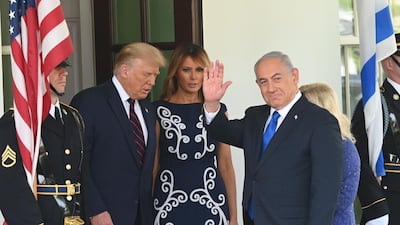
US President Donald Trump and First Lady Melania Trump welcome the arrival of Prime Minister of Israel Benjamin Netanyahu and his wife Sara on the North Lawn of the White House in Washington DC. AFP -
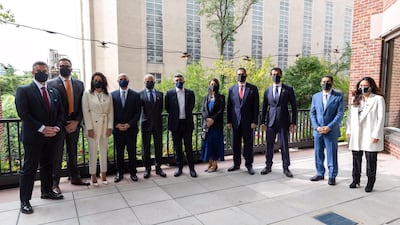
A delegation of senior UAE officials led by Sheikh Abdullah bin Zayed, UAE Minister of Foreign Affairs and International Co-operation, prepares to depart for the White House to sign the Abraham Accord. MOFAIC -
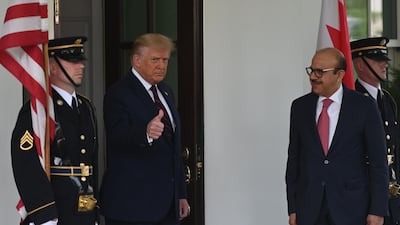
US President Donald Trump welcomes Bahraini Foreign Minister Abdullatif Al Zayani. AFP -

Bahraini Foreign Minister Abdullatif Al Zayani arrives at the White House in Washington DC. AFP -
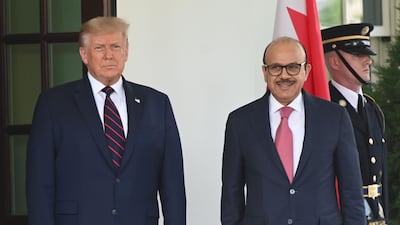
US President Donald Trump welcomes Bahraini Foreign Minister Abdullatif Al Zayani on the North Lawn of the White House in Washington, DC. AFP -
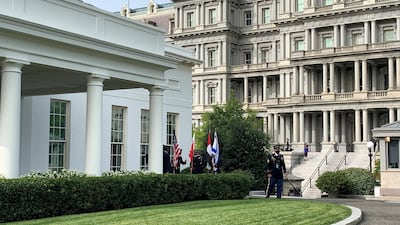
Preparations at the White House for the signing of the Abraham Accord. -
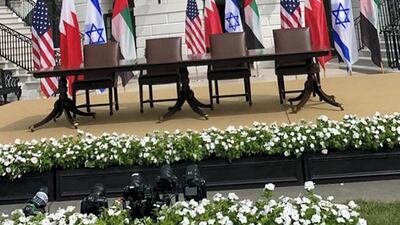
Preparations under way at the White House for the signing of the Abraham Accord. -
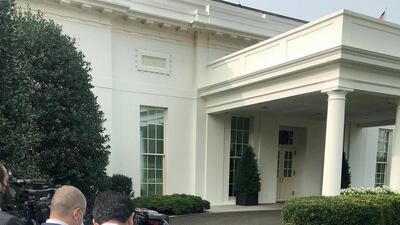
Preparations under way at the White House for the signing of the Abraham Accord. -

Preparation at the White House for the signing of the Abraham Accord. The National


Today, the region is moving in the opposite direction. The Abraham Accords formally establish two Gulf states’ ties to Israel, and push Turkey deeper into isolated, Islamist waters. Quietly, Turkey and Israel maintain significant trade ties; before the pandemic, 10 commercial flights flew the Istanbul-Tel Aviv route every day. Yet no country may be as hostile to Israel as Turkey. Israeli intelligence reportedly now views Ankara as a greater threat than Tehran.
Spain and Portugal have offered to grant citizenship to any proven descendants of Jews expelled in 1492. Dr Yanarocak says many of his Jewish friends in Turkey have applied for that programme so they have an escape hatch should the situation deteriorate further. Three years ago, his parents finally picked up and left Istanbul for Israel – one more step toward Turkey’s Jewish community acknowledging that its days are numbered.
In former US President Barack Obama’s hot-selling new memoir, he warns of Mr Erdogan’s “vocal sympathy for both the Muslim Brotherhood and Hamas…[which] made Washington and Tel Aviv nervous”. Former Turkish parliamentarian Aykan Erdemir told an Israeli newspaper earlier this year that Mr Erdogan’s anti-Semitism would haunt Turkey at home and abroad long after he leaves office. “The hate and prejudice inculcated in the Turkish people for almost two decades will have lasting effects,” Mr Erdemir said.
It already has.
David Lepeska is a veteran journalist who has been covering Turkey for the past decade

