Donald Trump's Covid-19 diagnosis and the ongoing drama of the American elections has managed to suck the oxygen out of major news developments around the world – whether it is the accelerating spread of the coronavirus in the Middle East and elsewhere, the toll of wildfires in America itself and around the world, or the eruption of a new war in the south Caucasus.
In late September, fighting erupted between Azerbaijan and Armenia, after months of rising tension, over Nagorno-Karabakh, an autonomous zone that is internationally recognised as part of Azerbaijan but is a de facto independent state with an Armenian ethnic majority. A major war was fought over the territory after the collapse of the Soviet Union, claiming thousands of lives. The latest conflagration has already led to indiscriminate shelling of civilian areas.
It is also another hotspot in which Turkey and Russia are once again at loggerheads. Moscow is a military ally of Armenia, while Ankara has close ties, both political and cultural, with Azerbaijan. Over the weekend, Recep Tayyip Erdogan vowed to support Baku.
Turkey is supporting Azerbaijan in its conflict with Armenia. AFP
This is the third proxy war between Turkey and Russia in the Middle East and the surrounding regions, after Syria and Libya. Both countries appear to see the region as a board in a game of Risk, rather than viewing their strategic geopolitical conflicts as ones that cost actual human lives and the devastation of their homes and dreams.
As the conflict in Nagorno-Karabakh escalated, reports emerged of Turkey sending Syrian mercenaries, former rebels who fought against the regime of Bashar Al Assad, to Azerbaijan. Initial coverage seemed to indicate that their role was intended to guard critical facilities, and that the fighters were sent with the promise of high monthly salaries, a lifeline for Syrians struggling to eke out a living in communities that were destroyed time and again in nearly 10 years of war.
Over the past few days, however, videos and testimony have emerged indicating that dozens of these fighters have been killed and their remains are being brought back to their homes. Elizabeth Tsurkov, a researcher with in-depth knowledge of most factions in Syria, published footage on social media showing the repatriation of one such fighter, and the independent media outlet Jesr Press published video purporting to show the hasty mass burials of dozens whose bodies had been brought back. It is not enough for Syrians to die at the hands of all the combatants in their country’s civil war and through myriad different methods, but they must also be brought home from abroad in body bags.
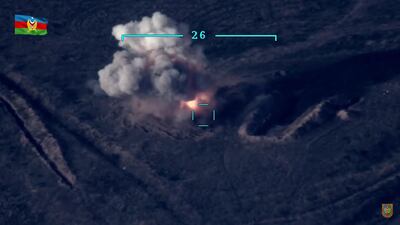
A frame grab from handout video provided by the Ministry of Defence of the Republic of Azerbaijan allegedly shows an Armenian tank being destroyed by Azerbaijan's military at Nagorno-Karabakh Republic, on the border of Armenia and Azerbaijan. EPA
In this handout photo taken from a footage released by Azerbaijan's Defense Ministry, Azerbaijan's forces destroy Armenian anti-aircraft system at the contact line of the self-proclaimed Republic of Nagorno-Karabakh, Azerbaijan. AP
In this photo released by the Armenian Foreign Ministry, a woman with her child sit in a bombshelter to protect against shelling, in Stepanakert, the self-proclaimed Republic of Nagorno-Karabakh, Azerbaijan. AP
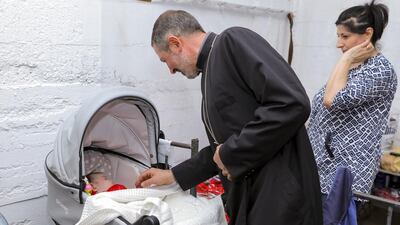
In this handout photo released by Armenian Foreign Ministry, an Armenian church priest looks a a baby in a bombshelter to protect against shelling in Stepanakert, the self-proclaimed Republic of Nagorno-Karabakh, Azerbaijan. AP
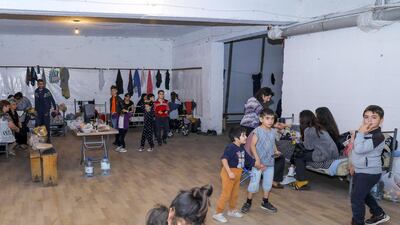
In this photo released by the Armenian Foreign Ministry, people gather in a bombshelter to protect against shelling in Stepanakert, the self-proclaimed Republic of Nagorno-Karabakh, Azerbaijan. AP
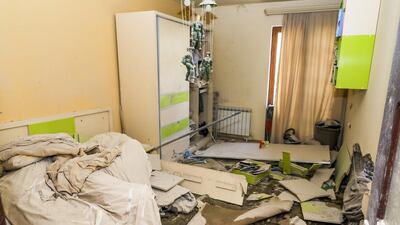
This handout photo released by Armenian Foreign Ministry, shows a damaged after shelling flat in Stepanakert, the self-proclaimed Republic of Nagorno-Karabakh, Azerbaijan. AP
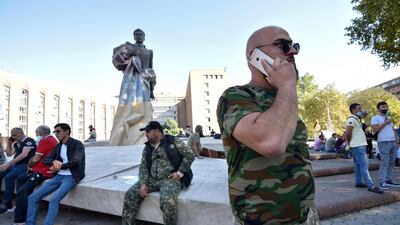
Volunteers and veterans, who are ready to go to the frontline in Nagorny Karabakh, gather in Yerevan. AFP
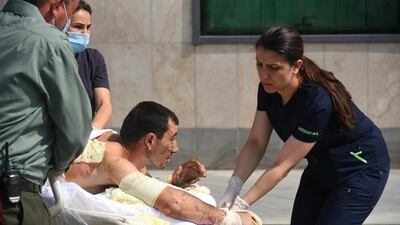
A handout photo released by the Armenian Foreign Ministry shows specialists delivering medical support to a man, who is said to be a civilian injured during clashes in the breakaway region of Nagorno-Karabakh. REUTERS
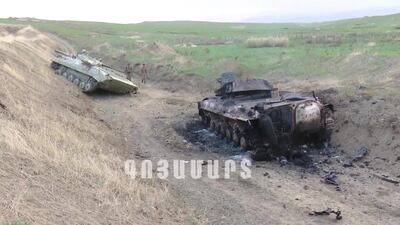
A grab taken from a handout video released by the so-called Nagorno-Karabakh (NKR) Defense Army, or Artsakh Defence Army, via Youtube claims to show tanks allegedly destroyed in shelling, artillery and air attacks along the front at Nagorno-Karabakh Republic, on a border of Armenia and Azerbaijan. EPA
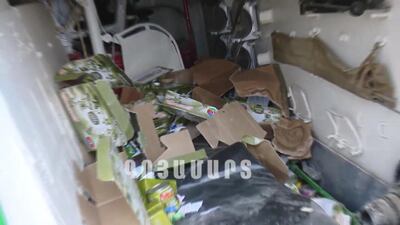
A grab taken from a handout video released by the so-called Nagorno-Karabakh (NKR) Defense Army, or Artsakh Defence Army, via Youtube claims to show Azerbaijani food rations in a tank allegedly destroyed in shelling, artillery and air attacks along the front at Nagorno-Karabakh Republic, on a border of Armenia and Azerbaijan. EPA
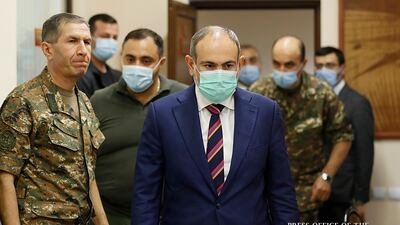
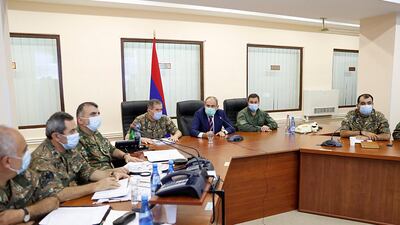
A handout photo made available by the Armenian Government Press Office shows Armenian Prime Minister Nikol Pashinyan meeting with the military leaders in Yerevan, Armenia. EPA
Armenian Prime Minister Nikol Pashinyan meets with top military officials in Yerevan. AFP
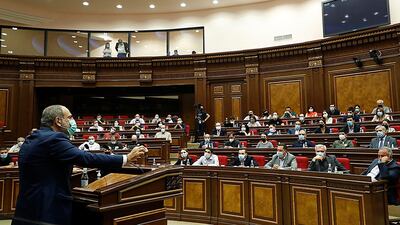
Armenian Prime Minister Nikol Pashinyan gives a speech at the parliament in Yerevan. AFP
The rebel fighters recruited and sent by Turkey are reportedly part of the ironically named National Army, an umbrella group that encompasses various rebel factions that were united at Ankara’s urging. Turkey quickly put them to task doing its bidding, rather than fighting Mr Al Assad. I interviewed commanders and fighters in the National Army early in its history, and while most understood that Turkey was calling the shots and would deploy them for its own strategic benefit, they hoped that would buy them the goodwill that would allow them to fight their own war, and one day perhaps form the core of a peacekeeping force that would bring an end to the fighting in their country.
Instead, Ankara deployed them as an auxiliary to the Turkish armed forces, the main fighters on the ground that would risk their lives to accomplish Turkey's strategic goals, so that Turkey's soldiers may live. They battled Kurdish militants so that Turkey can secure its own borders in two separate military campaigns. They were sent to Libya to help protect the government in Tripoli, and now they find themselves in Azerbaijan, fighting a faraway foe.
An ethnic Armenian fighter carries Kalashnikov machine guns in the separatist region of Nagorno-Karabakh, Azerbaijan. AP Photo
They are of course not the only mercenaries in the region’s wars. Russian mercenaries fight in both Syria and Libya. Every warlord in a region with many warlords has his own private army.
But the story of the Syrian mercenaries exemplifies the many betrayals Syrians have had to endure from the moment they decided to rise up and demand a life of dignity free of Mr Al Assad’s totalitarian control.
They were abandoned to their own fate, left to fend for themselves against chemical weapons and barrel bombs. And as the war dragged on, even sympathy and helpless outrage was in short supply.
Turkish and allied Syrian rebel forces on the outskirts of Tel Abyad in October 2019. Bakr Alkasem for The National
Turkey, which once claimed the mantle of steadfast backer of the revolution, has leveraged that support into an army for hire, an institution that preys on the destitute and needy by recruiting them to fight in faraway wars, because for Turkey and the other geopolitical powers competing for influence around the region, these lives mean nothing and carry no value. That is why they can keep up their proxy wars with no political cost. It is no better than trafficking.
Syria’s rebel mercenaries represent yet another nail in the coffin of a revolution whose adherents dared once to dream of freedom. But it is also a stain on the conscience of an entire global system.
Kareem Shaheen is a veteran Middle East correspondent in Canada and columnist for The National

AUSTRALIA SQUAD
Tim Paine (captain), Sean Abbott, Pat Cummins, Cameron Green, Marcus Harris, Josh Hazlewood, Travis Head, Moises Henriques, Marnus Labuschagne, Nathan Lyon, Michael Neser, James Pattinson, Will Pucovski, Steve Smith, Mitchell Starc, Mitchell Swepson, Matthew Wade, David Warner
Checks continue
A High Court judge issued an interim order on Friday suspending a decision by Agriculture Minister Edwin Poots to direct a stop to Brexit agri-food checks at Northern Ireland ports.
Mr Justice Colton said he was making the temporary direction until a judicial review of the minister's unilateral action this week to order a halt to port checks that are required under the Northern Ireland Protocol.
Civil servants have yet to implement the instruction, pending legal clarity on their obligations, and checks are continuing.
Gulf Under 19s final
Dubai College A 50-12 Dubai College B
Hili 2: Unesco World Heritage site
The site is part of the Hili archaeological park in Al Ain. Excavations there have proved the existence of the earliest known agricultural communities in modern-day UAE. Some date to the Bronze Age but Hili 2 is an Iron Age site. The Iron Age witnessed the development of the falaj, a network of channels that funnelled water from natural springs in the area. Wells allowed settlements to be established, but falaj meant they could grow and thrive. Unesco, the UN's cultural body, awarded Al Ain's sites - including Hili 2 - world heritage status in 2011. Now the most recent dig at the site has revealed even more about the skilled people that lived and worked there.
Company name/date started: Abwaab Technologies / September 2019
Founders: Hamdi Tabbaa, co-founder and CEO. Hussein Alsarabi, co-founder and CTO
Based: Amman, Jordan
Sector: Education Technology
Size (employees/revenue): Total team size: 65. Full-time employees: 25. Revenue undisclosed
Stage: early-stage startup
Investors: Adam Tech Ventures, Endure Capital, Equitrust, the World Bank-backed Innovative Startups SMEs Fund, a London investment fund, a number of former and current executives from Uber and Netflix, among others.
Dubai Bling season three
Cast: Loujain Adada, Zeina Khoury, Farhana Bodi, Ebraheem Al Samadi, Mona Kattan, and couples Safa & Fahad Siddiqui and DJ Bliss & Danya Mohammed
Rating: 1/5
England v South Africa Test series:
First Test: at Lord's, England won by 211 runs
Second Test: at Trent Bridge, South Africa won by 340 runs
In addition to the Emirates and Etihad programmes, there is the Air Miles Middle East card, which offers members the ability to choose any airline, has no black-out dates and no restrictions on seat availability. Air Miles is linked up to HSBC credit cards and can also be earned through retail partners such as Spinneys, Sharaf DG and The Toy Store.
An Emirates Dubai-London round-trip ticket costs 180,000 miles on the Air Miles website. But customers earn these ‘miles’ at a much faster rate than airline miles. Adidas offers two air miles per Dh1 spent. Air Miles has partnerships with websites as well, so booking.com and agoda.com offer three miles per Dh1 spent.
“If you use your HSBC credit card when shopping at our partners, you are able to earn Air Miles twice which will mean you can get that flight reward faster and for less spend,” says Paul Lacey, the managing director for Europe, Middle East and India for Aimia, which owns and operates Air Miles Middle East.
Mazen Abukhater, principal and actuary at global consultancy Mercer, Middle East, says the company’s Melbourne Mercer Global Pension Index - which benchmarks 34 pension schemes across the globe to assess their adequacy, sustainability and integrity - included Saudi Arabia for the first time this year to offer a glimpse into the region.
The index highlighted fundamental issues for all 34 countries, such as a rapid ageing population and a low growth / low interest environment putting pressure on expected returns. It also highlighted the increasing popularity around the world of defined contribution schemes.
“Average life expectancy has been increasing by about three years every 10 years. Someone born in 1947 is expected to live until 85 whereas someone born in 2007 is expected to live to 103,” Mr Abukhater told the Mena Pensions Conference.
“Are our systems equipped to handle these kind of life expectancies in the future? If so many people retire at 60, they are going to be in retirement for 43 years – so we need to adapt our retirement age to our changing life expectancy.”
Saudi Arabia came in the middle of Mercer’s ranking with a score of 58.9. The report said the country's index could be raised by improving the minimum level of support for the poorest aged individuals and increasing the labour force participation rate at older ages as life expectancies rise.
Mr Abukhater said the challenges of an ageing population, increased life expectancy and some individuals relying solely on their government for financial support in their retirement years will put the system under strain.
“To relieve that pressure, governments need to consider whether it is time to switch to a defined contribution scheme so that individuals can supplement their own future with the help of government support,” he said.
Should late investors consider cryptocurrencies?
Wealth managers recommend late investors to have a balanced portfolio that typically includes traditional assets such as cash, government and corporate bonds, equities, commodities and commercial property.
They do not usually recommend investing in Bitcoin or other cryptocurrencies due to the risk and volatility associated with them.
“It has produced eye-watering returns for some, whereas others have lost substantially as this has all depended purely on timing and when the buy-in was. If someone still has about 20 to 25 years until retirement, there isn’t any need to take such risks,” Rupert Connor of Abacus Financial Consultant says.
He adds that if a person is interested in owning a business or growing a property portfolio to increase their retirement income, this can be encouraged provided they keep in mind the overall risk profile of these assets.
Sheikh Dhiyab bin Isa (ruled 1761-1793) Built Qasr Al Hosn as a watchtower to guard over the only freshwater well on Abu Dhabi island.
Sheikh Shakhbut bin Dhiyab (ruled 1793-1816) Expanded the tower into a small fort and transferred his ruling place of residence from Liwa Oasis to the fort on the island.
Sheikh Tahnoon bin Shakhbut (ruled 1818-1833) Expanded Qasr Al Hosn further as Abu Dhabi grew from a small village of palm huts to a town of more than 5,000 inhabitants.
Sheikh Khalifa bin Shakhbut (ruled 1833-1845) Repaired and fortified the fort.
Sheikh Saeed bin Tahnoon (ruled 1845-1855) Turned Qasr Al Hosn into a strong two-storied structure.
Sheikh Zayed bin Khalifa (ruled 1855-1909) Expanded Qasr Al Hosn further to reflect the emirate's increasing prominence.
Sheikh Shakhbut bin Sultan (ruled 1928-1966) Renovated and enlarged Qasr Al Hosn, adding a decorative arch and two new villas.
Sheikh Zayed bin Sultan (ruled 1966-2004) Moved the royal residence to Al Manhal palace and kept his diwan at Qasr Al Hosn.
Mercer, the investment consulting arm of US services company Marsh & McLennan, expects its wealth division to at least double its assets under management (AUM) in the Middle East as wealth in the region continues to grow despite economic headwinds, a company official said.
Mercer Wealth, which globally has $160 billion in AUM, plans to boost its AUM in the region to $2-$3bn in the next 2-3 years from the present $1bn, said Yasir AbuShaban, a Dubai-based principal with Mercer Wealth.
“Within the next two to three years, we are looking at reaching $2 to $3 billion as a conservative estimate and we do see an opportunity to do so,” said Mr AbuShaban.
Mercer does not directly make investments, but allocates clients’ money they have discretion to, to professional asset managers. They also provide advice to clients.
“We have buying power. We can negotiate on their (client’s) behalf with asset managers to provide them lower fees than they otherwise would have to get on their own,” he added.
Mercer Wealth’s clients include sovereign wealth funds, family offices, and insurance companies among others.
From its office in Dubai, Mercer also looks after Africa, India and Turkey, where they also see opportunity for growth.
Wealth creation in Middle East and Africa (MEA) grew 8.5 per cent to $8.1 trillion last year from $7.5tn in 2015, higher than last year’s global average of 6 per cent and the second-highest growth in a region after Asia-Pacific which grew 9.9 per cent, according to consultancy Boston Consulting Group (BCG). In the region, where wealth grew just 1.9 per cent in 2015 compared with 2014, a pickup in oil prices has helped in wealth generation.
BCG is forecasting MEA wealth will rise to $12tn by 2021, growing at an annual average of 8 per cent.
Drivers of wealth generation in the region will be split evenly between new wealth creation and growth of performance of existing assets, according to BCG.
Another general trend in the region is clients’ looking for a comprehensive approach to investing, according to Mr AbuShaban.
“Institutional investors or some of the families are seeing a slowdown in the available capital they have to invest and in that sense they are looking at optimizing the way they manage their portfolios and making sure they are not investing haphazardly and different parts of their investment are working together,” said Mr AbuShaban.
Some clients also have a higher appetite for risk, given the low interest-rate environment that does not provide enough yield for some institutional investors. These clients are keen to invest in illiquid assets, such as private equity and infrastructure.
“What we have seen is a desire for higher returns in what has been a low-return environment specifically in various fixed income or bonds,” he said.
“In this environment, we have seen a de facto increase in the risk that clients are taking in things like illiquid investments, private equity investments, infrastructure and private debt, those kind of investments were higher illiquidity results in incrementally higher returns.”
The Abu Dhabi Investment Authority, one of the largest sovereign wealth funds, said in its 2016 report that has gradually increased its exposure in direct private equity and private credit transactions, mainly in Asian markets and especially in China and India. The authority’s private equity department focused on structured equities owing to “their defensive characteristics.”
If you go: The flights: Etihad, Emirates, British Airways and Virgin all fly from the UAE to London from Dh2,700 return, including taxes The tours: The Tour for Muggles usually runs several times a day, lasts about two-and-a-half hours and costs £14 (Dh67) Harry Potter and the Cursed Child is on now at the Palace Theatre. Tickets need booking significantly in advance
Entrance to the Harry Potter exhibition at the House of MinaLima is free The hotel: The grand, 1909-built Strand Palace Hotel is in a handy location near the Theatre District and several of the key Harry Potter filming and inspiration sites. The family rooms are spacious, with sofa beds that can accommodate children, and wooden shutters that keep out the light at night. Rooms cost from £170 (Dh808).
Red flags
Promises of high, fixed or 'guaranteed' returns.
Unregulated structured products or complex investments often used to bypass traditional safeguards.
Lack of clear information, vague language, no access to audited financials.
Overseas companies targeting investors in other jurisdictions - this can make legal recovery difficult.
Dubai launched the pilot phase of its real estate tokenisation project last month.
The initiative focuses on converting real estate assets into digital tokens recorded on blockchain technology and helps in streamlining the process of buying, selling and investing, the Dubai Land Department said.
Dubai’s real estate tokenisation market is projected to reach Dh60 billion ($16.33 billion) by 2033, representing 7 per cent of the emirate’s total property transactions, according to the DLD.