A vehicle carrying parts of the S-400 air defense systems, exits a Russian transport aircraft after landing at Murted military airport outside Ankara, Turkey. The Trump administration is imposing sanctions on its Nato ally Turkey over its purchase of a Russian air defense system. Turkish Defence Ministry via AP
A vehicle carrying parts of the S-400 air defense systems, exits a Russian transport aircraft after landing at Murted military airport outside Ankara, Turkey. The Trump administration is imposing sanc

Trump's sanctions on Turkey are a gift for Joe Biden


  • English
  • Arabic

US President Donald Trump did his successor Joe Biden a favour last week when he sanctioned Turkey under the Countering America’s Adversaries Through Sanctions Act (CAATSA).

The new sanctions, in response to Turkey’s purchase of Russian-made S-400 missile defence systems, were required under US law, and thus all but inevitable. The US State Department has barred American dealings with Turkey’s military procurement body, its chief and three top officials.

In the context of the broader Turkish economy, this amounts to little more than a slap on the wrist. But depending how long they remain in place, the sanctions could do real damage to Turkey’s defence industry, which relies on US imports. That industry has matured a great deal under the Justice and Development Party (AKP), from a $5 billion budget in 2002 to $60bn today, while producing some of the world’s most advanced drones.

For a time during the Trump administration, the leaders of Turkey and the US enjoyed warm relations. Reuters

Of course, Turkish defence industry leaders will not have forgotten that it was a previous punishment from Washington – an American arms embargo from 1975-78, in response to Turkey’s invasion of Cyprus – that helped spur their sector’s development in the first place. They may see these latest sanctions as another hurdle to overcome, rather than an unprecedented assault.

Turkish President Recep Tayyip Erdogan, unsurprisingly, has decried the sanctions as a blatant attack on a Nato ally. But it is undeniably better for Mr Biden that Mr Trump levied them now, clearing the way for the next administration to take office without being on a direct collision course with Turkey.

Of course, the two sides are not about to change their stripes. Mr Biden's White House is most likely to call for greater respect for human rights, international law and the continued integrity of defence alliances like Nato, while Mr Erdogan's Turkey will remain dogged and challenge the western system at nearly every turn.

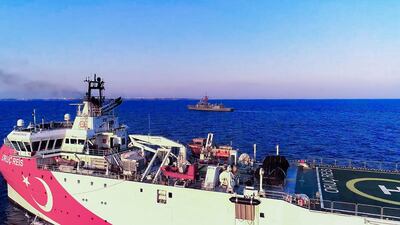
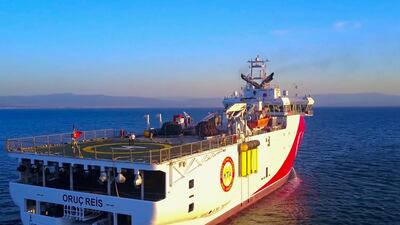
US analysts and some officials will, in the days ahead, denounce Mr Erdogan's authoritarianism and probably call for Turkey to be removed from Nato. Turkish analysts will talk of kicking the US and its nuclear weapons out of Incirlik airbase, as Mr Erdogan continues to push the envelope. The Turkish drillship Oruc Reis, which has been accused of aggressive forays into Greek waters, is already back at sea after a brief return to port under the threat of EU sanctions. Ankara is now calling for Greek islands to be demilitarised.

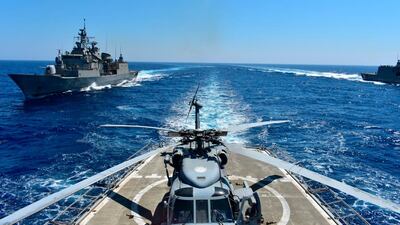
  • Greek warships take part in military exercises in Eastern Mediterranean sea, as tensions rise with Turkey over the waters. Greek Defense Ministry/AP
    Greek warships take part in military exercises in Eastern Mediterranean sea, as tensions rise with Turkey over the waters. Greek Defense Ministry/AP
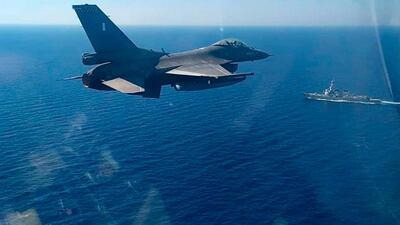
  • The Greek air force joined the exercises. Greek Defense Ministry/AP
    The Greek air force joined the exercises. Greek Defense Ministry/AP
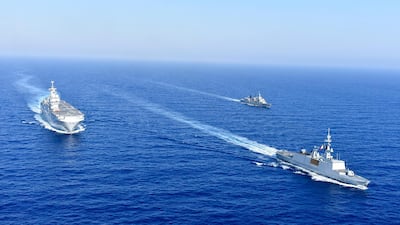
  • The Tonnerre is escorted by Greek and French military vessels. Greek National Defence/AP)
    The Tonnerre is escorted by Greek and French military vessels. Greek National Defence/AP)
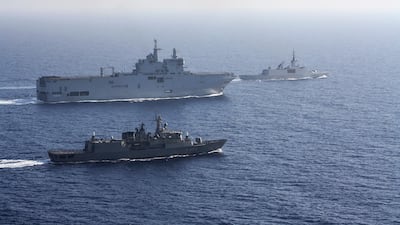
  • The French Tonnerre helicopter carrier, rear left, is escorted by Greek and French military vessels during a maritime exercise in the Eastern Mediterranean, where Greek and Turkish warships are also closely shadowing each other. (Greek National Defence/AP)
    The French Tonnerre helicopter carrier, rear left, is escorted by Greek and French military vessels during a maritime exercise in the Eastern Mediterranean, where Greek and Turkish warships are also closely shadowing each other. (Greek National Defence/AP)
  • The Turkish seismic research vessel 'Oruc Reis' heading west of Antalya in the Mediterranean Sea. Turkish Defence Ministry/AFP
    The Turkish seismic research vessel 'Oruc Reis' heading west of Antalya in the Mediterranean Sea. Turkish Defence Ministry/AFP
  • Tension are high between Greece and Turkey, over the 'Oruc-Reis' and its mission in the eastern Mediterranean. IHA via AP
    Tension are high between Greece and Turkey, over the 'Oruc-Reis' and its mission in the eastern Mediterranean. IHA via AP
  • Turkey’s claims to the waters, which it says are on its continental shelf, have repeatedly been dismissed as illegal by Greece and its allies. Turkish Defence Ministry/AFP
    Turkey’s claims to the waters, which it says are on its continental shelf, have repeatedly been dismissed as illegal by Greece and its allies. Turkish Defence Ministry/AFP
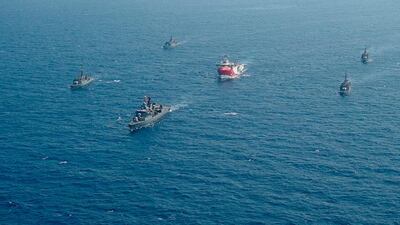
  • Turkish ships accompany the 'Oruc Reis,' a seismic research vessel. Turkish Defence Ministry/AFP
    Turkish ships accompany the 'Oruc Reis,' a seismic research vessel. Turkish Defence Ministry/AFP
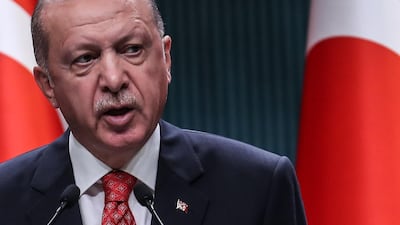
  • Turkish President Recep Tayyip Erdogan has called for dialogue while still pushing ahead with a Mediterranean gas development plan that has outraged Greece. AFP
    Turkish President Recep Tayyip Erdogan has called for dialogue while still pushing ahead with a Mediterranean gas development plan that has outraged Greece. AFP
  • Greek Prime Minister Kyriakos Mitsotakis warned of the potential for a mishap with Greek and Turkish navies both in the area.. EPA
    Greek Prime Minister Kyriakos Mitsotakis warned of the potential for a mishap with Greek and Turkish navies both in the area.. EPA
  • France will strengthen its military presence in the eastern Mediterranean. Reuters
    France will strengthen its military presence in the eastern Mediterranean. Reuters

This is precisely why US sanctions will have little longer-term impact. The US-Turkey relationship is nowadays defined largely by disagreements. These include maritime boundaries in the Eastern Mediterranean, the extradition of Turkish dissident cleric Fethullah Gulen, the US alliance with Syrian Kurds and the rule of law. The threats and disputes have become almost mechanical, habitual.

As with a bickering elderly couple, nobody fears they will divorce. Turkey is too crucial to Nato’s defence strategy, and it needs the US all the more in the face of regional isolation. It also needs the EU as its economy faces growing hardship.

Key to Mr Biden’s success with respect to Turkey will be his ability to work with European leaders to apply greater pressure on Ankara. That groundwork has already been laid. The US sanctions came a few days after the EU concluded its summit with an agreement to levy sanctions on Turkish individuals and entities linked to Eastern Mediterranean drilling. EU leaders said they would seek to co-ordinate with the White House before deciding on harsher sanctions, such as an arms embargo, at their next summit in March.

That gathering, which will come two months after Mr Biden’s January 20 inauguration, may be a bellwether for Turkey-West relations. If Mr Biden and Mr Erdogan have by then agreed on a plan to lift CAATSA sanctions, the EU may once again revert to a softer approach on Turkey. If Mr Erdogan remains uncompromising, things could take a darker turn.

Despite Mr Trump's stated affinity for Mr Erdogan, some analysts have argued that it was the US President's problematic diplomacy that led to these sanctions in the first place. Throughout 2018 and into 2019, Trump defended Turkey's decision to buy the S-400s, laying the blame on the Obama administration and vowing never to levy sanctions. Now that he has done precisely that, Mr Erdogan likely feels betrayed.

But Mr Trump is now on his way out, and the relatively mild sanctions from both the US and EU represent the “Goldilocks approach”: if the punishments had been harsher, the Turkish economy might be imperilled and Mr Erdogan more willing to lash out; if no sanctions had been levied, Mr Erdogan would feel free to do as he pleases on the high seas and beyond.

This makes for a strong starting point for Mr Biden. The warning shots have been fired and the new administration has an opportunity to take a clear diplomatic stand. Assuming Ankara will want to avoid total degradation of its western alliances, the relationship has a solid chance of starting with compromise, rather than confrontation. Mr Erdogan has already begun to talk of major economic and judicial reforms and has talked up how Mr Biden, in his role as vice president under the previous US administration, visited him at his home.

However the looming Biden-Erdogan talks play out, the battered US-Turkey alliance will stagger on. It’s less than ideal. One would sooner have Nato’s two largest militaries on friendlier terms. But at this point, strained relations is the best these two can do.

David Lepeska is a Turkish and Eastern Mediterranean affairs columnist for The National

Ten tax points to be aware of in 2026

1. Domestic VAT refund amendments: request your refund within five years

If a business does not apply for the refund on time, they lose their credit.

2. E-invoicing in the UAE

Businesses should continue preparing for the implementation of e-invoicing in the UAE, with 2026 a preparation and transition period ahead of phased mandatory adoption. 

3. More tax audits

Tax authorities are increasingly using data already available across multiple filings to identify audit risks. 

4. More beneficial VAT and excise tax penalty regime

Tax disputes are expected to become more frequent and more structured, with clearer administrative objection and appeal processes. The UAE has adopted a new penalty regime for VAT and excise disputes, which now mirrors the penalty regime for corporate tax.

5. Greater emphasis on statutory audit

There is a greater need for the accuracy of financial statements. The International Financial Reporting Standards standards need to be strictly adhered to and, as a result, the quality of the audits will need to increase.

6. Further transfer pricing enforcement

Transfer pricing enforcement, which refers to the practice of establishing prices for internal transactions between related entities, is expected to broaden in scope. The UAE will shortly open the possibility to negotiate advance pricing agreements, or essentially rulings for transfer pricing purposes. 

7. Limited time periods for audits

Recent amendments also introduce a default five-year limitation period for tax audits and assessments, subject to specific statutory exceptions. While the standard audit and assessment period is five years, this may be extended to up to 15 years in cases involving fraud or tax evasion. 

8. Pillar 2 implementation 

Many multinational groups will begin to feel the practical effect of the Domestic Minimum Top-Up Tax (DMTT), the UAE's implementation of the OECD’s global minimum tax under Pillar 2. While the rules apply for financial years starting on or after January 1, 2025, it is 2026 that marks the transition to an operational phase.

9. Reduced compliance obligations for imported goods and services

Businesses that apply the reverse-charge mechanism for VAT purposes in the UAE may benefit from reduced compliance obligations. 

10. Substance and CbC reporting focus

Tax authorities are expected to continue strengthening the enforcement of economic substance and Country-by-Country (CbC) reporting frameworks. In the UAE, these regimes are increasingly being used as risk-assessment tools, providing tax authorities with a comprehensive view of multinational groups’ global footprints and enabling them to assess whether profits are aligned with real economic activity. 

Contributed by Thomas Vanhee and Hend Rashwan, Aurifer

Our legal consultant

Name: Dr Hassan Mohsen Elhais

Position: legal consultant with Al Rowaad Advocates and Legal Consultants.

Formula Middle East Calendar (Formula Regional and Formula 4)
Round 1: January 17-19, Yas Marina Circuit – Abu Dhabi
 
Round 2: January 22-23, Yas Marina Circuit – Abu Dhabi
 
Round 3: February 7-9, Dubai Autodrome – Dubai
 
Round 4: February 14-16, Yas Marina Circuit – Abu Dhabi
 
Round 5: February 25-27, Jeddah Corniche Circuit – Saudi Arabia
INFO
Jetour T1 specs

Engine: 2-litre turbocharged

Power: 254hp

Torque: 390Nm

Price: From Dh126,000

Available: Now

Blue%20Beetle
%3Cp%3E%3Cstrong%3EDirector%3A%3C%2Fstrong%3E%20Angel%20Manuel%20Soto%3Cbr%3E%3Cstrong%3EStars%3A%20%3C%2Fstrong%3EXolo%20Mariduena%2C%20Adriana%20Barraza%2C%20Damian%20Alcazar%2C%20Raoul%20Max%20Trujillo%2C%20Susan%20Sarandon%2C%20George%20Lopez%3Cbr%3E%3Cstrong%3ERating%3A%20%3C%2Fstrong%3E4%2F5%C2%A0%3C%2Fp%3E%0A
Itcan profile

Founders: Mansour Althani and Abdullah Althani

Based: Business Bay, with offices in Saudi Arabia, Egypt and India

Sector: Technology, digital marketing and e-commerce

Size: 70 employees 

Revenue: On track to make Dh100 million in revenue this year since its 2015 launch

Funding: Self-funded to date


Name: Peter Dicce

Title: Assistant dean of students and director of athletics

Favourite sport: soccer

Favourite team: Bayern Munich

Favourite player: Franz Beckenbauer

Favourite activity in Abu Dhabi: scuba diving in the Northern Emirates 


Company: Instabug

Founded: 2013

Based: Egypt, Cairo

Sector: IT

Employees: 100

Stage: Series A

Investors: Flat6Labs, Accel, Y Combinator and angel investors

Frankenstein in Baghdad
Ahmed Saadawi
​​​​​​​Penguin Press

COMPANY PROFILE

Name: Lamsa

Founder: Badr Ward

Launched: 2014

Employees: 60

Based: Abu Dhabi

Sector: EdTech

Funding to date: $15 million

UPI facts

More than 2.2 million Indian tourists arrived in UAE in 2023
More than 3.5 million Indians reside in UAE
Indian tourists can make purchases in UAE using rupee accounts in India through QR-code-based UPI real-time payment systems
Indian residents in UAE can use their non-resident NRO and NRE accounts held in Indian banks linked to a UAE mobile number for UPI transactions