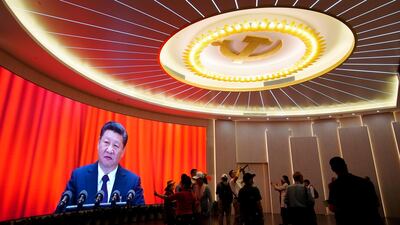
Chinese President Xi Jinping is shown on a screen during an event marking the 100th founding anniversary of the Communist Party, in Shanghai, China. Reuters

The rise of China is not the death of western democracy


  • English
  • Arabic

If the G7 leaders had taken to heart China's President Xi Jinping’s recent exhortation to Communist Party officials to promote a “credible, loveable and respectable China”, they showed little sign of it at last weekend’s summit in Britain. The G7’s criticisms were strong enough for Beijing’s UK embassy to condemn what it called “baseless accusations” and of “slandering” and “interfering in China’s internal affairs.” The Nato summit then followed up by warning of China’s “coercive policies” and “use of disinformation” on Monday, leading Beijing to denounce the organisation’s “Cold War mentality”.

This is not a good direction of travel. Mr Xi will be well aware that negative perceptions of China increased drastically in a number of parts of the world last year. So when he said, “It is necessary to make friends, unite and win over the majority, and constantly expand the circle of friends with those who understand and are friendly to China," that ought to have been welcomed and taken seriously.

For while competition on trade and influence between China and the US and its allies is here to stay, the polarisation is getting worse partly because several false narratives are becoming set in stone. The Build Back Better World initiative that the G7 launched, for instance, has been unanimously framed as a counter to China’s Belt and Road Initiative (BRI). Why would the BRI need “countering”? Only because it has been painted as a cunning plan to advance Chinese domination through stealthy “debt trap diplomacy”.

The polarisation is getting worse partly because several false narratives are becoming set in stone

Never mind that this myth has been thoroughly debunked, not least by an excellent report produced by the leading international affairs think tank Chatham House, as I wrote about last October. Never mind that many states in the Asia-Pacific welcome the support Beijing is providing to build much-needed infrastructure. No, the BRI's very real achievements remain unsung as it has been successfully smeared in the West, whereas in fact the G7 should be seeking to complement this great exercise in connectivity and growth, not rival or replace it.

Double standards are applied to anything connected to China. Thus branches of the British Council or Germany’s Goethe Institutes are benign promoters of their countries’ culture, language and values, whereas China’s Confucius Institutes – which do exactly the same thing – are denigrated as purveyors of propaganda and have been kicked off a string of university campuses in the US and Europe.

Sometimes these narratives are completely manufactured, deliberately, it seems, to ramp up the sense of confrontation. I have read time and again, for example, that China is trying to export its model of governance. Where is the evidence for this? Yes, Mr Xi wants to hold his system up as a success, and under his leadership China has been far more assertive in standing up for itself and its interests.

In the South China Sea, where there are many often overlapping claims, Chinese presence in disputed maritime features and the appearance of Chinese fleets in disputed waters has ruffled feathers in the neighbourhood, to say the least. The tariffs Beijing has placed on Australian wine and barley were meant to hurt because they are aimed at influencing policy-making in Canberra. That may be tough and it may not seem fair to Australians, but it is hardly out of the ordinary behaviour for a great power.

Could any US official claim with a straight face that Washington hasn’t acted similarly? Former US President Barack Obama even intervened in the Brexit referendum – surely none of his business – by threatening Britons they would be at the “back of queue” for a trade deal if they voted to leave the EU.

In contrast, one of the aspects of today’s China that countries in South-East Asia do appreciate is that while Beijing may attempt to influence them, it does not seek to interfere in their internal issues. It is certainly not going around trying to tell others to adopt a one-party mixed Marxist-Leninist-capitalist system. The notion then that China is trying to export its model of governance is baseless and ought to be called out.

These and other falsehoods matter because what the Brookings Institution’s Thomas Wright recently identified as “the Biden doctrine” consists precisely of “a competition of governance systems with China”. If in that context China is being accused of doing something it is verifiably not doing, that is a highly irresponsible attempt to raise tension further.

To take another example, in US President Joe Biden’s speeches about “democracies versus autocracies”, he doesn’t always mention Beijing. But Mr Wright is correct in suggesting that he has China principally in mind. If that is so, it is vital that this framing relies not on insinuation but on evidence – which was not the case when Mr Biden gave a speech to a US military base in the UK last week. He said: “We have to discredit those who believe that the age of democracy is over, as some of our fellow nations believe”, which again was clearly aimed at China (and to a lesser extent Russia).

It fitted with much of what he and his officials have been saying over the past few months, and perhaps didn’t stand out as a result. But who actually believes that the “age of democracy is over” – which nations or leaders? Mr Xi has said nothing of the sort. In fact the “death of democracy” is most frequently brought up by western writers who are worried it is happening in America.

Mr Biden has said he is determined to stop China surpassing the US as the leading, wealthiest and most powerful country in the world on his watch. That is a legitimate aspiration for a man in his position. What is not right is for him to erect and rely on straw men in pursuit of that goal. Doing so falsely fosters the idea that competition between nations is a zero-sum game, when “win-win co-operation” with a China that Mr Xi said should be “open and confident, but also modest and humble” is still possible.

Sholto Byrnes is an East Asian affairs columnist for The National

25%20Days%20to%20Aden
%3Cp%3EAuthor%3A%20Michael%20Knights%3C%2Fp%3E%0A%3Cp%3EPages%3A%20256%3C%2Fp%3E%0A%3Cp%3EAvailable%3A%20January%2026%3C%2Fp%3E%0A
Ten tax points to be aware of in 2026

1. Domestic VAT refund amendments: request your refund within five years

If a business does not apply for the refund on time, they lose their credit.

2. E-invoicing in the UAE

Businesses should continue preparing for the implementation of e-invoicing in the UAE, with 2026 a preparation and transition period ahead of phased mandatory adoption. 

3. More tax audits

Tax authorities are increasingly using data already available across multiple filings to identify audit risks. 

4. More beneficial VAT and excise tax penalty regime

Tax disputes are expected to become more frequent and more structured, with clearer administrative objection and appeal processes. The UAE has adopted a new penalty regime for VAT and excise disputes, which now mirrors the penalty regime for corporate tax.

5. Greater emphasis on statutory audit

There is a greater need for the accuracy of financial statements. The International Financial Reporting Standards standards need to be strictly adhered to and, as a result, the quality of the audits will need to increase.

6. Further transfer pricing enforcement

Transfer pricing enforcement, which refers to the practice of establishing prices for internal transactions between related entities, is expected to broaden in scope. The UAE will shortly open the possibility to negotiate advance pricing agreements, or essentially rulings for transfer pricing purposes. 

7. Limited time periods for audits

Recent amendments also introduce a default five-year limitation period for tax audits and assessments, subject to specific statutory exceptions. While the standard audit and assessment period is five years, this may be extended to up to 15 years in cases involving fraud or tax evasion. 

8. Pillar 2 implementation 

Many multinational groups will begin to feel the practical effect of the Domestic Minimum Top-Up Tax (DMTT), the UAE's implementation of the OECD’s global minimum tax under Pillar 2. While the rules apply for financial years starting on or after January 1, 2025, it is 2026 that marks the transition to an operational phase.

9. Reduced compliance obligations for imported goods and services

Businesses that apply the reverse-charge mechanism for VAT purposes in the UAE may benefit from reduced compliance obligations. 

10. Substance and CbC reporting focus

Tax authorities are expected to continue strengthening the enforcement of economic substance and Country-by-Country (CbC) reporting frameworks. In the UAE, these regimes are increasingly being used as risk-assessment tools, providing tax authorities with a comprehensive view of multinational groups’ global footprints and enabling them to assess whether profits are aligned with real economic activity. 

Contributed by Thomas Vanhee and Hend Rashwan, Aurifer

Company%20profile
%3Cp%3EName%3A%20Tabby%3Cbr%3EFounded%3A%20August%202019%3B%20platform%20went%20live%20in%20February%202020%3Cbr%3EFounder%2FCEO%3A%20Hosam%20Arab%2C%20co-founder%3A%20Daniil%20Barkalov%3Cbr%3EBased%3A%20Dubai%2C%20UAE%3Cbr%3ESector%3A%20Payments%3Cbr%3ESize%3A%2040-50%20employees%3Cbr%3EStage%3A%20Series%20A%3Cbr%3EInvestors%3A%20Arbor%20Ventures%2C%20Mubadala%20Capital%2C%20Wamda%20Capital%2C%20STV%2C%20Raed%20Ventures%2C%20Global%20Founders%20Capital%2C%20JIMCO%2C%20Global%20Ventures%2C%20Venture%20Souq%2C%20Outliers%20VC%2C%20MSA%20Capital%2C%20HOF%20and%20AB%20Accelerator.%3Cbr%3E%3C%2Fp%3E%0A
Bert van Marwijk factfile

Born: May 19 1952
Place of birth: Deventer, Netherlands
Playing position: Midfielder

Teams managed:
1998-2000 Fortuna Sittard
2000-2004 Feyenoord
2004-2006 Borussia Dortmund
2007-2008 Feyenoord
2008-2012 Netherlands
2013-2014 Hamburg
2015-2017 Saudi Arabia
2018 Australia

Major honours (manager):
2001/02 Uefa Cup, Feyenoord
2007/08 KNVB Cup, Feyenoord
World Cup runner-up, Netherlands

Company%20profile
%3Cp%3EName%3A%20Cashew%0D%3Cbr%3EStarted%3A%202020%0D%3Cbr%3EFounders%3A%20Ibtissam%20Ouassif%20and%20Ammar%20Afif%0D%3Cbr%3EBased%3A%20Dubai%2C%20UAE%0D%3Cbr%3EIndustry%3A%20FinTech%0D%3Cbr%3EFunding%20size%3A%20%2410m%0D%3Cbr%3EInvestors%3A%20Mashreq%2C%20others%0D%3C%2Fp%3E%0A
Greatest Royal Rumble results

John Cena pinned Triple H in a singles match

Cedric Alexander retained the WWE Cruiserweight title against Kalisto

Matt Hardy and Bray Wyatt win the Raw Tag Team titles against Cesaro and Sheamus

Jeff Hardy retained the United States title against Jinder Mahal

Bludgeon Brothers retain the SmackDown Tag Team titles against the Usos

Seth Rollins retains the Intercontinental title against The Miz, Finn Balor and Samoa Joe

AJ Styles remains WWE World Heavyweight champion after he and Shinsuke Nakamura are both counted out

The Undertaker beats Rusev in a casket match

Brock Lesnar retains the WWE Universal title against Roman Reigns in a steel cage match

Braun Strowman won the 50-man Royal Rumble by eliminating Big Cass last

Farage on Muslim Brotherhood

Nigel Farage told Reform's annual conference that the party will proscribe the Muslim Brotherhood if he becomes Prime Minister.
"We will stop dangerous organisations with links to terrorism operating in our country," he said. "Quite why we've been so gutless about this – both Labour and Conservative – I don't know.
“All across the Middle East, countries have banned and proscribed the Muslim Brotherhood as a dangerous organisation. We will do the very same.”
It is 10 years since a ground-breaking report into the Muslim Brotherhood by Sir John Jenkins.
Among the former diplomat's findings was an assessment that “the use of extreme violence in the pursuit of the perfect Islamic society” has “never been institutionally disowned” by the movement.
The prime minister at the time, David Cameron, who commissioned the report, said membership or association with the Muslim Brotherhood was a "possible indicator of extremism" but it would not be banned.

Company Profile

Company name: Yeepeey

Started: Soft launch in November, 2020

Founders: Sagar Chandiramani, Jatin Sharma and Monish Chandiramani

Based: Dubai

Industry: E-grocery

Initial investment: $150,000

Future plan: Raise $1.5m and enter Saudi Arabia next year

The specs

Engine: 2.0-litre 4cyl turbo

Power: 261hp at 5,500rpm

Torque: 405Nm at 1,750-3,500rpm

Transmission: 9-speed auto

Fuel consumption: 6.9L/100km

On sale: Now

Price: From Dh117,059

What is blockchain?

Blockchain is a form of distributed ledger technology, a digital system in which data is recorded across multiple places at the same time. Unlike traditional databases, DLTs have no central administrator or centralised data storage. They are transparent because the data is visible and, because they are automatically replicated and impossible to be tampered with, they are secure.

The main difference between blockchain and other forms of DLT is the way data is stored as ‘blocks’ – new transactions are added to the existing ‘chain’ of past transactions, hence the name ‘blockchain’. It is impossible to delete or modify information on the chain due to the replication of blocks across various locations.

Blockchain is mostly associated with cryptocurrency Bitcoin. Due to the inability to tamper with transactions, advocates say this makes the currency more secure and safer than traditional systems. It is maintained by a network of people referred to as ‘miners’, who receive rewards for solving complex mathematical equations that enable transactions to go through.

However, one of the major problems that has come to light has been the presence of illicit material buried in the Bitcoin blockchain, linking it to the dark web.

Other blockchain platforms can offer things like smart contracts, which are automatically implemented when specific conditions from all interested parties are reached, cutting the time involved and the risk of mistakes. Another use could be storing medical records, as patients can be confident their information cannot be changed. The technology can also be used in supply chains, voting and has the potential to used for storing property records.

Wicked: For Good

Director: Jon M Chu

Starring: Ariana Grande, Cynthia Erivo, Jonathan Bailey, Jeff Goldblum, Michelle Yeoh, Ethan Slater

Rating: 4/5
