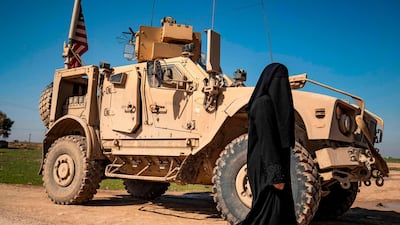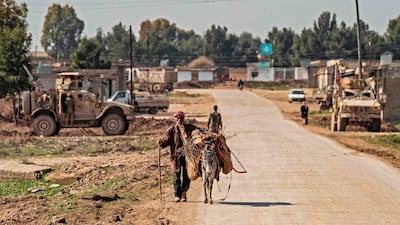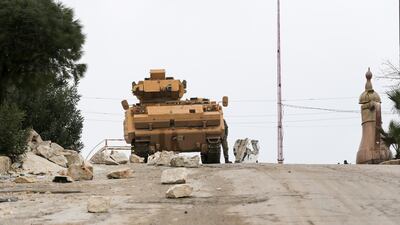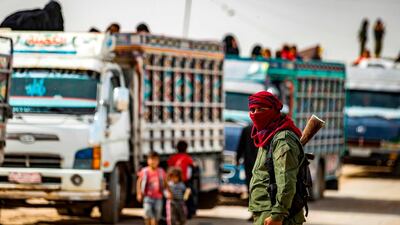
A Kurdish fighter at the Kurdish-run Al Hol Camp, transporting women and children suspected of being related to Islamic State (IS) group, after being released from the camp to return to their homes, in Al Hasakeh in northeastern Syria, October 28. AFP
A Kurdish fighter at the Kurdish-run Al Hol Camp, transporting women and children suspected of being related to Islamic State (IS) group, after being released from the camp to return to their homes, i

The next US president must work towards resolving the Syrian crisis


  • English
  • Arabic

American policy in Syria has over the past decade been chaotic, bumbling and tragic in equal measure. From an early reluctance to call on President Bashar Al Assad to step down, to absurd attempts to back the opposition with just enough arms to maintain a stalemate without doing anything to protect civilians from the destruction, and America's failure to act on its own chemical weapons red lines, the US policy on Syria helped seal the ultimate defeat of the rebellion.

That lack of coherence in America's regional strategy manifested under former US president Barack Obama, when he negotiated a nuclear deal with Iran, while attempting neither to tame its regional ambitions nor the proxy militias that were unleashing havoc in Syria.

Washington’s focus on counter-terrorism – through a narrow campaign to defeat ISIS – without trying to address the violence and power vacuum that led to the rise of the group’s depraved ideology, gave carte blanche to Mr Al Assad and his backers to violently subdue his own populace.

Even Mr Obama’s vaunted deal to strip Damascus of its chemical weapons arsenal, after the latter used it to kill over a 1000 people in the towns of Eastern Ghouta in 2013, did not prevent other chemical atrocities in Khan Sheikhun and Douma, as well as dozens of chlorine attacks.

Donald Trump did more than his predecessor to punish Mr Al Assad through limited strikes after chemical attacks and through wide-ranging sanctions, but his tweet-based foreign policy and impulsive troop withdrawals ensured that Washington had little capacity to influence peace negotiations, which were dominated by Russia, Iran and Turkey. This resulted in a deadlock.

The next US president has the opportunity to revive these stalled peace talks and leverage the broad and tough Caesar sanctions, which the US imposed earlier this year, to push for a political resolution. Failing to do so risks perpetuating a frozen conflict and heaping further misery upon Syria's beleaguered people.

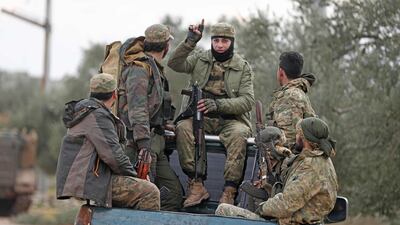
US involvement in Syria began with a call in October 2011 for Mr Al Assad to step down, followed by non-lethal aid for the Syrian opposition. Separate CIA and Pentagon programmes were set to arm Syrian rebel groups, but only succeeded in providing a little weaponry to carefully vetted rebel groups that had little influence on the ground, and certainly no arsenal that could have allowed them to shoot down Mr Al Assad's warplanes.

Kurdish fighters stand guard as a Syrian child, suspected of being related to Islamic State (IS) group fighters, waits at the Kurdish-run Al Hol Camp, before being released along with women and children to return to their homes, in the Al Hasakeh governorate in northeastern Syria, on October 28. AFP

These programmes eventually descended into farce when the campaign against ISIS began, as the US insisted that those weapons should be used to combat terrorist groups rather than the regime, and were eventually cancelled.

Despite declaring chemical weapons a red line, the US dithered when they were used, allowing the Assad regime to continue to wage its campaign that killed hundreds of thousands of civilians with impunity.

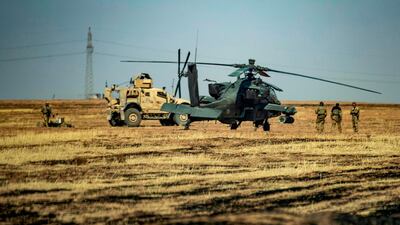
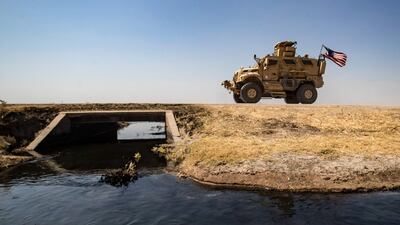
The US focused its military efforts to defeat ISIS after the group declared its false caliphate. Washington backed Kurdish militias that spearheaded the assault on the terrorists' strongholds, alienating Turkey, which saw the strongholds as a national security threat.

The next US president also has an opportunity to undo a decade of damage

The lack of a clear strategy was manifest in Mr Trump's sudden decision to withdraw American troops from Syria, a surprise to most diplomats, analysts and his own military, prompting the resignation of his defence secretary and abandoning his Kurdish allies, who were forced to seek a rapprochement with the Assad regime.

American involvement in Syria is not necessarily altogether good, but at the very least it counters the influence of Russia and Iran, that have aided Mr Al Assad’s worst excesses. And Turkey, which is primarily interested in prosecuting its conflict with the Kurds, and building a sphere of influence along its southern border, rather than striving for a comprehensive peace.

The Caesar Act offers a useful leverage point for the next US president to push for tangible political reforms in exchange for lifting the sanctions, which are primarily aimed, at least publicly, at holding accountable Syria’s war criminals.

Inadvertently, Mr Trump has created conditions – through the Caesar Act and the wide-ranging sanctions against Iran – for the US to force a re-examination of the peace process and to offer incentives to Mr Al Assad's staunchest backers to come to the negotiating table and seriously discuss ways to end the war.

But the next US president also has an opportunity to undo a decade of damage that Mr Obama’s craven policies and Mr Trump’s term have done – not just in Syria but to international norms at large.

The effects of the Syrian conflict have been felt beyond the country’s borders. It triggered a refugee crisis that reshaped politics in Europe. It also eroded customs against bombing hospitals, starving civilians to death and using chemical weapons. Allowing war crimes such as these to continue enshrines barbarity instead of decency.

The next US president, whether it is Joe Biden or Donald Trump, must work seriously towards solving the Syrian crisis. The rejuvenation of a decrepit entity we call the international community depends on it.

Kareem Shaheen is a veteran Middle East correspondent in Canada and a columnist for The National

How to improve Arabic reading in early years

One 45-minute class per week in Standard Arabic is not sufficient

The goal should be for grade 1 and 2 students to become fluent readers

Subjects like technology, social studies, science can be taught in later grades

Grade 1 curricula should include oral instruction in Standard Arabic

First graders must regularly practice individual letters and combinations

Time should be slotted in class to read longer passages in early grades

Improve the appearance of textbooks

Revision of curriculum should be undertaken as per research findings

Conjugations of most common verb forms should be taught

Systematic learning of Standard Arabic grammar

Breast cancer in men: the facts

1) Breast cancer is men is rare but can develop rapidly. It usually occurs in those over the ages of 60, but can occasionally affect younger men.

2) Symptoms can include a lump, discharge, swollen glands or a rash. 

3) People with a history of cancer in the family can be more susceptible. 

4) Treatments include surgery and chemotherapy but early diagnosis is the key. 

5) Anyone concerned is urged to contact their doctor


Mercer, the investment consulting arm of US services company Marsh & McLennan, expects its wealth division to at least double its assets under management (AUM) in the Middle East as wealth in the region continues to grow despite economic headwinds, a company official said.

Mercer Wealth, which globally has $160 billion in AUM, plans to boost its AUM in the region to $2-$3bn in the next 2-3 years from the present $1bn, said Yasir AbuShaban, a Dubai-based principal with Mercer Wealth.

Within the next two to three years, we are looking at reaching $2 to $3 billion as a conservative estimate and we do see an opportunity to do so,” said Mr AbuShaban.

Mercer does not directly make investments, but allocates clients’ money they have discretion to, to professional asset managers. They also provide advice to clients.

“We have buying power. We can negotiate on their (client’s) behalf with asset managers to provide them lower fees than they otherwise would have to get on their own,” he added.

Mercer Wealth’s clients include sovereign wealth funds, family offices, and insurance companies among others.

From its office in Dubai, Mercer also looks after Africa, India and Turkey, where they also see opportunity for growth.

Wealth creation in Middle East and Africa (MEA) grew 8.5 per cent to $8.1 trillion last year from $7.5tn in 2015, higher than last year’s global average of 6 per cent and the second-highest growth in a region after Asia-Pacific which grew 9.9 per cent, according to consultancy Boston Consulting Group (BCG). In the region, where wealth grew just 1.9 per cent in 2015 compared with 2014, a pickup in oil prices has helped in wealth generation.

BCG is forecasting MEA wealth will rise to $12tn by 2021, growing at an annual average of 8 per cent.

Drivers of wealth generation in the region will be split evenly between new wealth creation and growth of performance of existing assets, according to BCG.

Another general trend in the region is clients’ looking for a comprehensive approach to investing, according to Mr AbuShaban.

“Institutional investors or some of the families are seeing a slowdown in the available capital they have to invest and in that sense they are looking at optimizing the way they manage their portfolios and making sure they are not investing haphazardly and different parts of their investment are working together,” said Mr AbuShaban.

Some clients also have a higher appetite for risk, given the low interest-rate environment that does not provide enough yield for some institutional investors. These clients are keen to invest in illiquid assets, such as private equity and infrastructure.

“What we have seen is a desire for higher returns in what has been a low-return environment specifically in various fixed income or bonds,” he said.

“In this environment, we have seen a de facto increase in the risk that clients are taking in things like illiquid investments, private equity investments, infrastructure and private debt, those kind of investments were higher illiquidity results in incrementally higher returns.”

The Abu Dhabi Investment Authority, one of the largest sovereign wealth funds, said in its 2016 report that has gradually increased its exposure in direct private equity and private credit transactions, mainly in Asian markets and especially in China and India. The authority’s private equity department focused on structured equities owing to “their defensive characteristics.”

Alan%20Wake%20Remastered%20
%3Cp%3E%3Cstrong%3EDeveloper%3A%20%3C%2Fstrong%3ERemedy%20Entertainment%3Cbr%3E%3Cstrong%3EPublisher%3A%3C%2Fstrong%3E%20Microsoft%20Game%20Studios%3Cbr%3E%3Cstrong%3EConsoles%3A%3C%2Fstrong%3E%20PlayStation%204%20%26amp%3B%205%2C%20Xbox%3A%20360%20%26amp%3B%20One%20%26amp%3B%20Series%20X%2FS%20and%20Nintendo%20Switch%3Cbr%3E%3Cstrong%3ERating%3A%3C%2Fstrong%3E%204%2F5%3C%2Fp%3E%0A
Apple%20Mac%20through%20the%20years
%3Cp%3E1984%20-%20Apple%20unveiled%20the%20Macintosh%20on%20January%2024%3Cbr%3E1985%20-%20Steve%20Jobs%20departed%20from%20Apple%20and%20established%20NeXT%3Cbr%3E1986%20-%20Apple%20introduced%20the%20Macintosh%20Plus%2C%20featuring%20enhanced%20memory%3Cbr%3E1987%20-%20Apple%20launched%20the%20Macintosh%20II%2C%20equipped%20with%20colour%20capabilities%3Cbr%3E1989%20-%20The%20widely%20acclaimed%20Macintosh%20SE%2F30%20made%20its%20debut%3Cbr%3E1994%20-%20Apple%20presented%20the%20Power%20Macintosh%3Cbr%3E1996%20-%20The%20Macintosh%20System%20Software%20OS%20underwent%20a%20rebranding%20as%20Mac%20OS%3Cbr%3E2001%20-%20Apple%20introduced%20Mac%20OS%20X%2C%20marrying%20Unix%20stability%20with%20a%20user-friendly%20interface%3Cbr%3E2006%20-%20Apple%20adopted%20Intel%20processors%20in%20MacBook%20Pro%20laptops%3Cbr%3E2008%20-%20Apple%20introduced%20the%20MacBook%20Air%2C%20a%20lightweight%20laptop%3Cbr%3E2012%20-%20Apple%20launched%20the%20MacBook%20Pro%20with%20a%20retina%20display%3Cbr%3E2016%20-%20The%20Mac%20operating%20system%20underwent%20rebranding%20as%20macOS%3Cbr%3E2020%20-%20Apple%20introduced%20the%20M1%20chip%20for%20Macs%2C%20combining%20high%20performance%20and%20energy%20efficiency%3Cbr%3E2022%20-%20The%20M2%20chip%20was%20announced%3Cbr%3E2023%20-The%20M3%20line-up%20of%20chip%20was%20announced%20to%20improve%20performance%20and%20add%20new%20capabilities%20for%20Mac.%3C%2Fp%3E%0A
Timeline

2012-2015

The company offers payments/bribes to win key contracts in the Middle East

May 2017

The UK SFO officially opens investigation into Petrofac’s use of agents, corruption, and potential bribery to secure contracts

September 2021

Petrofac pleads guilty to seven counts of failing to prevent bribery under the UK Bribery Act

October 2021

Court fines Petrofac £77 million for bribery. Former executive receives a two-year suspended sentence 

December 2024

Petrofac enters into comprehensive restructuring to strengthen the financial position of the group

May 2025

The High Court of England and Wales approves the company’s restructuring plan

July 2025

The Court of Appeal issues a judgment challenging parts of the restructuring plan

August 2025

Petrofac issues a business update to execute the restructuring and confirms it will appeal the Court of Appeal decision

October 2025

Petrofac loses a major TenneT offshore wind contract worth €13 billion. Holding company files for administration in the UK. Petrofac delisted from the London Stock Exchange

November 2025

180 Petrofac employees laid off in the UAE

Short-term let permits explained

Homeowners and tenants are allowed to list their properties for rental by registering through the Dubai Tourism website to obtain a permit.

Tenants also require a letter of no objection from their landlord before being allowed to list the property.

There is a cost of Dh1,590 before starting the process, with an additional licence fee of Dh300 per bedroom being rented in your home for the duration of the rental, which ranges from three months to a year.

Anyone hoping to list a property for rental must also provide a copy of their title deeds and Ejari, as well as their Emirates ID.

Our legal columnist

Name: Yousef Al Bahar

Advocate at Al Bahar & Associate Advocates and Legal Consultants, established in 1994

Education: Mr Al Bahar was born in 1979 and graduated in 2008 from the Judicial Institute. He took after his father, who was one of the first Emirati lawyers

UAE currency: the story behind the money in your pockets
The specs

Engine: 3.8-litre, twin-turbo V8

Transmission: eight-speed automatic

Power: 582bhp

Torque: 730Nm

Price: Dh649,000

On sale: now  

U19 WORLD CUP, WEST INDIES

UAE group fixtures (all in St Kitts)

  • Saturday 15 January: UAE beat Canada by 49 runs 
  • Thursday 20 January: v England 
  • Saturday 22 January: v Bangladesh 

UAE squad:

Alishan Sharafu (captain), Shival Bawa, Jash Giyanani, Sailles
Jaishankar, Nilansh Keswani, Aayan Khan, Punya Mehra, Ali Naseer, Ronak Panoly,
Dhruv Parashar, Vinayak Raghavan, Soorya Sathish, Aryansh Sharma, Adithya
Shetty, Kai Smith  

The specs: 2018 Audi R8 V10 RWS

Price: base / as tested: From Dh632,225

Engine: 5.2-litre V10

Gearbox: Seven-speed automatic

Power: 540hp @ 8,250rpm

Torque: 540Nm @ 6,500rpm

Fuel economy, combined: 12.4L / 100km

match info

Union Berlin 0

Bayern Munich 1 (Lewandowski 40' pen, Pavard 80')

Man of the Match: Benjamin Pavard (Bayern Munich)

UAE currency: the story behind the money in your pockets
SPEC%20SHEET%3A%20NOTHING%20PHONE%20(2)
%3Cp%3E%3Cstrong%3EDisplay%3A%3C%2Fstrong%3E%206.7%E2%80%9D%20LPTO%20Amoled%2C%202412%20x%201080%2C%20394ppi%2C%20HDR10%2B%2C%20Corning%20Gorilla%20Glass%3C%2Fp%3E%0A%3Cp%3E%3Cstrong%3EProcessor%3A%3C%2Fstrong%3E%20Qualcomm%20Snapdragon%208%2B%20Gen%202%2C%20octa-core%3B%20Adreno%20730%20GPU%3C%2Fp%3E%0A%3Cp%3E%3Cstrong%3EMemory%3A%3C%2Fstrong%3E%208%2F12GB%3C%2Fp%3E%0A%3Cp%3E%3Cstrong%3ECapacity%3A%3C%2Fstrong%3E%20128%2F256%2F512GB%3C%2Fp%3E%0A%3Cp%3E%3Cstrong%3EPlatform%3A%3C%2Fstrong%3E%20Android%2013%2C%20Nothing%20OS%202%3C%2Fp%3E%0A%3Cp%3E%3Cstrong%3EMain%20camera%3A%3C%2Fstrong%3E%20Dual%2050MP%20wide%2C%20f%2F1.9%20%2B%2050MP%20ultrawide%2C%20f%2F2.2%3B%20OIS%2C%20auto-focus%3C%2Fp%3E%0A%3Cp%3E%3Cstrong%3EMain%20camera%20video%3A%3C%2Fstrong%3E%204K%20%40%2030%2F60fps%2C%201080p%20%40%2030%2F60fps%3B%20live%20HDR%2C%20OIS%3C%2Fp%3E%0A%3Cp%3E%3Cstrong%3EFront%20camera%3A%3C%2Fstrong%3E%2032MP%20wide%2C%20f%2F2.5%2C%20HDR%3C%2Fp%3E%0A%3Cp%3E%3Cstrong%3EFront%20camera%20video%3A%3C%2Fstrong%3E%20Full-HD%20%40%2030fps%3C%2Fp%3E%0A%3Cp%3E%3Cstrong%3EBattery%3A%3C%2Fstrong%3E%204700mAh%3B%20full%20charge%20in%2055m%20w%2F%2045w%20charger%3B%20Qi%20wireless%2C%20dual%20charging%3C%2Fp%3E%0A%3Cp%3E%3Cstrong%3EConnectivity%3A%3C%2Fstrong%3E%20Wi-Fi%2C%20Bluetooth%205.3%2C%20NFC%20(Google%20Pay)%3C%2Fp%3E%0A%3Cp%3E%3Cstrong%3EBiometrics%3A%3C%2Fstrong%3E%20Fingerprint%2C%20face%20unlock%3C%2Fp%3E%0A%3Cp%3E%3Cstrong%3EI%2FO%3A%3C%2Fstrong%3E%20USB-C%3C%2Fp%3E%0A%3Cp%3E%3Cstrong%3EDurability%3A%3C%2Fstrong%3E%20IP54%2C%20limited%20protection%3C%2Fp%3E%0A%3Cp%3E%3Cstrong%3ECards%3A%3C%2Fstrong%3E%20Dual-nano%20SIM%3C%2Fp%3E%0A%3Cp%3E%3Cstrong%3EColours%3A%3C%2Fstrong%3E%20Dark%20grey%2C%20white%3C%2Fp%3E%0A%3Cp%3E%3Cstrong%3EIn%20the%20box%3A%3C%2Fstrong%3E%20Nothing%20Phone%20(2)%2C%20USB-C-to-USB-C%20cable%3C%2Fp%3E%0A%3Cp%3E%3Cstrong%3EPrice%20(UAE)%3A%3C%2Fstrong%3E%20Dh2%2C499%20(12GB%2F256GB)%20%2F%20Dh2%2C799%20(12GB%2F512GB)%3C%2Fp%3E%0A


Syria squad

Goalkeepers: Ibrahim Alma, Mahmoud Al Youssef, Ahmad Madania.
Defenders: Ahmad Al Salih, Moayad Ajan, Jehad Al Baour, Omar Midani, Amro Jenyat, Hussein Jwayed, Nadim Sabagh, Abdul Malek Anezan.
Midfielders: Mahmoud Al Mawas, Mohammed Osman, Osama Omari, Tamer Haj Mohamad, Ahmad Ashkar, Youssef Kalfa, Zaher Midani, Khaled Al Mobayed, Fahd Youssef.
Forwards: Omar Khribin, Omar Al Somah, Mardik Mardikian.

Dhadak 2

Director: Shazia Iqbal

Starring: Siddhant Chaturvedi, Triptii Dimri 

Rating: 1/5

Jawan
%3Cp%3E%3Cstrong%3EDirector%3A%20%3C%2Fstrong%3EAtlee%3C%2Fp%3E%0A%3Cp%3E%3Cstrong%3EStars%3A%3C%2Fstrong%3E%20Shah%20Rukh%20Khan%2C%20Nayanthara%2C%20Vijay%20Sethupathi%26nbsp%3B%3C%2Fp%3E%0A%3Cp%3E%3Cstrong%3ERating%3A%20%3C%2Fstrong%3E4%2F5%3C%2Fp%3E%0A