
“Diplomacy is back,” tweeted US Secretary of State Antony Blinken last month, in what was seen as a dig at the unorthodox manner in which the Trump administration had conducted international relations. I wish Mr Blinken was right. Instead, though, a number of incidents suggest that diplomacy, as it has traditionally been understood, has of late been remarkably absent in interactions across North America, Europe and Asia.
Last week the Italian prime minister Mario Draghi branded Turkish president Recep Tayyip Erdogan a "dictator", after the European Commission president Ursula von der Leyen was humiliated by not being provided with a proper seat in a meeting with Mr Erdogan. "This rhetoric... has no place in diplomacy," responded the Turkish leader's indignant spokesman; but then neither normally would snubbing Ms von der Leyen be considered very "diplomatic".
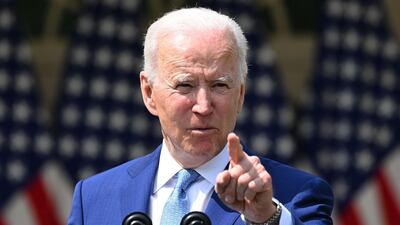
US president Joe Biden surprised many when he said he believed that Russian president Vladimir Putin was a “killer” withw no soul in an interview last month; Mr Putin responded by suggesting that the US president’s words reflected his country’s own troubled past of slavery and the slaughter of Native Americans.
But this was not Mr Biden’s first instance of unusually candid language. He also used a used a highly pejorative term to describe China’s Xi Jinping during his election campaign last year.
The blunt statements made by China and America's top foreign and security officials when they met in Anchorage last month caused similar shock, as I wrote at the time.
And after his recent letter to Afghan president Ashraf Ghani was leaked, Mr Blinken himself stands accused of being unacceptably condescending and high-handed in addressing an elected leader.
At the other end of the continent, Malaysia’s foreign minister Hishammuddin Hussein got into hot water this month when he used the Mandarin word for “big brother” during a press conference with his Chinese counterpart, Wang Yi. Although Mr Hishammuddin later clarified that he was referring respectfully to Mr Wang as an “older and more senior foreign minister”, rather than characterising the relationship between the two countries, he was attacked by one predecessor for committing a “diplomatic faux pas”, while opposition leader Anwar Ibrahim told him to apologise to the Malaysian people for making their country seem like “a puppet to a foreign power”.
Two points arise from the above. Firstly, in a multipolar world with increasing worry about flashpoints – from Ukraine's eastern border, beyond which Russian troops are massing, to tensions in the Taiwan Strait and the South China Sea – nuanced, careful and precise diplomatic language is more necessary than ever.
The old saw that a diplomat is “an honest gentleman sent to lie abroad for the good of his country” is witty, but can be interpreted too cynically. If it may often be true, it is also the case that outward displays of civility are important, that differences are often best left to private conversations, and that overly harsh words in public can be hard to row back from.
Mr Biden may well believe his descriptions of Mr Putin and Mr Xi to be true, but he would have been wiser not to say so. On a range of crucial issues, from climate change to arms control, he will have discussions and hope to make agreements with both men. Having publicly insulted them both will hardly help. It may also have damaged him – and by extension the US – in their estimation, for they may take it as a sign of weakness that Mr Biden lacks the self-control to conceal thoughts that shrewder souls would have kept to themselves.
Mr Biden has also made a rod for his own back. For how, human rights activists will ask, could the US president shake hands with Mr Putin or have him for dinner at the White House if he has such a low view of his record? Neither may be immediately on the horizon, but it is in everyone’s interests that US-Russia relations improve to the extent that such a visit could be possible. The same goes for US-China ties. What then?
Likewise, Turkey’s Mr Erdogan may well be an authoritarian who has cracked down on dissenters and freedom of the press, but he has still been elected many times, and has lost his own commercial capital, Istanbul, to an opposition mayor. Italy's Mr Draghi lacked caution in calling a man who has no certainty of winning his next presidential election a “dictator”.
Secondly, the case of Malaysia’s foreign minister shows that while diplomacy is essential, it should not be too obfuscatory. Mr Hishammuddin is a very experienced minister who has a long history with China and a family connection too – it was his uncle, the former prime minister Tun Razak, who opened diplomatic relations with Beijing in 1974.
I see nothing wrong with him paying respect to his Chinese counterpart. It appears to have gone down well with Malaysia’s biggest trading partner, and may well presage greater exports of palm oil to China.
It is also preposterous to claim that Mr Hishammuddin referring to Mr Wang as his “big brother” means that Kuala Lumpur is taking sides against Washington.
More importantly, however, are relatively small countries like Malaysia, with a population of 32 million, really supposed to suggest they are on an equal footing with 1.4 billion strong China?
When its then foreign minister – now termed Beijing’s “top diplomat” – Yang Ziechi said back in 2010 that “China is a big country and other countries are small countries, and that is just a fact”, that was viewed as being undiplomatic. True, he was cross when he said it. But wasn't he just telling the truth?
Are we really to make out that East Timor or Vanuatu – or for that matter, Germany or France – are at par with China, the US, Russia or India, which by dint of population, gross domestic product or geopolitical sway probably make up the top tier?
From the Monroe Doctrine in 1823 onwards, the US has seen itself first as a regional hegemon and then a global one. Shouldn't we be more honest about the reality of power?
So yes: we need diplomacy to be "back", as Mr Blinken says. But it should be practised with more civility than the US Secretary of State or his boss have evinced so far, while also being somewhat more straightforward. The language of "fraternal ties" should not blind us to the obvious fact that some countries really are more "big brother" than others.
Sholto Byrnes is an East Asian affairs columnist for The National

