A supporter of Lebanon's Hezbollah gestures as he holds a Hezbollah flag in Marjayoun, Lebanon May 7, 2018. Reuters
In 2019, Israel said this was a Hezbollah-dug tunnel under the "blue line", a demarcation line drawn by the UN to mark Israel's withdrawal from southern Lebanon in 2000. AFP
Lebanon's Hezbollah members hold party flags as they listen to their leader Sayyed Hassan Nasrallah. Reuters
A banner depicting Hezbollah leader Sayyed Hassan Nasrallah and an United Nation's post in Lebanon. Reuters
Hezbollah leader Hassan Nasrallah has direct ties with Iran's supreme leader Ayatollah Ali Khamenei. Reuters
The Israeli military claimed that Hezbollah, with Iranian assistance, had been bringing specialised equipment to a weapons factory in southern Lebanon. Screengrab/YouTube
Lebanon's Hezbollah deputy leader Sheikh Naim Qassem gestures as he speaks during an interview with Reuters in Beirut, Lebanon March 15, 2018. Reuters
Hezbollah fighters put Lebanese and Hezbollah flags at Juroud Arsal, Syria-Lebanon border, July 25, 2017. Reuters
Lebanese soldiers try to block Hezbollah supporters as they gesture and chant slogans against anti-government demonstrators, in Beirut. Reuters
A Hezbollah supporter holds a placard of its leader Hassan Nasrallah, during a protest against the US in Beirut. AP Photo
Lebanese soldiers on patrol drive by UN vehicles on the border with Israel on July 28, 2020. AP
A Lebanese police officer gesturing on the site of an explosion in Beirut that killed ex-premier Rafik Hariri in 2005. AFP
Israeli soldiers monitor the country's border with Lebanon near the northern town of Metula, in July 14, 2020. AFP
In this file photo obtained on July 29, 2011 from the Special Tribunal for Lebanon shows a combo of pictures showing four Hezbollah suspects indicted in the assassination case of former Lebanese prime minister Rafiq Hariri. AFP
A car drives past a poster depicting Lebanon's Hezbollah leader Sayyed Hassan Nasrallah in Adaisseh village, near the Lebanese-Israeli border, Lebanon July 28, 2020. REUTERS/Aziz Taher
Like an oil tanker, European security policies take a long time to turn from the established and settled course. When it comes to the European Union's stance on Hezbollah, the change is suddenly under way. The steering wheel has spun in a new direction, with the security threat to EU member states having spurred a rethink.
The fundamental shift on Hezbollah spotlights a terror group engaged in activities posing threats to life and more.
While always acknowledging the group's ties to terror, the European capitals had once sought to make a distinction with a wider political movement. Over time the dividing line dissolved as the tentacles of its network spread.
Hezbollah has grown organised criminal activities with an extensive presence in country after country. Money laundering and the smuggling of illicit goods are fundamental to its coffers. The group also exerts control across a series of religious and community centres for the diaspora in European cities.
For decades, lawmakers had been able to exercise what the German think tank analyst Eckart Woertz called a “Solomonic solution” on Hezbollah, referring to a Biblical story in which King Solomon is required to rule between two women both claiming to be the mother of a child. Solomon does not make the ultimate choice but offers the unpalatable option of dividing the child in two. Thus Hezbollah was treated by Europe as having two parts
European countries were willing to proscribe the “military” wing of Hezbollah but not its other operations. However, the specific formulation is no longer holding. What's worse from its standpoint, the wider landscape in which the group – which was set by Iranian agents to promote its revolutionary ideology in the 1980s – operates has changed utterly.
The explosion that wrecked the heart of Beirut last week is certain to resonate against Hezbollah in Europe's halls of power. In part, it is a culminating event that brings together a whole set of charges against the organisation and lays these at its feet. Indeed, the blast in Beirut calls into question decades of European policies towards its near neighbours.
In the aftermath of the migration surge in 2015 from ISIS-held Iraq and Syria, the continent had already lost confidence in the stability of the neighbourhood. The distance imposed by the Mediterranean Sea was for a long time an effective cordon sanitaire. No longer. The sea basin is an active source of dangers from its eastern to its western tip.
The former colonial powers, such as France vis-a-vis Lebanon, struggle to keep pace with each twist in the spiral downwards. Other countries, such as Germany, seek but fail to keep Greece and Turkey away from the edge of conflict.
The collapse of the Lebanese state, in which Hezbollah holds the whip hand as a political force, is certain to accelerate Europe’s rethinking of how it protects its interests.
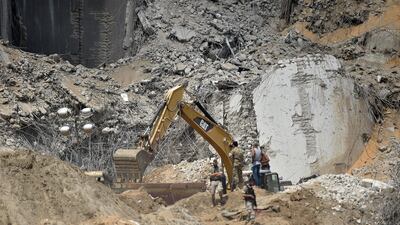
Greek rescue workers search amid the rubble three days after explosions that hit Beirut port. EPA
Workers and members of Lebanese civil defense search for bodies and survivors amid the rubble. EPA
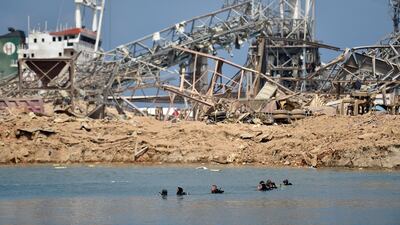
Divers inspect at the port waterfront. EPA
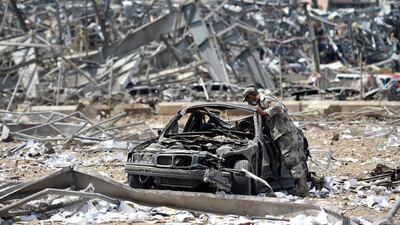
A Lebanese soldier looks at a damaged car. EPA
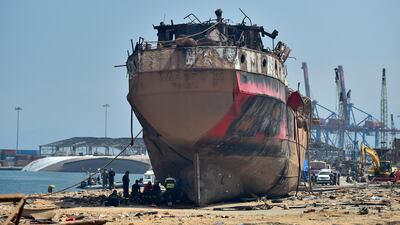
Workers and members of Lebanese civil defence rest next to a damaged vessel. EPA
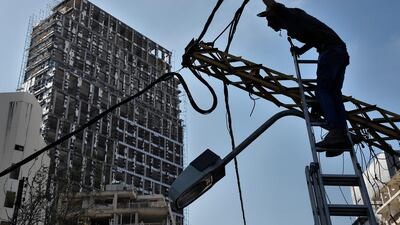
An electricity worker fixes power cables in front of a damaged building. AP Photo
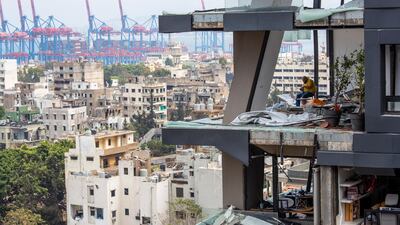
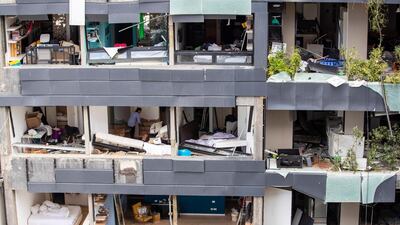
A man sits between debris inside his house damaged by Tuesday's explosion in the seaport of Beirut, Lebanon. AP Photo
A man who sustained injuries to his legs looks at the rubble. AP Photo
Workers remove debris from a house. AP Photo
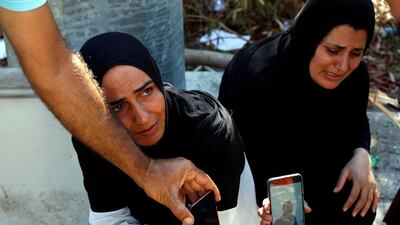
Zeinab Zer Eldin, left, and her sister-in-law shows a photo of her missing husband near the site of the explosion in the port of Beirut. AP Photo
Residents fix windows in a house damaged by Tuesday's explosion that hit the port of Beirut. AP Photo
When Europe had the luxury of detachment from day-to-day politics, it was able to devise its own policy on Hezbollah. A political and diplomatic argument was made that banning it would destabilise the Lebanese political settlement. Whatever credibility that idea possessed was long gone, even before last week's events at the port controlled by the group.
Britain moved to ban it in its entirety at the start of this year, putting a cap on the sea change in the climate facing the group. The Dutch had already done so. Austria's main political parties united behind a joint resolution demanding “effective action against Hezbollah” and “terrorist and criminal activities”.
Austria also began prosecution of a kingpin who had lived near its southern borders for decades for money laundering and terror financing activities.
Germany brought in its own ban a few months ago, and within hours, hundreds of police officers were searing the mosques and associations affiliated with the Iran-backed movement. The treasure trove of documents seized has triggered investigations that prosecutors expect to see in the courts in the coming months.
In just the city of Hamburg the local intelligence believes there are 30 institutions under Hezbollah's control. The associations send millions of euros to the organisation and its leadership every year. Nationwide, the German intelligence believes there are at least 1,050 Hezbollah operatives scattered around the country.
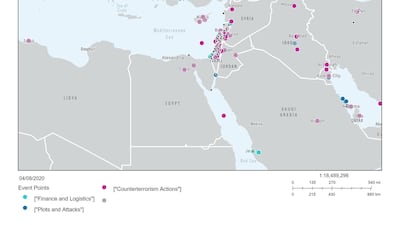
The map details Hezbollah activity in the Middle East. Courtesy of The Washington Institute for Near East Policy
Extensive activies were also recorded in Latin America. Courtesy of The Washington Institute for Near East Policy
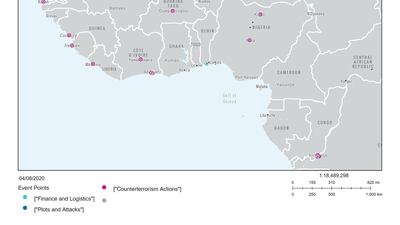
The group is also active in West Africa. Courtesy of The Washington Institute for Near East Policy
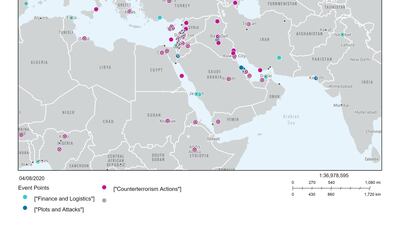
The map reveals extensive funding operations centred on Europe. Courtesy of The Washington Institute for Near East Policy
The new map details Hezbollah activity in the Middle East. Courtesy of The Washington Institute for Near East Policy
The Washington Institute, a US-based think tank, last week warned that Hezbollah was stockpiling an arsenal of arms depots around Europe. It released an exhaustive interactive map of the group's involvement in organised crime, drug running, smuggling, money laundering and much more over almost four decades.
One of the components of the map is a US Department of State report titled "Select Europe-based Operational Activity" by Hezbollah. It detailed in May 2015 an event with haunting overtones following the tragedy in Beirut. The Cypriot authorities arrested Hussein Bassam Abdallah, a Lebanese-Canadian Hezbollah operative, who had stored 420 boxes of ammonium nitrate, the very material that ignited in the Beirut explosion. He was sentenced to three years in prison. Three years earlier another operative was accused of renting storage space for the same material but he fled Cyprus.
Keeping a lid on Hezbollah while seeking to promote European influence in the near abroad was already an impossible task. Last week showed how irresponsible it was not to tackle this group head on.
Damien McElroy is the London bureau chief of The National

UAE currency: the story behind the money in your pockets
Al Jazira 3 (O Abdulrahman 43', Kenno 82', Mabkhout 90 4')
Al Ain 1 (Laba 39')
Red cards: Bandar Al Ahbabi (Al Ain)
The 12 breakaway clubs
England
Arsenal, Chelsea, Liverpool, Manchester City, Manchester United, Tottenham Hotspur
Italy
AC Milan, Inter Milan, Juventus
Spain
Atletico Madrid, Barcelona, Real Madrid
FIXTURES
All kick-off times UAE ( 4 GMT)
Brackets denote aggregate score
Tuesday:
Roma (1) v Shakhtar Donetsk (2), 11.45pm
Manchester United (0) v Sevilla (0), 11.45pm
Wednesday:
Besiktas (0) v Bayern Munich (5), 9pm
Barcelona (1) v Chelsea (1), 11.45pm
Key findings of Jenkins report
Founder of the Muslim Brotherhood, Hassan al Banna, "accepted the political utility of violence"
Views of key Muslim Brotherhood ideologue, Sayyid Qutb, have “consistently been understood” as permitting “the use of extreme violence in the pursuit of the perfect Islamic society” and “never been institutionally disowned” by the movement.
Muslim Brotherhood at all levels has repeatedly defended Hamas attacks against Israel, including the use of suicide bombers and the killing of civilians.
Laying out the report in the House of Commons, David Cameron told MPs: "The main findings of the review support the conclusion that membership of, association with, or influence by the Muslim Brotherhood should be considered as a possible indicator of extremism."
Moeen Ali, James Anderson, Jofra Archer, Jonny Bairstow, Dominic Bess, James Bracey, Stuart Broad, Rory Burns, Jos Buttler, Zak Crawley, Sam Curran, Joe Denly, Ben Foakes, Lewis Gregory, Keaton Jennings, Dan Lawrence, Jack Leach, Saqib Mahmood, Craig Overton, Jamie Overton, Matthew Parkinson, Ollie Pope, Ollie Robinson, Joe Root, Dom Sibley, Ben Stokes, Olly Stone, Amar Virdi, Chris Woakes, Mark Wood
Directed by: Shari Springer Berman, Robert Pulcini
Starring: Amanda Seyfried, James Norton
2/5
UPI facts
More than 2.2 million Indian tourists arrived in UAE in 2023 More than 3.5 million Indians reside in UAE Indian tourists can make purchases in UAE using rupee accounts in India through QR-code-based UPI real-time payment systems Indian residents in UAE can use their non-resident NRO and NRE accounts held in Indian banks linked to a UAE mobile number for UPI transactions
England's all-time record goalscorers:
Wayne Rooney 53
Bobby Charlton 49
Gary Lineker 48
Jimmy Greaves 44
Michael Owen 40
Tom Finney 30
Nat Lofthouse 30
Alan Shearer 30
Viv Woodward 29
Frank Lampard 29
Sanju
Produced: Vidhu Vinod Chopra, Rajkumar Hirani
Director: Rajkumar Hirani
Cast: Ranbir Kapoor, Vicky Kaushal, Paresh Rawal, Anushka Sharma, Manish’s Koirala, Dia Mirza, Sonam Kapoor, Jim Sarbh, Boman Irani
Mercer, the investment consulting arm of US services company Marsh & McLennan, expects its wealth division to at least double its assets under management (AUM) in the Middle East as wealth in the region continues to grow despite economic headwinds, a company official said.
Mercer Wealth, which globally has $160 billion in AUM, plans to boost its AUM in the region to $2-$3bn in the next 2-3 years from the present $1bn, said Yasir AbuShaban, a Dubai-based principal with Mercer Wealth.
“Within the next two to three years, we are looking at reaching $2 to $3 billion as a conservative estimate and we do see an opportunity to do so,” said Mr AbuShaban.
Mercer does not directly make investments, but allocates clients’ money they have discretion to, to professional asset managers. They also provide advice to clients.
“We have buying power. We can negotiate on their (client’s) behalf with asset managers to provide them lower fees than they otherwise would have to get on their own,” he added.
Mercer Wealth’s clients include sovereign wealth funds, family offices, and insurance companies among others.
From its office in Dubai, Mercer also looks after Africa, India and Turkey, where they also see opportunity for growth.
Wealth creation in Middle East and Africa (MEA) grew 8.5 per cent to $8.1 trillion last year from $7.5tn in 2015, higher than last year’s global average of 6 per cent and the second-highest growth in a region after Asia-Pacific which grew 9.9 per cent, according to consultancy Boston Consulting Group (BCG). In the region, where wealth grew just 1.9 per cent in 2015 compared with 2014, a pickup in oil prices has helped in wealth generation.
BCG is forecasting MEA wealth will rise to $12tn by 2021, growing at an annual average of 8 per cent.
Drivers of wealth generation in the region will be split evenly between new wealth creation and growth of performance of existing assets, according to BCG.
Another general trend in the region is clients’ looking for a comprehensive approach to investing, according to Mr AbuShaban.
“Institutional investors or some of the families are seeing a slowdown in the available capital they have to invest and in that sense they are looking at optimizing the way they manage their portfolios and making sure they are not investing haphazardly and different parts of their investment are working together,” said Mr AbuShaban.
Some clients also have a higher appetite for risk, given the low interest-rate environment that does not provide enough yield for some institutional investors. These clients are keen to invest in illiquid assets, such as private equity and infrastructure.
“What we have seen is a desire for higher returns in what has been a low-return environment specifically in various fixed income or bonds,” he said.
“In this environment, we have seen a de facto increase in the risk that clients are taking in things like illiquid investments, private equity investments, infrastructure and private debt, those kind of investments were higher illiquidity results in incrementally higher returns.”
The Abu Dhabi Investment Authority, one of the largest sovereign wealth funds, said in its 2016 report that has gradually increased its exposure in direct private equity and private credit transactions, mainly in Asian markets and especially in China and India. The authority’s private equity department focused on structured equities owing to “their defensive characteristics.”
SPECS
Engine: 4-litre V8 twin-turbo Power: 630hp Torque: 850Nm Transmission: 8-speed Tiptronic automatic Price: From Dh599,000 On sale: Now
The biog
Name: James Mullan
Nationality: Irish
Family: Wife, Pom; and daughters Kate, 18, and Ciara, 13, who attend Jumeirah English Speaking School (JESS)
Favourite book or author: “That’s a really difficult question. I’m a big fan of Donna Tartt, The Secret History. I’d recommend that, go and have a read of that.”
Dream: “It would be to continue to have fun and to work with really interesting people, which I have been very fortunate to do for a lot of my life. I just enjoy working with very smart, fun people.”
Springsteen: Deliver Me from Nowhere
Director: Scott Cooper
Starring: Jeremy Allen White, Odessa Young, Jeremy Strong
Rating: 4/5
Who's who in Yemen conflict
Houthis: Iran-backed rebels who occupy Sanaa and run unrecognised government
Yemeni government: Exiled government in Aden led by eight-member Presidential Leadership Council
Southern Transitional Council: Faction in Yemeni government that seeks autonomy for the south
Habrish 'rebels': Tribal-backed forces feuding with STC over control of oil in government territory
Tonight's Chat is a series of online conversations on The National. The series features a diverse range of celebrities, politicians and business leaders from around the Arab world.
Tonight’s Chat host Ricardo Karam is a renowned author and broadcaster who has previously interviewed Bill Gates, Carlos Ghosn, Andre Agassi and the late Zaha Hadid, among others.
Intellectually curious and thought-provoking, Tonight’s Chat moves the conversation forward.
They involve criminals conning mobile phone operators into issuing them with replacement Sim cards, often by claiming their phone has been lost or stolen
They use the victim's personal details - obtained through criminal methods - to convince such companies of their identity.
The criminal can then access any online service that requires security codes to be sent to a user's mobile phone, such as banking services.
UAE SQUAD
Mohammed Naveed (captain), Mohamed Usman (vice captain), Ashfaq Ahmed, Chirag Suri, Shaiman Anwar, Mohammed Boota, Ghulam Shabber, Imran Haider, Tahir Mughal, Amir Hayat, Zahoor Khan, Qadeer Ahmed, Fahad Nawaz, Abdul Shakoor, Sultan Ahmed, CP Rizwan
Our legal columnist
Name: Yousef Al Bahar
Advocate at Al Bahar & Associate Advocates and Legal Consultants, established in 1994
Education: Mr Al Bahar was born in 1979 and graduated in 2008 from the Judicial Institute. He took after his father, who was one of the first Emirati lawyers
Match info
Uefa Champions League Group F
Manchester City v Hoffenheim, midnight (Wednesday, UAE)
The new speaker of Iraq’s parliament Mohammed Al Halbousi is the youngest person ever to serve in the role.
The 37-year-old was born in Al Garmah in Anbar and studied civil engineering in Baghdad before going into business. His development company Al Hadeed undertook reconstruction contracts rebuilding parts of Fallujah’s infrastructure.
He entered parliament in 2014 and served as a member of the human rights and finance committees until 2017. In August last year he was appointed governor of Anbar, a role in which he has struggled to secure funding to provide services in the war-damaged province and to secure the withdrawal of Shia militias. He relinquished the post when he was sworn in as a member of parliament on September 3.
He is a member of the Al Hal Sunni-based political party and the Sunni-led Coalition of Iraqi Forces, which is Iraq’s largest Sunni alliance with 37 seats from the May 12 election.
He maintains good relations with former Prime Minister Nouri Al Maliki’s State of Law Coaliton, Hadi Al Amiri’s Badr Organisation and Iranian officials.
Brief scores:
Manchester City 2
Gundogan 27', De Bruyne 85'
Crystal Palace 3
Schlupp 33', Townsend 35', Milivojevic 51' (pen)
Man of the Match: Andros Townsend (Crystal Palace)
How England have scored their set-piece goals in Russia
Three Penalties
v Panama, Group Stage (Harry Kane)
v Panama, Group Stage (Kane)
v Colombia, Last 16 (Kane)
Four Corners
v Tunisia, Group Stage (Kane, via John Stones header, from Ashley Young corner)
v Tunisia, Group Stage (Kane, via Harry Maguire header, from Kieran Trippier corner)
v Panama, Group Stage (Stones, header, from Trippier corner)
v Sweden, Quarter-Final (Maguire, header, from Young corner)
One Free-Kick
v Panama, Group Stage (Stones, via Jordan Henderson, Kane header, and Raheem Sterling, from Tripper free-kick)
First Test at Barbados
West Indies won by 381 runs
Second Test at Antigua
West Indies won by 10 wickets
Third Test at St Lucia
February 9-13
Who was Alfred Nobel?
The Nobel Prize was created by wealthy Swedish chemist and entrepreneur Alfred Nobel.
In his will he dictated that the bulk of his estate should be used to fund "prizes to those who, during the preceding year, have conferred the greatest benefit to humankind".
Nobel is best known as the inventor of dynamite, but also wrote poetry and drama and could speak Russian, French, English and German by the age of 17. The five original prize categories reflect the interests closest to his heart.
Nobel died in 1896 but it took until 1901, following a legal battle over his will, before the first prizes were awarded.
RESULTS
5pm: Maiden (PA) Dh80,000 1,600m
Winner: Omania, Saif Al Balushi (jockey), Ibrahim Al Hadhrami (trainer) 5.30pm: Conditions (PA) Dh85,000 1,600m
Winner: Brehaan, Richard Mullen, Ana Mendez 6pm: Handicap (TB) Dh100,000 1,600m
Winner: Craving, Connor Beasley, Simon Crisford 6.30pm: The President’s Cup Prep (PA) Dh100,000 2,200m
Winner: Rmmas, Tadhg O’Shea, Jean de Roualle 7pm: Wathba Stallions Cup (PA) Dh70,000 1,200m
Winner: Dahess D’Arabie, Connor Beasley, Helal Al Alawi 7.30pm: Handicap (PA) Dh80,000 1,400m
Winner: Fertile De Croate, Sam Hitchcott, Ibrahim Aseel