

Millions of kilometres away from Earth is an amber-coloured planet called Mars, which has sparked the curiosity of multiple generations. To some it is a sphere of hope, while to others it is a new land that humans could colonise one day. Pictures of slopes and an ice slab suggest Mars may still have a vital life source – water. This has prompted one to ask whether the "Red Planet" could be the manifestation of what Earth might become, if we do not take care of our home.
Back in 1972, the late Sheikh Zayed was given a piece of the Moon by then US president Richard Nixon. Looking back at those pictures, which date to before the Apollo 17 space mission, and now, only a few decades later, seeing Emirati engineers taking part in an UAE-driven mission to Mars, shows what a giant leap forward this relatively young nation has taken. This has proven to be an even prouder moment with the project of a young Emirati student, Alia Al Mansoori, being tested at the International Space Agency.
We are building on the legacy of our Founding Father and continuing to realise his vision through the UAE Space Agency.
Adopting new perspectives

The vast potential of the global space industry, which currently stands at $350 billion and is projected to generate more than $1 trillion in revenue by 2040, has understandably captured the attention and interest of innovators and entrepreneurs in the Middle East. In fact, one of the world’s largest space insurance underwriting agencies is based right here in the UAE.
But the question remains, why should we invest in space exploration when we need to save our own planet from the impact of climate change? The answer is multi-pronged.
Technologies used in space give us a better understanding of the world we live in, and contribute to our scientific knowledge. They also help to prevent illegal poaching and over-fishing, and monitor endangered species.
Among the many companies sending satellites into orbit to prevent illicit trade, UnseenLabs, a space start-up based in France, uses electromagnetic technology and real-time data to track ships attempting to go undercover by shutting their identification systems.
We are depleting our fisheries, causing 90 per cent of fish stocks to be considered fully or over-exploited. Indeed, illegal fishing is a major issue, causing long-term ramifications for our oceans.
-
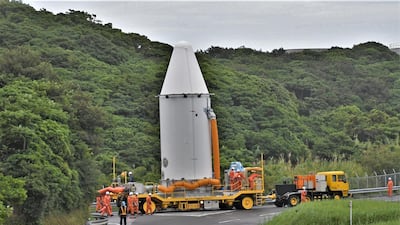
The Hope probe was placed inside this payload fairing last week and was transferred to building where the rocket is kept. Courtesy: Shoma Watanbe -
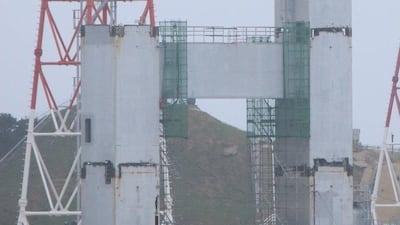
The launch pad is ready to receive the H-IIA rocket, which will deliver the Hope probe to space. It will take 30 to 40-minutes for the rocket to be transported to the launch pad. Courtesy: Yoshiaki Sakita -
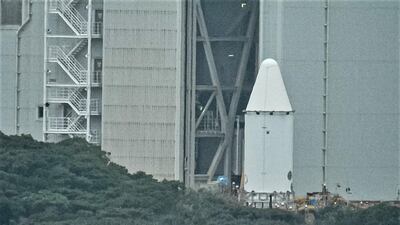
The payload fairing, which is holding the spacecraft, has been mounted on top of the rocket. The structure is meant to protect the probe from dynamic pressure and aerodynamic heating it experiences during its launch into an atmosphere. Courtesy: Shoma Watanbe -
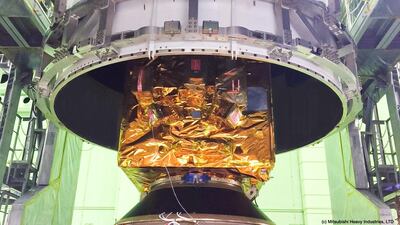
The probe was already fuelled with 800kgs of hydrogen for its seven-month-long journey to Mars. Courtesy: Emirates Mars Mission -
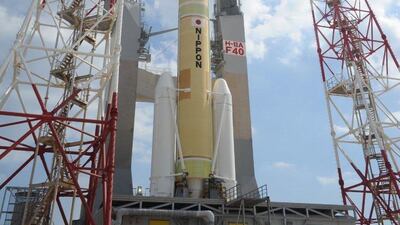
The H-IIA rocket that will carry the Hope probe into space. Dubai Twitter account -
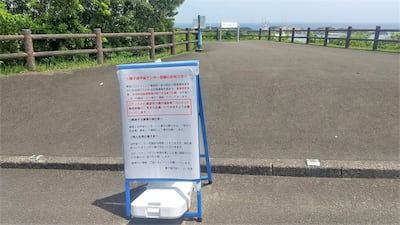
All launch viewing events in Tanegashima have been suspended as part of the Covid-19 safety measures. Signs have been up in all of popular spots, asking the public to keep a 3km distance from the Tanegashima Space Centre on launch day. Courtesy: Yoshiaki Sakita -
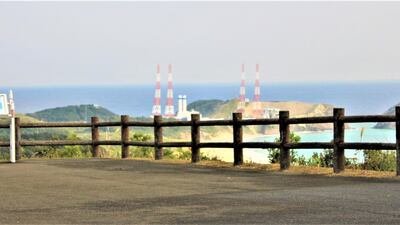
The most popular launch viewing site is the Rocket Hill. It is a five-minute drive from the main building of the Tangashima Space Centre and offers a clear view of the launch. It remains closed to the public. The National -
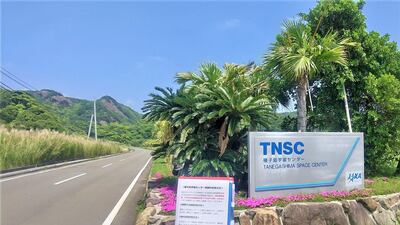
The free bus tour and exhibition at the Tanegashima Space Centre has also been suspended in efforts to contain the Covid-19 spread. Signs were placed outside of the centre, alerting the public. Courtesy: Yoshiaki Sakita -
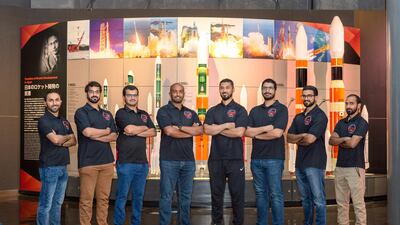
Engineers at the launch site in Tanegashima island, Japan. Courtesy: Emirates Mars Mission -

The completed Hope spacecraft. It will study the lower and upper atmosphere of Mars. Courtesy: Emirates Mars Mission


Satellites roam around our galaxy, providing essential services, particularly in the domain of telecoms and digital services. They are also providing us with pictures showing us how ecosystems are changing. This, in turn, is helping to monitor a wide spectrum of environmental indicators, from meteorological forecasting to investigating specific problems, such as "algae blooms" – a rapid accumulation of algae in water systems – that affect marine life, carbon emissions and even water levels.
Over the next decade, the number of satellites in our galaxy is projected to increase fourfold. Companies paving the way in this sector include Elon Musk's SpaceX, which has launched more than 60 satellites to date and aims to launch 12,000 by 2027, and Planet Labs, which has 120 active satellites orbiting and taking photographs of our planet.
Globalising knowledge-sharing

We live in a data-driven world that is going to become even more important, with the rise of big data, data analytics and artificial intelligence. It is through orbiting space technologies that we are able to receive critical information – essentially billions of data points – which gives us the foresight to better deal with natural disasters and manage resources. That we can access this information is driven by community spirit, whereby much of what is being created is open-source.
As we introduce new technologies and continue on our journey of space exploration, I am hopeful that the world will collaborate on charting these new territories. We only have to look at the International Space Station to realise how much stronger we are when nations work together.
Connecting future generations

The Covid-19 pandemic has affected every nation in many profound ways. It has especially created an unprecedented global education emergency. A recent report published by the UK-based humanitarian organisation Save the Children highlighted an alarming statistic: almost 10 million children may never go back to school.
In an increasingly connected world, mega-constellations orbiting our planet have the ability to provide high-speed internet access, thereby offering a viable solution to the learning deficit. As societies adapt to the concept of e-learning and online classrooms become the norm, the combination of affordable internet services and access to technology could be the missing link in resolving this issue.
Inspiring innovation and a circular economy

In a world with finite resources, we can learn about the efficiency of materials used by the space sector to weather harsh conditions and threats, such as ultraviolet rays and X-rays from the Sun, solar wind particle radiation, thermal cycling, space particles and atomic oxygen.
A study published in the scientific journal Nature Climate Change has warned that the Middle East could become uninhabitable due to the effects of extreme temperature rises. By using materials normally utilised in space, we can build things to last and also learn to repair goods rather than dispose of them.
Products used in space have a myriad of purposes and, therefore, I believe we should focus on building a circular economy here on Earth. Researcher Mark Blenner, for instance, is studying how human waste can be used to create aircraft parts.
I am given to understand that futuristic water conservation technologies have been developed from space tech. The world’s first recirculating shower-head system, which conserves up to 90 per cent of water and 80 per cent of energy, is one example. This piece of technology could come in handy in water-scarce regions. With the right levels of investment, there is little reason to believe that it cannot be scaled-up.
Breaking glass ceilings

Years ago, I met Sarah Al Amiri, Minister of State for Advanced Sciences and the woman leading the charge for the UAE's Hope Mars probe. During our meeting, I had the opportunity to lift Martian sand with a glove. It was a fascinating experience.
At the time, she came across as an ambitious and inspirational figure, worthy of being looked up to by other women. Today I am proud to see many others like her making their presence felt in traditionally male-dominated fields. It’s worth pointing out that three out of the five top aerospace companies are now headed by women.
True to its name, the UAE's Mars mission is already offering us hope for a more sustainable world. Just as importantly, it will encourage and empower future generations – regardless of gender – to explore the unknown. Let us all work together to protect our planet, because this home is all we have.
Sheikha Shamma bint Sultan bin Khalifa Al Nahyan is chief executive officer of Alliances for Global Sustainability

