
From overhead, the sea slime that has gripped great swathes of the Marmara Sea in recent weeks has a creamy sheen, as if the water has been given a smooth protective coating. But up close, the marine mucilage is gloopy and foul, and it’s easy to see how its slimy film poses a threat to all variety of marine life.
Scientists say the Marmara’s climate change-driven temperature increase of 2-2.25°C this century is likely to have worsened the outbreak. They also say local activity – increased pollution, overfishing, greater industrial and farm run-off and tons of untreated sewage from the 20 million people living around the sea – played a part.
After decades of rapid urbanisation and rampant construction across Turkey’s cultural and financial capital, it’s no surprise that Istanbul’s weakened ecosystem is more susceptible to shocks. As the city’s mayor in the 90s, Recep Tayyip Erdogan leaned green, improving waste management, proposing congestion pricing and switching buses to natural gas. He described plans to build a third bridge across the Bosphorus as “murder for the city”.
But as the country’s leader since 2003, he has overseen a massive construction boom, including tunnels under the Bosphorus, the world’s largest airport and that third bridge. “We are connecting continents,” he said at its 2016 inauguration. “With God’s permission, this country will get what it deserves.”
Millions of trees and several water basins were destroyed for those megaprojects and to make way for countless housing developments and gated communities along Istanbul’s periphery. A look at satellite images from 2002, when Mr Erdogan’s ruling Justice and Development Party (AKP) came to power, and from today highlights the massive shift, from predominantly green to mostly khaki, particularly along the Marmara.
Istanbul’s population has doubled since 2000, from 8 to 16 million, and we may be witnessing the slow-motion desertification of one of the world’s great cities. Eight years ago, as construction peaked, I wrote: “Scientists and planners estimate that the elimination of forests and water reservoirs required for Istanbul’s ongoing and planned projects will leave the city heavily polluted and gasping for water within a decade.”
In January, following a drought, Istanbul had only enough water left for 45 days. Mayor Ekrem Imamoglu urged locals to take shorter showers, turn off the tap while brushing teeth and install low-use taps. Spring rains rescued Istanbulites, but now the city and the region face an unprecedented assault of sea slime that points toward darker days ahead.
The mucilage is made up of bits of faeces and fragments of dead plants and animals combined with millions of micro-organisms such as phytoplankton. Outbreaks are not uncommon in the Mediterranean, as witnessed in Italy in 2007, but they are rarely this bad. Like a sick person with a runny nose, one Canadian oceanographer described extreme events like Turkey’s as “a call for help” from the system.
-
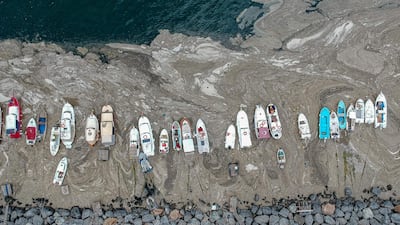
Thick, viscous fluid ‘sea snot’ produced by phytoplankton clogs up the Marmara sea shoreline in Istanbul, Turkey, on June 4, 2021. AFP -
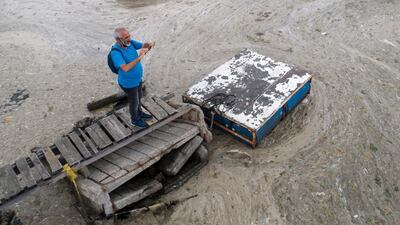
A man takes pictures of the Marmara sea covered by sea snot in Istanbul. EPA -

Sea snot, or mucilage, was first documented in Turkey's waters in 2007. AFP -

Experts say sea snot will occur more often because of global warming. AFP -
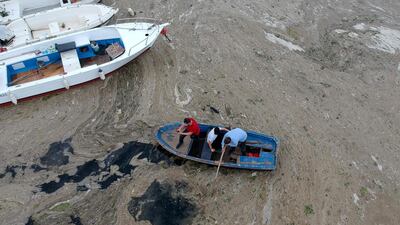
Turkey's President Recep Tayyip Erdogan promised on Saturday, June 5, to rescue the Marmara Sea from the outbreak of "sea snot". AP -

Sea snot poses a threat to the fishing industry and the environment, marine biologists said. AFP -
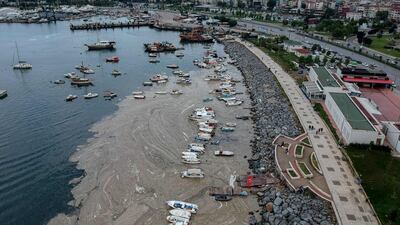
Untreated waste dumped into the Marmara Sea and climate change caused the sea snot bloom, Turkish authorities said. AFP -

Water temperatures in the Marmara sea are 2.5 degrees above the average of the last 40 years. EPA


To their credit, Turkey's leaders have responded. Last week Mr Erdogan vowed to rid the Marmara of the slimy scourge and declare the sea a conservation area. The government launched a massive 22-point clean-up campaign across seven provinces, acknowledging that the clean-up could take five years. The government also aims to cut pollution and properly treat the region's wastewater, rather than treating the Marmara like a "cesspool", as the head of the Marmara Municipalities' Union said last week.
Is it too little too late? Marmara fishing has already been sharply curtailed, and last week a blast of sea slime clogged the Black Sea port of Yalikoy in Ordu province, 800 kilometres from Istanbul. A major outbreak in the Black Sea would threaten the main source of Turkey’s fishing industry.
Researchers from the Institute of Marine Sciences at Turkey's Middle East Technical University have said the slime stretches as far as 30 metres below the surface. It can carry viruses and bacteria, such as deadly E Coli, which is why Turkey has closed area beaches, cutting further into an already troubled tourist season. Locals reported last week that swimming in Erdek, one of the Marmara’s top beach destinations, is down at least 40 per cent from last year, which was already significantly below normal due to the pandemic.
More problematic is Turkey's embrace of construction and development at all costs. Rather than finding ways to conserve water and protect reservoirs, Turkey has built hundreds of dams in recent years, such as the Tigris dam that submerged the ancient city of Hasankeyf last year, eviscerating the local economy.
Many of Turkey’s largest cities also faced water shortages this year, including Izmir, Ankara and Bursa. To address Istanbul’s long-standing water shortages, the AKP-run administration began construction on the $270m Melen dam in 2014, but inspectors found cracks in the basin in 2018, delaying completion until at least 2023.

New mines threaten rich ecosystems and cultural heritage across Turkey. In March, developers proposed a 100-hectare marble quarry near the ancient village of Tire, along the Aegean, an agricultural district known for its red pines. Locals in Ikizdere, in Mr Erdogan’s childhood province of Rize, along the Black Sea, have been battling the proposed construction of a massive stone quarry. In December, locals in Nevsehir province filed a lawsuit against a Canadian firm for illegal drilling for gold in forested lands. In Canakkale province, just south of the Marmara, local protests halted a $1 billion mining project on Mount Ida in October 2019 after forests had been razed to clear space for the mine.
Turkey, the only G20 country apart from the US that has yet to ratify the 2015 Paris agreement, is in part responsible for eco-destruction beyond its borders. Last week, Kurdish officials and locals in northern Iraq accused Turkey and its affiliates of significant environmental damage due to the forests cleared to build 80 military checkpoints and connecting roads. Even worse, Iraqis face a severe water shortage this summer because the construction of nearly two dozen Turkish dams on the Tigris and Euphrates has reduced water flow into Iraq by more than 40 per cent in recent decades. And the worst may be still to come. Mr Erdogan has vowed to break ground this month on an Istanbul canal parallel to the Bosphorus that the government says would decrease accident risk and generate $5bn in annual revenue. However, scientists argue that it would further imperil the Bosphorus and Marmara Sea and undermine ecosystems from the Black Sea to the Mediterranean.
The canal would significantly expand provincial deforestation and industrial run-off. Looking at horrifying images of sea slime in recent days, it’s hard to imagine a clearer sign that the one thing greater Istanbul cannot tolerate at the moment is one of the largest construction projects in the country’s history.
David Lepeska is a Turkish and Eastern Mediterranean affairs columnist for The National
-
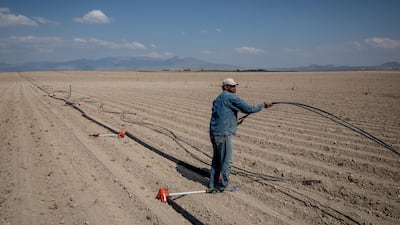
A farm worker puts down irrigation pipes in a parched field near the town of Karapinar, in Konya province, Central Anatolia, Turkey. All pictures Getty Images -

Farm workers tend a sugar beet field near Karapinar. Sugar beet consumes a lot of water, due to its long growth period. -

Farmers Cafer Ungor, left, and Ferhat Altintas add fertiliser to water extracted from their groundwater well. Two years of extreme drought has forced farmers to tap in to underground sources to sustain their crops. -
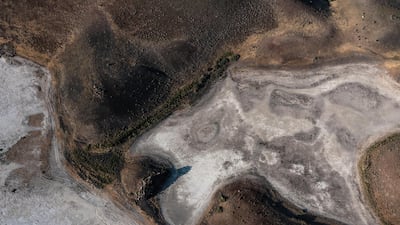
An aerial view shows salt deposits in Meke Lake, near Karapinar. The volcanic crater lake, which was created by an eruption four million years ago, dried out in 2020. -
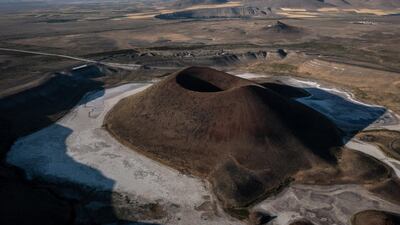
An aerial view reveals how little water remains around Lake Meke, its volcanic cone looming over the receding pools. Drought and groundwater extraction have caused it to dry out. -

As Lake Meke dried up, the water became increasingly saline, with crystallisation occurring and salt deposits forming. -
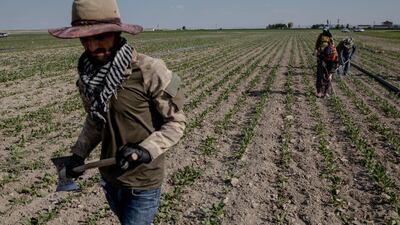
Farm workers tend a sugar beet field. Konya province is the heart of Turkey's agriculture sector, but extreme drought over the past two years has taken its toll on farmers and the land. -

A field of wheat near Karapinar. Konya province produces more than 2.5 million tonnes of grain a year, but officials predict this will drop by 5.5 per cent in 2021, due to drought. -
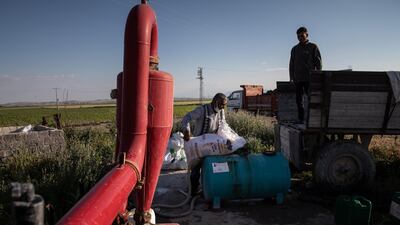
Farmers Hayri Kalkan, left, and Niyazi Ibrahimi add fertiliser to extracted groundwater for irrigation. Drought and the depletion of groundwater has raised questions over whether agriculture is sustainable in parts of Konya. -

Tending to sugar beet in Karapinar. Extracting water to sustain crop has caused the water table in the area to drop by two metres. -
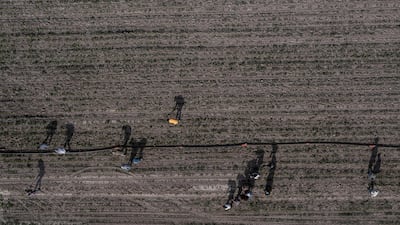
Farm workers tend sugar beet in parched field fields. As underground water levels fall, this creates cavities into which surface material collapses, creating hundreds of sinkholes around Karapinar. -
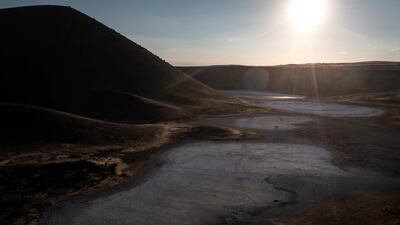
A low sun over the dried out Lake Meke. In the past, the lake was renowned for its rich array of wildfowl. -
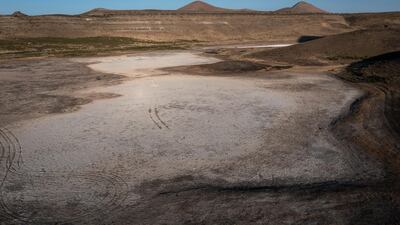
The salt-encrusted expanses of the dried out Lake Meke. While the lake had been home to more than 100 species of bird, by 2015, as the waters receded and become brackish, they were gone.



