
Ramadan is a month-long festival of fasting, eating and worship. Large crowds gather daily to eat together at the beginning and end of the daily fast, and to offer extra prayers together in mosques. Attendance at the five-times-daily and Friday prayers rockets throughout Ramadan. There is also a special practice of spiritual seclusion or retreat in mosques (i'tikaf), when millions of men, and occasionally women, remain confined to the mosque in close company with others during its last 10 days.
This carries many public health risks during the Covid-19 pandemic, especially in developing countries where many poor people rely on the Ramadan charitable practice of feeding people to eat two meals per day. Governments of countries with large Muslim populations face a crisis of decision-making and social acceptance around Covid-19 policy.
Already in Pakistan, leading clerics defied the government lockdown last week and announced that daily, nightly and Friday prayers would resume for Ramadan. This led to negotiations resulting in a 20-point plan agreed between the government and the dissenting clerics for a managed opening of Pakistan's mosques in time for Ramadan and Eid. In contrast, senior Saudi and UAE clerics maintain that mosques must remain closed in countries where the government enforces a lockdown to preserve public health.
But the problems do not end there. Within two months of the end of Ramadan, Saudi Arabia is due to host the Hajj, or annual pilgrimage to Makkah, an essential pillar of Islamic practice. Every healthy Muslim who can afford it is expected to perform the Hajj at least once in their lifetime.
Ramadan and Hajj are related: the two Eid festivals are associated with these two periods of worship, and Ramadan is seen as preparation for those intending to embark on the Hajj. The week of Hajj, spanning the end of July and beginning of August, overlaps with the original dates for the 2020 Tokyo Olympics that have already been postponed for a year.
The Hajj is usually attended by about 2.5 million people, three-quarters of whom (almost two million) are foreign visitors. Pilgrims come from every country in the world, and the Saudis solve a large and complex logistical problem every year in accommodating them. For countries with large Muslim populations, the Saudis impose a quota of 0.1 per cent or one pilgrim per 1,000 Muslims in that country.
-

Worshippers take photographs of the Kaaba inside Mecca's Grand Mosque a day after Saudi authorities emptied Islam's holiest site for sterilisation over fears of the new coronavirus COVID-19. AFP -
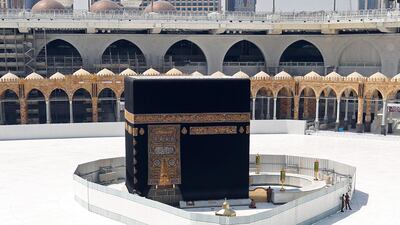
An almost empty Kaaba at the Grand Mosque is seen after Saudi authority suspended umrah amid the fear of coronavirus outbreak. Reuters -

A view of Kaaba at the Grand Mosque, which is almost empty of worshippers. Reuters -
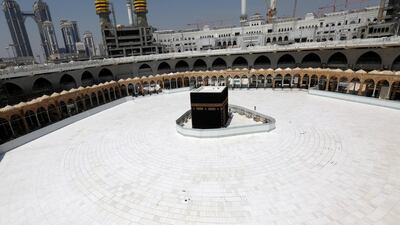
Kaaba at the Grand Mosque is almost empty of worshippers. Reuters -
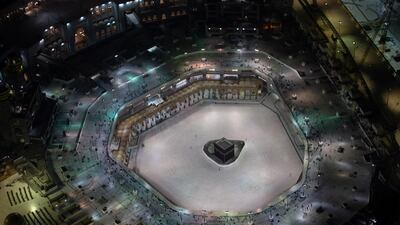
A view of Kaaba at the Grand Mosque, which is almost empty of worshippers. Reuters -

The Kaaba, inside Mecca's Grand Mosque, is shown to be empty of worshippers on Thursday in Makkah, Saudi Arabia. AFP -
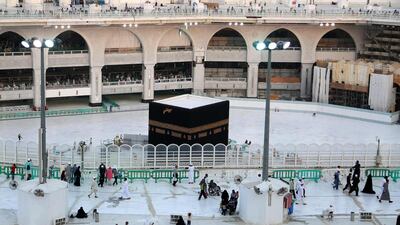
Small groups of pilgrims walk around the Kaaba. AFP -

Workers sterilize the ground in front of the Kaaba in Makkah, Saudi Arabia. AP Photo -
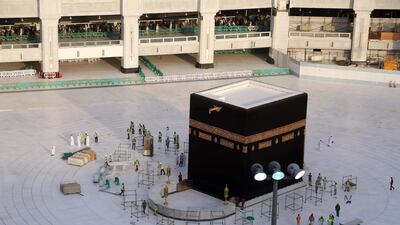
Municipal workers are seen in empty courtyard the Kaaba. AFP -
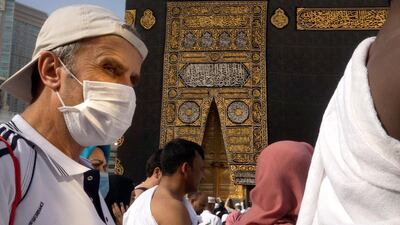
Few prayed around the Kaaba in Makkah on Thursday. AP Photo -
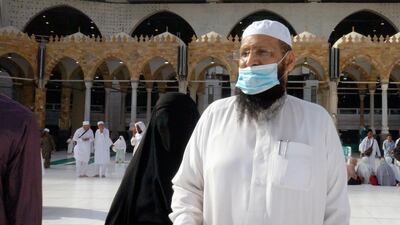
A pilgrim wears a mask as he visits the Grand Mosque in Makkah. AP Photo -

A Saudi policeman stands guard in front of the Kaaba. AP Photo -
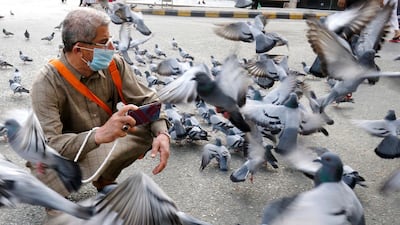
A pilgrim films pigeons outside the Grand Mosque. AP Photo -
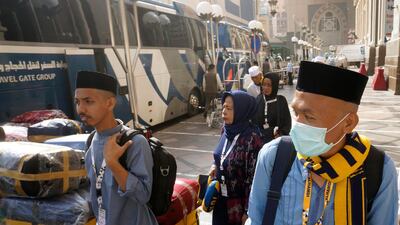
Indonesian pilgrims, who entered Mecca before visas were halted, wait their bus to leave home in Makkah. AP Photo -
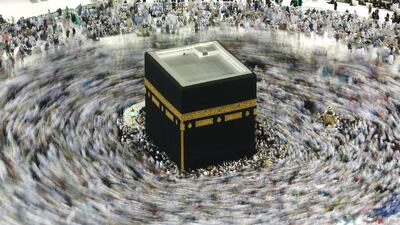
Far smaller crowds than usual of Muslim pilgrims circumambulate the Kaaba in Makkah, Saudi Arabia. AP Photo -
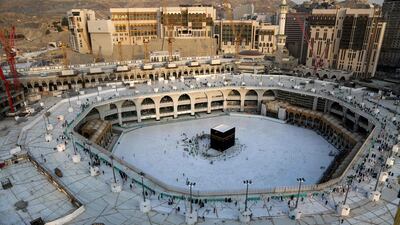
The white-tiled area surrounding the Kaaba is shown empty of worshippers. AFP


For an entire week, huge crowds crisscross Makkah and its surrounding plains daily in observance of complicated Hajj rituals. Most of them also spend a week or two in Madinah, the city of the Prophet. During a pandemic, it will be very difficult to see how this could be kept up safely. Makkah and Madinah are already under strict lockdown and curfew measures that have been ongoing for weeks.
To give a sense of the enormity of this decision affecting the journey of millions to their spiritual home and holiest sanctuary, the Hajj has been cancelled or become very difficult to attend many times in Islamic history due to war, natural disasters and plagues. But it has never, during the century-long Saudi rule over Makkah, been cancelled. Though there has been speculation in western media that it could be cancelled this year, the Saudis will be reluctant to cancel the Hajj completely, just as they have exempted the Holy Mosques of Makkah and Madinah from the nationwide closure of mosques due to Covid-19: small prayer services are still held daily at the two Holy Mosques.
-
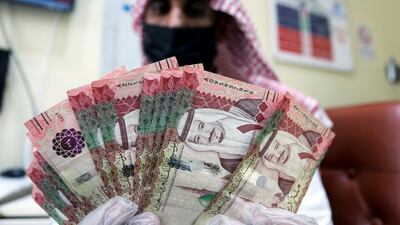
A Saudi money exchanger wears a protective face mask and gloves as he counts Saudi riyal currency at a currency exchange shop in Riyadh, Saudi Arabia March 10, 2020. Reuters -
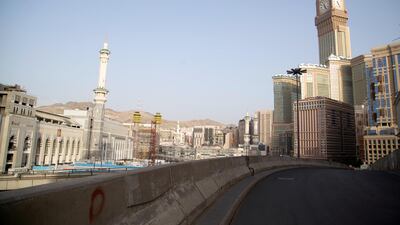
A view of a deserted street during a curfew imposed to prevent the spread of the coronavirus disease in the holy city of Makkah. Reuters -
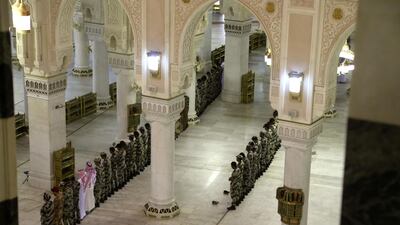
Members of the Saudi armed forces attend prayers at a mosque in Saudi Arabia's holy city of Makkah on April 3, 2020. AFP -

A view of a deserted street during a curfew imposed to prevent the spread of the coronavirus disease in the holy city of Makkah. Reuters -
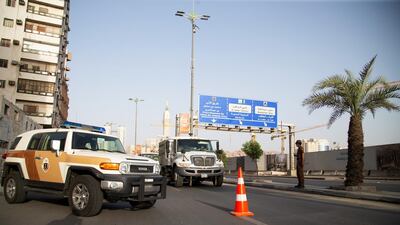
A policeman wearing a protective face mask blocks the road during a curfew imposed to prevent the spread of the coronavirus disease in the holy city of Makkah. Reuters -
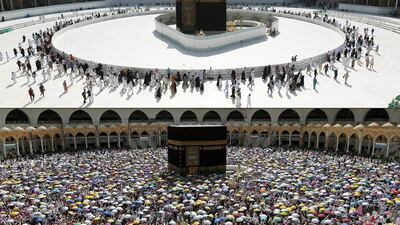
A combination of photos shows a small crowd of worshippers around the sacred Kaaba in Mecca's Grand Mosque on March 7, 2020, and a large crowd during the pilgrimage, on August 13, 2019. AFP -
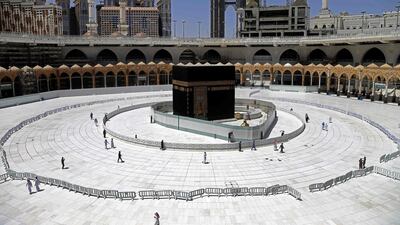
Muslim worshippers circumambulate the sacred Kaaba in Makkah's Grand Mosque, Islam's holiest site, on April 3, 2020. AFP -
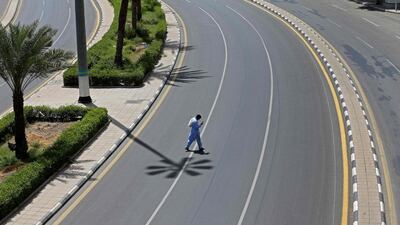
A man checks his phone as he crosses an empty street in Saudi Arabia's holy city of Makkah on April 3, 2020. AFP -
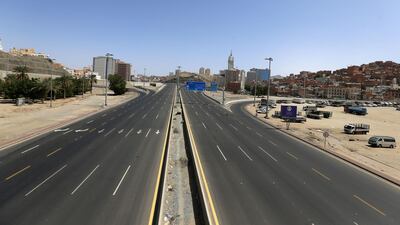
A view of a deserted street during a curfew imposed to prevent the spread of the coronavirus disease in the holy city of Makkah. AFP -
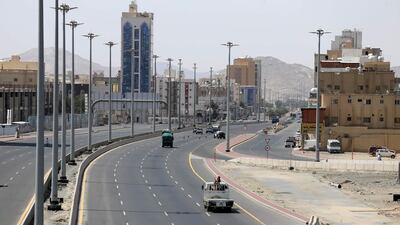
A view of a deserted street during a curfew imposed to prevent the spread of the coronavirus disease in the holy city of Makkah. AFP -

A view of a deserted street during a curfew imposed to prevent the spread of the coronavirus disease in the holy city of Makkah. AFP -
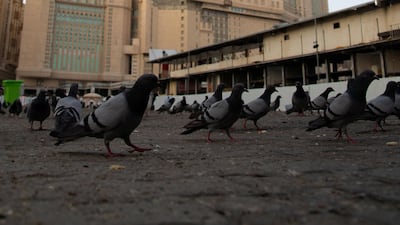
Birds are seen near the Grand Mosque during a curfew. Reuters -
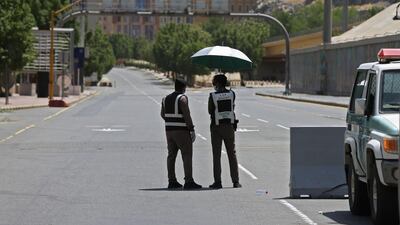
Police officers man a checkpoint in a street in Saudi Arabia's holy city of Makkah on April 3, 2020. AFP -
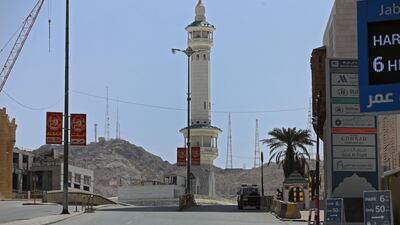
A view of a deserted street during a curfew imposed to prevent the spread of the coronavirus disease in the holy city of Makkah. AFP -
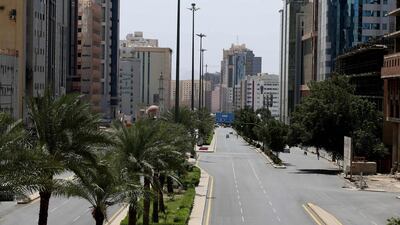
A view of a deserted street during a curfew imposed to prevent the spread of the coronavirus disease in the holy city of Makkah. AFP -
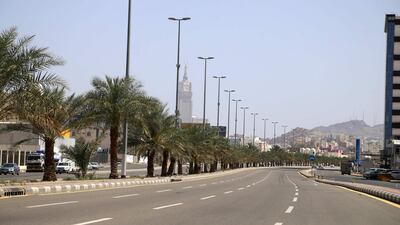
A view of a deserted street during a curfew imposed to prevent the spread of the coronavirus disease in the holy city of Makkah. AFP -
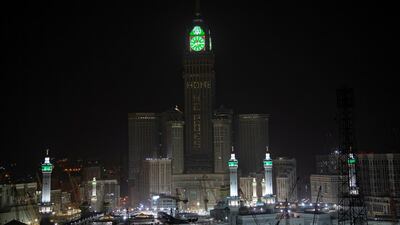
The clock tower is lit up with the phrase "Home Heroes" during a curfew. Reuters -

A view of a deserted street during a curfew imposed to prevent the spread of the coronavirus disease in the holy city of Makkah. Reuters -
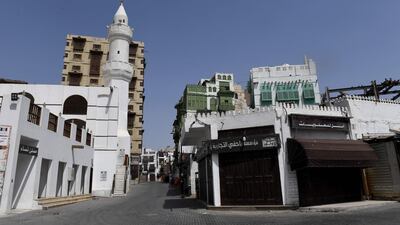
The deserted old town of Saudi Arabia's Red Sea coastal city of Jeddah. AFP -
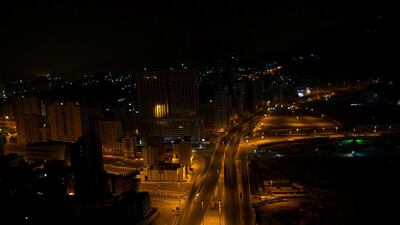
A view of a deserted street during a curfew imposed to prevent the spread of the coronavirus disease in the holy city of Makkah. Reuters -
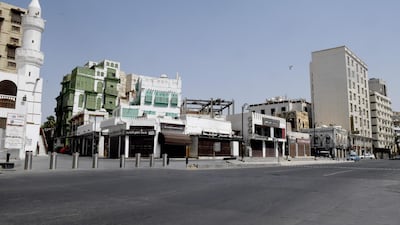
The announcement comes amid uncertainty over the hajj which is due to take place at the end of July, after authorities this week urged Muslims to temporarily defer preparations for the annual pilgrimage. AFP -
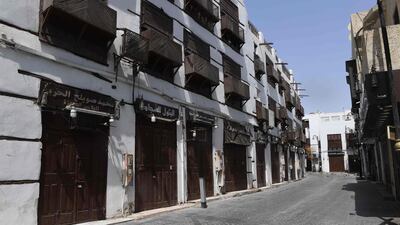
The measures bar people from entering and exiting the capital as well as Jeddah, Mecca and Medina and prohibiting movement between all provinces to stem the spread of coronavirus with the number of deaths from the disease rising to 21. AFP -

Pigeons fly around closed shops in the old town of Saudi Arabia's Red Sea coastal city of Jeddah on April 2, 2020. AFP -
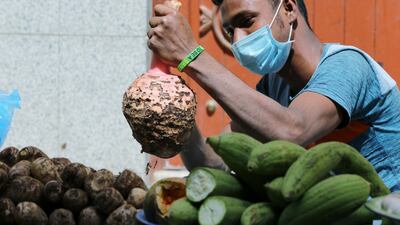
A vegetable seller wearing a protective face mask sells fruits and vegetables at a market before markets close, to prevent the spread of coronavirus disease, in Riyadh. Reuters -
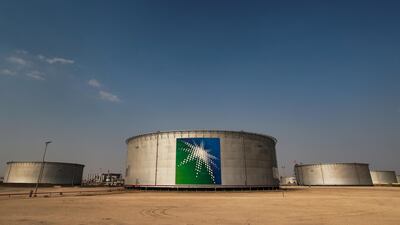
Branded oil tanks at Saudi Aramco oil facility in Abqaiq, Saudi Arabia. Reuters


Given this, the Hajj might happen this year, but with a vastly reduced number of pilgrims, stripped back to allow only a small number of Saudis who have tested negative for the coronavirus, including royalty and senior clerics. The Saudis have reduced pilgrim numbers before: the number of Hajis in 2013 was almost 40 per cent down on the previous year, due to restrictions imposed because of a large-scale construction project at the Sacred Mosque in Makkah. This week, the Saudis have installed scanners to monitor people’s body temperatures at the Prophet’s Mosque in Madinah as part of the fight against coronavirus.
The dilemma that Saudi authorities face is one which many religious leaders – Islamic and otherwise – are grappling with: how to strike a balance between fulfilling their obligations to their faith and their communities while acting responsibly in the battle to contain the spread of the coronavirus, a battle in which religious authorities can play a vital, and maybe even a decisive, role.
Indeed, imams, priests and rabbis around the world have urged their faith-communities to obey government and health agencies, as preservation of life is an essential religious principle. They have also helped to counter religion-based misinformation and misleading advice regarding the pandemic.
It is important for political leaders and health agencies to work with religious leaders on such matters. A case in point is the otherwise-excellent WHO guidance on Ramadan that has a problematic line asking authorities to "provide alcohol-based hand-rub (at least 70 per cent alcohol) at the entrance to and inside mosques". Given that hundreds of millions of Muslims believe that alcohol is impure (najas) and are prohibited to drink or even handle, this has the potential to undermine the guidance and even cause social unrest, because there will be loud and influential voices who will accuse the WHO of promoting physical impurity and uncleanliness inside mosques.
To mitigate this concern, the WHO could refer to the many religious and fatwa-issuing authorities who have endorsed the use of alcohol-based hand-rubs in the Covid-19 situation as a case of dire necessity, due to the Quranic principle that necessity allows even what is usually prohibited. This would be a good example of governments, health agencies and religious leaders working together against a lethal threat to everyone.
Usama Hasan is a research consultant at the Tony Blair Institute for Global Change

