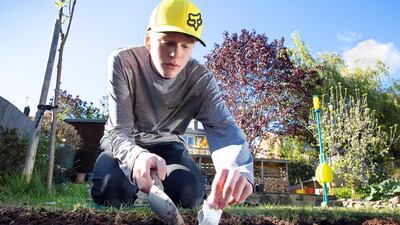
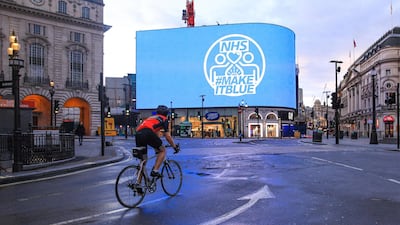
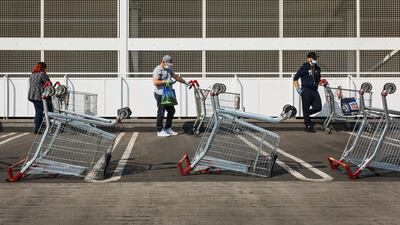
An audit by British fashion brand Next summarises how well-managed businesses are coping – and what comes next. Reuters

One British retailer has Covid-19 lessons to offer


  • English
  • Arabic

It was all going splendidly until it wasn't. That was the takeaway from a major audit by fashion brand Next about the balance of forces in the workplace since the Covid-19 pandemic-induced lockdown began in the UK in March. What it lays out for the future is a roadmap for society at large, and more specifically managers and the workforce.

A deep dive into the results statement of the British clothing brand retailer (full disclosure: I am neither a shareholder nor even a customer of the firm) summarises how well-managed businesses are coping. And what comes next.

“From a business perspective the pandemic has been hugely expensive and disruptive – but there has been much to learn from the experience,” it says. “Having to work from home has opened our eyes to new and better ways of working, collaborating and communicating amongst ourselves and with our suppliers. The world had obviously changed and one of the keys is embracing that reality."

With the UK government teetering on the brink of a second national lockdown, the country is not clear of shocks just yet.

When the first one was enforced six months ago, it was too late to "squash the sombrero", to use the graphic term employed by Prime Minister Boris Johnson. His (unfulfilled) wish was to kill off the familiar graph of infection cases spiking with a clunking fist of lockdown. Unfortunately he acted at least 10 days after the likely optimum moment to strike.

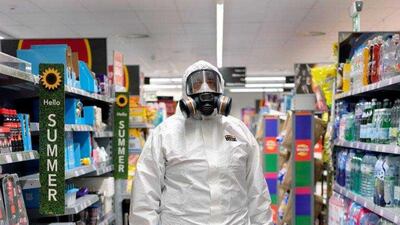
The effect on Next's business was an immense shock. More than half a million square metres of warehousing was repurposed to achieve social distancing. This included one-way systems, perspex shielding, sanitation equipment, temperature checks and a raft of new operating procedures. After just two weeks, more than 4,000 employees were asked to retrain how they did their jobs.

The lessons learned were broken into three sections: the good, the bad and the unknown.

The single-best feature of the lockdown conditions for employees was the slashing of the daily commute, which has caused stress and inconvenience for those undertaking long trips. The report said it was now open to question why either an employer would require or an individual would want to undertake lengthy daily journeys in future.

A firm at the forefront of worldwide procurement of “fast fashion” has a far-flung supply chain. The auditors found that the shift to digital platforms encouraged more regular contact with suppliers and closer collaboration through video calls. It added that its corporate procedures had held back small teams more capable of taking decisions.

Next's "bad" aspects called into question the very purpose of corporate life. "We have missed the chance conversations, unplanned questions, the ability to learn from colleagues, along with the training and camaraderie that the office provides. At its best, an office can be a cauldron for new ideas and enhanced collaboration.”

The killer assessment of video conferencing was that it often amounted to a colossal waste of time. “Large video calls have encouraged the proliferation of one of the business world's most damaging practices – death by deck: slideshow presentations that transform meetings from productive exchanges of ideas into boring, one-way lectures; with the "presenters" rattling through bullet points already visible to their stultified audience.”

So what about the outlook? Nobody knows. The firm’s leadership was careful not to lay out the obvious pitfalls, never mind the stored-up problems not yet apparent. “The prospects for the next six months remain as uncertain as the outlook for the virus itself; never has our guidance been more tentative or as broad in its possible outcomes," it warned.

How it intends to approach the coming rebirth (or cataclysm) is vaguer still. “We will allow the balance between working from home and in the office to evolve over time, allowing each functional area to work its way towards the optimum working practices for its particular needs and its particular people.

British Prime Minister Boris Johnson, seen at the new vaccine manufacturing centre near Didcot in England on Friday, has struggled to tackle the Covid-19 outbreak. AFP

“We will, however, set out some very clear simple principles, which we expect people to follow when determining the balance between home and office working – above all else we need to be clear that the business must come first.”

Global leaderships – in politics as well as the business sphere – would do well to boil down the priorities for the weeks ahead in similar terms. They, like rest of us, are likely to endure more turbulence and loss. It is somehow reassuring to know that the framework for progress can be set out along simple lines.

The initial lockdown produced productivity gains. The reasons behind this bounce were varied and the advantages need to be consolidated. As The National's series on the future of work-life balance demonstrated last week, change is already well entrenched. It is also true that the current set-up is deeply flawed and a better balance must be struck.

Damien McElroy is the London bureau chief of The National

Dengue%20fever%20symptoms
%3Cp%3EHigh%20fever%20(40%C2%B0C%2F104%C2%B0F)%3Cbr%3ESevere%20headache%3Cbr%3EPain%20behind%20the%20eyes%3Cbr%3EMuscle%20and%20joint%20pains%3Cbr%3ENausea%3Cbr%3EVomiting%3Cbr%3ESwollen%20glands%3Cbr%3ERash%26nbsp%3B%3C%2Fp%3E%0A
The lowdown

Rating: 4/5

Small Victories: The True Story of Faith No More by Adrian Harte
Jawbone Press

Grand Slam Los Angeles results

Men:
56kg – Jorge Nakamura
62kg – Joao Gabriel de Sousa
69kg – Gianni Grippo
77kg – Caio Soares
85kg – Manuel Ribamar
94kg – Gustavo Batista
110kg – Erberth Santos

Women:
49kg – Mayssa Bastos
55kg – Nathalie Ribeiro
62kg – Gabrielle McComb
70kg – Thamara Silva
90kg – Gabrieli Pessanha

The specs

Engine: 1.5-litre turbo

Power: 181hp

Torque: 230Nm

Transmission: 6-speed automatic

Starting price: Dh79,000

On sale: Now

Key recommendations
  • Fewer criminals put behind bars and more to serve sentences in the community, with short sentences scrapped and many inmates released earlier.
  • Greater use of curfews and exclusion zones to deliver tougher supervision than ever on criminals.
  • Explore wider powers for judges to punish offenders by blocking them from attending football matches, banning them from driving or travelling abroad through an expansion of ‘ancillary orders’.
  • More Intensive Supervision Courts to tackle the root causes of crime such as alcohol and drug abuse – forcing repeat offenders to take part in tough treatment programmes or face prison.
Key findings of Jenkins report
  • Founder of the Muslim Brotherhood, Hassan al Banna, "accepted the political utility of violence"
  • Views of key Muslim Brotherhood ideologue, Sayyid Qutb, have “consistently been understood” as permitting “the use of extreme violence in the pursuit of the perfect Islamic society” and “never been institutionally disowned” by the movement.
  • Muslim Brotherhood at all levels has repeatedly defended Hamas attacks against Israel, including the use of suicide bombers and the killing of civilians.
  • Laying out the report in the House of Commons, David Cameron told MPs: "The main findings of the review support the conclusion that membership of, association with, or influence by the Muslim Brotherhood should be considered as a possible indicator of extremism."
THE LOWDOWN

Romeo Akbar Walter

Rating: 2/5 stars
Produced by: Dharma Productions, Azure Entertainment
Directed by: Robby Grewal
Cast: John Abraham, Mouni Roy, Jackie Shroff and Sikandar Kher 

ESSENTIALS

The flights 

Etihad (etihad.com) flies from Abu Dhabi to Mykonos, with a flight change to its partner airline Olympic Air in Athens. Return flights cost from Dh4,105 per person, including taxes. 

Where to stay 

The modern-art-filled Ambassador hotel (myconianambassador.gr) is 15 minutes outside Mykonos Town on a hillside 500 metres from the Platis Gialos Beach, with a bus into town every 30 minutes (a taxi costs €15 [Dh66]). The Nammos and Scorpios beach clubs are a 10- to 20-minute walk (or water-taxi ride) away. All 70 rooms have a large balcony, many with a Jacuzzi, and of the 15 suites, five have a plunge pool. There’s also a private eight-bedroom villa. Double rooms cost from €240 (Dh1,063) including breakfast, out of season, and from €595 (Dh2,636) in July/August.

Yahya Al Ghassani's bio

Date of birth: April 18, 1998

Playing position: Winger

Clubs: 2015-2017 – Al Ahli Dubai; March-June 2018 – Paris FC; August – Al Wahda

Email sent to Uber team from chief executive Dara Khosrowshahi

From: Dara

To: Team@

Date: March 25, 2019 at 11:45pm PT

Subj: Accelerating in the Middle East

Five years ago, Uber launched in the Middle East. It was the start of an incredible journey, with millions of riders and drivers finding new ways to move and work in a dynamic region that’s become so important to Uber. Now Pakistan is one of our fastest-growing markets in the world, women are driving with Uber across Saudi Arabia, and we chose Cairo to launch our first Uber Bus product late last year.

Today we are taking the next step in this journey—well, it’s more like a leap, and a big one: in a few minutes, we’ll announce that we’ve agreed to acquire Careem. Importantly, we intend to operate Careem independently, under the leadership of co-founder and current CEO Mudassir Sheikha. I’ve gotten to know both co-founders, Mudassir and Magnus Olsson, and what they have built is truly extraordinary. They are first-class entrepreneurs who share our platform vision and, like us, have launched a wide range of products—from digital payments to food delivery—to serve consumers.

I expect many of you will ask how we arrived at this structure, meaning allowing Careem to maintain an independent brand and operate separately. After careful consideration, we decided that this framework has the advantage of letting us build new products and try new ideas across not one, but two, strong brands, with strong operators within each. Over time, by integrating parts of our networks, we can operate more efficiently, achieve even lower wait times, expand new products like high-capacity vehicles and payments, and quicken the already remarkable pace of innovation in the region.

This acquisition is subject to regulatory approval in various countries, which we don’t expect before Q1 2020. Until then, nothing changes. And since both companies will continue to largely operate separately after the acquisition, very little will change in either teams’ day-to-day operations post-close. Today’s news is a testament to the incredible business our team has worked so hard to build.

It’s a great day for the Middle East, for the region’s thriving tech sector, for Careem, and for Uber.

Uber on,

Dara

RedCrow Intelligence Company Profile

Started: 2016

Founders: Hussein Nasser Eddin, Laila Akel, Tayeb Akel 

Based: Ramallah, Palestine

Sector: Technology, Security

# of staff: 13

Investment: $745,000

Investors: Palestine’s Ibtikar Fund, Abu Dhabi’s Gothams and angel investors

How to donate

Send “thenational” to the following numbers or call the hotline on: 0502955999
2289 – Dh10
2252 – Dh 50
6025 – Dh20
6027 – Dh 100
6026 – Dh 200

Brief scores:

Day 1

Toss: India, chose to bat

India (1st innings): 215-2 (89 ov)

Agarwal 76, Pujara 68 not out; Cummins 2-40

The National in Davos

We are bringing you the inside story from the World Economic Forum's Annual Meeting in Davos, a gathering of hundreds of world leaders, top executives and billionaires.

The BIO:

He became the first Emirati to climb Mount Everest in 2011, from the south section in Nepal

He ascended Mount Everest the next year from the more treacherous north Tibetan side

By 2015, he had completed the Explorers Grand Slam

Last year, he conquered K2, the world’s second-highest mountain located on the Pakistan-Chinese border

He carries dried camel meat, dried dates and a wheat mixture for the final summit push

His new goal is to climb 14 peaks that are more than 8,000 metres above sea level