In the opening scene of the harrowing 2015 Second World War drama Land of Mine, Roland Moller plays Sgt Carl Rasmussen, a Danish soldier returning to his newly liberated country in May 1945.
Wearing the uniform of Britain’s Parachute Regiment, Rasmussen is driving past a line of bedraggled Wehrmacht troops who are trudging their way home after the collapse of the Nazis’ five-year occupation.
Something one of the soldiers has tucked under his arm catches Rasmussen’s eye, and the burly commando brings his jeep to a sudden stop. Striding over to the young man, Rasmussen can now see clearly what the German is carrying: a pilfered Danish flag.
Already seething with pent-up rage, Rasmussen lets loose, battering the solider to the ground and snatching the flag back. “This is not yours!” he yells in German. To the rest of the retreating troops he shouts: “This is my land! Understood? Get out!”
It is difficult to think of a more visceral depiction of the power of flags and emblems. Although some say that flags are merely coloured fabric – like NFL player Colin Kaepernick who said in 2016: "I am not going to value a piece of cloth over people's lives" – these emblems are alive with political and cultural voltage.
In the UAE, which celebrates Flag Day this week, the colours designed in 1971 by 19-year-old Abdullah Mohammad Al Maainah were first flown at Union House in Dubai and Mushrif Palace in Abu Dhabi on December 2 that year – the day of unification.
The UAE flag, with its pan-Arab colours, is an important symbol of statehood and played an important part in forging a strong Emirati identity. The flag is universally accepted by Emiratis as their emblem and it can be said that the UAE flag, for want of a better word, works.
This is not always the case. In 2004, Iraqis furiously rejected a new national flag that was intended to underline the break with the Saddam Hussein era.
The new flag – designed in London by the renowned Iraqi architect Rifat Chadirji – ditched the pan-Arab colours of the country’s previous flags in favour of a blue crescent and two blue lines on a white background.
For many Iraqis, the new flag was that of the occupying forces and, in a fatal blow to the flag’s chances of success, was unnervingly close in appearance to that of Israel’s. After protests, the new flag was quietly folded up and put away.
New Zealand voters chose to keep the current design of their national flag, right, instead of adopting the new design with a silver fern, in a referendum that ended on March 24, 2016. Reuters
Obsolete flags can retain their power, too. In Germany, for example, the illegal display of the swastika comes with a three-year jail sentence.
But even an uncontroversial flag that works can raise strong feelings. New Zealanders spent 16 months and nearly $17.5 million in designing a series of alternatives to its existing flag only for the electorate to keep the original Southern Cross design in a 2016 referendum.
That flags are more than just pieces of coloured cloth is even borne about by those who destroy them. Rows over flag burning as free speech in the US have rumbled through the American judicial system for years. Many countries punish those who insult their flag, or other national symbols, with a fine or jail time.
Not quite so in Iran, where a canny company that makes US, British and Israeli flags for protesters to burn reported in January that business was booming, with its workers producing about 2,000 conveniently combustible symbols of imperialism a month during peak demand.
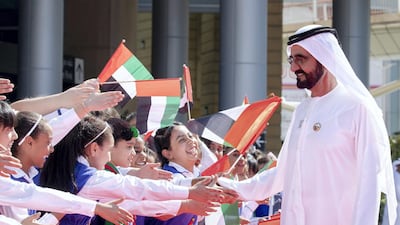
Sheikh Mohammed bin Rashid, Vice President and Ruler of Dubai, greets a crowd of young people on Flag Day on November 3, 2019. Courtesy Wam
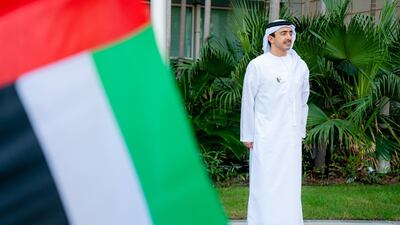
Sheikh Abdullah bin Zayed, Minister of Foreign Affairs and International Cooperation, attended the Flag Day celebrations at the ministry on November 3, 2019. Wam
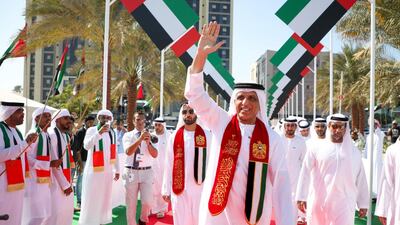
Ras Al Khaimah ruler Sheikh Saud bin Saqr Al Qasimi raises flag in Al Qawasim Corniche. Wam
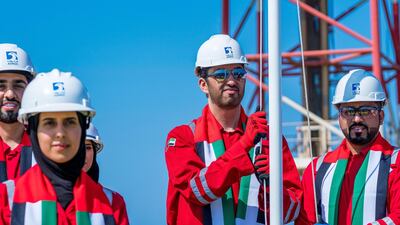
In a flag raising ceremony on the Umm Shaif platform, Dr. Sultan Al Jaber, Minister of State and CEO of ADNOC, hoisted the UAE flag in the presence of ADNOC employees. Wam
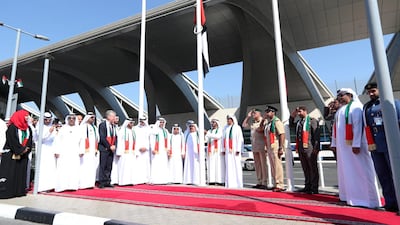
Sheikh Ahmed bin Saeed Al Maktoum (C), chairman and chief executive of Emirates Airline and Group, raises the UAE flag in front of Dubai International Airport. EPA
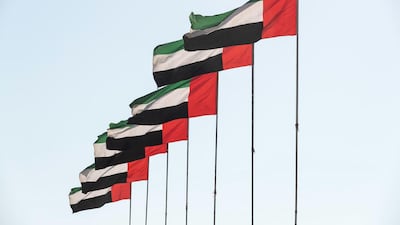
The UAE Flag flies proudly in the winter sunlight in Sharjah. Antonie Robertson/The National
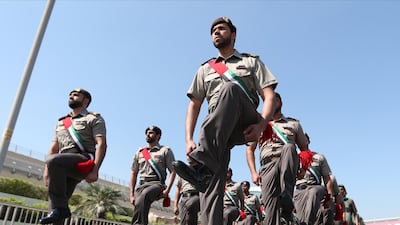
Members from Dubai Police take part in a parade in front of Dubai International Airport during UAE Flag Day in Dubai. EPA
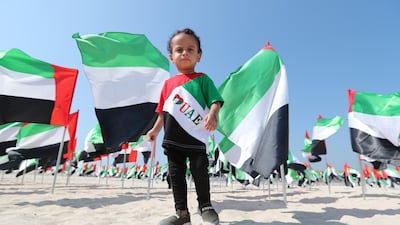
A child wears a T-shirt printed with an UAE sign at Kite beach which is decorated by UAE flag in Dubai. EPA
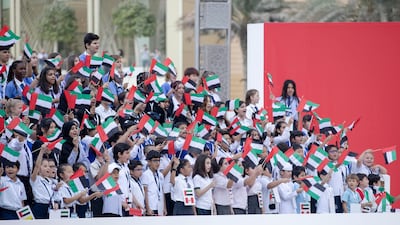
There was a sea of red, white, black and green on Flag Day. Wam
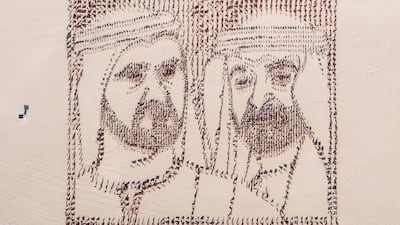
The ‘Flag Garden’ features 4,500 UAE flags arranged to create portraits of Sheikh Mohammed bin Rashid and Sheikh Mohamed bin Zayed. Wam
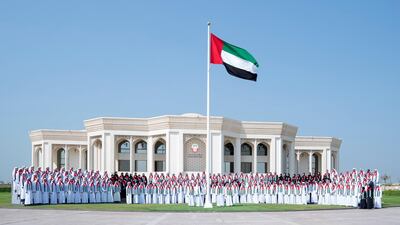
Sheikh Theyab bin Mohamed bin Zayed, Abu Dhabi Executive Council member and Chairman of the Abu Dhabi Crown Prince Court, stands for a photograph with CPC staff members during Flag Day celebrations, at Crown Prince Court. Hamad Al Kaabi / Ministry of Presidential Affairs
In keeping with this rather prosaic use of flags, there is their workaday role in the media. In the 90s a journalism tutor in Northern Ireland cheerfully told me about his so-called flag bag: a satchel of various, pristine emblems he would take with him when summoned by one paramilitary faction or another to photograph a statement or show of strength.
But, what actually makes a flag work? US librarian and vexillologist Steven Knowlton cast his expert eye over the UAE's flag for The National.
“The UAE's flag consists entirely of blocks of primary colours,” he said. “It is easy to make, even by amateurs at sewing, and to draw. This simplicity also makes it inexpensive if ordered from a manufacturer.
“Although UAE uses four colours, they are all colours commonly found in standard fabrics, and they contrast well when seen at a distance, which makes them easily visible against a clear blue sky or a cloudy sky.”
And although the UAE shares its colours with other countries in the Middle East, Mr Knowlton says the flag’s design helps to make it unique.
“The colour set of UAE's flag relates clearly to other Arab nations, such as Jordan, Sudan, Palestine, Iraq, Syria, Libya and Kuwait. But the distinctive use of only rectangular shapes helps it stand out against the other flags, which rely on triangles or horizontal stripes.”
When a teenage Abdullah Mohammad Al Maainah – who went on to become an Emirati diplomat – entered Aletihad newspaper's flag competition in 1971, little did he know the impact his red, black, green and white banner would have.
His winning flag will be ubiquitous this week, but as with so much this year, 2020's Flag Day will be one like no other. From being displayed to deliver stay-home messages or to encourage unity among the 200 nationalities who live and work here, the UAE's flag remains part of the fabric of this country.
Omar Abdulrahman (Al Hilal), Ali Khaseif, Ali Mabkhout, Salem Rashed, Khalifa Al Hammadi, Khalfan Mubarak, Zayed Al Ameri, Mohammed Al Attas (Al Jazira), Khalid Essa, Ahmed Barman, Ryan Yaslam, Bandar Al Ahbabi (Al Ain), Habib Fardan, Tariq Ahmed, Mohammed Al Akbari (Al Nasr), Ali Saleh, Ali Salmin (Al Wasl), Adel Al Hosani, Ali Hassan Saleh, Majed Suroor (Sharjah), Ahmed Khalil, Walid Abbas, Majed Hassan, Ismail Al Hammadi (Shabab Al Ahli), Hassan Al Muharrami, Fahad Al Dhahani (Bani Yas), Mohammed Al Shaker (Ajman)
Calls
Directed by: Fede Alvarez
Starring: Pedro Pascal, Karen Gillian, Aaron Taylor-Johnson
This article is part of a guide on where to live in the UAE. Our reporters will profile some of the country’s most desirable districts, provide an estimate of rental prices and introduce you to some of the residents who call each area home.
Ten tax points to be aware of in 2026
1. Domestic VAT refund amendments: request your refund within five years
If a business does not apply for the refund on time, they lose their credit.
2. E-invoicing in the UAE
Businesses should continue preparing for the implementation of e-invoicing in the UAE, with 2026 a preparation and transition period ahead of phased mandatory adoption.
3. More tax audits
Tax authorities are increasingly using data already available across multiple filings to identify audit risks.
4. More beneficial VAT and excise tax penalty regime
Tax disputes are expected to become more frequent and more structured, with clearer administrative objection and appeal processes. The UAE has adopted a new penalty regime for VAT and excise disputes, which now mirrors the penalty regime for corporate tax.
5. Greater emphasis on statutory audit
There is a greater need for the accuracy of financial statements. The International Financial Reporting Standards standards need to be strictly adhered to and, as a result, the quality of the audits will need to increase.
6. Further transfer pricing enforcement
Transfer pricing enforcement, which refers to the practice of establishing prices for internal transactions between related entities, is expected to broaden in scope. The UAE will shortly open the possibility to negotiate advance pricing agreements, or essentially rulings for transfer pricing purposes.
7. Limited time periods for audits
Recent amendments also introduce a default five-year limitation period for tax audits and assessments, subject to specific statutory exceptions. While the standard audit and assessment period is five years, this may be extended to up to 15 years in cases involving fraud or tax evasion.
8. Pillar 2 implementation
Many multinational groups will begin to feel the practical effect of the Domestic Minimum Top-Up Tax (DMTT), the UAE's implementation of the OECD’s global minimum tax under Pillar 2. While the rules apply for financial years starting on or after January 1, 2025, it is 2026 that marks the transition to an operational phase.
9. Reduced compliance obligations for imported goods and services
Businesses that apply the reverse-charge mechanism for VAT purposes in the UAE may benefit from reduced compliance obligations.
10. Substance and CbC reporting focus
Tax authorities are expected to continue strengthening the enforcement of economic substance and Country-by-Country (CbC) reporting frameworks. In the UAE, these regimes are increasingly being used as risk-assessment tools, providing tax authorities with a comprehensive view of multinational groups’ global footprints and enabling them to assess whether profits are aligned with real economic activity.
Contributed by Thomas Vanhee and Hend Rashwan, Aurifer
Company profile
Name: Dukkantek
Started: January 2021
Founders: Sanad Yaghi, Ali Al Sayegh and Shadi Joulani
Based: UAE
Number of employees: 140
Sector: B2B Vertical SaaS(software as a service)
Investment: $5.2 million
Funding stage: Seed round
Investors: Global Founders Capital, Colle Capital Partners, Wamda Capital, Plug and Play, Comma Capital, Nowais Capital, Annex Investments and AMK Investment Office
Favourite place on Sir Bani Yas Island: “I love all of Sir Bani Yas. Every spot of Sir Bani Yas, I love it.”
MEFCC information
Tickets range from Dh110 for an advance single-day pass to Dh300 for a weekend pass at the door. VIP tickets have sold out. Visit www.mefcc.com to purchase tickets in advance.
How will Gen Alpha invest?
Mark Chahwan, co-founder and chief executive of robo-advisory firm Sarwa, forecasts that Generation Alpha (born between 2010 and 2024) will start investing in their teenage years and therefore benefit from compound interest.
“Technology and education should be the main drivers to make this happen, whether it’s investing in a few clicks or their schools/parents stepping up their personal finance education skills,” he adds.
Mr Chahwan says younger generations have a higher capacity to take on risk, but for some their appetite can be more cautious because they are investing for the first time. “Schools still do not teach personal finance and stock market investing, so a lot of the learning journey can feel daunting and intimidating,” he says.
He advises millennials to not always start with an aggressive portfolio even if they can afford to take risks. “We always advise to work your way up to your risk capacity, that way you experience volatility and get used to it. Given the higher risk capacity for the younger generations, stocks are a favourite,” says Mr Chahwan.
Highlighting the role technology has played in encouraging millennials and Gen Z to invest, he says: “They were often excluded, but with lower account minimums ... a customer with $1,000 [Dh3,672] in their account has their money working for them just as hard as the portfolio of a high get-worth individual.”
'Moonshot'
Director: Chris Winterbauer
Stars: Lana Condor and Cole Sprouse
Rating: 3/5
UPI facts
More than 2.2 million Indian tourists arrived in UAE in 2023 More than 3.5 million Indians reside in UAE Indian tourists can make purchases in UAE using rupee accounts in India through QR-code-based UPI real-time payment systems Indian residents in UAE can use their non-resident NRO and NRE accounts held in Indian banks linked to a UAE mobile number for UPI transactions
What can victims do?
Always use only regulated platforms
Stop all transactions and communication on suspicion
Save all evidence (screenshots, chat logs, transaction IDs)
Investors: KISP ventures, Cedar Mundi, Towell Holding International, Takamul Capital, Dividend Gate Capital, Nizar AlNusif Sons Holding, Arab Investment Company and Al Imtiaz Investment Group
8 UAE companies helping families reduce their carbon footprint
Greenheart Organic Farms
This Dubai company was one of the country’s first organic farms, set up in 2012, and it now delivers a wide array of fruits and vegetables grown regionally or in the UAE, as well as other grocery items, to both Dubai and Abu Dhabi doorsteps.
Founded in Australia, Modibodi is now in the UAE with waste-free, reusable underwear that eliminates the litter created by a woman’s monthly cycle, which adds up to approximately 136kgs of sanitary waste over a lifetime.
From brushes made of plant fibres to eco-friendly storage solutions, this company has planet-friendly alternatives to almost everything we need, including tin foil and toothbrushes.
One Dubai boutique, Re:told, is taking second-hand garments and selling them on at a fraction of the price, helping to cut back on the hundreds of thousands of tonnes of clothes thrown into landfills each year.
Offering filtered, still and sparkling water on tap, Bubble Bro is attempting to ensure we don’t produce plastic or glass waste. Founded in 2017 by Adel Abu-Aysha, the company is on track to exceeding its target of saving one million bottles by the end of the year.
This company offers refillable, eco-friendly home cleaning and hygiene products that are all biodegradable, free of chemicals and certifiably not tested on animals.
This bricks-and-mortar shop and e-store, founded by a Dubai mum-of-four, is the place to go for all manner of family products – from reusable cloth diapers to organic skincare and sustainable toys.
Micro-retirement is not a recognised concept or employment status under Federal Decree Law No. 33 of 2021 on the Regulation of Labour Relations (as amended) (UAE Labour Law). As such, it reflects a voluntary work-life balance practice, rather than a recognised legal employment category, according to Dilini Loku, senior associate for law firm Gateley Middle East.
“Some companies may offer formal sabbatical policies or career break programmes; however, beyond such arrangements, there is no automatic right or statutory entitlement to extended breaks,” she explains.
“Any leave taken beyond statutory entitlements, such as annual leave, is typically regarded as unpaid leave in accordance with Article 33 of the UAE Labour Law. While employees may legally take unpaid leave, such requests are subject to the employer’s discretion and require approval.”
If an employee resigns to pursue micro-retirement, the employment contract is terminated, and the employer is under no legal obligation to rehire the employee in the future unless specific contractual agreements are in place (such as return-to-work arrangements), which are generally uncommon, Ms Loku adds.
SolarWinds supply chain attack: Came to light in December 2020 but had taken root for several months, compromising major tech companies, governments and its entities
Microsoft Exchange server exploitation: March 2021; attackers used a vulnerability to steal emails
Kaseya attack: July 2021; ransomware hit perpetrated REvil, resulting in severe downtime for more than 1,000 companies
Log4j breach: December 2021; attackers exploited the Java-written code to inflitrate businesses and governments
- persistent physical ailments such as headaches, frequent infections and fatigue
- substance abuse, such as smoking or drinking more
- impaired judgement
- excessive and continuous worrying
- irregular sleep patterns
Tips to help overcome burnout
Acknowledge how you are feeling by listening to your warning signs. Set boundaries and learn to say ‘no’
Do activities that you want to do as well as things you have to do
Undertake at least 30 minutes of exercise per day. It releases an abundance of feel-good hormones
Find your form of relaxation and make time for it each day e.g. soothing music, reading or mindful meditation
Sleep and wake at the same time every day, even if your sleep pattern was disrupted. Without enough sleep condition such as stress, anxiety and depression can thrive.
Finland 3-0 Armenia
Faroes Islands 1-0 Malta
Sweden 1-1 Spain
Gibraltar 2-3 Georgia
Romania 1-1 Norway
Greece 2-1 Bosnia and Herzegovina
Liechtenstein 0-5 Italy
Switzerland 2-0 Rep of Ireland
Israel 3-1 Latvia