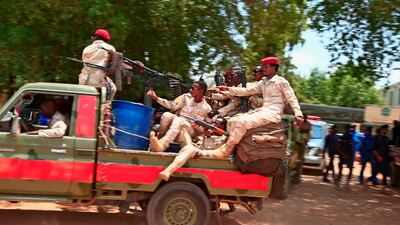
Sudanese security forces deploy outside the Khartoum courthouse during a trial session of Sudan's ousted president Omar Al Bashir along with others, in the Sudanese capital on August 25, 2020. AFP

Omar Al Bashir inches closer to facing justice


  • English
  • Arabic

“I reiterate that the government is fully prepared to co-operate with the ICC to facilitate access to those accused of war crimes and crimes against humanity.” So declared Sudanese Prime Minister Abdalla Hamdok on August 22, 2020.

Some surely are asking: haven’t we have heard this type of talk from Sudanese officials before? Yes, we have. What we have not seen are any trials of any perpetrators involved in atrocities in Darfur – or the rest of Sudan. Will this latest round of rhetorical commitment to justice translate into actual accountability?

Sudan's former vice president Ali Osman Taha is pictured behind the bars during the trial of ousted president Omar Al Bashir, along with others at a courthouse in the Sudanese capital Khartoum, on August 25, 2020. AFP

Not long after former Sudanese President Omar Al Bashir’s unceremonious fall from power in April 2019, officials in the country stated their interest in Al Bashir “appearing” before the ICC. The announcement was met with a feverish reaction. A decade after the ICC issued warrants for his arrest, would Al Bashir finally find himself before judges in The Hague?

The answer, we now know, was no. In fact, Sudan’s new rulers hadn’t said the country’s former head of state would be sent to the ICC. Rather, they appeared interested in having the ICC put Al Bashir – and others wanted for atrocities in Darfur – on trial in Sudan itself.

This is also how Mr Hamdok’s remarks should be understood. He did not say that Sudan was prepared to ship off defendants to the ICC, but that Sudan is now ready to co-operate with the court to facilitate “access” to those accused. Some, like Al Bashir and former ministers Ahmad Harun and Abdel Rahim Mohammed Hussein, who are also implicated in the commission of atrocities in Darfur, are currently under arrest in Sudan.

So, what does Mr Hamdok’s commitment to cooperate with the ICC mean? Is it an empty gesture?

The short answer is no. This is the first time that someone as senior as the Prime Minister has spoken out in favour of co-operating with the ICC. His comments also come in the wake of protests in which the subject of ICC justice has gained some traction, as well as the recent revision of laws that precluded Sudanese authorities from co-operating with the ICC.

As one human rights advocate recently observed, the reforms are “a welcome signal that Sudan’s leaders take seriously their public promises to co-operate with the court on outstanding arrest warrants”. The regular and repeated declarations of support for the ICC from within the Sudanese government also make it harder to backtrack on their pledge to ensure those targeted by the court for atrocities in Darfur will be prosecuted.

What justice for events in Darfur might look like remains murky. The same options on the table exist now as they did when the government first suggested it would work with the ICC. The court's Prosecutor, Fatou Bensouda, recently stated that she is not aware of the government's plans. She has spoken of difficulties in her interactions with interlocutors in Sudan due to the Covid-19 pandemic and the inability of her staff to visit Sudan.

Family members of the accused rally outside the Khartoum courthouse during a trial session of Sudan's ousted president Omar Al Bashir along with others, in the Sudanese capital on August 25, 2020. AFP
What justice for events in Darfur might look like remains murky

So far, authorities have not tipped their hand as to whether they would surrender Al Bashir, Harun or Hussein to The Hague if the court is unwilling or unable to hold proceedings on Sudanese territory. Nor have they indicated any interest in investigating and prosecuting those responsible for international crimes in Darfur themselves; Al Bashir has been tried in Sudan, but only for corruption and related crimes.

To be sure, after decades of Al Bashir’s rule and Sudan’s designation as a pariah state, Khartoum wants the benefits that international rehabilitation can bring. Co-operating with the ICC would appear to be part an effort to look like a member of the international community in good standing. But the desire to “come in from the cold” may also be a reason why Sudan has chosen a one-foot-in-one-foot-out approach to the ICC: committing to co-operation, but not spelling out what that would look like.

Governing authorities may want to leverage their co-operation for other benefits – including on financial, diplomatic, and trade matters – from states that would like to see Al Bashir prosecuted by the court. Sceptics might also suggest that while Sudan’s rulers are interested in co-operating with the ICC, they will only do so if their leadership is protected from investigation and prosecution by the court.

Despite the tectonic political changes in Khartoum and ongoing negotiations with rebel forces, which included an agreement to “hand over” Al Bashir to the ICC, mass violence in Darfur continues, with civilians facing the brunt.

Parallel to demands for ICC justice, Sudanese protestors have also demanded justice for the deaths of at least 120 demonstrators during the popular uprising that ousted Al Bashir from power. Authorities have promised accountability for the killings as well as alleged sexual assaults and rapes committed by security forces. But some of those same authorities are themselves implicated in atrocities. Awad Ibn Auf, one of Sudan’s coup leaders, for example, has been sanctioned by the United States and “helped to stand up the infamous proxy militia force known as the Janjaweed, who brutalised the Darfuri population”.

Ultimately, what the ICC needs most is co-operation from Sudanese authorities. It remains unclear whether ICC prosecutors are ready for Al Bashir to show up in The Hague. It has been an open secret for many years that prosecutors were not prepared for him to be handed over to be tried for genocide, a notorious difficult crime to prove in court. Of course, that was before he was overthrown and before ICC investigators had access to evidence in Darfur and the rest of Sudan.

Now, with Sudan’s co-operation and access to potential defendants, ICC investigators and prosecutors could encourage some of those languishing in jail to testify against Al Bashir or plead guilty while supplying the court with invaluable evidence and testimony. That would prove a coup of its own for prosecutors.

It might thus be wrong to suggest that Khartoum is dithering on justice only out of a sense of self-interest. Al Bashir’s prosecution would be the ICC’s biggest, most difficult and most dramatic to date – by far. The court’s prosecutors might be quite happy, then, for the wheels of justice to grind slowly but surely. It gives them ample opportunity to prepare for Al Bashir’s trial – wherever it may take place.

Mark Kersten is an expert in international law and a consultant at the Wayamo Foundation

Our family matters legal consultant


Name: Hassan Mohsen Elhais

Position: legal consultant with Al Rowaad Advocates and Legal Consultants.

STAGE%201%20RESULTS
%3Cp%3E1)%20Tim%20Merlier%20(Soudal-Quick-Step)%2C%203h%2017%E2%80%99%2035%E2%80%9D%3Cbr%3E2)%20Caleb%20Ewan%20(Lotto%20Dstny)%20same%20time%3Cbr%3E3)%20Mark%20Cavendish%20(Astana%20Qazaqstan%20Team)%20same%20time%3Cbr%3E%3Cstrong%3EGeneral%20Classification%3A%3C%2Fstrong%3E%3Cbr%3E1)%20Tim%20Merlier%20(Soudal%20Quick-Step)%203%3A17%3A25%3Cbr%3E2%20-%20Caleb%20Ewan%20(Lotto%20Dstny)%20%2B4%22%3Cbr%3E3%20-%20Luke%20Plapp%20(Ineos%20Grenadiers)%20%2B5%22%3C%2Fp%3E%0A
INFO
Company%20profile
%3Cp%3E%3Cstrong%3ECompany%20name%3A%20%3C%2Fstrong%3EHakbah%0D%3Cbr%3E%3Cstrong%3EStarted%3A%20%3C%2Fstrong%3E2018%0D%3Cbr%3E%3Cstrong%3EFounder%3A%20%3C%2Fstrong%3ENaif%20AbuSaida%0D%3Cbr%3E%3Cstrong%3EBased%3A%20%3C%2Fstrong%3ESaudi%20Arabia%0D%3Cbr%3E%3Cstrong%3ESector%3A%20%3C%2Fstrong%3EFinTech%0D%3Cbr%3E%3Cstrong%3ECurrent%20number%20of%20staff%3A%20%3C%2Fstrong%3E22%20%0D%3Cbr%3E%3Cstrong%3EInitial%20investment%3A%20%3C%2Fstrong%3E%24200%2C000%0D%3Cbr%3E%3Cstrong%3EInvestment%20stage%3A%20%3C%2Fstrong%3Epre-Series%20A%0D%3Cbr%3E%3Cstrong%3EInvestors%3A%20%3C%2Fstrong%3EGlobal%20Ventures%20and%20Aditum%20Investment%20Management%0D%3Cbr%3E%3Cbr%3E%3C%2Fp%3E%0A
Labour dispute

The insured employee may still file an ILOE claim even if a labour dispute is ongoing post termination, but the insurer may suspend or reject payment, until the courts resolve the dispute, especially if the reason for termination is contested. The outcome of the labour court proceedings can directly affect eligibility.


- Abdullah Ishnaneh, Partner, BSA Law 

Signs%20of%20%20%20%20%20%20%20heat%20stroke
%3Cul%3E%0A%3Cli%3EThe%20loss%20of%20sodium%20chloride%20in%20our%20sweat%20can%20lead%20to%20confusion%20and%20an%20altered%20mental%20status%20and%20slurred%20speech%3C%2Fli%3E%0A%3Cli%3EBody%20temperature%20above%2039%C2%B0C%3C%2Fli%3E%0A%3Cli%3EHot%2C%20dry%20and%20red%20or%20damp%20skin%20can%20indicate%20heatstroke%3C%2Fli%3E%0A%3Cli%3EA%20faster%20pulse%20than%20usual%3C%2Fli%3E%0A%3Cli%3EDizziness%2C%20nausea%20and%20headaches%20are%20also%20signs%20of%20overheating%3C%2Fli%3E%0A%3Cli%3EIn%20extreme%20cases%2C%20victims%20can%20lose%20consciousness%20and%20require%20immediate%20medical%20attention%3C%2Fli%3E%0A%3C%2Ful%3E%0A
Dubai works towards better air quality by 2021

Dubai is on a mission to record good air quality for 90 per cent of the year – up from 86 per cent annually today – by 2021.

The municipality plans to have seven mobile air-monitoring stations by 2020 to capture more accurate data in hourly and daily trends of pollution.

These will be on the Palm Jumeirah, Al Qusais, Muhaisnah, Rashidiyah, Al Wasl, Al Quoz and Dubai Investment Park.

“It will allow real-time responding for emergency cases,” said Khaldoon Al Daraji, first environment safety officer at the municipality.

“We’re in a good position except for the cases that are out of our hands, such as sandstorms.

“Sandstorms are our main concern because the UAE is just a receiver.

“The hotspots are Iran, Saudi Arabia and southern Iraq, but we’re working hard with the region to reduce the cycle of sandstorm generation.”

Mr Al Daraji said monitoring as it stood covered 47 per cent of Dubai.

There are 12 fixed stations in the emirate, but Dubai also receives information from monitors belonging to other entities.

“There are 25 stations in total,” Mr Al Daraji said.

“We added new technology and equipment used for the first time for the detection of heavy metals.

“A hundred parameters can be detected but we want to expand it to make sure that the data captured can allow a baseline study in some areas to ensure they are well positioned.”

RESULTS

2.15pm Maiden (PA) Dh40,000 (Dirt) 1,200m

Winner Shawall, Abdul Aziz Al Balushi (jockey), Majed Al Jahouri (trainer)

2.45pm Handicap (PA) Dh40,000 (D) 1,200m

Winner Anna Bella Aa, Fabrice Veron, Abdelkhir Adam

3.15pm Handicap (PA) Dh40,000 (D) 1,200m

Winner AF Thayer, Tadhg O’Shea, Ernst Oertel

3.45pm Handicap (PA) Dh40,000 (D) 1,700m

Winner Taajer, Fabrice Veron, Eric Lemartinel

4.15pm The Ruler of Sharjah Cup – Prestige (PA) Dh250,000 (D) 1,700m

Winner Jawaal, Jim Crowley, Majed Al Jahouri

4.45pm Handicap (TB) Dh40,000 (D) 2,000m

Winner Maqaadeer, Jim Crowley, Doug Watson

ENGLAND%20SQUAD
%3Cp%3EFor%20Euro%202024%20qualifers%20away%20to%20Malta%20on%20June%2016%20and%20at%20home%20to%20North%20Macedonia%20on%20June%2019%3A%3C%2Fp%3E%0A%3Cp%3E%3Cstrong%3EGoalkeepers%3C%2Fstrong%3E%20Johnstone%2C%20Pickford%2C%20Ramsdale.%0D%3Cbr%3E%0D%3Cbr%3E%3Cstrong%3EDefenders%3C%2Fstrong%3E%20Alexander-Arnold%2C%20Dunk%2C%20Guehi%2C%20Maguire%2C%20%20Mings%2C%20Shaw%2C%20Stones%2C%20Trippier%2C%20Walker.%0D%3Cbr%3E%0D%3Cbr%3E%3Cstrong%3EMidfielders%3C%2Fstrong%3E%20Bellingham%2C%20Eze%2C%20Gallagher%2C%20Henderson%2C%20%20Maddison%2C%20Phillips%2C%20Rice.%0D%3Cbr%3E%0D%3Cbr%3E%3Cstrong%3EForwards%20%3C%2Fstrong%3EFoden%2C%20Grealish%2C%20Kane%2C%20Rashford%2C%20Saka%2C%20Wilson.%3C%2Fp%3E%0A
BMW M5 specs

Engine: 4.4-litre twin-turbo V-8 petrol enging with additional electric motor

Power: 727hp

Torque: 1,000Nm

Transmission: 8-speed auto

Fuel consumption: 10.6L/100km

On sale: Now

Price: From Dh650,000

The President's Cake

Director: Hasan Hadi

Starring: Baneen Ahmad Nayyef, Waheed Thabet Khreibat, Sajad Mohamad Qasem 

Rating: 4/5

SPECS

Engine: Two-litre four-cylinder turbo
Power: 235hp
Torque: 350Nm
Transmission: Nine-speed automatic
Price: From Dh167,500 ($45,000)
On sale: Now

Specs

Engine: 51.5kW electric motor

Range: 400km

Power: 134bhp

Torque: 175Nm

Price: From Dh98,800

Available: Now

It Was Just an Accident

Director: Jafar Panahi

Stars: Vahid Mobasseri, Mariam Afshari, Ebrahim Azizi, Hadis Pakbaten, Majid Panahi, Mohamad Ali Elyasmehr

Rating: 4/5

Milestones on the road to union

1970

October 26: Bahrain withdraws from a proposal to create a federation of nine with the seven Trucial States and Qatar. 

December: Ahmed Al Suwaidi visits New York to discuss potential UN membership.

1971

March 1:  Alex Douglas Hume, Conservative foreign secretary confirms that Britain will leave the Gulf and “strongly supports” the creation of a Union of Arab Emirates.

July 12: Historic meeting at which Sheikh Zayed and Sheikh Rashid make a binding agreement to create what will become the UAE.

July 18: It is announced that the UAE will be formed from six emirates, with a proposed constitution signed. RAK is not yet part of the agreement.

August 6:  The fifth anniversary of Sheikh Zayed becoming Ruler of Abu Dhabi, with official celebrations deferred until later in the year.

August 15: Bahrain becomes independent.

September 3: Qatar becomes independent.

November 23-25: Meeting with Sheikh Zayed and Sheikh Rashid and senior British officials to fix December 2 as date of creation of the UAE.

November 29:  At 5.30pm Iranian forces seize the Greater and Lesser Tunbs by force.

November 30: Despite  a power sharing agreement, Tehran takes full control of Abu Musa. 

November 31: UK officials visit all six participating Emirates to formally end the Trucial States treaties

December 2: 11am, Dubai. New Supreme Council formally elects Sheikh Zayed as President. Treaty of Friendship signed with the UK. 11.30am. Flag raising ceremony at Union House and Al Manhal Palace in Abu Dhabi witnessed by Sheikh Khalifa, then Crown Prince of Abu Dhabi.

December 6: Arab League formally admits the UAE. The first British Ambassador presents his credentials to Sheikh Zayed.

December 9: UAE joins the United Nations.
