
Benjamin Netanyahu’s long spell as Israel’s prime minister may be about to end in a matter of days. He is not prepared to go gently, without a pitched fight over the vote of every member of the new coalition assembled to replace him. And even if he loses the vote, and is forced to leave office, at the age of 71, he has no intention of retiring. He will remain leader of Likud and leader of the opposition. He will be waiting for any slip-up of the new government, ready to exploit the first sign of discord in its ranks and fight his way back.
But there is a very real chance that this is the end of an era in Israel. Not just the end of the premiership of an exceptional politician, who stamped his presence on Israeli society for so long, but also the end of a generational shift in the diplomatic paradigm of the Israeli-Palestinian conflict and Middle East politics. Mr Netanyahu challenged the prevailing diplomatic orthodoxies and the way we all thought about the regional power balance. And whether we like it or not, he was before his time.
Mr Netanyahu began his public career in 1982 as a young Israeli diplomat, stationed first in the embassy in Washington and then as ambassador to the UN. The 1980s was when the world stopped using the term “Arab-Israeli conflict” – after all, Egypt, the largest of the Arab nations and Israel’s most powerful neighbour, had made peace with Israel and the last major war between Israel and Arab states had been fought in 1973. Instead, the new term that was coming in to vogue was “Israeli-Palestinian conflict”.
Until the 1980s, few, certainly in the West, had seen the Palestinians as the main challenge to Israel’s presence in the region. To the Israeli state, their resistance movements were at most a nuisance – small terror organisations, but not an existential threat to Israeli security.
But as the Arab states slowly began to accept Israel’s existence, in private at least, and Israel went to war in Lebanon, not strictly against the Lebanese state but against the Palestinian organisations which had taken over large territories of Lebanon and were using it as a launching pad for attacks on Israel, it became clear that Israel’s war was now with the Arab nation that had lived within the land that it had occupied since 1948, not those around it. This perception only increased in 1987 when the First Intifada broke out.
And it is this perception that had taken root, among Israelis almost as much as among Arabs and in the West, that Mr Netanyahu has fought, since his days as a diplomat, and then as a politician. That has been his mission for the past 39 years in public life, since his arrival in Washington as the deputy ambassador. A surprising choice for the job by the new ambassador Moshe Arens, a friend of his father Professor Benzion Netanyahu, who liberated him from a frustrating job as a furniture sales executive, correctly sensing he had the skills to argue Israel’s case to the world.

Mr Netanyahu in his speeches, interviews, his book “A Place Among the Nations” – published in 1993 and faithfully representing his beliefs to this day – and, ultimately, his policies, has stuck relentlessly to two messages. First, that the Palestinians are not a real threat to Israel. In fact, they are barely a nation in his eyes. They certainly don’t have, he believes, a real claim to sovereignty over the land lying between the Jordan and the Mediterranean that is historically the homeland of the Jewish people. The real threat to the Jewish state, and to the West, according to Mr Netanyahu, comes from much more powerful regional and global players. Back in the 1980s, he focused mainly on the Soviet Union and the regimes it supported in the Middle East, like Syria and Iraq. After the collapse of the USSR, Saddam Hussein’s Iraq still remained, and when Iraq was invaded by the US in 2003, he still had Iran. And has ever since.
It was these forces, insisted Mr Netanyahu, who were not only an existential threat to Israel, but were funding and using the Palestinian organisations as a tool against Israel. The Palestinians, he said, were not a real issue, just a “wedge issue” exploited by Israel’s real enemies.
Therefore, went his second message, it was foolish to consider any form of concession from Israel to the Palestinians, since they were not the real problem anyway and any territory Israel might cede them would merely be used to launch further attacks as proxies for the real enemy. Israel must stand firm against the international pressure, and he promised Israelis that, eventually, the West would realise that Israel was its bulwark against the extremist threat promoted by Iran and that more Arab nations would acknowledge that peace with Israel was in their interest and stop using the Palestinians as “an excuse”.
For many years, it looked like Mr Netanyahu was fighting a losing battle. In 1988, the US recognised the Palestinian Liberation Organisation and in 1993 Yitzhak Rabin’s government entered a diplomatic process with the Palestinians, allowing them establish an autonomous authority in the West Bank and Gaza. Mr Netanyahu, who had just been elected Likud’s new leader, was being seen as yesterday’s man, while the future was a “new Middle East”, in which the Palestinians were to open the door for Israel to the Arab world.
But the Oslo process floundered – Israeli and Palestinian leaders failed to reach an agreement on the next stage, which everyone assumed would be the two-state solution. A second intifada broke out, positions hardened and gradually the world, and the region, discovered that it had other problems which weren’t connected to the Israeli-Palestinian conflict. 9/11, the invasion of Iraq, increasing tension with Iran, the uprisings in much of the Arab world, the implosions of Syria and Yemen and Lebanon continuously on the brink.
Suddenly, it seemed within Israel that Mr Netanyahu had been right all along. Israel could continue with the occupation and with the lack of a viable diplomatic process, and the world would gradually focus on other more pressing matters. In between occasional flare-ups in Gaza, even the media, which had once paid so much attention to the conflict, found that it had other stories to report.
Even before Donald Trump won the US presidency in 2016, abandoning all previous pretences that Washington was an honest broker between Palestinians and Israelis, it seemed that the West had given up. Barack Obama had spoken early in his first term of a Palestinian state being just around the corner, but by his second term had given up on trying to get the sides together and focused on his nuclear agreement instead. Iran was indeed on everyone’s mind, bringing Israel and a number of Arab states closer together in matters of regional security.

Mr Netanyahu has billed last year’s Abraham Accords as the ultimate vindication of his message. His opponents in Israel had warned that if the occupation wasn’t ended, the country would face a “diplomatic tsunami” of boycotts and sanctions. Although the agreements secured an end to his plan to annex more Palestinian land, the occupation continues. And Israel’s economy has grown, and its ties with countries around the world have flourished. All this without moving an inch towards the Palestinians.
For now, this is Benjamin Netanyahu’s legacy – a complete reversal of the paradigm of the Israel-Palestine conflict. But it may turn out to be a very hollow legacy. Last month’s events in east Jerusalem, Gaza and on the streets of “mixed” towns in Israel, prove that the Palestinians are not prepared to remain silent forever. The occupation of the West Bank and the blockade of Gaza may not turn out to be as “sustainable” as Mr Netanyahu has promised.
In the last 12 years under Mr Netanyahu, Israel enjoyed uninterrupted economic growth, booming exports and the calmest decade in its history. But while the Palestinians in this period have not launched another Intifada, they haven’t accepted their situation either. One day, they will almost certainly rise up again and the world’s attention will return to the conflict.
Mr Netanyahu will no longer be Israel’s prime minister by then but his legacy will still be with us – will it have been to have bought time and support for Israel before the next Palestinian uprising? Or will that evaporate as international and regional pressure return and we will realise that he has squandered the best opportunity Israel ever had to make serious progress towards solving the conflict from a position of strength?
Anshel Pfeffer is a writer for Haaretz and the Israel correspondent for The Economist. He is the author of Bibi: The Turbulent Life and Times of Benjamin Netanyahu
-

Palestinians smoke a shisha pipe at the site of an Israeli air strike in the Gaza Strip. A ceasefire was announced on Friday. Reuters -
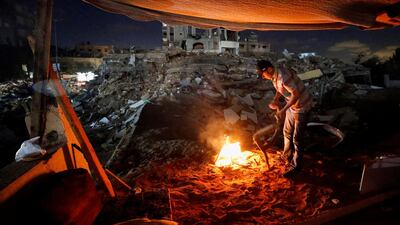
A Palestinian man lights a fire amid the rubble of his house in the Gaza Strip, which was destroyed by an Israeli air attack. Reuters -
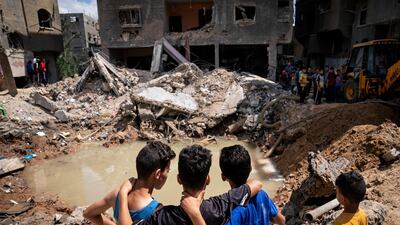
Children survey a water-filled crater where a home was destroyed by an Israeli air strike in the northern Gaza Strip. AP Photo -
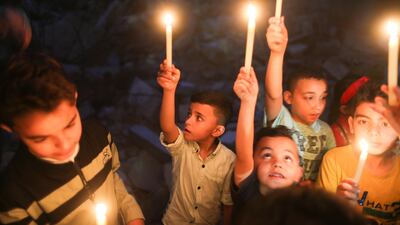
Children hold candles at the site of a house that was destroyed by Israeli air strikes during the recent Israeli-Palestinian fighting, in Gaza. Reuters -

A Palestinian man unloads boxes of aid from an Egyptian lorry at the Rafah border crossing, which connects the Gaza Strip to Egypt. AFP -
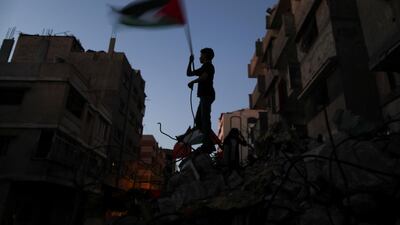
A boy waves a Palestinian flag at a site damaged by Israeli air strikes in Gaza. Reuters -
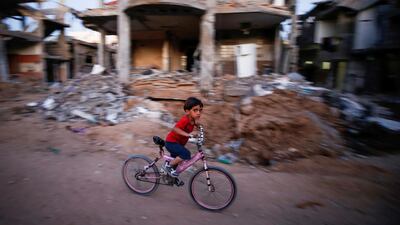
A bicycle ride near the rubble of a house in Gaza that was destroyed during the Israeli-Palestinian conflict. Reuters -
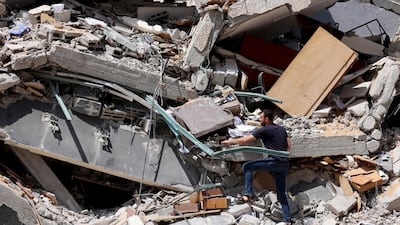
A Palestinian man sifts through the debris of the Al Jalaa tower, which housed media organisations and was destroyed by Israeli air strikes in Gaza city. AFP -
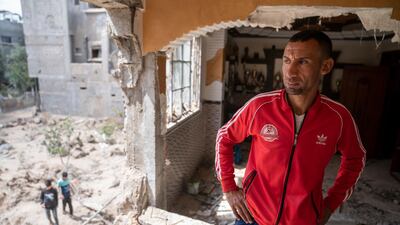
Nader Al Masri, a Palestinian long-distance runner who competed in the 2008 Olympics. His home in the northern Gaza Strip was severely damaged in an Israeli air strike. AP Photo -
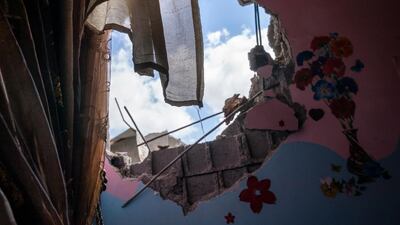
An Israeli air strike blew this hole in the wall of a child's room in Beit Hanoun, the northern Gaza Strip. AP Photo



