
The Great Depression, the worst economic downturn in the history of the industrialised world, was a time of great pain in the US.
At one point, in 1932, national unemployment rose to 25 per cent. Poverty-stricken people sold apples on the streets of Manhattan and San Francisco to make a few pennies. Mobs looted supermarkets; migrant workers moved from farms to cities, desperately seeking food and shelter. In the midst of such misery, the Klu Klux Klan had an evil resurgence and grown men fought like animals for scraps of leftover food in garbage pails. In Oklahoma, where drought ravaged the Southern Plains, ranchers threatened a revolution. The stock market lost almost 90 per cent of its value between 1929 and 1933. It was a time that threatened to bring America to its knees.
2020, dominated by Covid-19, did not reach those epic levels of misery, but it has taken a chunk out of America’s soul.
To compound this tragedy, climate change-related icy storms over the past weeks have made the lives of many miserable. There are power outages and rolling blackouts of electricity. Recent winter snow has left many in Texas – which rarely gets such weather – without power. People were having to crowd into churches, now known as “warming centres”. Where I live on the Bowery, a street in New York City, there are more homeless than I have ever seen, despite the bitter cold and grey mushy snow. People sleep in the subways.
Midtown Manhattan is ghostly and empty. Many businesses are shuttered and dark; the once-glorious skyscraper offices empty. It’s hard not to compare the past year to the Great Depression.
We are now in mid-winter, with many weeks to go until our metaphorical spring and resurgence.
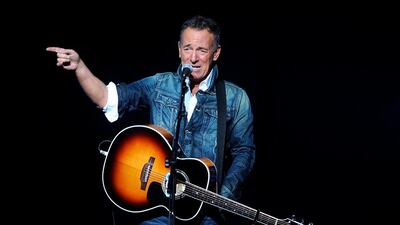
This is why Bruce Springsteen’s poignant advert for Jeep, “The Middle”, shown during the Super Bowl, matters so much. In it, Springsteen – who wrote, directed and executed the video – drives through the most central point of “the lower 48 of America” in Lebanon, Kansas. The images are stark and haunting: flat, snowy fields, abandoned factory towers and a small chapel “that never closes. All are welcome”.

Springsteen is now 71 and an icon in America, a troubadour who speaks for the abandoned veterans and working class. He always shunned appearing in ads, but as the unofficial chronicler of the blue collar worker, he must have felt the time was right to talk about re-unifying America.
In order to recover from all we have witnessed, he says we must abandon our red and blue politics, our anger and our trauma. In a deeply divided country, we must move forward, taking our cue from the symbolic Middle America.
It’s interesting he chose the most central point of the Midwest of America, usually associated with conservative politics and family values. As a graduate student in Iowa, I remember arriving to that great expanse of land, pickup trucks and unshakable faith in Republican politics with a kind of stunned horror. It is vastly different to the East Coast where I was raised.
The Middle comprises the deep red states. Kansas, for instance, has given its electoral college votes to the Democrats only once – in 1964 – since 1940.
“The Middle has been a hard place to get to lately," Springsteen says quietly, lighting a candle in the chapel and eventually driving off.
His message is that freedom belongs to us all. It’s about climbing through darkness to hope.
While it sounds corny, with his masterful storytelling, the two-minute video is poetic, even if it is an advertisement for Jeep. “Fear has never been the best of who we are,” he says quietly. “And as for freedom, it is not the property of the fortunate few…it belongs to us all”.
I think it’s a message we need to hear. My mother grew up during the Great Depression. Her father lost his business and her entire family moved in with my great-grandmother. She says they were never hungry, but she remembers, even as a tiny girl, the fear that gripped the household.
She also remembers it ending. Her father went to work for the WPA (Works Progress Administration), a part of the New Deal. This was former US president Franklin Delano Roosevelt’s programme that began to heal America through a series of projects and reforms that gradually brought the country out of its misery. Although it did not end the Great Depression, it restored public confidence and brought relief to millions of Americans. “The only thing we have to fear is fear itself,” was FDR’s inaugural message.

We are on hold right now, waiting for vaccines, waiting for President Biden’s first 100 days in office to erase the pain of the Trump years, waiting for schools to open and waiting to go back to work. Springsteen’s video, seen by 37 million viewers, means just that.
Not everyone liked it. One tweet sent to Steve Van Zant (a member of Springsteen’s E Street Band) said: "You think we can just move on now if we’re just nice to one another? I don’t. It’s whistling past the graveyard. And it was cynical on Jeep’s part and naive on Springsteen’s part."
All of this came as news broke that Springsteen was arrested last November for driving under the influence of alcohol in Sandy Hook, a national recreation area in New Jersey near his home.
According to police, Springsteen acted with his usual decorum, but Jeep took the advert off their YouTube page. It was later revealed that Springsteen reportedly blew a .02 on the breathalyser test, which is one-quarter of his home state's .08 legal limit for drink-driving. As I expected, the minor offence didn’t tarnish Springsteen’s reputation.
To me, the video was about getting to our core. Springsteen and Jeep aren’t telling us all to agree on everything, and yes, it is an advert that wants you to buy cars and albums. But it’s also telling us to put the greater good ahead of our pain and move forward. The US is a broken country and it is hurting. But it needs to find its way to the Middle.
Janine di Giovanni is a Senior Fellow at Yale’s Jackson Institute. Her next book, The Vanishing, about Christians in the Middle East, is out in the autumn of 2021.

