
As Lebanon nears a breaking point due to its acute financial crisis, the Trump administration faces a policy dilemma: should it financially support a corrupt ruling faction that is allied with Hezbollah – Iran’s friend and Washington’s nemesis – or should it hold off on aid and watch the country fall apart?
Both options are problematic but there is a better alternative.
The US can prevent Lebanon’s collapse while keeping the pressure on Hezbollah and its allies to implement serious reforms. It can do this by co-ordinating with Gulf and European governments on modest, conditional and targeted economic assistance from which the more vulnerable members of Lebanese society would primarily benefit. Such aid, which would be deposited in an international fund, would provide food and medicine but also launch various small and medium-sized businesses that would be overseen strictly by local non-governmental organisations under the watchful eye of international bodies.
These immediately impactful local community development projects will not fix the economy, which suffers from a combination of structural maladies, but they will help those Lebanese who are most in need.
-
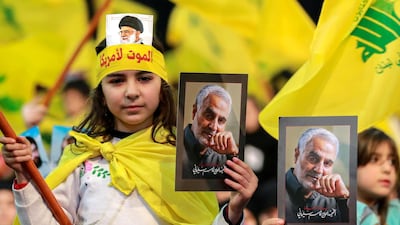
Supporters of Hezbollah hold photos of slain Iranian general Qassem Suleimani as they listen to a televised speech by Hezbollah leader Hassan Nasrallah in a southern suburb of the Lebanese capital Beirut. EPA -
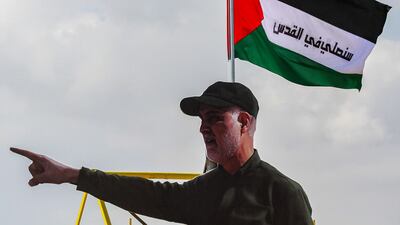
A giant cutout of Qassem Suleimani set up in the Garden of Iran park built by the Iranian government in the southern Lebanese village of Maroun Al Ras near the border with Israel. AFP -
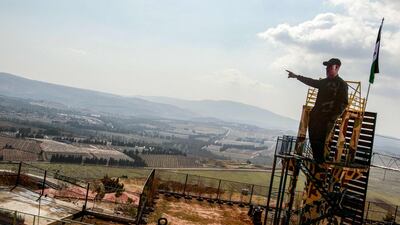
A view of a giant cutout depicting Iran's late top general Qasem Soleimani, who was killed in a US drone strike near Baghdad airport on January 3, 2020. AFP -
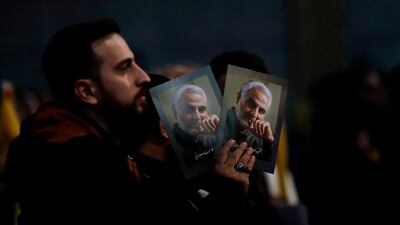
A Hezbollah supporter holds pictures of Qassem Suleimani during a ceremony marking the the end of a 40-day Muslim mourning period for the Iranian general and the anniversary of the assassination of Hezbollah leaders Abbas Al Moussawi, Ragheb Harb and Imad Mughniyeh. AP Photo -

Hezbollah supporters hold pictures of Qassem Suleimani in the southern suburb of Beirut. AP Photo -
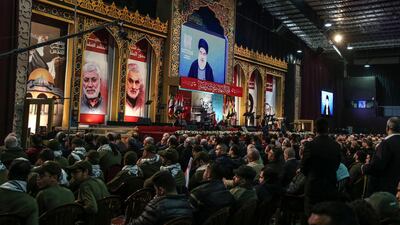
Hezbollah leader Hassan Nasrallah addresses supporters via a video link. EPA -
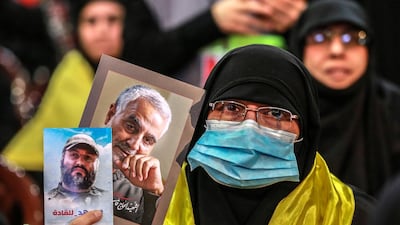
A Hezbollah supporter holds a photo of Qassem Suleimani during a rally to mark the group's Martyrs Day. EPA -
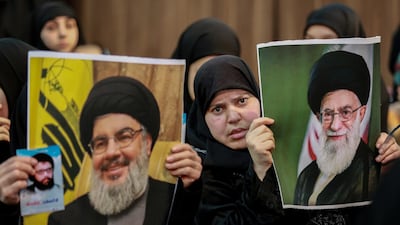
Supporters of Hezbollah hold photos of Hassan Nasrallah and Iran's supreme leader Ali Khamenei in southern Beirut. EPA -
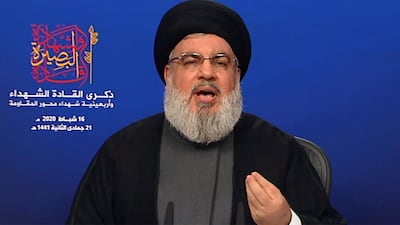
An screen grab from Hezbollah's Al Manar TV shows Hassan Nasrallah delivering a televised address from an undisclosed location in Lebanon. AFP -
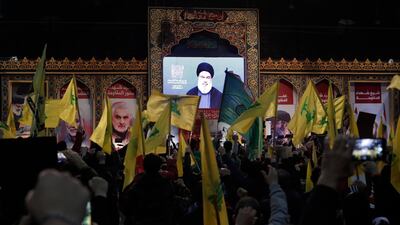
Hezbollah supporters wave the group's flag as they listen to Hassan Nasrallah speak. AP Photo -
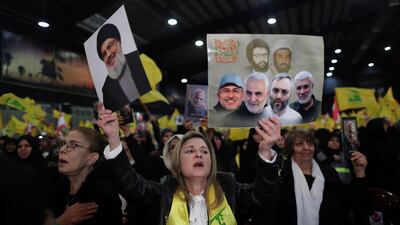
Hezbollah supporters sing the Lebanese and Hezbollah anthems during a ceremony marking the deaths of slain commanders and the Iranian general Qassem Suleimani in the southern suburb of Beirut. AP Photo


While limited, this is the best approach for Washington to take in the short term given that a more comprehensive solution – the Lebanese committing to a wholesale and credible reform programme – is not on the cards any time soon. That is because there are deep societal and political divisions in the country, as well as disagreements over the nature of the crisis and the way forward. Some people desire a new social contract that is not based on sectarianism, while others want to preserve the status quo and stick to reform.
Then there is Hezbollah, the dominant political force in the country that is opposed to meaningful change, thus blocking any road to recovery.
Any reform process that seeks to stem corruption and promote good governance would weaken Hezbollah’s cross-sectarian patronage system – and thus its grip over politics. It would also limit its access to arms and illegal sources of revenue reaching them through the Lebanese-Syrian borders, the national airport and its seaports. That is why, even though it has no problem with the International Monetary Fund providing technical advice to the Lebanese government, it has zero interest in any assistance package that would impose transparency and accountability measures.
As long as Hezbollah has the ability to veto any international reform package that it does not like, Lebanon as a whole is stuck in an economic rut and rapidly losing its balance.

To protect its interests in Lebanon and the region, Washington should therefore recognise these realities and try to work around them. While it might be eminently reasonable and understandable for the US to tie economic assistance – either directly or through the IMF – to Beirut's implementation of structural reforms, it will not stave off state collapse.
Lebanon’s descent into chaos, which is only a matter of time in the absence of international assistance, is no laughing matter. It will also hurt US interests.
Let us start with Hezbollah. If the group presents problems for the US now, imagine how much worse those would be if Lebanon becomes a failed state. History offers useful lessons.
Hezbollah came into being in 1982 in the throes of a vicious civil war and an Israeli occupation. With every existential challenge that it has faced since, including its destructive confrontation with Israel in 2006 and the ongoing Syrian civil war that broke out in 2011, it has only grown stronger. Hezbollah stands to gain the most from anarchy in Lebanon because no local actor would be able to challenge its military supremacy and political dominance.
-
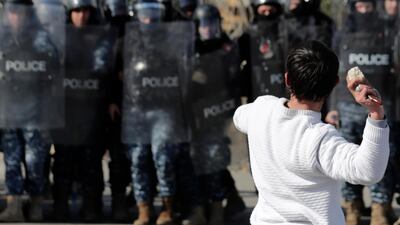
An anti-government protester holds a knife as throws stones at riot police during a scuffle near the parliament building in downtown Beirut. AP Photo -
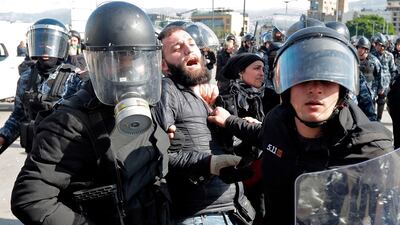
Lebanese security forces detain an anti-government protester during clashes in a demonstration in the centre of the capital Beirut. AFP -

Lebanese riot police arrest an anti-government protester trying to prevent Parliament members from reaching the Parliament to attend the 2020 budget discussion session, in downtown Beirut. EPA -

Anti-government protesters shout slogans as they try to prevent Parliament members from reaching the Parliament building to debate the 2020 budget in downtown Beirut. EPA -
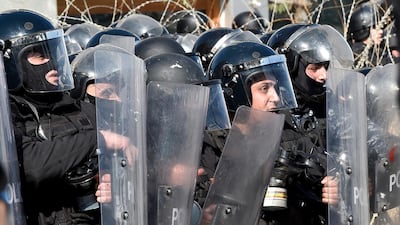
Anti-riot policemen react as protesters throw stones during a demonstration against parliament session on 2020 budget in downtown Beirut. EPA -

An anti-government protester carries away an unconscious woman during a demonstration in the centre of the Lebanese capital Beirut. AFP -
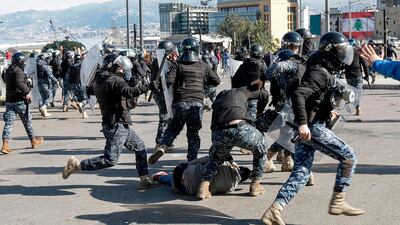
Lebanese riot police beat a fallen anti-government protester during clashes in a demonstration in the centre of the Lebanese capital Beirut. AFP -

Anti-government protesters remove barbed wires at the entrance leading to the Lebanese Parliament building to protest Parliament meeting in downtown Beirut. EPA -
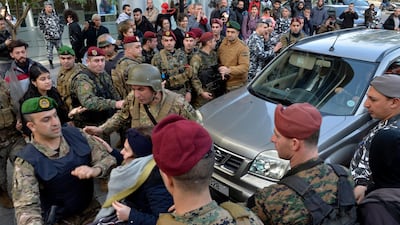
Lebanese army soldiers clash with anti-government protesters as they attempt to block a road leading to the parliament building to protest parliament meeting in downtown Beirut. EPA -

A Lebanese anti-government protester grabs the shield of a Lebanese army soldier as she blocks a road leading to the parliament in the capital Beirut's downtown district. AFP -

Lebanese army commandos remove anti-government protesters blocking a road leading to the parliament in the capital Beirut's downtown district. AFP -
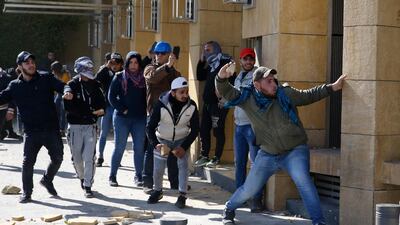
Anti-government protesters throw stones at the riot police during a protest in downtown Beirut. AP Photo -
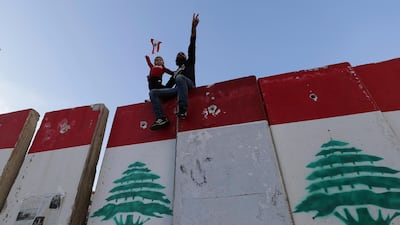
An anti-government protester and his daughter stand on a concrete wall installed by authorities to keep protesters far from the main Lebanese government headquarters and open the road to parliament, in downtown Beirut, Lebanon. AP Photo -

Students, on their way to school, cross a road through the smoke from burning tires which were set on fire by the anti-government protesters to block the southern entrance of a highway during a protest against the newly formed cabinet, in Beirut, Lebanon. AP Photo -
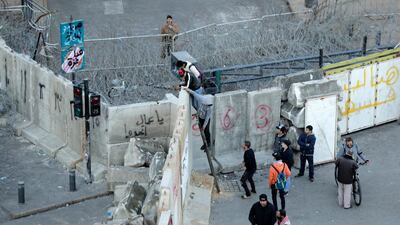
Anti-government protesters climb a concrete wall installed by authorities to keep protesters far from the main Lebanese government headquarters and open road to parliament, in downtown Beirut, Lebanon. AP Photo -
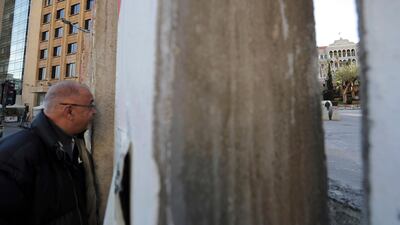
An anti-government protester peers through a gap in a concrete wall installed by authorities to keep protesters far from the main Lebanese government headquarters, far right, and open road to parliament, in downtown Beirut, Lebanon. AP Photo


Should Hezbollah further spread its wings in Lebanon, it is likely to draw the opposition of Sunni extremists from all over the region. That is a recipe for a return of ISIS, which will use the country as a base for operations against US interests and its allies. It has done it in Syria and there is no reason why it would not be able to do it in Lebanon. Facing sectarian conflict, the Lebanese army would either take cover or disintegrate, prompting many in Washington to intensify their calls for terminating US military assistance. This in turn would invite further Russian involvement in Lebanon, with Moscow keen to do business with the Lebanese army through multiple offers of arms and money. In the context of great-power competition, this would amount to a setback for Washington.
Then there is Iran. If Hezbollah’s fortunes in Lebanon and the region improve, so will those of Iran. The Trump administration is doing everything it can to weaken Tehran and force it to come to the negotiating table. But if Iran is allowed to control Lebanon unchallenged, it will gain an important lifeline and thus be able to more effectively counter US policy.
Given their size and depth, none of Lebanon’s problems will be solved any time soon. The country as a whole requires much healing. But the US has every reason to maintain its strategic position in the country and the Eastern Mediterranean as well as helping its people confront their old sectarian demons and make the hard choices.
Bilal Y Saab is senior fellow and director of the Defence and Security Programme at the Middle East Institute

