

One of my earliest memories is my parents pulling their Oldsmobile to the side of the road on a Maryland motorway to listen to a radio special report. It was April 4, 1968. Dr Martin Luther King, the great civil rights leader, had been shot dead in Memphis, Tennessee.
Sometimes I wonder if I dreamt that moment, because I was certainly too tiny to comprehend. What I remember – and perhaps this is the adult looking back at a pivotal, historical moment – were my parent’s tears, their disbelief that anyone could kill such a good man, and my own sense of dread. Dr King was used to death threats. He survived a near fatal stabbing in 1958. His calling, to lead a peaceful revolution towards change, was more urgent. He died for that cause.
Riots tore through the major cities of America in the spring and summer after his death. But change would not come for black people for decades. If we are honest, we will admit it still hasn’t arrived.
Even now, with the sentencing of Derek Chauvin in the murder trial of George Floyd, that triple guilty sentence of murder and manslaughter is not enough. It considers accountability though, which is a start.
But it is extremely rare for police officers to be charged. One theory is that juries and judges are reluctant to second-guess the action of on-duty police officers. Even while I was eagerly waiting for the verdict, I was reading reports of other young people of colour being killed by police.
At least six police killings took place in the 24 hours after the verdict was reached in Chauvin's trial, reported AP.
According to Phillip Matthew Stinson, criminal justice professor at Bowling Green University in Ohio who studies police behaviour, 140 law enforcement officers have been arrested related to on-duty shootings since 2005 in the US. Only a third were convicted of any charges.

Only 5 per cent (seven officers) were convicted during that time frame. Mr Stinson’s database is based on media reports and may not be comprehensive but it shows how difficult it is to get officers convicted.
The Washington Post has also built a disturbing database and it shows that since 2015, on-duty police officers shot and killed more than 5,000 people.
Why are such few police officers convicted of their crimes? In 1989, the US Supreme Court decided that police use of force must be “objectively reasonable”. And that officers often must make extremely hasty decision in dangerous circumstances. Following this decision, some states adapted their own constitutions to reflect it.
"Unlike the vast bulk of criminal cases that result in convictions through guilty pleas, many police officers do not plead guilty and they are successful in trial," Brandon Garrett, a professor at Duke University School of Law told CNN recently.
Waiting for the verdict in my apartment on Manhattan’s East Village – a street that was once “owned” by the Hell’s Angels who notoriously battled against the police – was tense. My neighbourhood, predominantly Latinx, and already battered by Covid-19, seemed on edge. When the guilty verdict was announced, people banged pots and pans, the same way they did last year every night at 8pm for health care workers during America's worst phase of Covid-19. It was a moment, albeit brief, of hope.
For sure, the George Floyd verdict will change America. But it is now up to our political leaders to deliver similar justice by reforming the police. As the US Vice President Kamala Harris said: this is the true way to honour George Floyd.
-
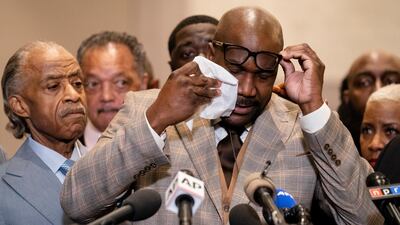
Philonise Floyd, brother of George Floyd, wipes tears from his eyes as he speaks during a news conference after former Minneapolis police Officer Derek Chauvin is convicted in the killing of George Floyd. AP Photo -
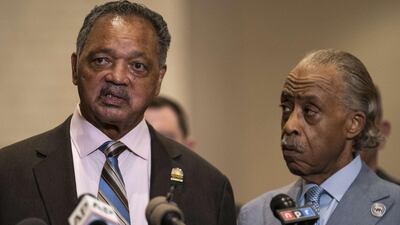
The Rev. Jessie Jackson speaks at a news conference as the Rev. Al Sharpton looks on following the verdict in the Derek Chauvin trial in Minneapolis. AFP -
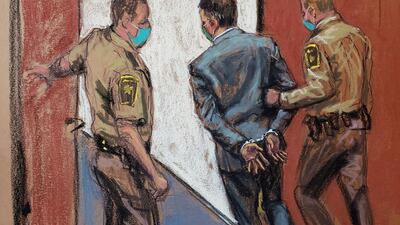
Former Minneapolis police officer Derek Chauvin is led away in handcuffs after a jury found him guilty on all counts in his trial for second-degree murder, third-degree murder and second-degree manslaughter in the death of George Floyd. Reuters -
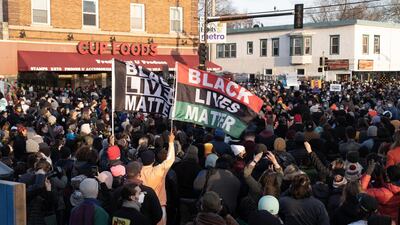
Thousands of people gathered at the site where George Floyd was killed on May 25, 2020, to celebrate Derek Chauvin's guilty verdict. Willy Lowry / The National -
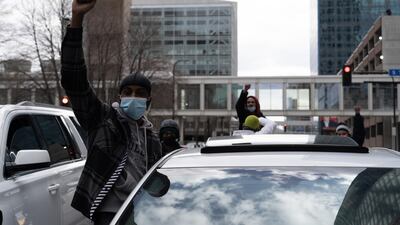
A man pumps his fist from out his car window after former police officer Derek Chauvin was found guilty of 3 counts in the death of George Floyd. Willy Lowry / The National -
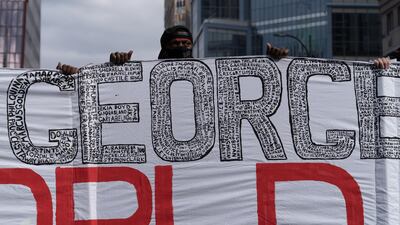
A man holds a George Floyd banner outside the Hennepin County Government Centre where former officer Derek Chauvin was found guilty. Willy Lowry / The National -
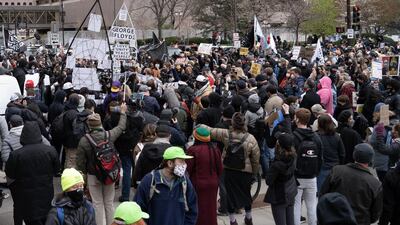
People gather outside the Hennepin County Government Centre. Willy Lowry / The National -

A man holds a portrait of George Floyd outside the Hennepin County Government Centre. Willy Lowry / The National -

A man holds an infant in his lap as he celebrates the verdict in Derek Chauvin's trial. Willy Lowry / The National -
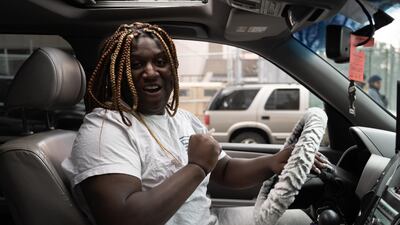
A person celebrates in their car after Derek Chauvin was found guilty of all charges. Willy Lowry / The National -
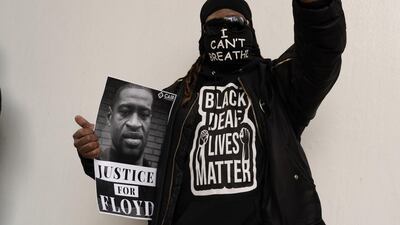
A man holds a portrait of George Floyd outside the Hennepin County Government Centre. Willy Lowry / The National -
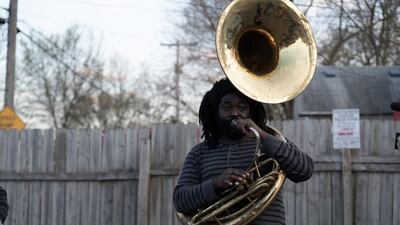
A man plays the sousaphone in George Floyd Square. Willy Lowry / The National -
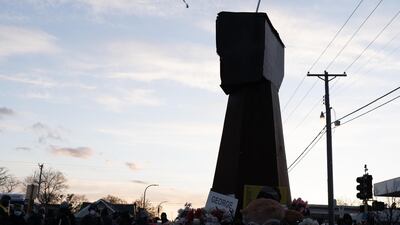
A shrine to black lives lost to police brutality at George Floyd Square. Willy Lowry / The National -

Charles McMillan and Genevieve Hansen, witnesses who testified in the trial, embrace in George Floyd Square after the verdict was read in the Derek Chauvin trial. AFP -
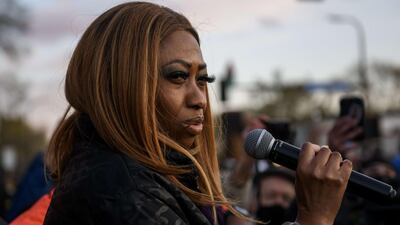
Paris Stevens, cousin of George Floyd, speaks at George Floyd Square after the guilty verdict in the Derek Chauvin trial in Minneapolis, Minnesota. AFP -
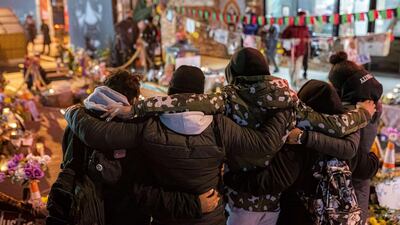
Mourners gather for a vigil for George Floyd following the verdict in the Derek Chauvin trial in Minneapolis, Minnesota. AFP -
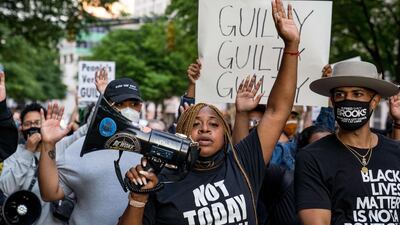
Porchse Queen Miller and others march through the streets after the verdict was announced for Derek Chauvin in Atlanta, United States. AFP -

Georgia state representative Erica Thomas hugs her daughter while listening to speakers speak before marching through the streets after the verdict was announced for Derek Chauvin in Atlanta. AFP -
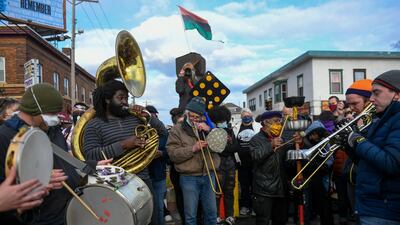
People celebrate at the George Floyd Square after former Minneapolis Police Officer Derek Chauvin was found guilty on all counts in the death of George Floyd in Minneapolis. EPA -

A person pays his respect at a mural of George Floyd after the verdict in the trial of former Minneapolis police officer Derek Chauvin, found guilty of the death of Floyd, in Denver, Colorado. Reuters -
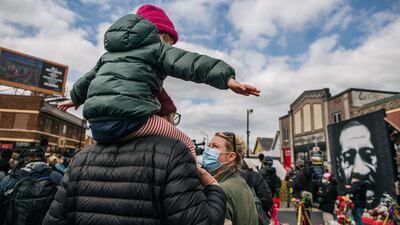
People gather at the intersection of 38th Street and Chicago Avenue following the guilty verdict in the trial of Derek Chauvin in Minneapolis. AFP -

A woman places a placard at a makeshift memorial with the image of Daunte Wright after the verdict in the trial of former Minneapolis police officer Derek Chauvin, found guilty of the death of George Floyd, in New York City, New York. Reuters -

A protester holds a poster displaying the portrait of Ma'Khia Bryant as people gathered to the news that former Minneapolis police officer Derek Chauvin was found guilty of all three charges in the murder of George Floyd in Los Angeles, Californi. EPA -
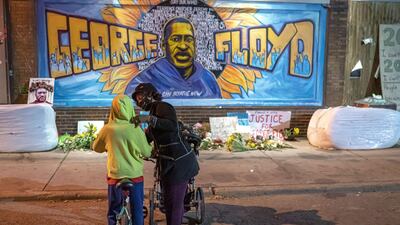
Shannon Haynes talks to her son Ronald Haynes, 9, about George Floyd in front of a memorial following the verdict in the Derek Chauvin trial in Minneapolis. AFP


This is all important. But we also must address the root cause of why black men and women get shot by the police. We must look to eradicate the deep-seated racism that still exists in America. While Black Lives Matter has done much good to educate people, and BLM has become a household phrase, much more needs to be done. For a start, we need to be reminded of our past.
A friend who lives in Louisiana recently told me that whenever people come visit her, the first thing they want to see are the plantations, the last remnants of Scarlett O’Hara’s Old South.
My friend reluctantly takes them, but first she insists they see the Whitney Plantation, which tells the real story. The Whitney Plantation, on the banks of the Mississippi, is the only museum in Louisiana with a focus on enslaved people. It recounts what slavery did to black men and women, people whose only role was to produce more cotton or sugar or crops. Women were raped, families were separated, whippings, beatings, lynching and starvation was common.
Years after the car trip with my parents on the day of Dr King's death, I got as a Christmas present a book depicting the life of Harriet Tubman. Tubman was a great abolitionist, who escaped slavery and then made 13 trips harrowing back to the South to rescue an estimated 70 people, using the network known as the Underground Railroad.
These terrified people who had spent their lives treated inhumanely followed the North Star to freedom, moving from house to house. I read the biography of Tubman, finding it hard to believe it was little more than a 100 years ago when this extreme cruelty was happening in my own country.
Tubman’s courage stunned me; her quest for freedom and justice set me on a path to do the work I try to do. But 40 years later, though, not much has changed in America. If anything, Covid-19 has exposed even deeper systematic racism. Why did so many people of colour die or did not have access to the same health care as whites?

So, what could take the Floyd verdict even further towards change? This is where slavery reparations come in: many believe it could be part of a larger effort to address systematic racism.
A lot of talk about reparations came up during the presidential elections in November, but I worry about how we put a price on that horror. Numbers are being crunched to calculate the manpower and hours of slavery, but it seems an impossible task – the cost runs into trillions of dollars.
Of course, I’d like to see the descendants compensated – for slavery, for Jim Crow laws, for “separate but equal”. But what I’d like to see more is integration and education, and more chances for black people, economically and socially.
American colleges this year have taken in a record number of “diverse” students. There should be more, and they shouldn’t be called “diverse”. When there are more people of colour in the halls of power, on Wall Street and in Silicon Valley, it shouldn't be diverse, it should just be the norm.
Our institutions must be closely examined, starting with the justice system. Young black men shouldn’t be forced to take plea bargains and stay in prison because they can’t afford lawyers. They shouldn’t have to have “the talk” with family when they are still young, about what to do if they are stopped by police. Simply put, black men should not be disproportionally affected by police shootings.
All this comes down to education, essentially. This, to me, is the key to everything. But we shouldn’t just teach our children not to be racist. We must teach them to be anti-racist. If we do not drive home that concept and begin change on a deep level, then what would people like Harriet Tubman or Martin Luther King – or George Floyd – have lived and died for?
Janine di Giovanni teaches human rights at Yale University's Jackson Institute for Global Affairs and is a columnist for The National

