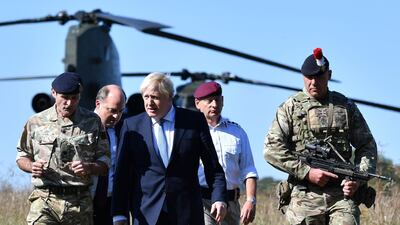
Boris Johnson arrives with Britain's Defence Secretary Ben Wallace (2L) to visit military personnel on Salisbury plain training area near Salisbury, south-west England, September 19, 2019. AFP

Increasing military spend won't increase UK influence abroad


  • English
  • Arabic

In 1850, Lord Palmerston, the British foreign secretary and later prime minister, sent a squadron of gunboats to blockade the Greek port of Piraeus. A British subject, David Pacifico, had received what Palmerston believed was unfair treatment at the hands of the Greek government.

Palmerston justified sending gunboats by telling parliament: “A British subject, in whatever land he may be, shall feel confident that the watchful eye and the strong arm of England will protect him against injustice and wrong.”

This “gunboat diplomacy” extends back into British history, ever since the Royal Navy was celebrated in the famous 1740’s anthem Rule Britannia, with its famous chorus: “Britannia rules the waves.”

Since Palmerston in the 1850s – and despite the quite remarkable force projection of the Royal Navy to the South Atlantic during the Falklands War in 1982 – Britain’s military capacity has shrunk.

Palmerston's successor, Boris Johnson, promises a £16.5 billion increase in British defence spending to end what he calls "an era of retreat" from defence commitments. Mr Johnson emphasises naval spending to restore Britain's position as the foremost sea power in Europe.

Royal Navy aircraft carrier, HMS Queen Elizabeth, is towed by tugs as it arrives at Portsmouth Naval base, Britain August 16, 2017. Reuters

At a time when so much taxpayers' money is being spent on the coronavirus pandemic, Mr Johnson also wants to create jobs in shipyards that just happen to be in areas where there has often been strong anti-government feeling – Scotland, Northern Ireland and the north of England.

He explained: "If there is one policy that strengthens the UK in every possible sense, it is building more ships for the Royal Navy. This will spur a renaissance of British ship building in Glasgow, Rosyth, Belfast, Appledore and Birkenhead. Guaranteeing jobs and illuminating the benefits of the union in the white light of the arc-welder's torch."

Shorn of the oratorical flourishes, the new money is claimed to be largest defence spending increase since the end of the Cold War.

British Royal Navy members march during the National Service of Remembrance at The Cenotaph amid the coronavirus pandemic on Whitehall in London, Britain November 8. Reuters

American critics of the European arm of Nato will be happy. US President Donald Trump says Europe gets American defence on the cheap and Britain aims to continue as the second-biggest Nato military spender after the US. But Mr Johnson has a track record of eye-catching and expensive plans that are badly thought out and often go nowhere – literally.

As mayor of London, for example, he boasted that he would build what came to be known as the Garden Bridge. The project was eventually abandoned for a variety of reasons but not before £53 million, much of it public money, was spent on it.

In a world where anti-tank drones are cheap and deadly, spending nowadays on heavy armour is fighting yesterday's wars

So it is worth examining what the new spending is for. Beyond all the military kit, what is the perceived threat to British interests? What is the UK’s geostrategic role, if any?

For decades British tanks have taken part in military exercises on the North German Plain aimed at repelling an invasion from the Soviet Union.

In a world where anti-tank drones are cheap and deadly, spending nowadays on heavy armour is fighting yesterday’s wars. Cyber-warfare and a future conflict in space are, instead, high on the defence agenda. Sure, since Britain aims to emphasise its role as an international trading nation after Brexit, safe sea lanes are vital.

A British aircraft carrier may in future be stationed semi-permanently in or near the Gulf. But the idea of significant British force projection without major allies – the US and France – seems unlikely.

Some strategists also argue that Britain’s two new aircraft carriers are merely expensive floating targets.

The big change, beyond the rosy rhetoric of Mr Johnson and his colleagues, is that post-Brexit Britain’s global role is diminishing.

A year or so after the 2016 Brexit vote, Simon Fraser, the former permanent secretary at the UK Foreign Office, put it quite brutally: “It is hard to call to mind a major foreign policy matter on which we [in Britain] have had a decisive influence since the [Brexit] referendum.”

Members of the Royal Navy stand with a police officer, and members of the Army at the Cenotaph on Whitehall in central London, on November 8. AFP

In the New York Times, veteran foreign correspondent Steven Erlanger offered his sense of regret that Britain had lost an empire and failed to find a post-Brexit role on the world stage.

He singled out Mr Johnson, then foreign secretary, for ludicrous posturing: “Many Britons see their country as a brave galleon, banners waving, cannons firing, trumpets blaring. That is how the country’s voluble foreign secretary, Boris Johnson, likes to describe it. But Britain is now but a modest-size ship on the global ocean. Having voted to leave the European Union, it is unmoored, heading to nowhere, while on deck, fire has broken out.”

Mr Johnson would describe Mr Fraser and Mr Erlanger as “doomsters and gloomsters" for talking Britain down. But they have a point.

In 1850, the threat of gunboats was enough to demand fair treatment for a British national abroad. But now, for example, the British national Nazanin Zaghari-Ratcliffe has been unfairly detained in Iran since April 2016. No British gunboats will protect her from what Palmerston called "injustice and wrong".

More investment in defence may be welcome but – to adapt the words of the late British humorist George Mikes – if Britannia no longer rules the waves, then Mr Johnson seems to think it is because the waves jolly well no longer deserve it any more.

Gavin Esler is a broadcaster and UK columnist for The National

Milestones on the road to union

1970

October 26: Bahrain withdraws from a proposal to create a federation of nine with the seven Trucial States and Qatar. 

December: Ahmed Al Suwaidi visits New York to discuss potential UN membership.

1971

March 1:  Alex Douglas Hume, Conservative foreign secretary confirms that Britain will leave the Gulf and “strongly supports” the creation of a Union of Arab Emirates.

July 12: Historic meeting at which Sheikh Zayed and Sheikh Rashid make a binding agreement to create what will become the UAE.

July 18: It is announced that the UAE will be formed from six emirates, with a proposed constitution signed. RAK is not yet part of the agreement.

August 6:  The fifth anniversary of Sheikh Zayed becoming Ruler of Abu Dhabi, with official celebrations deferred until later in the year.

August 15: Bahrain becomes independent.

September 3: Qatar becomes independent.

November 23-25: Meeting with Sheikh Zayed and Sheikh Rashid and senior British officials to fix December 2 as date of creation of the UAE.

November 29:  At 5.30pm Iranian forces seize the Greater and Lesser Tunbs by force.

November 30: Despite  a power sharing agreement, Tehran takes full control of Abu Musa. 

November 31: UK officials visit all six participating Emirates to formally end the Trucial States treaties

December 2: 11am, Dubai. New Supreme Council formally elects Sheikh Zayed as President. Treaty of Friendship signed with the UK. 11.30am. Flag raising ceremony at Union House and Al Manhal Palace in Abu Dhabi witnessed by Sheikh Khalifa, then Crown Prince of Abu Dhabi.

December 6: Arab League formally admits the UAE. The first British Ambassador presents his credentials to Sheikh Zayed.

December 9: UAE joins the United Nations.

Is it worth it? We put cheesecake frap to the test.

The verdict from the nutritionists is damning. But does a cheesecake frappuccino taste good enough to merit the indulgence?

My advice is to only go there if you have unusually sweet tooth. I like my puddings, but this was a bit much even for me. The first hit is a winner, but it's downhill, slowly, from there. Each sip is a little less satisfying than the last, and maybe it was just all that sugar, but it isn't long before the rush is replaced by a creeping remorse. And half of the thing is still left.

The caramel version is far superior to the blueberry, too. If someone put a full caramel cheesecake through a liquidiser and scooped out the contents, it would probably taste something like this. Blueberry, on the other hand, has more of an artificial taste. It's like someone has tried to invent this drink in a lab, and while early results were promising, they're still in the testing phase. It isn't terrible, but something isn't quite right either.

So if you want an experience, go for a small, and opt for the caramel. But if you want a cheesecake, it's probably more satisfying, and not quite as unhealthy, to just order the real thing.


MATCH INFO

Fulham 0

Aston Villa 3 (Grealish 4', Hourihane 15', Mings 48')

Man of the match: Jack Grealish (Aston Villa)

Tuesday's fixtures
Group A
Kyrgyzstan v Qatar, 5.45pm
Iran v Uzbekistan, 8pm
N Korea v UAE, 10.15pm
UAE%20ILT20
%3Cp%3E%3Cstrong%3EMarquee%20players%3A%3C%2Fstrong%3E%0D%3Cbr%3EMoeen%20Ali%2C%20Andre%20Russell%2C%20Dawid%20Malan%2C%20Wanindu%20Hasiranga%2C%20Sunil%20Narine%2C%20Evin%20Lewis%2C%20Colin%20Munro%2C%20Fabien%20Allen%2C%20Sam%20Billings%2C%20Tom%20Curran%2C%20Alex%20Hales%2C%20Dushmantha%20Chameera%2C%20Shimron%20Hetmyer%2C%20Akeal%20Hosein%2C%20Chris%20Jordan%2C%20Tom%20Banton%2C%20Sandeep%20Lamichhane%2C%20Chris%20Lynn%2C%20Rovman%20Powell%2C%20Bhanuka%20Rajapaksa%2C%20Mujeeb%20Ul%20Rahman%0D%3Cbr%3E%3Cstrong%3EInternational%20players%3A%3C%2Fstrong%3E%0D%3Cbr%3ELahiru%20Kumara%2C%20Seekugge%20Prassanna%2C%20Charith%20Asalanka%2C%20Colin%20Ingram%2C%20Paul%20Stirling%2C%20Kennar%20Lewis%2C%20Ali%20Khan%2C%20Brandon%20Glover%2C%20Ravi%20Rampaul%2C%20Raymon%20Reifer%2C%20Isuru%20Udana%2C%20Blessing%20Muzarabani%2C%20Niroshan%20Dickwella%2C%20Hazaratullah%20Zazai%2C%20Frederick%20Klassen%2C%20Sikandar%20Raja%2C%20George%20Munsey%2C%20Dan%20Lawrence%2C%20Dominic%20Drakes%2C%20Jamie%20Overton%2C%20Liam%20Dawson%2C%20David%20Wiese%2C%20Qais%20Ahmed%2C%20Richard%20Gleeson%2C%20James%20Vince%2C%20Noor%20Ahmed%2C%20Rahmanullah%20Gurbaz%2C%20Navin%20Ul%20Haq%2C%20Sherfane%20Rutherford%2C%20Saqib%20Mahmood%2C%20Ben%20Duckett%2C%20Benny%20Howell%2C%20Ruben%20Trumpelman%0D%3Cbr%3E%3C%2Fp%3E%0A
The specs

Engine: 2.0-litre 4cyl turbo

Power: 261hp at 5,500rpm

Torque: 405Nm at 1,750-3,500rpm

Transmission: 9-speed auto

Fuel consumption: 6.9L/100km

On sale: Now

Price: From Dh117,059

Our legal consultant

Name: Dr Hassan Mohsen Elhais

Position: legal consultant with Al Rowaad Advocates and Legal Consultants.

MATCH INFO

BRIGHTON 0

MANCHESTER UNITED 3

McTominay 44'

Mata 73'

Pogba 80'

Tamkeen's offering
  • Option 1: 70% in year 1, 50% in year 2, 30% in year 3
  • Option 2: 50% across three years
  • Option 3: 30% across five years 
Manchester City (0) v Liverpool (3)

Uefa Champions League, quarter-final, second leg

Where: Etihad Stadium
When: Tuesday, 10.45pm
Live on beIN Sports HD

Fund-raising tips for start-ups

Develop an innovative business concept

Have the ability to differentiate yourself from competitors

Put in place a business continuity plan after Covid-19

Prepare for the worst-case scenario (further lockdowns, long wait for a vaccine, etc.) 

Have enough cash to stay afloat for the next 12 to 18 months

Be creative and innovative to reduce expenses

Be prepared to use Covid-19 as an opportunity for your business

* Tips from Jassim Al Marzooqi and Walid Hanna

Mercer, the investment consulting arm of US services company Marsh & McLennan, expects its wealth division to at least double its assets under management (AUM) in the Middle East as wealth in the region continues to grow despite economic headwinds, a company official said.

Mercer Wealth, which globally has $160 billion in AUM, plans to boost its AUM in the region to $2-$3bn in the next 2-3 years from the present $1bn, said Yasir AbuShaban, a Dubai-based principal with Mercer Wealth.

Within the next two to three years, we are looking at reaching $2 to $3 billion as a conservative estimate and we do see an opportunity to do so,” said Mr AbuShaban.

Mercer does not directly make investments, but allocates clients’ money they have discretion to, to professional asset managers. They also provide advice to clients.

“We have buying power. We can negotiate on their (client’s) behalf with asset managers to provide them lower fees than they otherwise would have to get on their own,” he added.

Mercer Wealth’s clients include sovereign wealth funds, family offices, and insurance companies among others.

From its office in Dubai, Mercer also looks after Africa, India and Turkey, where they also see opportunity for growth.

Wealth creation in Middle East and Africa (MEA) grew 8.5 per cent to $8.1 trillion last year from $7.5tn in 2015, higher than last year’s global average of 6 per cent and the second-highest growth in a region after Asia-Pacific which grew 9.9 per cent, according to consultancy Boston Consulting Group (BCG). In the region, where wealth grew just 1.9 per cent in 2015 compared with 2014, a pickup in oil prices has helped in wealth generation.

BCG is forecasting MEA wealth will rise to $12tn by 2021, growing at an annual average of 8 per cent.

Drivers of wealth generation in the region will be split evenly between new wealth creation and growth of performance of existing assets, according to BCG.

Another general trend in the region is clients’ looking for a comprehensive approach to investing, according to Mr AbuShaban.

“Institutional investors or some of the families are seeing a slowdown in the available capital they have to invest and in that sense they are looking at optimizing the way they manage their portfolios and making sure they are not investing haphazardly and different parts of their investment are working together,” said Mr AbuShaban.

Some clients also have a higher appetite for risk, given the low interest-rate environment that does not provide enough yield for some institutional investors. These clients are keen to invest in illiquid assets, such as private equity and infrastructure.

“What we have seen is a desire for higher returns in what has been a low-return environment specifically in various fixed income or bonds,” he said.

“In this environment, we have seen a de facto increase in the risk that clients are taking in things like illiquid investments, private equity investments, infrastructure and private debt, those kind of investments were higher illiquidity results in incrementally higher returns.”

The Abu Dhabi Investment Authority, one of the largest sovereign wealth funds, said in its 2016 report that has gradually increased its exposure in direct private equity and private credit transactions, mainly in Asian markets and especially in China and India. The authority’s private equity department focused on structured equities owing to “their defensive characteristics.”

How to vote in the UAE

1) Download your ballot https://www.fvap.gov/

2) Take it to the US Embassy

3) Deadline is October 15

4) The embassy will ensure all ballots reach the US in time for the November 3 poll

Lexus LX700h specs

Engine: 3.4-litre twin-turbo V6 plus supplementary electric motor

Power: 464hp at 5,200rpm

Torque: 790Nm from 2,000-3,600rpm

Transmission: 10-speed auto

Fuel consumption: 11.7L/100km

On sale: Now

Price: From Dh590,000

Timeline

2012-2015

The company offers payments/bribes to win key contracts in the Middle East

May 2017

The UK SFO officially opens investigation into Petrofac’s use of agents, corruption, and potential bribery to secure contracts

September 2021

Petrofac pleads guilty to seven counts of failing to prevent bribery under the UK Bribery Act

October 2021

Court fines Petrofac £77 million for bribery. Former executive receives a two-year suspended sentence 

December 2024

Petrofac enters into comprehensive restructuring to strengthen the financial position of the group

May 2025

The High Court of England and Wales approves the company’s restructuring plan

July 2025

The Court of Appeal issues a judgment challenging parts of the restructuring plan

August 2025

Petrofac issues a business update to execute the restructuring and confirms it will appeal the Court of Appeal decision

October 2025

Petrofac loses a major TenneT offshore wind contract worth €13 billion. Holding company files for administration in the UK. Petrofac delisted from the London Stock Exchange

November 2025

180 Petrofac employees laid off in the UAE

The Written World: How Literature Shaped History
Martin Puchner
Granta

MATCH INFO

Uefa Champions League semi-final, first leg
Bayern Munich v Real Madrid

When: April 25, 10.45pm kick-off (UAE)
Where: Allianz Arena, Munich
Live: BeIN Sports HD
Second leg: May 1, Santiago Bernabeu, Madrid

Why it pays to compare

A comparison of sending Dh20,000 from the UAE using two different routes at the same time - the first direct from a UAE bank to a bank in Germany, and the second from the same UAE bank via an online platform to Germany - found key differences in cost and speed. The transfers were both initiated on January 30.

Route 1: bank transfer

The UAE bank charged Dh152.25 for the Dh20,000 transfer. On top of that, their exchange rate margin added a difference of around Dh415, compared with the mid-market rate.

Total cost: Dh567.25 - around 2.9 per cent of the total amount

Total received: €4,670.30 

Route 2: online platform

The UAE bank’s charge for sending Dh20,000 to a UK dirham-denominated account was Dh2.10. The exchange rate margin cost was Dh60, plus a Dh12 fee.

Total cost: Dh74.10, around 0.4 per cent of the transaction

Total received: €4,756

The UAE bank transfer was far quicker – around two to three working days, while the online platform took around four to five days, but was considerably cheaper. In the online platform transfer, the funds were also exposed to currency risk during the period it took for them to arrive.

Specs

Engine: 51.5kW electric motor

Range: 400km

Power: 134bhp

Torque: 175Nm

Price: From Dh98,800

Available: Now

Ms Yang's top tips for parents new to the UAE
  1. Join parent networks
  2. Look beyond school fees
  3. Keep an open mind
UAE currency: the story behind the money in your pockets
Sun jukebox

Rufus Thomas, Bear Cat (The Answer to Hound Dog) (1953)

This rip-off of Leiber/Stoller’s early rock stomper brought a lawsuit against Phillips and necessitated Presley’s premature sale to RCA.

Elvis Presley, Mystery Train (1955)

The B-side of Presley’s final single for Sun bops with a drummer-less groove.

Johnny Cash and the Tennessee Two, Folsom Prison Blues (1955)

Originally recorded for Sun, Cash’s signature tune was performed for inmates of the titular prison 13 years later.

Carl Perkins, Blue Suede Shoes (1956)

Within a month of Sun’s February release Elvis had his version out on RCA.

Roy Orbison, Ooby Dooby (1956)

An essential piece of irreverent juvenilia from Orbison.

Jerry Lee Lewis, Great Balls of Fire (1957)

Lee’s trademark anthem is one of the era’s best-remembered – and best-selling – songs.
