
In a country where taking to the streets is second nature, it is hardly unprecedented to find French police officers breaking off from controlling the demonstrations of others to highlight grievances of their own.
But amid the displays of public anger prompted by the death of George Floyd in the American city of Minneapolis, sharpened in France by memories of the death of a young black man while under arrest, there is something especially striking about the indignant response to la haine antiflics, the hatred of cops.
On the Champs-Elysees and in front of the Arc de Triomphe, and beyond Paris to Lyon, Bordeaux and other towns and cities, these protesters are mainly male and white but include a sprinkling of women and on occasion a black person.
In place of the familiar “no justice, no peace” Black Lives Matter banners, and a homegrown refinement declaring “French police are not innocent”, some officers hold banners with the slogan “no police, no peace”. Handcuffs are symbolically flung to the ground in exasperation at accusations of racism and a perceived lack of support from the man known as France’s “No 1 flic”, the Interior Minister Christophe Castaner.
-
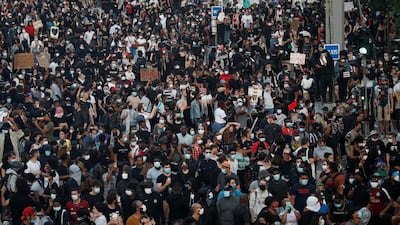
People attend a banned demonstration planned in memory of Adama Traore, a 24-year old black Frenchman who died in a 2016 police operation. Reuters -
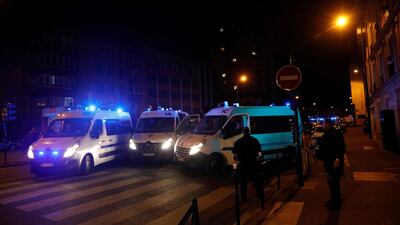
French policemen block a street in Clichy, north-west of Paris, on Tuesday. AFP -
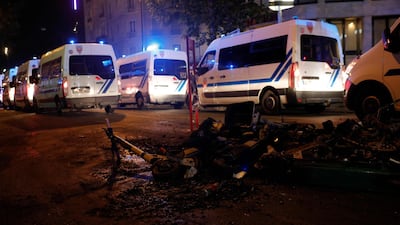
Destroyed electric scooters litter the pavement in Porte de Clichy. AFP -
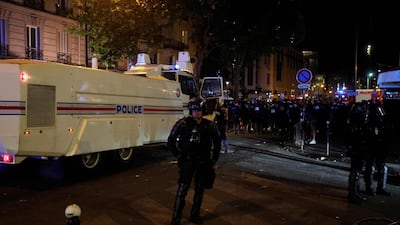
French police block a street. AFP -
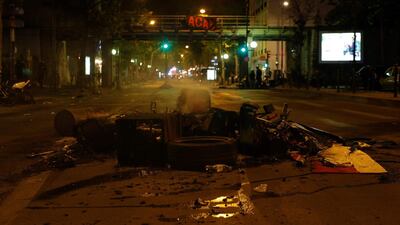
A destroyed motor scooter and other burnt waste have been left behind by protesters at Porte de Clichy, in the northwest of Paris, on June 2, 2020 following a demonstration against police violence and in memory of late US citizen George Floyd who died a week before after a Minneapolis police officer knelt on his neck. Several US cities have deployed the guard in the face of angry protests against police brutality following the killing of unarmed black man George Floyd by police during an arrest in Minneapolis last week. / AFP / GEOFFROY VAN DER HASSELT -

Protesters burn rubbish bins, electric scooters and bicycles. AFP -
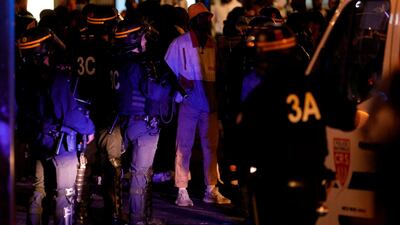
French CRS police stop protesters at Porte de Clichy. AFP


The disgruntlement is understandable. As the French President, Emmanuel Macron, said in a televised address to the nation on Sunday, police and gendarmes “face danger daily in our name” and deserve the respect of all. There is spectacular hypocrisy on the part of the minority of anti-racism demonstrators who resort to violence when opposing police brutality.
It is difficult, nonetheless, to escape an uncomfortable reality: there is a strong case for French forces of law and order to answer. Young Arabs, French-born but of Maghrebin descent, and black people with roots in sub-Saharan Africa, speak compellingly of instances of harassment and persecution, sometimes accompanied by violence, in the banlieue, immigrant-dominated suburbs.
In classic French style, BLM rallies staged across France have focused less on events in the US than on a domestic issue, that of Adama Traore, a 24-year-old French-Malian whose death in 2016 has never been explained to the satisfaction of his family and its supporters. His elder sister, Assa, has said: "The death of George Floyd has a strong echo in the death in France of my little brother. What's happening in the US is happening in France. Our brothers are dying."
According to police, Mr Traore fled with his brother Bagui during an identity check in the outer northern Parisian suburb of Beaumont-sur-Oise nearly four years ago. He was traced to a block of flats nearby.

The family says he died from asphyxiation, as confirmed by a second port-mortem examination carried out after police accounts of the incident were challenged. The cause of asphyxiation has not been established; police insist only necessary force was used in a difficult arrest whereas relatives believe he was pinned down and suffocated.
Clear discrepancies in the first official report of Mr Traore’s death have heightened suspicions about why he died. The family’s dismay is aggravated by feelings of alienation – common to people of Arab or African origin throughout France – despite having been residents of Beaumont for decades. Discontent has been fuelled by revelations of openly racist comments apparently posted by officers in a private Facebook group.
Mr Castaner, typically the target of criticism and abuse from left-wing and anti-racist elements, infuriated individual officers and their unions with the tone of his response to both global outrage at George Floyd's death and the allegations levelled at French police. The minister committed himself to a "zero tolerance" policy on racism and initially banned chokeholds as an arrest technique. The ban was then suspended pending consideration of other forms of restraint but the police feel targeted by blanket claims of prejudice based on the actions of a few rogue colleagues. They can also find themselves caught in the middle, as seen this week in the famous mustard-producing town of Dijon, where Chechen mobs have violently targeted an Arab district in apparently score-settling attacks.

But those from ethnic minorities are not alone in accusing the police of instances of brutality. Serious injuries occurred among participants throughout the countrywide "gilets jaunes" anti-government protests, a predominantly white working-class movement that began in November 2018 and continues if with greatly diminished support.
Few in France doubt that police faced appalling provocation from gilets jaunes as well as the extremists who mingled with them. Businesses, from offices, shops and restaurants to kiosks run by sole traders, were trashed, the Arc de Triomphe was defiled and ordinary people were prevented from reaching workplaces or even the hospital bedsides of loved ones. But there is ample evidence of gross police misconduct. The allegedly reckless use of rubber bullets left dozens of people with serious facial injuries including the loss of sight in one eye.
A report on the state-owned France 2 channel last week showed shocking footage of vicious attacks on demonstrators posing no evident threat to anyone. However, of almost 700 cases of alleged police violence reported, only two have led to criminal proceedings.

In one case from the southern city of Marseille, a young woman was brutally battered by passing officers even though she had merely strayed into an area of the city where gilets jaunes had gathered. The officers concerned have not even been identified. In another, from Paris, a woman is seen being struck viciously on the head from behind by the leading officer in a police charge on a missile-throwing mob some way ahead of her. Prosecutors made no attempt to interview her but accepted the officer’s explanation that he struck her head accidentally while trying to hit her on the shoulder to force her away from the scene.
Without casting doubt of the decency of most officers, an obstinate group seems to feel it is untouchable. And racism plays a part. Mr Castaner said: “I will not let the hateful actions of some stigmatise the police as a whole.” Jacques Toubon, France's human rights ombudsman, says there is a "crisis of public confidence in the security forces" and has called for an end to “discriminatory harassment”.
Mr Macron has won respect for his candid description of French colonialism as a "crime against humanity". He may now need to live up to a pre-election pledge to launch an "uncompromising" fight against police violence and the structural flaws that allow it to occur.
Colin Randall is a former executive editor of The National and writes from France and Britain

