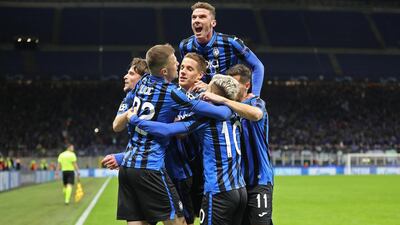
At the end of a wintry schoolday in February, a teacher in Bergamo, northern Italy opened up a note from a parent. It raised a smile. “This is to inform you Edoardo will be away from class for a socio-historic commitment,” it read. The teacher posted it online for locals to enjoy. Among them was the mayor of Bergamo, Giorgio Gori, who cheerfully told his constituents that he thoroughly approved of young Edoardo playing truant for a day.
Young Edoardo’s "socio-historic commitment" would be a family trip to a football match, a landmark occasion for Bergamo’s leading club, Atalanta. They had reached the knockout stage of the Uefa Champions League for the first time ever, an against-the-odds achievement that captivated a city of 120,000. Atalanta versus Spain’s Valencia represented a once-in-a-childhood "I was there" moment. Edoardo would be travelling in a vast convoy to the match, and the journey itself would be an adventure. The game was staged at San Siro, Milan, some 70 kilometres away because Atalanta’s stadium, built for a middle-ranking team in a small city, was not deemed sufficiently large or modern.
Forty thousand, equal to one-third of Bergamo's population, were supporting Atalanta in Milan as they beat Valencia 4-1 – a community united in the sort of civic pride that a crowd at a sports event can display just as vividly as any street march. In the context of modern elite, pan-European football, where the connection between the mighty, wealthy clubs and their locale often seems diminished by ever-shifting ownership and corporate branding, Atalanta's underdogs were refreshingly old-fashioned.
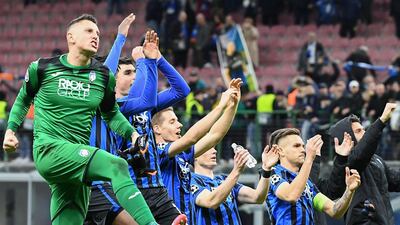
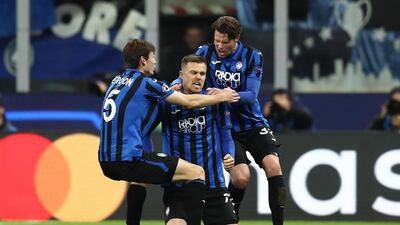
Atalanta's Italian goalkeeper Pierluigi Gollini and teammates celebrate their Champions League win against Valencia. AFP
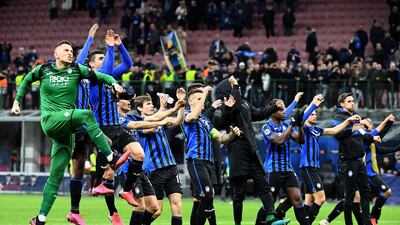
Atalanta delight at the San Siro stadium in Milan. AFP
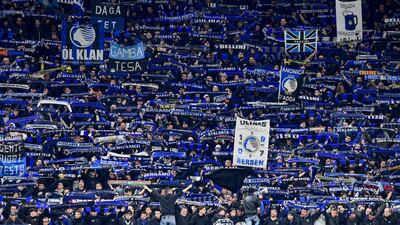
Atalanta fans cheer during the match at the San Siro stadium in Milan. AFP
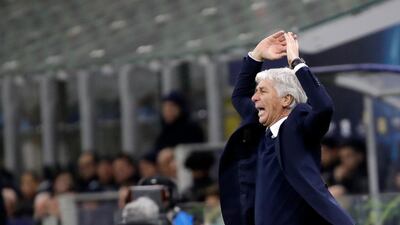
Atalanta's coach Gian Piero Gasperini during the match. AP
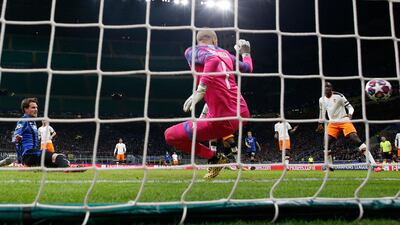
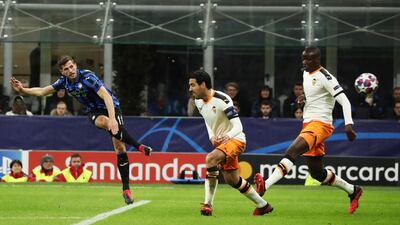
Atalanta's Hans Hateboer, right, scores his side's opening goal. AP
Josip Ilicic (C) celebrates with his teammates after making it 2-0. EPA
Remo Freuler scores the third. EPA
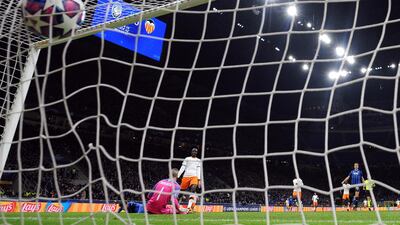
Hans Hateboer scores their fourth goal past Valencia's Jaume Domenech. Reuters
Hans Hateboer (L) celebrates with teammates after scoring his second goal. Atalanta won 4-1. EPA
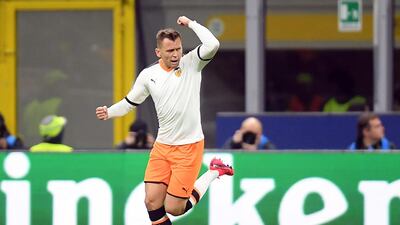
Valencia's Denis Cheryshev gets one back. Reuters
Fast-forward a matter of days, and the thrilling result on the evening of February 19 had become a socio-historic event for very different, terrible reasons. Bergamo was suddenly the centre of Europe's coronavirus contagion, and as medical experts struggled to understand the disease and its fatal grip on a prosperous Italian city, they cited the amassing of so many people at exactly the wrong time. "That football match," Mayor Gori concluded, "was a ticking time-bomb." In Spain, the soaring Covid-19 crisis was being traced to the very same match. Some of Spain's first diagnosed infections were patients who had been among the 2,000 who travelled to Milan to follow Valencia.
Covid-19 would abruptly alter attitudes to all public spaces. Our habits in sporting arenas turned out to tick almost every high-risk box: the close contact with strangers, who you might spontaneously high-five or embrace; the shouting and chanting, releasing all those aerosol droplets; the cramming into packed trains, busses or shared cars to and from stadiums.
The habits of major events, meanwhile, directly confront any notion of safe confinement: the Olympic Games, World Cups, continental championships are celebrated precisely for the way they hurdle national borders, gathering fans from all corners of the planet. In a pandemic, the glorious frivolity of sport as we know it quickly looks irresponsible. It needs to tread sensitively, as the Abu Dhabi Grand Prix did last weekend, when a small number of spectators was allowed in at Yas Marina – 600 spread over the two days of practice and race day. Priority for tickets was given to frontline workers.
For the past six months, most of the popular spectator sports that have returned to the calendar have done so to emptied stadiums, as television-only events driven back into action largely by the need for the sports involved to honour television contracts. It has created a very different landscape, and for all the inventiveness of broadcasters – using simulated crowd noise, interactive Zoom interludes with on-screen fans – it is a decaffeinated version of live sport. But it has been part of life in 2020 for long enough that readjusting to crowds will take some getting used to.
In some parts of the world, spectators have now begun to trickle back into arenas, with governments aware that having fans on site is a strong symbol of a "return to normality", a sort of political triumph. In the English Premier League – the most watched domestic football competition in the world – that normality means ordered, regimented, socially distanced rows and lines of masked fans, no more than 2,000 in stadiums built for 50,000-odd, in certain towns and cities.
Premier League games such as this one between Southampton and Brighton have been played inside empty stadiums. Getty Images
Taking a knee had become a powerful statement of sport's power to unite
London was one, for a brief two weeks. There, the first weekend of limited attendance at football produced not unconfined joy but controversy. In the Championship, the second tier of English football, with fans let in under the same regulations as the Premier League, Millwall's match against Derby County kicked off to loud booing, a premeditated response from a portion of the 2,000 home supporters directed specifically at players taking a knee to mark their rejection of racism.
Since elite English football resumed after the spring lockdown, players from a vast majority of clubs have been taking a knee, symbolically, for a few seconds at the sound of the referee's whistle at the beginning of each game. The gesture has become a powerful statement of sport's power to unite, articulate a cause and send it, via television, across the planet. With fans back on site in south-east London, that unity fractured. Those who booed at Millwall very purposefully gained a platform, some of them later arguing that they booed not as racists but in protest against a Black Lives Matter movement that had become "politicised".
Derby County's Colin Kazim-Richards raises his right fist as Millwall players take the knee ahead of their Championship match. Getty Images
Ahead of Millwall’s next home match, the club issued a letter to all those attending, arguing that there should be no repeat of the booing. It spelled out “your duty and responsibility”, that “the eyes of the world are on this football club – your club – and they want us to fail". It worked in as far as there was applause as players from visiting Queens Park Rangers took a knee after both teams’ players had linked arms; it struck a sour note in that the letter suggested very clearly that Millwall felt that its fans in the stands needed to be corralled into decency by the threat that the world “wants us to fail".
Importantly, across dozens of stadiums in England, the Millwall booing was a rarity; but it was not quite unique. There have been similar incidents when players took a knee at Cambridge United and Colchester United, clubs lower down the hierarchy of the English professional game. The Colchester chairman, Robbie Cowling, condemned the booing, told those who had booed to “at the very least stay silent, or just stay away from our club".
“I will be happy," he added, “to refund anyone for the remaining value of their season permit if that is the reason they feel they can no longer attend our games."
Shirts of amateur clubs on the Malieveld in The Hague, Netherlands, this week. The sports association wants to use the campaign to draw attention on the issue that amateur football players are temporarily unable to play sports due to the coronavirus measures. EPA
In 11-a-side sports, competitors refer to on-site supporters as 'our 12th player'
How long taking the knee remains part of the matchday remains to be seen. What happened at Millwall reminded that sports stadiums are public spaces that some spectators occupy with a sense of entitlement, of antagonism, and a feeling that in a crowd there is a safety in numbers to act disruptively and abusively.
The continuing health emergency means it will be a while yet before large numbers are deemed safe enough to be filling big stadiums. And when they are, many may fill more slowly than they did pre-pandemic. Surveys show a public reluctance, after nine months of restrictions, to re-enter crowded spaces. But sport needs them. At sport's richer summits, money from television, and the sponsorship and advertising that feeds off big TV audiences mean ticket-sales are only one pillar of the sport's income. But for most teams and clubs, the traffic through the turnstiles is what keeps the business afloat.
Liverpool's Joe Gomez concedes a penalty after holding back Manchester City's Raheem Sterling during the Premier League match at the Etihad Stadium, Manchester, while fans watch on Zoom. PA
Broadcasters, anxious that a generation of fans prefer consuming their matches in brief highlights, via smartphone, also need crowds as part of their 24/7 live show. Skilfully staged though major behind-closed-doors events like the Indian Premier League cricket tournament in the UAE, or the one-venue conclusion to the Uefa Champions League in Lisbon have been in 2020, there is nothing like an audience to stimulate the adrenaline.
In 11-a-side sports, competitors refer to on-site supporters as “our 12th player". He or she is often unruly, frequently biased, occasionally obnoxious. But almost every elite athlete will recognise a piece of themselves in every crowd. They were once just like young Edoardo of Bergamo, enchanted at being part of a special occasion that meant so much to so many.
Ian Hawkey is a European football correspondent for The National

Engine: 3.4-litre twin-turbo V6 plus supplementary electric motor
Power: 464hp at 5,200rpm
Torque: 790Nm from 2,000-3,600rpm
Transmission: 10-speed auto
Fuel consumption: 11.7L/100km
On sale: Now
Price: From Dh590,000
Mercer, the investment consulting arm of US services company Marsh & McLennan, expects its wealth division to at least double its assets under management (AUM) in the Middle East as wealth in the region continues to grow despite economic headwinds, a company official said.
Mercer Wealth, which globally has $160 billion in AUM, plans to boost its AUM in the region to $2-$3bn in the next 2-3 years from the present $1bn, said Yasir AbuShaban, a Dubai-based principal with Mercer Wealth.
“Within the next two to three years, we are looking at reaching $2 to $3 billion as a conservative estimate and we do see an opportunity to do so,” said Mr AbuShaban.
Mercer does not directly make investments, but allocates clients’ money they have discretion to, to professional asset managers. They also provide advice to clients.
“We have buying power. We can negotiate on their (client’s) behalf with asset managers to provide them lower fees than they otherwise would have to get on their own,” he added.
Mercer Wealth’s clients include sovereign wealth funds, family offices, and insurance companies among others.
From its office in Dubai, Mercer also looks after Africa, India and Turkey, where they also see opportunity for growth.
Wealth creation in Middle East and Africa (MEA) grew 8.5 per cent to $8.1 trillion last year from $7.5tn in 2015, higher than last year’s global average of 6 per cent and the second-highest growth in a region after Asia-Pacific which grew 9.9 per cent, according to consultancy Boston Consulting Group (BCG). In the region, where wealth grew just 1.9 per cent in 2015 compared with 2014, a pickup in oil prices has helped in wealth generation.
BCG is forecasting MEA wealth will rise to $12tn by 2021, growing at an annual average of 8 per cent.
Drivers of wealth generation in the region will be split evenly between new wealth creation and growth of performance of existing assets, according to BCG.
Another general trend in the region is clients’ looking for a comprehensive approach to investing, according to Mr AbuShaban.
“Institutional investors or some of the families are seeing a slowdown in the available capital they have to invest and in that sense they are looking at optimizing the way they manage their portfolios and making sure they are not investing haphazardly and different parts of their investment are working together,” said Mr AbuShaban.
Some clients also have a higher appetite for risk, given the low interest-rate environment that does not provide enough yield for some institutional investors. These clients are keen to invest in illiquid assets, such as private equity and infrastructure.
“What we have seen is a desire for higher returns in what has been a low-return environment specifically in various fixed income or bonds,” he said.
“In this environment, we have seen a de facto increase in the risk that clients are taking in things like illiquid investments, private equity investments, infrastructure and private debt, those kind of investments were higher illiquidity results in incrementally higher returns.”
The Abu Dhabi Investment Authority, one of the largest sovereign wealth funds, said in its 2016 report that has gradually increased its exposure in direct private equity and private credit transactions, mainly in Asian markets and especially in China and India. The authority’s private equity department focused on structured equities owing to “their defensive characteristics.”
Email sent to Uber team from chief executive Dara Khosrowshahi
From: Dara
To: Team@
Date: March 25, 2019 at 11:45pm PT
Subj: Accelerating in the Middle East
Five years ago, Uber launched in the Middle East. It was the start of an incredible journey, with millions of riders and drivers finding new ways to move and work in a dynamic region that’s become so important to Uber. Now Pakistan is one of our fastest-growing markets in the world, women are driving with Uber across Saudi Arabia, and we chose Cairo to launch our first Uber Bus product late last year.
Today we are taking the next step in this journey—well, it’s more like a leap, and a big one: in a few minutes, we’ll announce that we’ve agreed to acquire Careem. Importantly, we intend to operate Careem independently, under the leadership of co-founder and current CEO Mudassir Sheikha. I’ve gotten to know both co-founders, Mudassir and Magnus Olsson, and what they have built is truly extraordinary. They are first-class entrepreneurs who share our platform vision and, like us, have launched a wide range of products—from digital payments to food delivery—to serve consumers.
I expect many of you will ask how we arrived at this structure, meaning allowing Careem to maintain an independent brand and operate separately. After careful consideration, we decided that this framework has the advantage of letting us build new products and try new ideas across not one, but two, strong brands, with strong operators within each. Over time, by integrating parts of our networks, we can operate more efficiently, achieve even lower wait times, expand new products like high-capacity vehicles and payments, and quicken the already remarkable pace of innovation in the region.
This acquisition is subject to regulatory approval in various countries, which we don’t expect before Q1 2020. Until then, nothing changes. And since both companies will continue to largely operate separately after the acquisition, very little will change in either teams’ day-to-day operations post-close. Today’s news is a testament to the incredible business our team has worked so hard to build.
It’s a great day for the Middle East, for the region’s thriving tech sector, for Careem, and for Uber.
Founder of the Muslim Brotherhood, Hassan al Banna, "accepted the political utility of violence"
Views of key Muslim Brotherhood ideologue, Sayyid Qutb, have “consistently been understood” as permitting “the use of extreme violence in the pursuit of the perfect Islamic society” and “never been institutionally disowned” by the movement.
Muslim Brotherhood at all levels has repeatedly defended Hamas attacks against Israel, including the use of suicide bombers and the killing of civilians.
Laying out the report in the House of Commons, David Cameron told MPs: "The main findings of the review support the conclusion that membership of, association with, or influence by the Muslim Brotherhood should be considered as a possible indicator of extremism."
UAE v Gibraltar
What: International friendly
When: 7pm kick off
Where: Rugby Park, Dubai Sports City
Admission: Free
Online: The match will be broadcast live on Dubai Exiles’ Facebook page
UAE squad: Lucas Waddington (Dubai Exiles), Gio Fourie (Exiles), Craig Nutt (Abu Dhabi Harlequins), Phil Brady (Harlequins), Daniel Perry (Dubai Hurricanes), EsekaiaDranibota (Harlequins), Matt Mills (Exiles), JaenBotes (Exiles), KristianStinson (Exiles), Murray Reason (Abu Dhabi Saracens), Dave Knight (Hurricanes), Ross Samson (Jebel Ali Dragons), DuRandt Gerber (Exiles), Saki Naisau (Dragons), Andrew Powell (Hurricanes), EmosiVacanau (Harlequins), NikoVolavola (Dragons), Matt Richards (Dragons), Luke Stevenson (Harlequins), Josh Ives (Dubai Sports City Eagles), Sean Stevens (Saracens), ThinusSteyn (Exiles)
Tips for newlyweds to better manage finances
All couples are unique and have to create a financial blueprint that is most suitable for their relationship, says Vijay Valecha, chief investment officer at Century Financial. He offers his top five tips for couples to better manage their finances.
Discuss your assets and debts: When married, it’s important to understand each other’s personal financial situation. It’s necessary to know upfront what each party brings to the table, as debts and assets affect spending habits and joint loan qualifications. Discussing all aspects of their finances as a couple prevents anyone from being blindsided later.
Decide on the financial/saving goals: Spouses should independently list their top goals and share their lists with one another to shape a joint plan. Writing down clear goals will help them determine how much to save each month, how much to put aside for short-term goals, and how they will reach their long-term financial goals.
Set a budget: A budget can keep the couple be mindful of their income and expenses. With a monthly budget, couples will know exactly how much they can spend in a category each month, how much they have to work with and what spending areas need to be evaluated.
Decide who manages what: When it comes to handling finances, it’s a good idea to decide who manages what. For example, one person might take on the day-to-day bills, while the other tackles long-term investments and retirement plans.
Money date nights: Talking about money should be a healthy, ongoing conversation and couples should not wait for something to go wrong. They should set time aside every month to talk about future financial decisions and see the progress they’ve made together towards accomplishing their goals.
Funding: $500,000 in Series A funding from family and friends in 2018. A Series B round looking to raise $1.5m is now live.
Gulf Under 19s final
Dubai College A 50-12 Dubai College B
World record transfers
1. Kylian Mbappe - to Real Madrid in 2017/18 - €180 million (Dh770.4m - if a deal goes through)
2. Paul Pogba - to Manchester United in 2016/17 - €105m
3. Gareth Bale - to Real Madrid in 2013/14 - €101m
4. Cristiano Ronaldo - to Real Madrid in 2009/10 - €94m
5. Gonzalo Higuain - to Juventus in 2016/17 - €90m
6. Neymar - to Barcelona in 2013/14 - €88.2m
7. Romelu Lukaku - to Manchester United in 2017/18 - €84.7m
8. Luis Suarez - to Barcelona in 2014/15 - €81.72m
9. Angel di Maria - to Manchester United in 2014/15 - €75m
10. James Rodriguez - to Real Madrid in 2014/15 - €75m
The bairaq is a competition for the best herd of 50 camels, named for the banner its winner takes home
Namoos - a word of congratulations reserved for falconry competitions, camel races and camel pageants. It best translates as 'the pride of victory' - and for competitors, it is priceless
Majahim - chocolate-brown camels that can grow to weigh two tonnes. They were only valued for milk until camel pageantry took off in the 1990s
Millions Street - the thoroughfare where camels are led and where white 4x4s throng throughout the festival
It
Director: Andres Muschietti
Starring: Bill Skarsgard, Jaeden Lieberher, Sophia Lillis, Chosen Jacobs, Jeremy Ray Taylor
Three stars
TOURNAMENT INFO
Fixtures
Sunday January 5 - Oman v UAE
Monday January 6 - UAE v Namibia
Wednesday January 8 - Oman v Namibia
Thursday January 9 - Oman v UAE
Saturday January 11 - UAE v Namibia
Sunday January 12 – Oman v Namibia
UAE squad
Ahmed Raza (captain), Rohan Mustafa, Mohammed Usman, CP Rizwan, Waheed Ahmed, Zawar Farid, Darius D’Silva, Karthik Meiyappan, Jonathan Figy, Vriitya Aravind, Zahoor Khan, Junaid Siddique, Basil Hameed, Chirag Suri