
As the United Nations General Assembly meets for its 75th session in New York, many are focusing on the UN's record as it reaches its three quarters of a century. Among the plusses: the UN was primarily formed to ensure that there wasn't a Third World War, and there hasn't been one. Among the minuses: sclerotic decision-making means that the organisation is often too slow or fails to act; and while everyone agrees on the need for serious reforms, there is never a consensus on implementing any.
UN Under-Secretary General Fabrizio Hochschild has been consulting younger generations of global citizens in order to think about UN’s future for the past year and a half. But what if one started from scratch and asked: if it didn’t already exist, what kind of UN would one create today?
To start with, assuming the current 193-state membership, I would make it a condition of joining that countries treat decisions of the UN as binding. Presently, too many rulings from the UN’s International Court of Justice, for instance, are either discretionary, advisory, unenforced or unenforceable.

The next step would be to remove the power of veto from the permanent five (P5) members of the UN Security Council – China, France, Russia, the UK and the US – and, indeed, to remove their permanent status as well. Too often individual members of the P5 have used their veto to stop the UN acting in any meaningful way, and 75 years on there is no justification for the victors of the Second World War to be elevated above all others. Plenty have suggested something similar over the years. A recent article in the Foreign Policy magazine argues that "abolishing" the P5 is necessary to "decolonise" the UN.
I agree with some of the authors’ proposals, such as all Security Council seats “being made temporary, for periods of five years to provide more continuity", with “open competition for each seat, alongside clear, monitored restrictions on lobbying expenses". But I would go further.
If one were to re-imagine the UN General Assembly as a lower legislative chamber, it would be dominated numerically on any definition by developing countries and the Global South and East – a welcome readjustment, perhaps, after the long hegemony of the West. The Security Council could then be expanded into an elected upper chamber or senate of, say, 20-25 members, with some form of qualified-majority decision-making.
Voting for the senate by country could be weighted by population and budgetary contribution to make up for the outsize influence smaller and less wealthy countries would have in the General Assembly, with regional groupings also being eligible to stand. Rather than Indonesia – a country regularly touted as deserving a more permanent membership of the Security Council – standing on its own for the UN senate, the 10 countries of the Association of South-East Asian Nations could propose a group candidate.
-
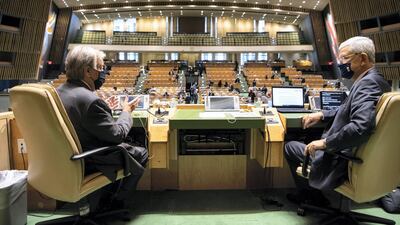
Secretary-General António Guterres (left) and Volkan Bozkir, President of the seventy-fifth session of the United Nations General Assembly, speak ahead of the start of the General Assembly high-level meeting to commemorate the seventy-fifth anniversary of the United Nations. UN Photo -
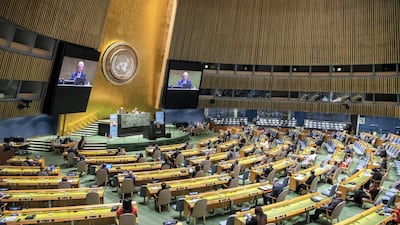
Shaping Peace Together: Celebrating 75 Years of the United Nations. In observance of the International Day of Peace, United Nations Academic Impact (UNAI) is co-hosting a musical commemoration. -
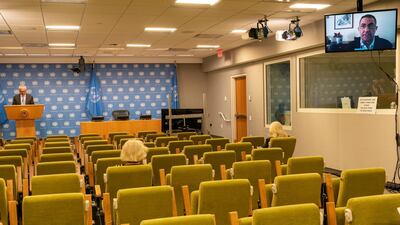
Stephane Dujarric de la Riviere, left, spokesperson for the United Nations Secretary-General António Guterres, takes a question from a reporter, right, via video link as others observe social distancing during the noon briefing, on Monday, September 21, 2020 at United Nations headquarters. AP Photo -
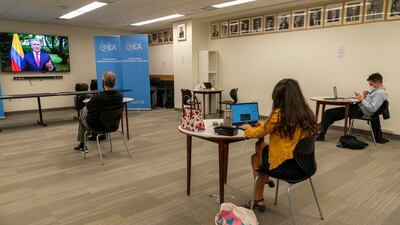
Members of the media observe social distancing as they listen to Colombian President Ivan Duque Marquez deliver an address via video link in the United Nations Correspondents Association office at United Nations headquarters. AP Photo -
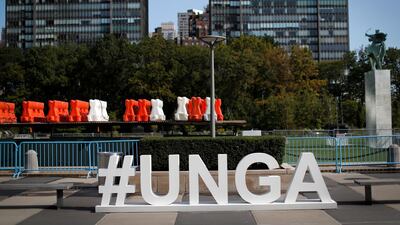
A sign sits in the empty North entrance plaza at United Nations headquarters during the 75th annual UN General Assembly high-level debate, which is being held mostly virtually. Reuters -
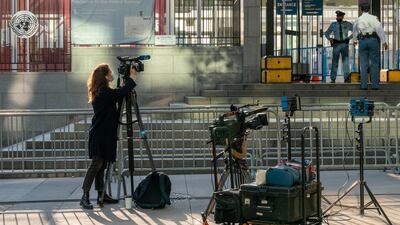
A journalist films United Nations security outside the main entrance to the UN headquarters. AP Photo -
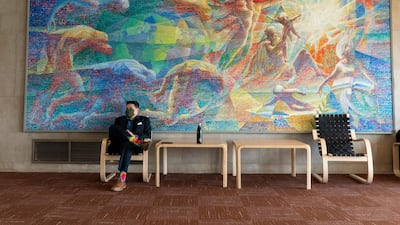
A representative with the United Nations Media Accreditation & Liaison Unit staffs an area reserved for members of the press at United Nations headquarters. AP Photo -
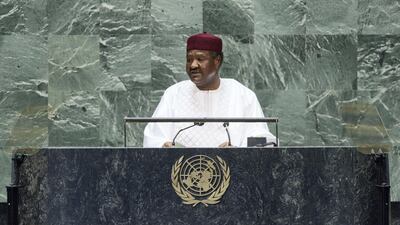
Abdou Abarry, Permanent Representative of Republic of Niger to the United Nations and President of the Security Council for the month of September, addresses the high-level meeting of the General Assembly to commemorate the seventy-fifth anniversary of the United Nations. UN Photo -
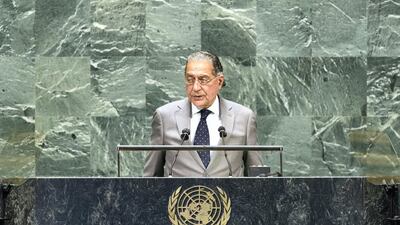
Munir Akram, seventy-sixth President of the Economic and Social Council (ECOSOC) and Premanent Representative of Pakistan to the United Nations, addresses the high-level meeting of the General Assembly to commemorate the seventy-fifth anniversary of the United Nations. UN Photo -
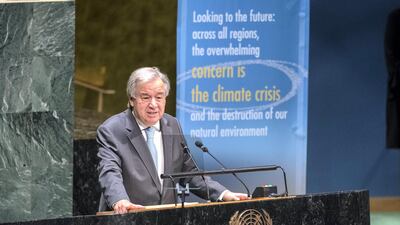
Secretary-General António Guterres makes remarks to the high-level meeting of the General Assembly to commemorate the seventy-fifth anniversary of the United Nations. UN Photo -
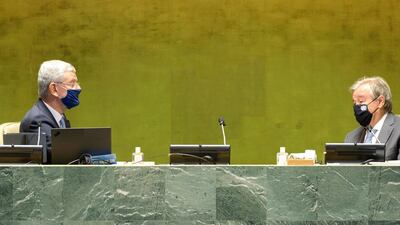
Secretary-General António Guterres (right) and Volkan Bozkir, President of the seventy-fifth session of the United Nations General Assembly, are seated at the dais at the start of the General Assembly high-level meeting to commemorate the seventy-fifth anniversary of the United Nations. UN Photo / Manuel Elías -
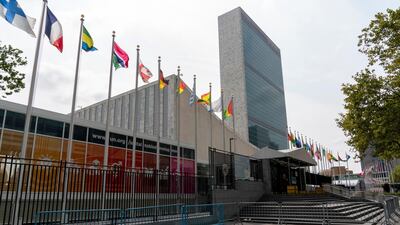
Metal barricades line the shuttered main entrance to the United Nations headquarters, on Friday, September 18, 2020, in New York. AP Photo -
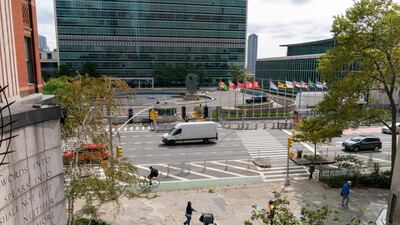
Pedestrians and traffic make their way past metal barricades lining the sidewalk outside the United Nations headquarters in New York. AP Photo -
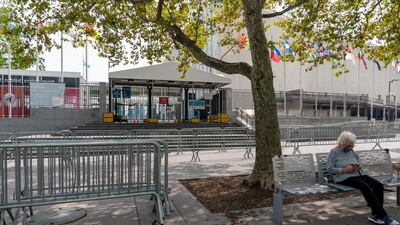
A woman sits next to metal barricades lining the sidewalk outside the shuttered main entrance to the United Nations headquarters in New York. AP Photo -
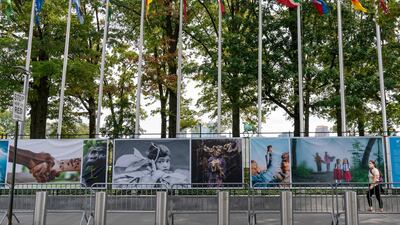
A woman wearing a face mask to protect against the coronavirus walks past artwork and metal barricades lining the sidewalk outside the United Nations headquarters in New York. AP Photo -
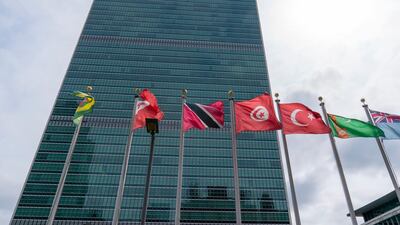
Member state flags fly outside the United Nations headquarters in New York. AP Photo -
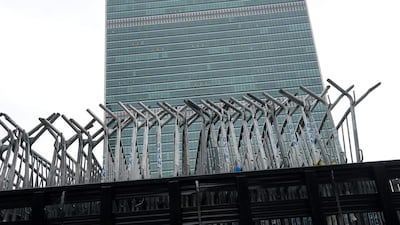
Police barricades outside the United Nations in New York. AFP -
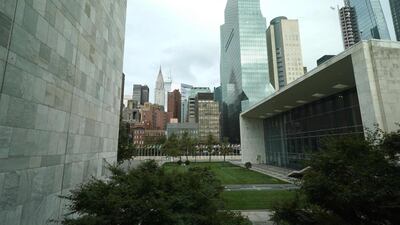
A view of the city from the United Nations in New York on September 18, 2020. AFP -
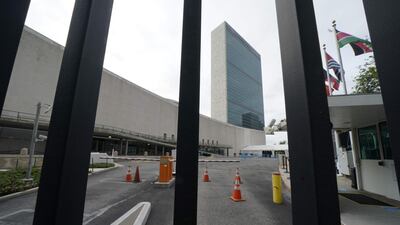
The closed entrance to the United Nations, in New York on September 18, 2020. AFP -
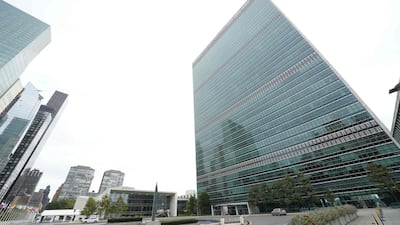
The entrance to the United Nations, in New York on September 18, 2020. AFP -
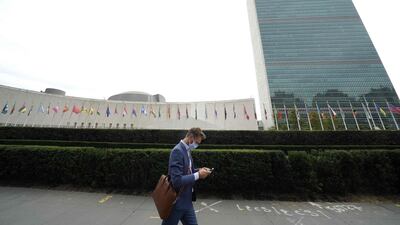
A man passes by the United Nations in New York on September 18, 2020. AFP -
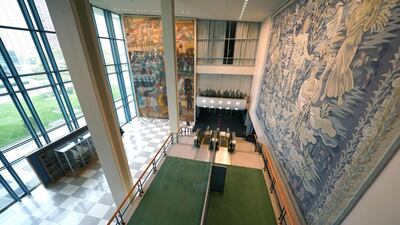
The United Nations GA Hall is seen empty in New York on September 18, 2020. AFP


European Union states would probably reckon on electing several of their members to this proposed senate so might not want to band together, but other organisations such as the Southern African Development Community – perhaps any group of countries that has now or is working towards observer status at the UN – could do the same.
These two chambers combined would have far more legitimacy than any other global institution that currently exists, and would have the heft to formulate and codify that potpourri known as “international law”.
Why is that necessary? Well, Britain's Conservative administration has gotten itself into hot water on both sides of the Atlantic after a minister conceded that he was proposing legislation relating to the UK's border with Ireland that would "break international law in a very specific and limited way". This led to condemnation all round, not least because many people thought this was akin to a government saying it was going to break domestic law – absolutely unthinkable.

But it was not the same at all. As Hywel Williams, director of the Erasmus Historical and Cultural Forum in London and a former cabinet adviser, put it to me: “‘International law’ does not exist – not, anyway, as a coherent body of jurisprudence comparable to ‘the laws of England and Wales'.” Many historians and jurists concur. National laws are passed or promulgated according to the constitutions of individual countries. International law by contrast consists of a ragbag of customs, treaties and conventions that are, for the most part, signed up to by a limited number of countries; that are frequently ignored or flouted – particularly when great powers find them uncongenial; and are also often unenforced or unenforceable.
Take the example of the UN Convention on the Law of the Sea (Unclos). The US accuses China of violating this treaty; even though Beijing and 167 other parties have ratified it, but Washington has not – a hypocritical stance, but one typical of American attitudes towards "international law".

The concept is in dire need of truly worldwide institutional grounding. So a UN that was in the position to propose and regulate this corpus would be performing a very valuable service. It would have to act in a very limited way, as individual countries would still jealously guard their autonomy. With its rulings being binding, some states – perhaps the US – would choose to leave rather than be thus bound. The remaining UN would nevertheless still be more coherent, purposeful and capable of enforcing its decisions through the ultimate sanction of expulsion.
It would also remain a place of debate and an important space for de-escalation. As Professor Waheguru Pal Singh Sidhu of New York University puts it, enemies could still "abuse each other in the UN instead of throwing missiles at each other".
The road to such a UN would be strewn with obstacles. But we surely owe it to the visionaries who created the organisation in the 1940s to insist on a revitalisation of our global forum. The UN remains our last best hope if there is ever to be such a thing as an “international rules-based order”, and it is no surprise that at 75 it needs a new lease of life.
Sholto Byrnes is an East Asian affairs columnist for The National

