A Syrian boy removes a dead chicken from the debris of a building hit by an air strike in Idlib, Syria. REUTERS
Internally displaced Syrian boys play on a mobile phone outside a tent in Azaz, Syria. REUTERS
Internally displaced Syrian girls carry their belongings in an IDP camp located in Sarmada in Idlib province, Syria. REUTERS
Clothes hang to dry on a cluster of branches in Azaz, Syria. REUTERS
Fighters drive through Idlib city center from Saraqeb in Idlib province, Syria. REUTERS
A relative of a wounded fighter waits for the end of his surgery in a hospital in Idlib, Syria. REUTERS
Internally displaced Syrian boys stand near tents in Azaz, Syria. REUTERS
An internally displaced woman with a child on her lap prepares food outside a tent in Azaz, Syria. REUTERS
An internally displaced Syrian girl collects firewood for cooking, in Azaz, Syria. REUTERS
Turkish ambassador to the United Nations Feridun Sinirlioglu speaks with U.S. Ambassador to the United Nations Kelly Craft alone following a Security Council meeting about the situation in Syria at United Nations Headquarters in the Manhattan borough of New York City, New York, U.S. REUTERS
Secretary General of the United Nations Antonio Guterres speaks during a Security Council meeting about the situation in Syria at U.N. Headquarters in the Manhattan borough of New York City, New York, U.S. REUTERS
Last week marked the 75th anniversary of the signing of the UN Charter, the foundational treaty of the United Nations. It passed uneventfully, in part due to the world's preoccupation with the coronavirus pandemic, but also because the UN is not the robust, muscular organisation it was intended to become following its formation in 1945.
The UN General Assembly (UNGA) will not convene in New York in September, as it does every year. In which case, the pandemic will have had a major impact on how global decision making will be carried out in the future.
One of the UNGA's mandates is conflict resolution, which sadly remains a challenge in many parts of the world.
The conflict in Syria, for instance, has dragged on endlessly. Even as an estimated 700,000 people have lost their lives, respected statesmen from Kofi Annan and Lakhdar Brahimi to the current envoy Geir Pedersen have failed in their roles as UN-appointed negotiators to bring lasting peace to the country.
UN Special Envoy for Syria Geir Pedersen is among many high-profile figures trying to bring peace to the country. AFP
It isn't their fault, of course. The blame for Syria's predicament lies mostly at a very divided UN Security Council's door. Unfortunately for the UN, its reputation as a peacemaker has been in tatters since the 1990s, when on its own it failed to resolve conflict and end bloodshed in countries such as Bosnia and Rwanda.
So the answer to the question of how to achieve peace in today's increasingly complex world perhaps lies in changing how humankind negotiates with one another.
The traditional negotiating process, known as Track One diplomacy, involves the UN, national governments and elite-level politicians. But it excludes non-state actors such as NGOs, civil society groups and private citizens, who may be key to the process given their access to power at crucial levels. There are limitations to this process as a consequence of key constituents being left out of negotiations.
With many conflicts in the world yet to be resolved, Track Two diplomacy, a term coined by the American diplomat Joseph Montville as far back as 1981, could be the future of peacemaking.
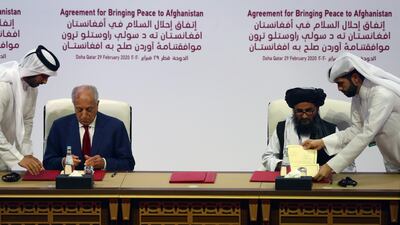
Mullah Abdul Ghani Baradar, the leader of the Taliban delegation, signs an agreement with Zalmay Khalilzad, US envoy for peace in Afghanistan, at a signing agreement ceremony between members of Afghanistan's Taliban and the US in Doha, Qatar February 29, 2020. Reuters
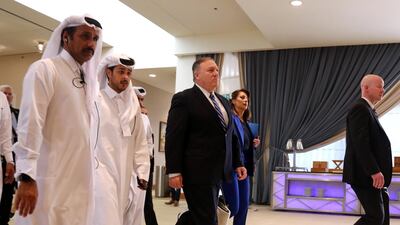
US Secretary of State Mike Pompeo walks ahead of the signing of an agreement between members of Afghanistan's Taliban delegation and the US government in Doha, Qatar. Reuters
Members of Afghanistan's Taliban delegation speak to the media ahead of an agreement signing between them and US officials in Doha, Qatar. Reuters
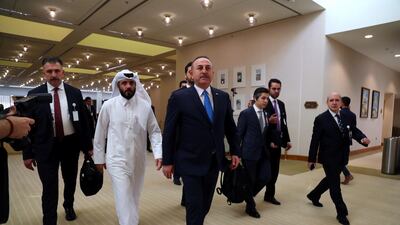
Turkish Foreign Minister Mevlut Cavusoglu walks ahead of the signing of an agreement between members of Afghanistan's Taliban delegation and the US government in Doha, Qatar. Reuters
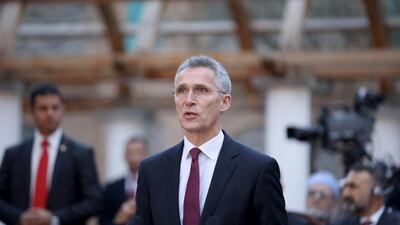
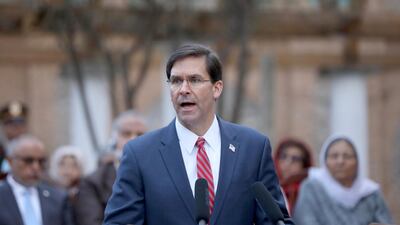
NATO Secretary General Jens Stoltenberg attends a joint press conference with Afghan President Ghani and US Secretary of Defence Mark Esper on the declaration of a peace deal to be signed between the US and the Taliban, at the presidential palace in Kabul, Afghanistan. EPA
US Secretary of Defence Mark Esper attends a joint press conference with Afghan President Ghani and NATO Secretary General Stoltenberg on the declaration of a peace deal to be signed between the US and the Taliban, at the presidential palace in Kabul, Afghanistan. EPA
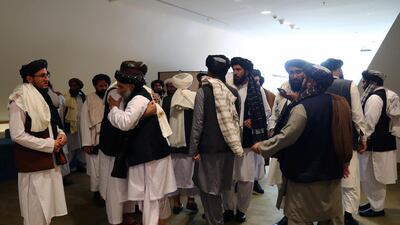
Members of the Taliban delegation gather ahead of an agreement signing between them and US officials in Doha, Qatar. Reuters
The UN has been involved in efforts to bring peace to Afghanistan, Libya, sub-Saharan Africa and, of course, Syria. Yet the most substantive work towards this end is being done by so-called conflict resolution centres. Key among them are organisations such as the Centre for Humanitarian Dialogue in Geneva, the Berghof Foundation in Berlin and the European Institute of Peace in Brussels. Interestingly, they are all headed by former UN officials who have witnessed the failures of the system from close quarters.
Other examples include the Atlanta-based Carter Centre, headed by the former US president Jimmy Carter, and Crisis Management Initiative, a group founded by the former Finland president Martti Ahtisaari in Helsinki.
A crucial aspect of Track Two diplomacy is that it offers an opportunity for people who genuinely matter to make decisions that will affect their own countries or regions. Unfortunately, it is a much less preferred and pursued method given that it is time-consuming and requires more dialogue and mediation than traditional peacemaking does.
The former US president Jimmy Carter continues to be involved in diplomacy. The Carter Centre
“It’s never a quick fix. These processes can take years and years,” says Andrew Gilmour, executive director at the Berghof Foundation and formerly the assistant secretary general for human rights at the UN. “It requires tremendous patience, but also ego-lessness has to be a key factor."
Conflict resolution centres also need to play the role of a referee in any given mediation process. "You can’t boast that, 'I was the mediator'," Mr Gilmour says. "You need local ownership, as the parties to conflict need to really know that the violence ended as a result of their will, their actions, their sacrifices, their skills.”
At these levels, who you talk to also assumes importance.
A decade ago, for instance, it would have been unthinkable to include the Taliban into negotiations to end the war in Afghanistan. Or, for that matter, bringing Farc in from the cold for the sake of peace in Colombia.
Former US ambassador to Syria Robert S Ford has called for some armed groups to be included in negotiations. Victor Besa / The National
Likewise in Syria, there is a case to be made for inviting armed groups to the negotiating table, as Robert S Ford, the former US Ambassador to Syria, has recommended. UN officials could not be seen talking to these groups. But others could.
“We will always need the UN because of the universality and legitimacy it brings,” says Mr Gilmour. “But there will be increasing co-operation with foundations like Berghof.”
Much like Covid-19 is forcing us to be creative in all aspects of life and work, we should also be thinking out of the box when it comes to diplomacy in the 21st century. The advantage of Track 2 is that it allows for more agility, which lumbering international organisations lack. Perhaps, then, Track 2 can achieve conflict resolution and lasting peace where the likes of the UN has failed.
Janine di Giovanni is a Senior Fellow at Yale’s Jackson Institute for Global Affairs

Thalassaemia is part of a family of genetic conditions affecting the blood known as haemoglobin disorders.
Haemoglobin is a substance in the red blood cells that carries oxygen and a lack of it triggers anemia, leaving patients very weak, short of breath and pale.
The most severe type of the condition is typically inherited when both parents are carriers. Those patients often require regular blood transfusions - about 450 of the UAE's 2,000 thalassaemia patients - though frequent transfusions can lead to too much iron in the body and heart and liver problems.
The condition mainly affects people of Mediterranean, South Asian, South-East Asian and Middle Eastern origin. Saudi Arabia recorded 45,892 cases of carriers between 2004 and 2014.
A World Health Organisation study estimated that globally there are at least 950,000 'new carrier couples' every year and annually there are 1.33 million at-risk pregnancies.
Mercer, the investment consulting arm of US services company Marsh & McLennan, expects its wealth division to at least double its assets under management (AUM) in the Middle East as wealth in the region continues to grow despite economic headwinds, a company official said.
Mercer Wealth, which globally has $160 billion in AUM, plans to boost its AUM in the region to $2-$3bn in the next 2-3 years from the present $1bn, said Yasir AbuShaban, a Dubai-based principal with Mercer Wealth.
“Within the next two to three years, we are looking at reaching $2 to $3 billion as a conservative estimate and we do see an opportunity to do so,” said Mr AbuShaban.
Mercer does not directly make investments, but allocates clients’ money they have discretion to, to professional asset managers. They also provide advice to clients.
“We have buying power. We can negotiate on their (client’s) behalf with asset managers to provide them lower fees than they otherwise would have to get on their own,” he added.
Mercer Wealth’s clients include sovereign wealth funds, family offices, and insurance companies among others.
From its office in Dubai, Mercer also looks after Africa, India and Turkey, where they also see opportunity for growth.
Wealth creation in Middle East and Africa (MEA) grew 8.5 per cent to $8.1 trillion last year from $7.5tn in 2015, higher than last year’s global average of 6 per cent and the second-highest growth in a region after Asia-Pacific which grew 9.9 per cent, according to consultancy Boston Consulting Group (BCG). In the region, where wealth grew just 1.9 per cent in 2015 compared with 2014, a pickup in oil prices has helped in wealth generation.
BCG is forecasting MEA wealth will rise to $12tn by 2021, growing at an annual average of 8 per cent.
Drivers of wealth generation in the region will be split evenly between new wealth creation and growth of performance of existing assets, according to BCG.
Another general trend in the region is clients’ looking for a comprehensive approach to investing, according to Mr AbuShaban.
“Institutional investors or some of the families are seeing a slowdown in the available capital they have to invest and in that sense they are looking at optimizing the way they manage their portfolios and making sure they are not investing haphazardly and different parts of their investment are working together,” said Mr AbuShaban.
Some clients also have a higher appetite for risk, given the low interest-rate environment that does not provide enough yield for some institutional investors. These clients are keen to invest in illiquid assets, such as private equity and infrastructure.
“What we have seen is a desire for higher returns in what has been a low-return environment specifically in various fixed income or bonds,” he said.
“In this environment, we have seen a de facto increase in the risk that clients are taking in things like illiquid investments, private equity investments, infrastructure and private debt, those kind of investments were higher illiquidity results in incrementally higher returns.”
The Abu Dhabi Investment Authority, one of the largest sovereign wealth funds, said in its 2016 report that has gradually increased its exposure in direct private equity and private credit transactions, mainly in Asian markets and especially in China and India. The authority’s private equity department focused on structured equities owing to “their defensive characteristics.”
5pm: Maiden (PA) Dh80,000 1,200m
Winner: Ferdous, Szczepan Mazur (jockey), Ibrahim Al Hadhrami (trainer)
5.30pm: Arabian Triple Crown Round-3 Group 3 (PA) Dh300,000 2,400m
Winner: Basmah, Fabrice Veron, Eric Lemartinel
6pm: UAE Arabian Derby Prestige (PA) Dh150,000 2,200m
Winner: Ihtesham, Szczepan Mazur, Ibrahim Al Hadhrami
6.30pm: Emirates Championship Group 1 (PA) Dh1,000,000 2,200m
Winner: Somoud, Patrick Cosgrave, Ahmed Al Mehairbi
7pm: Abu Dhabi Championship Group 3 (TB) Dh380,000 2,200m
Winner: GM Hopkins, Patrick Cosgrave, Jaber Ramadhan
7.30pm: Wathba Stallions Cup Conditions (PA) Dh70,000 1,600m
Winner: AF Al Bairaq, Tadhg O’Shea, Ernst Oertel
THE BIO
Ms Al Ameri likes the variety of her job, and the daily environmental challenges she is presented with.
Regular contact with wildlife is the most appealing part of her role at the Environment Agency Abu Dhabi.
She loves to explore new destinations and lives by her motto of being a voice in the world, and not an echo.
She is the youngest of three children, and has a brother and sister.
Her favourite book, Moby Dick by Herman Melville helped inspire her towards a career exploring the natural world.
Funders: Oman Technology Fund, 500 Startups, Vision Ventures, Seedstars, Mindshift Capital, Delta Partners Ventures, with support from the OQAL Angel Investor Network and UAE Business Angels
Group B: Paris Saint-Germain, Atletico Madrid, Botafogo, Seattle.
Group C: Bayern Munich, Auckland City, Boca Juniors, Benfica.
Group D: Flamengo, ES Tunis, Chelsea, (Leon banned).
Group E: River Plate, Urawa, Monterrey, Inter Milan.
Group F: Fluminense, Borussia Dortmund, Ulsan, Mamelodi Sundowns.
Group G: Manchester City, Wydad, Al Ain, Juventus.
Group H: Real Madrid, Al Hilal, Pachuca, Salzburg.
Global Fungi Facts
• Scientists estimate there could be as many as 3 million fungal species globally • Only about 160,000 have been officially described leaving around 90% undiscovered • Fungi account for roughly 90% of Earth's unknown biodiversity • Forest fungi help tackle climate change, absorbing up to 36% of global fossil fuel emissions annually and storing around 5 billion tonnes of carbon in the planet's topsoil
What the law says
Micro-retirement is not a recognised concept or employment status under Federal Decree Law No. 33 of 2021 on the Regulation of Labour Relations (as amended) (UAE Labour Law). As such, it reflects a voluntary work-life balance practice, rather than a recognised legal employment category, according to Dilini Loku, senior associate for law firm Gateley Middle East.
“Some companies may offer formal sabbatical policies or career break programmes; however, beyond such arrangements, there is no automatic right or statutory entitlement to extended breaks,” she explains.
“Any leave taken beyond statutory entitlements, such as annual leave, is typically regarded as unpaid leave in accordance with Article 33 of the UAE Labour Law. While employees may legally take unpaid leave, such requests are subject to the employer’s discretion and require approval.”
If an employee resigns to pursue micro-retirement, the employment contract is terminated, and the employer is under no legal obligation to rehire the employee in the future unless specific contractual agreements are in place (such as return-to-work arrangements), which are generally uncommon, Ms Loku adds.
Avatar: Fire and Ash
Director: James Cameron
Starring: Sam Worthington, Sigourney Weaver, Zoe Saldana
Rating: 4.5/5
Classification of skills
A worker is categorised as skilled by the MOHRE based on nine levels given in the International Standard Classification of Occupations (ISCO) issued by the International Labour Organisation.
A skilled worker would be someone at a professional level (levels 1 – 5) which includes managers, professionals, technicians and associate professionals, clerical support workers, and service and sales workers.
The worker must also have an attested educational certificate higher than secondary or an equivalent certification, and earn a monthly salary of at least Dh4,000.
Position: legal consultant with Al Rowaad Advocates and Legal Consultants.
The specs
Engine: 2.3-litre, turbo four-cylinder
Transmission: 10-speed auto
Power: 300hp
Torque: 420Nm
Price: Dh189,900
On sale: now
The specs: 2018 Opel Mokka X
Price, as tested: Dh84,000
Engine: 1.4L, four-cylinder turbo
Transmission: Six-speed auto
Power: 142hp at 4,900rpm
Torque: 200Nm at 1,850rpm
Fuel economy, combined: 6.5L / 100km
The specs: 2019 Audi A7 Sportback
Price, base: Dh315,000
Engine: 3.0-litre V6
Transmission: Seven-speed automatic
Power: 335hp @ 5,000rpm
Torque: 500Nm @ 1,370rpm
Fuel economy 5.9L / 100km
Our legal columnist
Name: Yousef Al Bahar
Advocate at Al Bahar & Associate Advocates and Legal Consultants, established in 1994
Education: Mr Al Bahar was born in 1979 and graduated in 2008 from the Judicial Institute. He took after his father, who was one of the first Emirati lawyers
Just as McDonald’s has the Big Mac, Jollibee has Spicy Chickenjoy – a piece of fried chicken that’s crispy and spicy on the outside and comes with a side of spaghetti, all covered in tomato sauce and topped with sausage slices and ground beef. It sounds like a recipe that a child would come up with, but perhaps that’s the point – a flavourbomb combination of cheap comfort foods. Chickenjoy is Jollibee’s best-selling product in every country in which it has a presence.
How to help
Call the hotline on 0502955999 or send "thenational" to the following numbers:
2289 - Dh10
2252 - Dh50
6025 - Dh20
6027 - Dh100
6026 - Dh200
The specs
Engine: 2.0-litre 4cyl turbo
Power: 261hp at 5,500rpm
Torque: 405Nm at 1,750-3,500rpm
Transmission: 9-speed auto
Fuel consumption: 6.9L/100km
On sale: Now
Price: From Dh117,059
The biog
Born: Kuwait in 1986
Family: She is the youngest of seven siblings
Time in the UAE: 10 years
Hobbies: audiobooks and fitness: she works out every day, enjoying kickboxing and basketball
Men’s singles
Group A: Son Wan-ho (Kor), Lee Chong Wei (Mas), Ng Long Angus (HK), Chen Long (Chn) Group B: Kidambi Srikanth (Ind), Shi Yugi (Chn), Chou Tien Chen (Tpe), Viktor Axelsen (Den)
Women’s Singles
Group A: Akane Yamaguchi (Jpn), Pusarla Sindhu (Ind), Sayaka Sato (Jpn), He Bingjiao (Chn) Group B: Tai Tzu Ying (Tpe), Sung Hi-hyun (Kor), Ratchanok Intanon (Tha), Chen Yufei (Chn)
Islamophobia definition
A widely accepted definition was made by the All Party Parliamentary Group on British Muslims in 2019: “Islamophobia is rooted in racism and is a type of racism that targets expressions of Muslimness or perceived Muslimness.” It further defines it as “inciting hatred or violence against Muslims”.
Scoreline:
Manchester City 1
Jesus 4'
Brighton 0
UAE currency: the story behind the money in your pockets