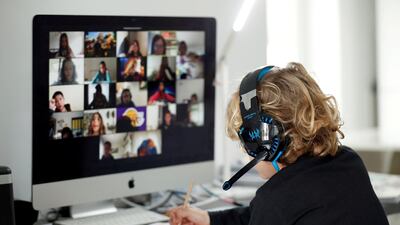

How do you Zoom? I had never even heard of Zoom a year ago but now it has become my new best friend – the online connection for webinars, interviews, podcasts, family gatherings, my children's piano lessons. What a joy, especially in lockdown to be able to connect live, work (sort of) and play. But then came a new question: Zoom etiquette.
At first I did not think of this at all. I set up my laptop at a desk where I write and there happen to be a lot of books on the shelves behind me. Then on one Zoom presentation with a number of other people, someone asked about the pictures on my bookshelf – who was that person over my left shoulder? What? Who?
It turned out to be a picture of my son, but I began to wake up to the risks that a space I had always considered private was now in some way in the public domain. And then came a real shock.
A British Cabinet minister Michael Gove, married to a newspaper columnist, Sarah Vine, were pilloried on social media for the content of their bookshelves. Was there some new kind of Zoom rules that needed to be kept? On my next Zoom call the presenter of a podcast asked if I had “any embarrassing material on my bookshelves.” On the Gove-Vine shelves were a couple of texts labelled by the Book Police as unwise, including one by the discredited historian David Irving.
Irving famously falsified the historical account from documents to – in essence – exculpate Hitler from the Holocaust. When he was discredited as a Holocaust denier, he sued Professor Deborah Lipstadt who had debunked his false account. She won in court.
I ended up interviewing Irving for the BBC where he protested that suing Professor Lipstadt was a matter of his freedom of speech. I pointed out that he was suing her to deny Professor Lipstadt's freedom of speech. He went very quiet at that point.
Historians – real historians – regard Irving as a dangerous charlatan. In our interview he turned out to be a hypocrite too. One professor of history I spoke to this week – on Zoom from Berlin, as it happens –said that he thought Irving’s books were a travesty of history because he was “not a real historian” and his books are worthless. I then consulted friends and relatives (again on Zoom) and asked their views. I haven’t any of Irving’s books but I did borrow some of his work in preparation for the interview.
The most useful advice came from a relative in the publishing industry. She pointed out that in video conferencing the private space has become public, therefore we need to “curate it” as if Zoom is a public event.

When I suggested that my study was private, she said, wisely, “not any more,” if I chose to let the cameras in. She used the analogy that we might slouch around the house in a dirty old tee shirt, but we would not wear those clothes to a public event, to appear on television or when making a speech. “Curating” the background for a Zoom meeting is therefore essential.
The professor of history I talked with from Berlin picked up his laptop to show me on camera the background he uses for important meetings – a plain white wall. Nothing to distract from what he said. My relative in publishing added that people judge others on their looks, their clothes, furnishings and therefore inevitably on the books they choose to present to the world.
When it comes to books, she said, this is not censorship. Read whatever books you like. But it is common sense not to put material behind you in public view to distract from what you are saying. I started to look round the books behind me, divided by genre – fiction, poetry, history, current affairs and reference or language books. Fiction, fine. Poetry, fine. History? Well, I have biographies on Hitler, Stalin, Napoleon and Mao Tse Tung as well as British prime ministers and US presidents.

But as I was rearranging the bookshelves I was alerted to something else. A website article offered different ways to arrange bookshelves. They included by genre, by colour, chronologically by period, alphabetically by author and then by value.
Each method says something about the human character. Do you regard books as an investment? Then arrange by value. Do you want to find various works? Bookshops use genre and then sub-divide alphabetically.
Sorting books into alphabetical order seems such a waste of time, unless you have thousands of titles. What about arranging bookshelves by colour? I have a friend who does this. She is a very smart and successful woman but – and I hope she doesn’t read this – if you really do sort books by colour, why do you need the words inside? Wouldn’t it be easier just to buy the covers? Oops. Sorry. Don’t judge a book by its cover – and please don’t judge me for saying so. But you will.
Gavin Esler is a journalist, author and presenter

