
In France, President Emmanuel Macron has announced that the strict lockdown imposed to tackle Covid-19 is to remain in place for another four weeks. Meanwhile, across the border in Spain – one of the European countries worst-hit by the pandemic – the government has taken the first tentative steps towards easing the lockdown by allowing certain industries, such as construction, to resume work.
It is a similar picture in Italy, another of France's near neighbours, where the authorities have allowed a modest number of shops, such as those selling baby clothes, to reopen as part of measures to ease the strictest lockdown regime seen in Europe.

Other countries are taking even bolder steps to revive economic activity, with Denmark leading the way by announcing that schools are to reopen, a move that is seen as an important development in beginning the long process of getting the country back to normal. Germany, the country whose measures to counter the Covid-19 outbreak have proved to be most effective in Europe, plans to ease its lockdown measures next week after Chancellor Angela Merkel ruled that most shops will be allowed to reopen their doors on Monday and millions of pupils will be allowed to go back to school at the beginning of May.
The stark contrast between those countries – such as France – that argue it is premature to ease the lockdown while the daily mortality rate from Covid-19 remains high throughout Europe, and those that believe the economic imperative for easing the restrictions cannot be ignored, indicates a sharp divergence of views among leaders over how best to deal with the biggest crisis the continent has faced since the Second World War.

It also shows that European governments are acting unilaterally, rather than co-ordinating their efforts, in accordance with the wishes of the European Union.
From the outset of the pandemic, the EU has struggled to cope with the enormity of the crisis. For example, the European Commission – the EU's executive branch – has attracted criticism for its failure to provide badly needed medical assistance to the worst-hit countries.
The 27-nation bloc's confused response has already resulted in one high-profile resignation. Professor Mauro Ferrari quit his position as President of the European Research Council last week after becoming frustrated with the bloc's refusal to set up a dedicated research programme into Covid-19.

In a blistering resignation letter, Prof Ferrari claimed there was “a complete absence of co-ordination of healthcare politics among member states".
Another area where the EU has been found wanting in its response to the crisis has been its attempts to put together a financial support package for member states such as Italy and Spain, which have seen their economies ravaged.
A meeting of EU finance ministers held to discuss setting up a coronavirus rescue package failed to reach agreement when wealthier northern states, led by the Netherlands, refused to back measures to help their less wealthy southern partners unless they agreed to punitive loan terms.
That failure has prompted Italian Prime Minister Giuseppe Conte to warn that the EU is in danger of collapse. "If we do not seize the opportunity to put new life into the European project, the risk of failure is real," Mr Conte warned.
The commission's President Ursula von der Leyen offered a "heartfelt apology" to Italy for not helping at the start of the crisis. But the EU’s shortcomings mean that the organisation now finds itself in the unhappy position of facing a crisis of credibility as the pandemic reaches a critical stage in the continent. For, instead of heeding the EU’s pleas for co-ordination, all the evidence suggests leaders are giving their own domestic concerns priority.
-
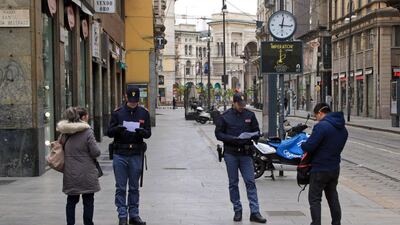
Italian police officers carry out document permit checks and self-certifications against citizens walking down in Torino street, Milan. EPA -
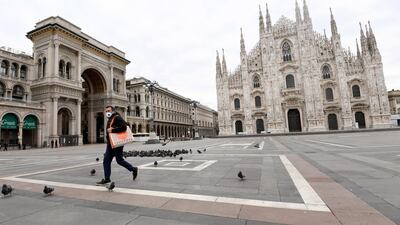
A man wearing a protective mask walks in the deserted Piazza Duomo (Cathedral Square), the symbol of the city. EPA -
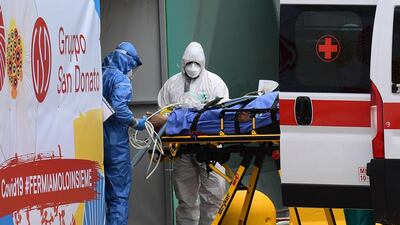
Medical workers stretch a patient from an Italian Red Cross ambulance into an intensive care unit set up in a sports center outside the San Raffaele hospital in Milan. AFP -
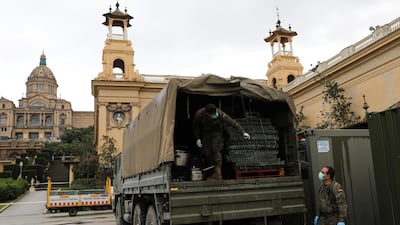
Members of the Logistics Brigade of the Spanish Army work to convert a Fira pavilion into a shelter center for homeless people in Barcelona. Reuters -
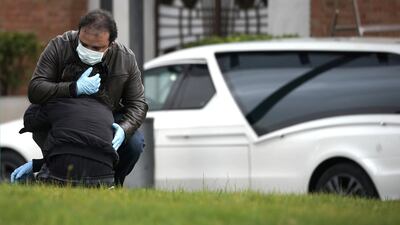
Relatives react next to a coffin of a person who died of coronavirus disease (COVID-19) at the crematorium of La Almudena cemetery during partial lockdown to combat the coronavirus disease (COVID-19) outbreak in Madrid, Spain, March 23, 2020. REUTERS/Juan Medina -
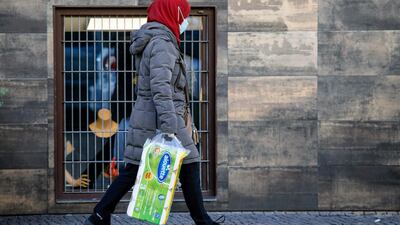
A woman wears a face mask as she carries a pack of toilet paper in Berlin's Kreuzberg district. AFP -
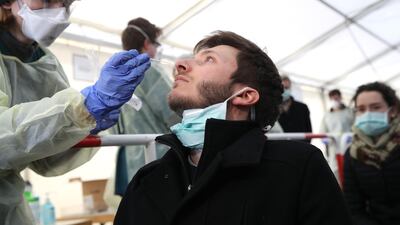
Medical personnel demonstrate taking nose and throat mucous samples for coronavirus testing in Munich, Germany. Getty Images -
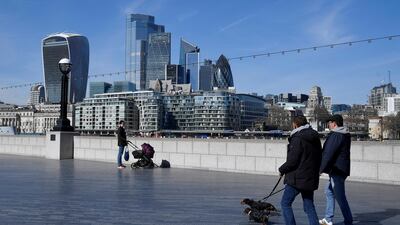
People walk their dogs in London. Reuters -
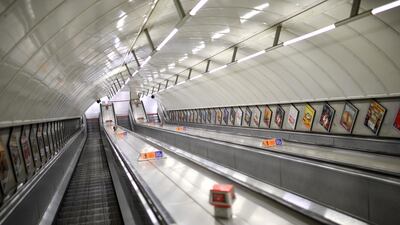
The deserted escalators inside Leicester Square underground station in central London. AFP -
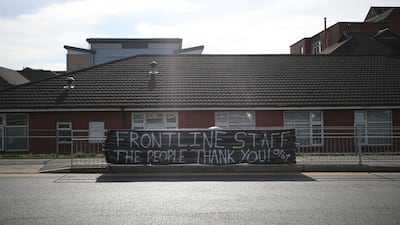
Banners showing support for NHS staff are displayed at Stepping Hill Hospital in Manchester. Reuters -
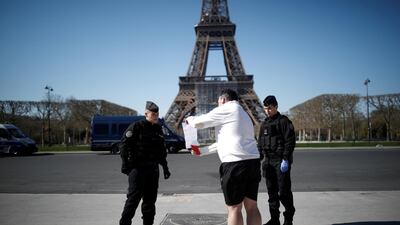
French Gendarmes control a man near the Eiffel tower in Paris. Reuters -
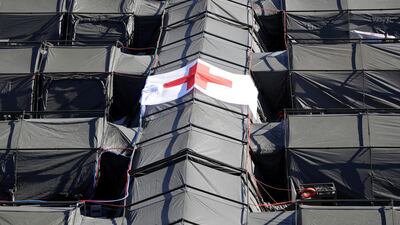
Tents with intensive care units installed by French Army are seen at a miitary field hospital near Mulhouse hospital. Reuters -
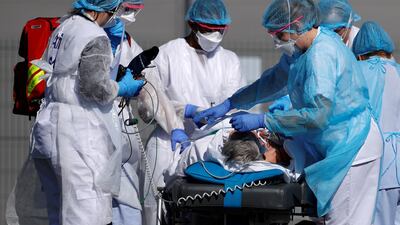
French rescue team wearing protective suits carry a patient on a stretcher from Mulhouse hospital. Reuters


The divergent approach being taken by many countries is certainly not ideal, as it raises the distinct possibility that, due to the lack of co-ordination between different governments, their actions could undermine the international effort against Covid-19. As an advisory note that the EU has recently circulated to member states warns, lack of co-ordination could “unavoidably lead to a corresponding increase in new cases".
The disinclination to act in concert also raises troubling questions about the survival of some of the EU’s fundamental principles, such as the single market, which requires all member states to conduct business on an equal footing.
The fact that some countries are allowing industries such as construction to resume working – as is the case in Spain – whereas other nations – such as France – have banned them during the lockdown, has created disparities that are likely to increase tensions between leaders in the months to come.
Brussels is belatedly trying to assert its authority in terms of co-ordinating the measures to end the lockdown, and is planning to present an EU-wide blueprint for lifting restrictions next week, which will call for national capitals to co-ordinate their exit strategies.
“At a minimum, member states should notify each other and the [European] Commission in due time before they lift measures and take into account their views,” the document is expected to recommend. “It is essential that there is a common approach and operating framework.”
The problem is that this intervention may have come too late as European leaders, dissatisfied with Brussels’ handling of the crisis, opt to take matters into their own hands.
Con Coughlin is the Telegraph’s defence and foreign affairs editor

