The government led by Hassan Diab will not succeed in rescuing the Lebanese economy as long as its touted reforms are tailored to suit the needs of Hezbollah and its regional allies – and as long as the Prime Minister's No 1 priority is to remain in power at any cost. This government is essentially a fig leaf for a coalition of political parties led by Hezbollah, an entity that is loyal to the Iranian regime in Tehran.
The assessment in the Iranian capital today, as I have been told, is that the country's economic problems are continuing to pose a grave threat to the regime's hold over power. It has therefore opted to direct public attention away from its internal challenges in two ways: engage in high-stakes military operations in the region that would compel the US to respond in ways that could potentially cost President Donald Trump his re-election chances this year; and mobilise a regional front in Iraq and Lebanon that is opposed to America.
Lebanon's Prime Minister Hassan Diab may be unpopular but he has the backing of Hezbollah. AFP
With Hezbollah being an important weapon in its arsenal, Tehran has two objectives that it is determined to achieve in Lebanon. First, it intends to help consolidate Hezbollah’s dominance over the country by overturning its banking system, market economy, political system and the constitution. Second, it hopes to eliminate all possibilities of a popular uprising demanding reform and accountability, as this could not only topple the corrupt ruling class in Beirut but also expose Hezbollah’s power structure to major risks – a red line for Tehran.
It is therefore important for European powers to stop advocating, as they have, for the Diab government to be given time and a chance to prove that it is serious about reforms. This is not a technocratic government, as it claims to be, but a single-shade establishment powered by Hezbollah and its ally the Free Patriotic Movement, which is represented by President Michel Aoun and his son-in-law Gebran Bassil.
It is clear to all sides that there is no way to rescue Lebanon from collapse except through serious negotiations with the IMF, which would unlock external funds conditioned on serious reforms.
Hezbollah has rejected Beirut’s co-operation with the organisation except on its own terms, endorsed by President Aoun and Mr Bassil; the latter is known to hold the keys to Lebanon’s energy sector. In other words, this axis is bent on cherry-picking only that part of the IMF’s advice which suits it, while preventing any scrutiny of the government’s books, especially in the energy sector that has bankrupted the state.
The IMF has so far resisted the government’s pleas, including one for assistance to cope with the coronavirus pandemic; Beirut had hoped that this could pave the way towards securing loans without having to meet previously set conditions. But I have been reliably informed that the IMF’s response was to point to Lebanon’s default on its eurobonds as a reason for it to reject its request.
The key to foreign aid is clear: serious negotiations must be held with the IMF with a proven commitment to comprehensive reforms – not selective adjustments that overlook certain sectors for political reasons.
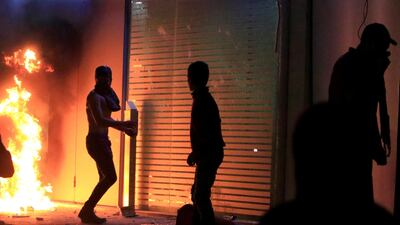
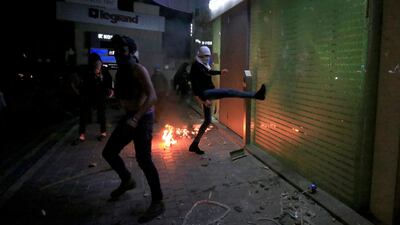
A demonstrator is seen next to a burning fire in front of a bank during a protest against growing economic hardship in Sidon, Lebanon. Reuters
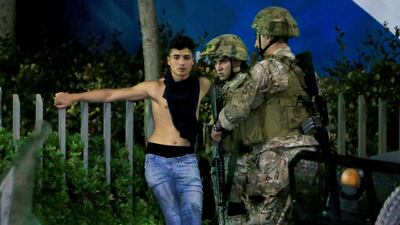
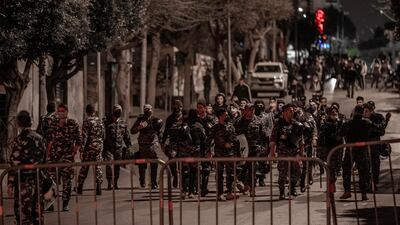
A detained demonstrator stands near Lebanese army soldiers during a protest against growing economic hardship in Sidon, Lebanon. Reuters
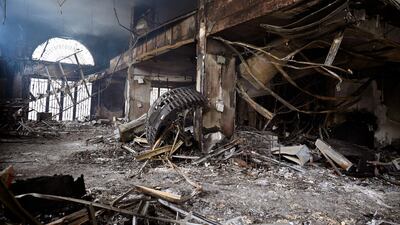
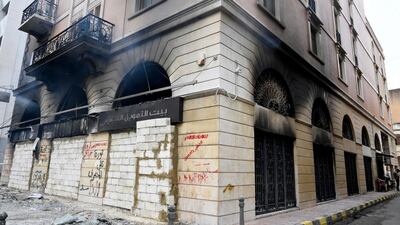
Interior view of a damaged bank that was set ablaze by protesters in Tripoli, northern Lebanon. EPA
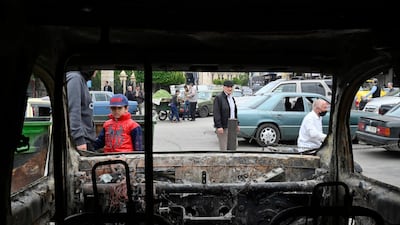
Lebanese people inspect a burnt out car of the Lebanese Internal Security Forces which was set ablaze by protesters in Tripoli, northern Lebanon. EPA
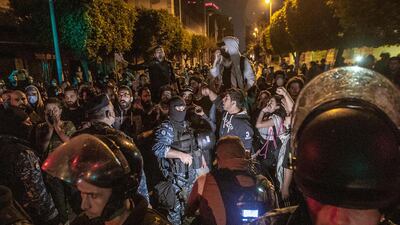
Anti-government protesters shout slogans during a protest against the collapsing Lebanese currency and the price hikes of goods, in front the central bank in Beirut, Lebanon. EPA
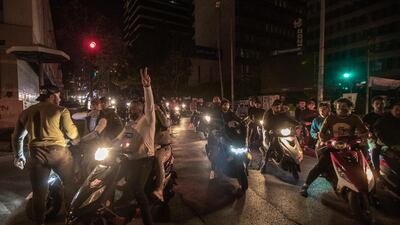
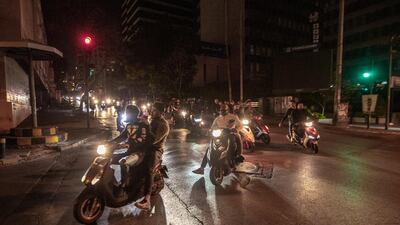
Anti-government protesters ride their motorcycles during a protest against the collapsing Lebanese currency and the price hikes of goods, in front the central bank in Beirut, Lebanon. EPA
Lebanese men inspect a burnt out car of the Lebanese Internal Security Forces which was set ablaze by protesters in Tripoli, northern Lebanon. EPA
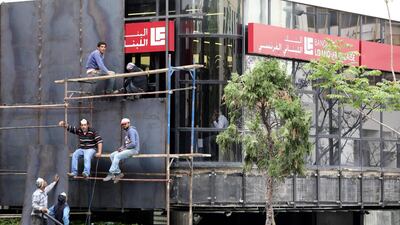
Workers install metallic barriers on the facade of a bank as a protective measure against vandalism in Tripoli, northern Lebanon. EPA
Exterior view of a damaged bank that was set ablaze by protesters in Tripoli, northern Lebanon. EPA
Workers install metallic barriers along the facade of a bank as a protective measure against vandalism in the Lebanese capital Beirut. AFP
Anti-government protesters shout slogans during a protest against the collapsing Lebanese currency and the price hikes of goods, in front the central bank in Beirut, Lebanon. EPA
Lebanese riot control police watch as annti-government protesters gather during a demonstration against the collapsing Lebanese currency and the price hikes of goods, in Beirut, Lebanon. EPA
Anti-government protesters ride their motorcycles during a protest against the collapsing Lebanese currency and the price hikes of goods, in front the central bank in Beirut, Lebanon. EPA
A demonstrator smashes a window of a bank during a protest against growing economic hardship in Sidon, Lebanon. Reuters
Meanwhile, even as public anger continues to evidently grow on the streets, most of that focus seems to be directed at the banking sector. It should be stated that banks are not immune from the kind of political deal-making that has brought Lebanon to the brink of economic collapse. It is therefore the right of the citizens to hold accountable the Central Bank and its governor –as is currently the case– but this suits the Diab government.
First, it helps to deflect public fury away from itself. Second, it feeds into the narrative that Lebanon’s system that is based on constitutional and economic freedoms needs to be overturned. By trying to force a break away from existing financial and banking regulations, Hezbollah hopes to seize dollars from these banks and build for itself a foreign currency war chest that it can use to sponsor its regional battles. This puts the country in a dangerous situation.
Making this crisis worse is the spread of the coronavirus, which has not only claimed lives and livelihoods and destroyed the economy, but also left global powers preoccupied with more pressing priorities in their backyards. Of course, even as Lebanon is left to its own devices, one positive development has come in the form of Germany’s decision last week to put a stop on all Hezbollah activities on its soil and designate it a terrorist organisation.
The Trump administration, while seemingly less focused on Hezbollah than it is on its patrons in Tehran, is planning additional sanctions on Iran in the coming weeks. This move, as I have been told, could prompt Tehran to launch some form of military action as a show of force.
In the coming days and weeks, therefore, the difficulties for both Iran and Lebanon are set to increase. And as we expect an escalation in tensions, the dollar will become an ever more important weapon.
Raghida Dergham is the founder and executive chairwoman of the Beirut Institute

50-man Royal Rumble - names entered so far include Braun Strowman, Daniel Bryan, Kurt Angle, Big Show, Kane, Chris Jericho, The New Day and Elias
Universal Championship Brock Lesnar (champion) v Roman Reigns in a steel cage match
WWE World Heavyweight ChampionshipAJ Styles (champion) v Shinsuke Nakamura
Intercontinental Championship Seth Rollins (champion) v The Miz v Finn Balor v Samoa Joe
United States Championship Jeff Hardy (champion) v Jinder Mahal
SmackDown Tag Team Championship The Bludgeon Brothers (champions) v The Usos
Raw Tag Team Championship (currently vacant) Cesaro and Sheamus v Matt Hardy and Bray Wyatt
Casket match The Undertaker v Chris Jericho
Singles match John Cena v Triple H
Cruiserweight Championship Cedric Alexander v tba
Some of Darwish's last words
"They see their tomorrows slipping out of their reach. And though it seems to them that everything outside this reality is heaven, yet they do not want to go to that heaven. They stay, because they are afflicted with hope." - Mahmoud Darwish, to attendees of the Palestine Festival of Literature, 2008
His life in brief: Born in a village near Galilee, he lived in exile for most of his life and started writing poetry after high school. He was arrested several times by Israel for what were deemed to be inciteful poems. Most of his work focused on the love and yearning for his homeland, and he was regarded the Palestinian poet of resistance. Over the course of his life, he published more than 30 poetry collections and books of prose, with his work translated into more than 20 languages. Many of his poems were set to music by Arab composers, most significantly Marcel Khalife. Darwish died on August 9, 2008 after undergoing heart surgery in the United States. He was later buried in Ramallah where a shrine was erected in his honour.
Graduated from the American University of Sharjah
She is the eldest of three brothers and two sisters
Has helped solve 15 cases of electric shocks
Enjoys travelling, reading and horse riding
Kanguva
Director: Siva
Stars: Suriya, Bobby Deol, Disha Patani, Yogi Babu, Redin Kingsley
Rating: 2/5
Infiniti QX80 specs
Engine: twin-turbocharged 3.5-liter V6
Power: 450hp
Torque: 700Nm
Price: From Dh450,000, Autograph model from Dh510,000
Salman Khan’s father, Salim Khan, is one of Bollywood’s most legendary screenwriters. Through his partnership with co-writer Javed Akhtar, Salim is credited with having paved the path for the Indian film industry’s blockbuster format in the 1970s. Something his son now rules the roost of. More importantly, the Salim-Javed duo also created the persona of the “angry young man” for Bollywood megastar Amitabh Bachchan in the 1970s, reflecting the angst of the average Indian. In choosing to be the ordinary man’s “hero” as opposed to a thespian in new Bollywood, Salman Khan remains tightly linked to his father’s oeuvre. Thanks dad.
The specs: 2018 Nissan Patrol Nismo
Price: base / as tested: Dh382,000
Engine: 5.6-litre V8
Gearbox: Seven-speed automatic
Power: 428hp @ 5,800rpm
Torque: 560Nm @ 3,600rpm
Fuel economy, combined: 12.7L / 100km
FIXTURES
Monday, January 28
Iran v Japan, Hazza bin Zayed Stadium (6pm)
Tuesday, January 29
UAEv Qatar, Mohamed Bin Zayed Stadium (6pm)
Friday, February 1
Final, Zayed Sports City Stadium (6pm)
1. Mathieu van der Poel (NED) Alpecin-Fenix - 3:45:47
2. David Dekker (NED) Jumbo-Visma - same time
3. Michael Morkov (DEN) Deceuninck-QuickStep
4. Emils Liepins (LAT) Trek-Segafredo
5. Elia Viviani (ITA) Cofidis
6. Tadej Pogacar (SLO UAE Team Emirates
7. Anthony Roux (FRA) Groupama-FDJ
8. Chris Harper (AUS) Jumbo-Visma - 0:00:03
9. Joao Almeida (POR) Deceuninck-QuickStep
10. Fausto Masnada (ITA) Deceuninck-QuickStep
MATCH INFO
What: 2006 World Cup quarter-final When: July 1 Where: Gelsenkirchen Stadium, Gelsenkirchen, Germany
Result:
England 0 Portugal 0
(Portugal win 3-1 on penalties)
Tailors and retailers miss out on back-to-school rush
Tailors and retailers across the city said it was an ominous start to what is usually a busy season for sales.
With many parents opting to continue home learning for their children, the usual rush to buy school uniforms was muted this year.
“So far we have taken about 70 to 80 orders for items like shirts and trousers,” said Vikram Attrai, manager at Stallion Bespoke Tailors in Dubai.
“Last year in the same period we had about 200 orders and lots of demand.
“We custom fit uniform pieces and use materials such as cotton, wool and cashmere.
“Depending on size, a white shirt with logo is priced at about Dh100 to Dh150 and shorts, trousers, skirts and dresses cost between Dh150 to Dh250 a piece.”
A spokesman for Threads, a uniform shop based in Times Square Centre Dubai, said customer footfall had slowed down dramatically over the past few months.
“Now parents have the option to keep children doing online learning they don’t need uniforms so it has quietened down.”
Test
Director: S Sashikanth
Cast: Nayanthara, Siddharth, Meera Jasmine, R Madhavan
Group A: Sri Lanka, PNG, Ireland, Oman Group B: Bangladesh, Netherlands, Namibia, Scotland
The specs: 2018 Volkswagen Teramont
Price, base / as tested Dh137,000 / Dh189,950
Engine 3.6-litre V6
Gearbox Eight-speed automatic
Power 280hp @ 6,200rpm
Torque 360Nm @ 2,750rpm
Fuel economy, combined 11.7L / 100km
Mercer, the investment consulting arm of US services company Marsh & McLennan, expects its wealth division to at least double its assets under management (AUM) in the Middle East as wealth in the region continues to grow despite economic headwinds, a company official said.
Mercer Wealth, which globally has $160 billion in AUM, plans to boost its AUM in the region to $2-$3bn in the next 2-3 years from the present $1bn, said Yasir AbuShaban, a Dubai-based principal with Mercer Wealth.
“Within the next two to three years, we are looking at reaching $2 to $3 billion as a conservative estimate and we do see an opportunity to do so,” said Mr AbuShaban.
Mercer does not directly make investments, but allocates clients’ money they have discretion to, to professional asset managers. They also provide advice to clients.
“We have buying power. We can negotiate on their (client’s) behalf with asset managers to provide them lower fees than they otherwise would have to get on their own,” he added.
Mercer Wealth’s clients include sovereign wealth funds, family offices, and insurance companies among others.
From its office in Dubai, Mercer also looks after Africa, India and Turkey, where they also see opportunity for growth.
Wealth creation in Middle East and Africa (MEA) grew 8.5 per cent to $8.1 trillion last year from $7.5tn in 2015, higher than last year’s global average of 6 per cent and the second-highest growth in a region after Asia-Pacific which grew 9.9 per cent, according to consultancy Boston Consulting Group (BCG). In the region, where wealth grew just 1.9 per cent in 2015 compared with 2014, a pickup in oil prices has helped in wealth generation.
BCG is forecasting MEA wealth will rise to $12tn by 2021, growing at an annual average of 8 per cent.
Drivers of wealth generation in the region will be split evenly between new wealth creation and growth of performance of existing assets, according to BCG.
Another general trend in the region is clients’ looking for a comprehensive approach to investing, according to Mr AbuShaban.
“Institutional investors or some of the families are seeing a slowdown in the available capital they have to invest and in that sense they are looking at optimizing the way they manage their portfolios and making sure they are not investing haphazardly and different parts of their investment are working together,” said Mr AbuShaban.
Some clients also have a higher appetite for risk, given the low interest-rate environment that does not provide enough yield for some institutional investors. These clients are keen to invest in illiquid assets, such as private equity and infrastructure.
“What we have seen is a desire for higher returns in what has been a low-return environment specifically in various fixed income or bonds,” he said.
“In this environment, we have seen a de facto increase in the risk that clients are taking in things like illiquid investments, private equity investments, infrastructure and private debt, those kind of investments were higher illiquidity results in incrementally higher returns.”
The Abu Dhabi Investment Authority, one of the largest sovereign wealth funds, said in its 2016 report that has gradually increased its exposure in direct private equity and private credit transactions, mainly in Asian markets and especially in China and India. The authority’s private equity department focused on structured equities owing to “their defensive characteristics.”
If you go
The flights
Etihad and Emirates fly direct from the UAE to Chicago from Dh5,215 return including taxes.
The hotels
Recommended hotels include the Intercontinental Chicago Magnificent Mile, located in an iconic skyscraper complete with a 1929 Olympic-size swimming pool from US$299 (Dh1,100) per night including taxes, and the Omni Chicago Hotel, an excellent value downtown address with elegant art deco furnishings and an excellent in-house restaurant. Rooms from US$239 (Dh877) per night including taxes.
Starring: Walton Goggins, Jason Isaacs, Natasha Rothwell
Rating: 4.5/5
Who was Alfred Nobel?
The Nobel Prize was created by wealthy Swedish chemist and entrepreneur Alfred Nobel.
In his will he dictated that the bulk of his estate should be used to fund "prizes to those who, during the preceding year, have conferred the greatest benefit to humankind".
Nobel is best known as the inventor of dynamite, but also wrote poetry and drama and could speak Russian, French, English and German by the age of 17. The five original prize categories reflect the interests closest to his heart.
Nobel died in 1896 but it took until 1901, following a legal battle over his will, before the first prizes were awarded.