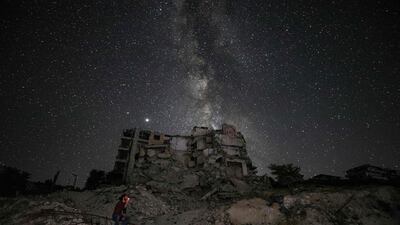
Buildings destroyed by prior bombardment in the town of Ariha in Syria's rebel-held north-western Idlib province. AFP

How Biden can help resolve the Syrian crisis


  • English
  • Arabic

Joe Biden's victory in the recent US presidential election brings a degree of unease to many Syrians. They are concerned that the incoming administration will repeat the flawed foreign policy pursued by the Obama administration towards their war-ravaged country between 2011 and 2017.

President-elect Biden, who will be sworn in on January 20, has made it clear that he wants to rejoin the Iran nuclear deal, which Barack Obama had signed in 2015 and which his successor Donald Trump walked out of two years ago. This then begs the following question: will the Syrian people pay the price for US-Iran rapprochement once again?

Mr Obama's handling of the Syrian conflict was poor, to say the least. His "red line" threat did little to deter President Bashar Al Assad, who used chemical weapons against his own civilians. Mr Al Assad's military operations went on to displace millions of ordinary Syrians – thereby creating one of the largest humanitarian crises since the Second World War – and his regime destroyed much of the country. He also turned a blind eye to ISIS' expansion across the region. Even as American influence waned in parts of the region, the Assad regime was propped up by Iranian and Russian military support.

Then US president Barack Obama and his vice president Joe Biden crafted Middle East policy that proved to be flawed. Reuters

Mr Obama also used the Kurdish Workers' Party (PKK) – which neighbouring Turkey considers a terrorist organisation – for the purpose of defeating ISIS in north-eastern Syria. This helped further destabilise the region, as the PKK was also involved in a conflict with the Arab populations living there. Mr Obama's strategy would have been more effective had he partnered with local Kurdish and Arab populations who had suffered ISIS' terror.

All this happened at a time when the Obama administration was engaging with Iran and negotiating a deal over its nuclear programme. The message to the American public – and to the foreign policy establishment in Washington – was that the agreement was tailored to deter Tehran's nuclear ambitions but did not preclude confronting the regime on other issues, including its destabilising activities in countries such as Syria. However, the reality was completely different. In order to make this deal materialise, the president made geopolitical concessions, allowing the regime to expand in Syria and turning a blind eye to Mr Al Assad's atrocities. He also provided little support to Syrian grassroots groups that were essentially demanding dignity, human rights and democracy – core American principles.

In contrast, the outgoing Trump administration considered Syria to be within Iran's sphere of influence and used it as a lever to apply pressure – albeit haphazardly – on Tehran. It curbed Iran's regional influence and imposed costs by way of economic sanctions on the Assad regime and its backers. Israel, meanwhile, carried out military attacks on Iranian facilities inside Syria.

The Syrian regime led by Bashar Al Assad has all but defeated rebel forces since war erupted in 2011. AP Photo

These campaigns have left the Assad regime's backers under enormous military and economic pressure. These backers have also failed to rally the international community to aid Syria's reconstruction, which would have eased their own financial burden and helped normalise the Assad regime in the eyes of the world.

Mr Biden's position on Syria is ambiguous. His team has released two documents devoted to foreign policy. But they shed little light on America's approach towards the Assad regime or with regard to the ongoing refugee crisis, which has had a ripple effect across the globe. These documents, however, do articulate a clear policy vis-a-vis Iran – and that includes re-engagement with Tehran with the purpose of securing a new nuclear agreement.

Due to the coronavirus pandemic and its economic impact in the US, domestic affairs will be of greater priority for a Biden administration, at least in the early days. However, with the Iranian regime also unlikely to engage with the US until after its own presidential election in June, it would be prudent for the new president to deal with Syria in the interim.

The incoming administration certainly needs a different approach to the Syrian crisis. A clear strategy will reassure Syrians, and Arabs more broadly, that the US is looking to lead by example again. It should be clear that it will not tolerate human rights abuses or violations of international law, both of which have come to define a decade of conflict. A strong response vis-a-vis Syria will also send a signal to members of the so-called Astana Process that the US is serious about the country's future, and that they will all need to come to the table to support a negotiated political settlement to the conflict.

Furthermore, the incoming administration should be clear with Iran that no new deal will be signed at the expense of Syria's future or that of its displaced people.

I hope the Biden team builds on the Trump administration's aforementioned achievements in Syria, while making a push for the implementation of the UN Security Council resolutions pertaining to the country and using them as pre-conditions for reconstruction. Economic sanctions on – and the political isolation of – the Assad regime must remain in place. The new administration should also demand the withdrawal of the various armies and militias operating in the country, and hold the Assad regime accountable for the crimes it has committed against civilians.

Finally, and most importantly, I hope the new administration will work closer with the UN, the European Union and all the region's stakeholders to empower those Syrians living outside the regime-controlled areas of the country, and in neighbouring countries. Empowering the Syrian people is the only way for the world to confront extremists and opportunists, as well as standing up to Mr Al Assad's policies, which have, fuelled extremism and sectarianism in the country.

Bassam Barabandi is a former Syrian diplomat

NO OTHER LAND

Director: Basel Adra, Yuval Abraham, Rachel Szor, Hamdan Ballal

Stars: Basel Adra, Yuval Abraham

Rating: 3.5/5

SPEC SHEET

Display: 6.8" edge quad-HD  dynamic Amoled 2X, Infinity-O, 3088 x 1440, 500ppi, HDR10 , 120Hz

Processor: 4nm Snapdragon 8 Gen 1/Exynos 2200, 8-core

Memory: 8/12GB RAM

Storage: 128/256/512GB/1TB

Platform: Android 12

Main camera: quad 12MP ultra-wide f/2.2, 108MP wide f/1.8, 10MP telephoto f/4.9, 10MP telephoto 2.4; Space Zoom up to 100x, auto HDR, expert RAW

Video: 8K@24fps, 4K@60fps, full-HD@60fps, HD@30fps, super slo-mo@960fps

Front camera: 40MP f/2.2

Battery: 5000mAh, fast wireless charging 2.0 Wireless PowerShare

Connectivity: 5G, Wi-Fi, Bluetooth 5.2, NFC

I/O: USB-C

SIM: single nano, or nano and SIM, nano and nano, eSIM/nano and nano

Colours: burgundy, green, phantom black, phantom white, graphite, sky blue, red

Price: Dh4,699 for 128GB, Dh5,099 for 256GB, Dh5,499 for 512GB; 1TB unavailable in the UAE

The specs

Engine: 4.0-litre V8 twin-turbocharged and three electric motors

Power: Combined output 920hp

Torque: 730Nm at 4,000-7,000rpm

Transmission: 8-speed dual-clutch automatic

Fuel consumption: 11.2L/100km

On sale: Now, deliveries expected later in 2025

Price: expected to start at Dh1,432,000

Ferrari 12Cilindri specs

Engine: naturally aspirated 6.5-liter V12

Power: 819hp

Torque: 678Nm at 7,250rpm

Price: From Dh1,700,000

Available: Now

HAJJAN
%3Cp%3EDirector%3A%20Abu%20Bakr%20Shawky%C2%A0%3C%2Fp%3E%0A%3Cp%3E%3Cbr%3EStarring%3A%20Omar%20Alatawi%2C%20Tulin%20Essam%2C%20Ibrahim%20Al-Hasawi%C2%A0%3C%2Fp%3E%0A%3Cp%3E%3Cbr%3ERating%3A%204%2F5%3C%2Fp%3E%0A
The specs

Engine: 3.8-litre twin-turbo flat-six

Power: 650hp at 6,750rpm

Torque: 800Nm from 2,500-4,000rpm

Transmission: 8-speed dual-clutch auto

Fuel consumption: 11.12L/100km

Price: From Dh796,600

On sale: now

SCHEDULE

Saturday, April 20: 11am to 7pm - Abu Dhabi World Jiu-Jitsu Festival and Para jiu-jitsu.

Sunday, April 21: 11am to 6pm - Abu Dhabi World Youth (female) Jiu-Jitsu Championship.

Monday, April 22: 11am to 6pm - Abu Dhabi World Youth (male) Jiu-Jitsu Championship.

Tuesday, April 23: 11am-6pm Abu Dhabi World Masters Jiu-Jitsu Championship.

Wednesday, April 24: 11am-6pm Abu Dhabi World Professional Jiu-Jitsu Championship.

Thursday, April 25: 11am-5pm Abu Dhabi World Professional Jiu-Jitsu Championship.

Friday, April 26: 3pm to 6pm Finals of the Abu Dhabi World Professional Jiu-Jitsu Championship.

Saturday, April 27: 4pm and 8pm awards ceremony.

The five pillars of Islam

1. Fasting 

2. Prayer 

3. Hajj 

4. Shahada 

5. Zakat 

Zakat definitions

Zakat: an Arabic word meaning ‘to cleanse’ or ‘purification’.

Nisab: the minimum amount that a Muslim must have before being obliged to pay zakat. Traditionally, the nisab threshold was 87.48 grams of gold, or 612.36 grams of silver. The monetary value of the nisab therefore varies by current prices and currencies.

Zakat Al Mal: the ‘cleansing’ of wealth, as one of the five pillars of Islam; a spiritual duty for all Muslims meeting the ‘nisab’ wealth criteria in a lunar year, to pay 2.5 per cent of their wealth in alms to the deserving and needy.

Zakat Al Fitr: a donation to charity given during Ramadan, before Eid Al Fitr, in the form of food. Every adult Muslim who possesses food in excess of the needs of themselves and their family must pay two qadahs (an old measure just over 2 kilograms) of flour, wheat, barley or rice from each person in a household, as a minimum.

Emergency

Director: Kangana Ranaut

Stars: Kangana Ranaut, Anupam Kher, Shreyas Talpade, Milind Soman, Mahima Chaudhry 

Rating: 2/5

Race card

5.30pm: Maiden (TB) Dh82,500 (Turf) 1,400m

6.05pm: Handicap (TB) Dh87,500 (T) 1,400m

6.40pm: Handicap (TB) Dh105,000 (Dirt) 1,400m

7.15pm: Handicap (TB) Dh105,000 (T) 1,200m

7.50pm: Longines Stakes – Conditions (TB) Dh120,00 (D) 1,900m

8.25pm: Zabeel Trophy – Rated Conditions (TB) Dh120,000 (T) 1,600m

9pm: Handicap (TB) Dh105,000 (T) 2,410m

9.35pm: Handicap (TB) Dh92,500 (T) 2,000m

The National's picks

4.35pm: Tilal Al Khalediah
5.10pm: Continous
5.45pm: Raging Torrent
6.20pm: West Acre
7pm: Flood Zone
7.40pm: Straight No Chaser
8.15pm: Romantic Warrior
8.50pm: Calandogan
9.30pm: Forever Young

COMPANY%20PROFILE%20
%3Cp%3E%3Cstrong%3ECompany%20name%3A%20%3C%2Fstrong%3EAlmouneer%3Cbr%3E%3Cstrong%3EStarted%3A%3C%2Fstrong%3E%202017%3Cbr%3E%3Cstrong%3EFounders%3A%3C%2Fstrong%3E%20Dr%20Noha%20Khater%20and%20Rania%20Kadry%3Cbr%3E%3Cstrong%3EBased%3A%20%3C%2Fstrong%3EEgypt%3Cbr%3E%3Cstrong%3ENumber%20of%20staff%3A%20%3C%2Fstrong%3E120%3Cbr%3E%3Cstrong%3EInvestment%3A%20%3C%2Fstrong%3EBootstrapped%2C%20with%20support%20from%20Insead%20and%20Egyptian%20government%2C%20seed%20round%20of%20%3Cbr%3E%243.6%20million%20led%20by%20Global%20Ventures%3Cbr%3E%3C%2Fp%3E%0A
Other key dates
  • Finals draw: December 2
  • Finals (including semi-finals and third-placed game): June 5–9, 2019
  • Euro 2020 play-off draw: November 22, 2019
  • Euro 2020 play-offs: March 26–31, 2020
