
In the era of the forever wars, politicians are ill-advised to bandy ideas that their country is inevitably bound for all-out conflict. That was exactly the position of France as the baleful month of October drew to a close in a bout of blood letting.
There is a sense of a country besieged in itself. France views itself as first among the secular nations and its challenges are particularly acute, particularly because the tensions over its government’s policies are both domestic and foreign.
To provide context, French President Emmanuel Macron last week defended a French schoolteacher who was beheaded by a teenage extremist after showing his students offensive cartoons of the Prophet Mohammed, which are considered blasphemous under Islam, during a class on freedom of expression. This led to widespread condemnation in many parts of the world and calls for a boycott of French products. Meanwhile, a man armed with knives killed three people at a church in Nice in the first of four terror attacks that unfolded in four hours on Thursday in Avignon, Lyon and Paris.
The timing of the spate of attacks is no coincidence. President Macron recently proposed an overhaul of the laws of laicite, which level to nothing any access or acknowledgement of a religious role in state-funded life. The law guaranteeing this dates back to 1905.
Why then is France often singled out? Indeed, it is shocking to read that 250 people have been killed there in the past five years. Moreover, the toll of killing that France has suffered over the past five years has been out of kilter with any other country outside the Middle East.
-
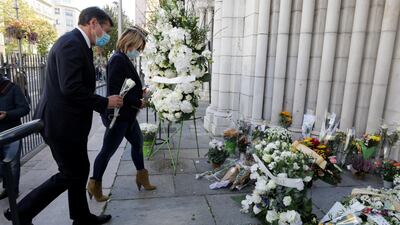
Mayor of Nice Christian Estrosi and his wife Laura pay tribute to the victims of a deadly knife attack at the Notre Dame church in Nice. Reuters -
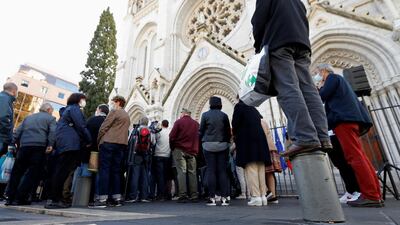
People gather in front of the Notre Dame church. Reuters -
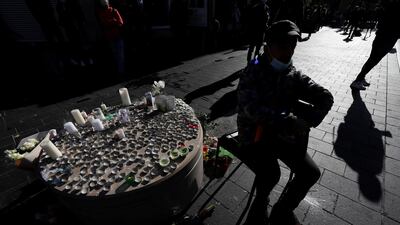
A man sits near candles and flowers placed in tribute to the victims. Reuters -
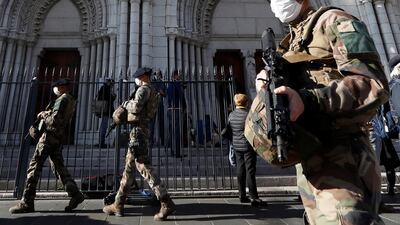
French soldiers patrol near the Notre Dame church. Reuters -
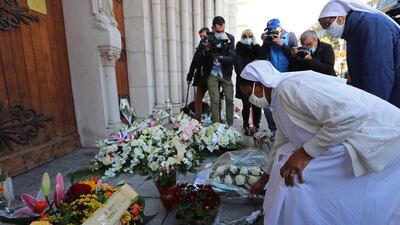
Two nuns lay flowers in front of the church in Nice. AFP -
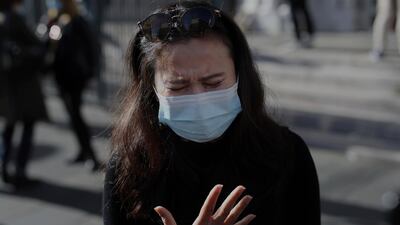
A woman cries as she speaks to reporters. AP Photo -
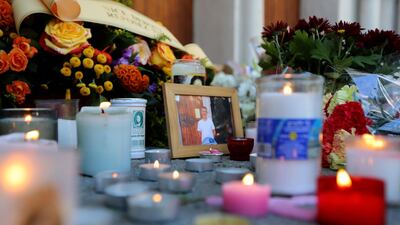
Tributes to one of the victims outside the church. AFP -
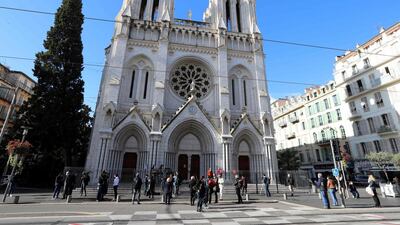
The scene outside the Notre Dame church on Friday morning. AFP -
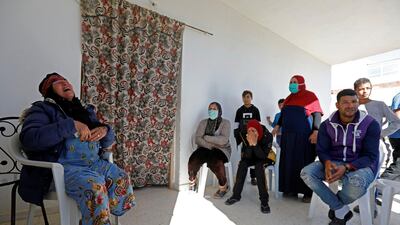
Gamra, the mother of Brahim Aouissaoui, who is suspected of carrying out Thursday's attack in Nice, reacts at her home in Tunisia. Reuters -

The Family home of Brahim Aouissaoui in Thina, a suburb of Sfax, Tunisia. Reuters


It is not just the number of deaths but their unrelenting regularity that has marked France out. The rhythm of this loss has come in a pattern of bursts of violence. From the first months of 2015 to the most recent set of outrages, the country has been on edge. It seems as if the next attack – one that justifies the armed patrols in the streets and other disconcerting controls – is just days or weeks away.
The particular choice of killing by beheading is worth dwelling on. It maximises the outrage over the terror attacks and resonates far and wide. It also underlines the fact that France is marked for punishment by the radicalised fighters of ISIS and Al Qaeda.
The immediate aftermath of the attacks is a time for heightened emotions but also essential truths.
As towns such as Nice fall victim to the surge of hatred pulsing through the country, the poignancy of local tragedy is spotlighted. The truck attack that mowed promenaders down in 2016 struck at the heart of the city's identity. It is a sun-blessed spot where the ideals of leisure and indulgence reign supreme. Troubles appear the antithesis of its ethos.
Yet behind the glitz, there is another Nice. It is also a trailblazer for a securitised response to terror. It has earned the moniker "surveillance city" following the installation of almost 4,000 cameras. Still, the algorithm-based network was not tight enough to stop a repeat attack.
Nice is just one facet of how France as a nation is on a difficult journey.
Britain and Germany have also suffered attacks, and extremism poses a challenge to those countries, too.
The French response to the attacks, however, has enveloped its politics in a uniquely overwhelming way. This has allowed the agitators, who nourish and promote the extremists, purchase within the country’s own political debate. It also means that leaders such as Mr Macron cannot acknowledge the depth of pain and anger that triggers demonstrations against their country.
The cost to the French standing around the world has been considerable.
Within Europe there has been an expression of solidarity by the leaders of other states. At a time of loss of life, and while the grips of terror are still being exercised, the need to express sorrow and sympathy is paramount. At the same time there is an acknowledgement that the issues in Paris run particularly deep.
-

People gather on Place de la Republique in Paris in homage to history teacher Samuel Paty two days after he was beheaded by an attacker who was shot dead by policemen. AFP -
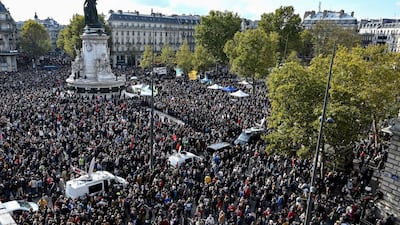
The murder has shocked France and politicians of all stripes attended the Paris rally. AFP -
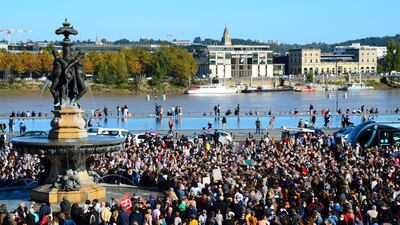
In Bordeaux, people gather on Place de la Bourse. AFP -
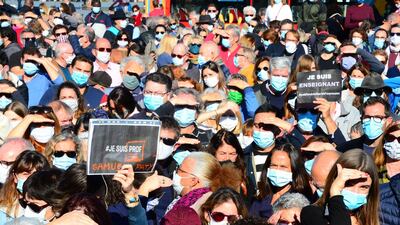
A person holds a placard reading 'I am a teacher' as people gather on Place de la Bourse. AFP -
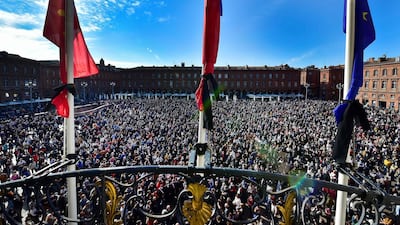
Flags at city hall are at half-mast as people gather in Place du Capitole in Toulouse. AFP -
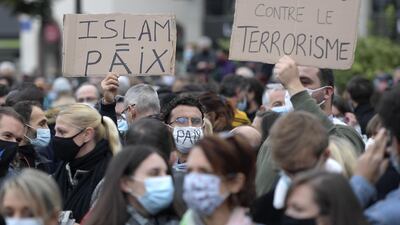
People hold placards reading 'Islam = peace' and 'Muslims against terrorism' as they gather in Strasbourg. AFP -
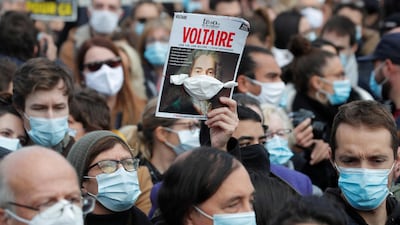
Samuel Paty, was killed in the Paris suburb of Conflans-Sainte-Honorine. Reuters -
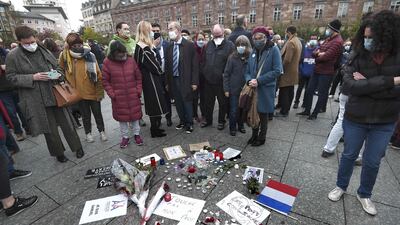
People stand near flowers and placards reading 'I am Samuel' and 'Don't touch my teacher' at a rally in Strasbourg. AFP -
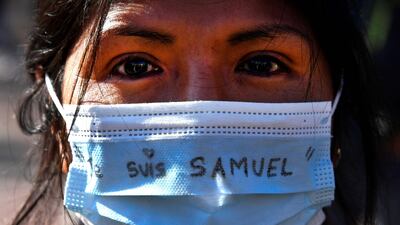
A person wears a prtotective face mask with an inscription reading 'I am Samuel'. AFP -
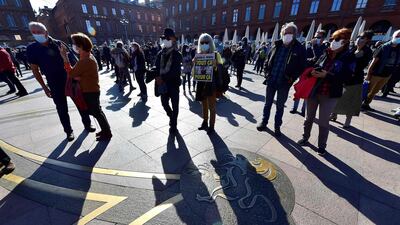
History teacher Samuel Paty was killed on Friday. AFP -

People gather at the Place de la Republique in Paris. Reuters -
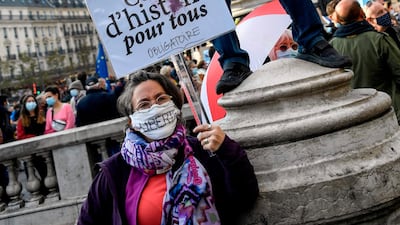
A woman holds a placard reading 'History course for eveyone' and a man holds a French flag on Place de la Republique in Paris. AFP


As it is buffeted by grief and loss, the onus on France is to be mindful of the balancing act it performed once before. It sought to carve out the autonomy for French state in 1905 from the overwhelming dominance of the Catholic Church. More than a century ago, it acted explicitly not to repress beliefs held by individuals or the wider practice of religion.
Back then it was seeking to define clericalism as the force it wanted to ring fence. And it did not seek to tamp down the beliefs of its citizens. A new way emerged to insulate schools or the medical profession from the interference and strictures of the priests or other religious figures. Creating a code of rules and regulations brought modern bureaucratic rules to institutions while not impinging on the individuals.
The republican principles laid down then can be adapted by law as Mr Macron suggests, but his France has very little margin to manoeuvre.
Damien McElroy is the London bureau chief of The National

