People hold a candlelight vigil in support of sexual assault victims and against the alleged rape and murder of a 27-year-old veterinary doctor in Hyderabad, in Bangalore. AFP
A policeman walks past as people hold a candlelight vigil in support of sexual assault victims and against the alleged rape and murder of a 27-year-old veterinary doctor in Hyderabad, in Bangalore. AFP
People hold a candlelight vigil in support of sexual assault victims and against the alleged rape and murder of a 27-year-old veterinary doctor in Hyderabad, in Bangalore. AFP
No one could have failed to have been horrified by the gang-rape and murder of a 27-year-old vet in Hyderabad, India, ambushed as she made her way home. Nor would anyone doubt the anguish felt by her family, or her father's sentiment that "justice was done to my daughter, at last" on hearing that the four suspects had been shot and killed by police while allegedly trying to escape. The rape and murder, almost exactly seven years after a 23-year-old student was attacked by a gang on a bus in Delhi and died from her injuries, sparked a national outpouring of rage, exacerbated by a profound sense of how little has changed in the interim years to better protect women. The torment felt by the victims' families has reverberated on a national scale and manifested in protests in major cities.
But what has been disturbing are the scenes of jubilation at the deaths of the four suspects. Despite the suspicious circumstances around the shootings during a reconstruction of their alleged crime, and the suggestion they might have been subject to extrajudicial killings, known in India as "encounters", there have been celebrations across the country with police officers garlanded and fed sweets for what is being seen as swift, decisive justice being served. So strong is the nationwide sentiment that the father of a rape victim in Unnao, set ablaze last Thursday by her five alleged attackers while on her way to a court hearing, has urged for "Hyderabad-like justice", implying he would like to see those responsible for her assault and death subjected to the same treatment. This business of baying for blood shows how little faith Indians have in the judicial process and how badly reforms are needed to better protect victims of sexual assault.
More than a lack of education, there is a lack of will to instil in boys from a young age the notion that girls are not there to serve their needs but must be treated as equals and with respect
Seven years after physiotherapy intern Jyoti Singh was beaten, tortured and raped by a gang of six men in Delhi, dying a few days later, little seems to have changed for women in India. Despite thousands of people pouring onto the streets at the time, calling for better security and protection for women, the incidents in Delhi, Hyderabad and Unnao are reminders of the challenges millions of women face every day simply trying to get home. According to a survey last year by the Thomson Reuters Foundation, India is the most dangerous place in the world to be a woman. Figures show there are nearly 100 rapes a day and while government statistics put rape cases at just more than 32,000 in 2017, the actual figure is thought to be a lot higher as so many sex crimes go unreported because of the shame attached to victims.
Following the 2012 Delhi incident, there were protests across the country that led to anti-rape laws being overhauled. The death penalty was introduced for the crime of raping girls under 12. Nevertheless, a sense of impunity persists, aided by attitudes towards women, resulting in the prevalence of a rape culture – two words that should never go together. The Hyderabad attackers targeted the vet because they saw that she was alone and unprotected, first deflating her scooter tyres, then luring her to a remote spot with the promise of help. In the Delhi assault, the convicted bus driver Mukesh Singh blamed the victim for being out late at night. “A decent girl won’t roam around at nine o’clock at night,” he reasoned. “A girl is far more responsible for rape than a boy.”
Gender-based violence is not unique to India; it is simply one of the worst examples of a global problem. According to the World Health Organisation, one in three women has been beaten, coerced into sex or abused, most often by someone she knows. The report said:"The impunity enjoyed by perpetrators, and the fear generated by their actions, has an effect on all women and girls. It also takes a toll on a global level, stunting the contributions women and girls can make to international development, peace and progress."
South Africa, where attacks on women and femicide have risen alarmingly in recent months, is also failing to make them feel safe. In one such incident in August, 19-year-old student Uyinene Mrwetyana was raped and murdered by a post office worker while collecting a parcel. Yet last week South Africa's social development deputy minister, Hendrietta Ipeleng Bogopane-Zulu, said women bore some responsibility for gender-based violence and femicide. "Let's not deal with women as [if] they are only victims, they are also contributors," she said at a conference called Prevention of Violence Against Women and Girls in Southern Africa. "We raise angry boys. We are equally guilty, we all contribute one way or another to the status we find ourselves in," she added.
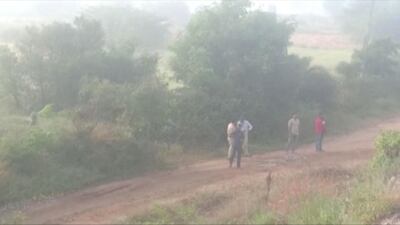
A still frame taken from a December 6, 2019 video shows various policemen and officials standing at a spot where police shot dead four men suspected of raping a veterinary doctor, in Hyderabad. ANI via Reuters
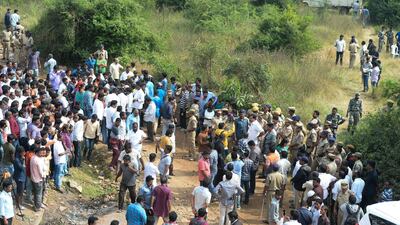
A crowd cheers on police in Shadnagar. AP Photo
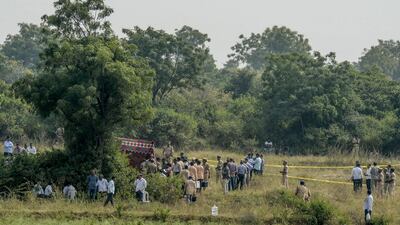
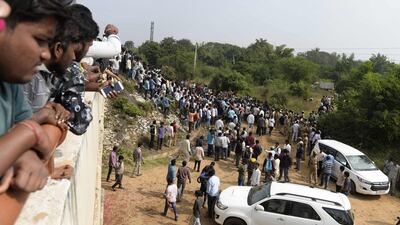
Police block an area near the site where they shot dead four detained gang-rape and murder suspects in Shadnagar. AFP
The men were killed while trying to escape during a re-enactment of the crime in the southern city of Hyderabad, a top police officer said. AFP
The four men killed on Friday were arrested last week on charges of raping, murdering and burning the body of the veterinary doctor, who had parked her scooter on a busy highway on November 27. AFP
In Sierra Leone, the issue of women’s safety has reached such a critical point that in February the president declared sexual violence a national emergency, following an attack last year on a five-year-old girl. She was paralysed from the waist down after being raped by a 28-year-old uncle, crushing her spine. “We as a nation must stand up and address this scourge,” president Julius Maada Bio said at the time.
This malaise runs deep in some societies. In the Indian subcontinent, an entrenched patriarchal system is a factor. More than a lack of education, there is a lack of will to instil in boys from a young age the notion that girls are not there to serve their needs but must be treated as equals and with respect. Greater awareness can begin to challenge long-held ideas about societal roles and subjugation.
Nor is this India’s problem alone. In neighbouring Pakistan, there are an estimated 1,000 so-called honour killings every year. In June last year, 19-year-old Mahwish Arshad was shot dead in Faisalabad after refusing a marriage proposal. Meanwhile the country has seen a spate of girls as young as five being raped and murdered, including six-year-old Zainab Ansari, whose body was found on a rubbish heap after she was abducted on her way to a Quran recital.
Societies across the world struggle with gender-based crimes. Too often, women are blamed for provoking their attackers, whether by their choice of clothes or their behaviour. And the stigma often prevents victims from reporting incidents. One reason is the warped notion of a woman’s honour, particularly in places such as India and Pakistan. The fear that no one will marry a woman who has been raped can be pervasive throughout different strata of society. While these issues are not exclusive to the subcontinent, they play a huge role in violence against women.
Then there is the fear of a cases that will drag on for years, which goes some way to explain the celebratory scenes on the streets of India. Yet despite the initial outcry when such incidents happen, it rarely results in significant change. After the candlelit marches and the calls on social media for justice – real justice, not extrajudicial solutions to an ongoing problem – what then? Assurances from politicians that things will change ring hollow because they say the same thing on repeat. The candlelit vigils do not change the numbers. More women than ever before in urban India are commuting to work. They deserve to know they will be safe when they do so.
But until entrenched patriarchy and misogyny are addressed and the authorities step up security, women will keep being afraid and looking over their shoulders. It is a slow process to change mindsets. That will not happen overnight, particularly when Indian politicians like Mulayam Singh Yadav defend sexual harassers with lines like “boys will be boys – they make mistakes”. Until those attitudes to women change, this will, tragically, not be the last incident of its kind.
Nivriti Butalia is an assistant comment editor at The National

RESULT
Manchester United 2 Tottenham Hotspur 1
Man United: Sanchez (24' ), Herrera (62')
Spurs: Alli (11')
The flights
Return flights from Dubai to Santiago, via Sao Paolo cost from Dh5,295 with Emirates.
The trip
A five-day trip (not including two days of flight travel) was split between Santiago and in Puerto Varas, with more time spent in the later where excursions were organised by TurisTour.
When to go
The summer months, from December to February are best though there is beauty in each season
Important questions to consider
1. Where on the plane does my pet travel?
There are different types of travel available for pets:
Manifest cargo
Excess luggage in the hold
Excess luggage in the cabin
Each option is safe. The feasibility of each option is based on the size and breed of your pet, the airline they are traveling on and country they are travelling to.
2. What is the difference between my pet traveling as manifest cargo or as excess luggage?
If traveling as manifest cargo, your pet is traveling in the front hold of the plane and can travel with or without you being on the same plane. The cost of your pets travel is based on volumetric weight, in other words, the size of their travel crate.
If traveling as excess luggage, your pet will be in the rear hold of the plane and must be traveling under the ticket of a human passenger. The cost of your pets travel is based on the actual (combined) weight of your pet in their crate.
3. What happens when my pet arrives in the country they are traveling to?
As soon as the flight arrives, your pet will be taken from the plane straight to the airport terminal.
If your pet is traveling as excess luggage, they will taken to the oversized luggage area in the arrival hall. Once you clear passport control, you will be able to collect them at the same time as your normal luggage. As you exit the airport via the ‘something to declare’ customs channel you will be asked to present your pets travel paperwork to the customs official and / or the vet on duty.
If your pet is traveling as manifest cargo, they will be taken to the Animal Reception Centre. There, their documentation will be reviewed by the staff of the ARC to ensure all is in order. At the same time, relevant customs formalities will be completed by staff based at the arriving airport.
4. How long does the travel paperwork and other travel preparations take?
This depends entirely on the location that your pet is traveling to. Your pet relocation compnay will provide you with an accurate timeline of how long the relevant preparations will take and at what point in the process the various steps must be taken.
In some cases they can get your pet ‘travel ready’ in a few days. In others it can be up to six months or more.
5. What vaccinations does my pet need to travel?
Regardless of where your pet is traveling, they will need certain vaccinations. The exact vaccinations they need are entirely dependent on the location they are traveling to. The one vaccination that is mandatory for every country your pet may travel to is a rabies vaccination.
Other vaccinations may also be necessary. These will be advised to you as relevant. In every situation, it is essential to keep your vaccinations current and to not miss a due date, even by one day. To do so could severely hinder your pets travel plans.
This is how many recognised sects Lebanon is home to, along with about four million citizens
450,000
More than this many Palestinian refugees are registered with UNRWA in Lebanon, with about 45 per cent of them living in the country’s 12 refugee camps
1.5 million
There are just under 1 million Syrian refugees registered with the UN, although the government puts the figure upwards of 1.5m
73
The percentage of stateless people in Lebanon, who are not of Palestinian origin, born to a Lebanese mother, according to a 2012-2013 study by human rights organisation Frontiers Ruwad Association
18,000
The number of marriages recorded between Lebanese women and foreigners between the years 1995 and 2008, according to a 2009 study backed by the UN Development Programme
77,400
The number of people believed to be affected by the current nationality law, according to the 2009 UN study
4,926
This is how many Lebanese-Palestinian households there were in Lebanon in 2016, according to a census by the Lebanese-Palestinian dialogue committee
Al Jazira's foreign quartet for 2017/18
Romarinho, Brazil
Lassana Diarra, France
Sardor Rashidov, Uzbekistan
Mbark Boussoufa, Morocco
Nepotism is the name of the game
Salman Khan’s father, Salim Khan, is one of Bollywood’s most legendary screenwriters. Through his partnership with co-writer Javed Akhtar, Salim is credited with having paved the path for the Indian film industry’s blockbuster format in the 1970s. Something his son now rules the roost of. More importantly, the Salim-Javed duo also created the persona of the “angry young man” for Bollywood megastar Amitabh Bachchan in the 1970s, reflecting the angst of the average Indian. In choosing to be the ordinary man’s “hero” as opposed to a thespian in new Bollywood, Salman Khan remains tightly linked to his father’s oeuvre. Thanks dad.
JUDAS AND THE BLACK MESSIAH
Directed by: Shaka King
Starring: Daniel Kaluuya, Lakeith Stanfield, Jesse Plemons
Four stars
The biog
Age: 32
Qualifications: Diploma in engineering from TSI Technical Institute, bachelor’s degree in accounting from Dubai’s Al Ghurair University, master’s degree in human resources from Abu Dhabi University, currently third years PHD in strategy of human resources.
Favourite mountain range: The Himalayas
Favourite experience: Two months trekking in Alaska
Mercer, the investment consulting arm of US services company Marsh & McLennan, expects its wealth division to at least double its assets under management (AUM) in the Middle East as wealth in the region continues to grow despite economic headwinds, a company official said.
Mercer Wealth, which globally has $160 billion in AUM, plans to boost its AUM in the region to $2-$3bn in the next 2-3 years from the present $1bn, said Yasir AbuShaban, a Dubai-based principal with Mercer Wealth.
“Within the next two to three years, we are looking at reaching $2 to $3 billion as a conservative estimate and we do see an opportunity to do so,” said Mr AbuShaban.
Mercer does not directly make investments, but allocates clients’ money they have discretion to, to professional asset managers. They also provide advice to clients.
“We have buying power. We can negotiate on their (client’s) behalf with asset managers to provide them lower fees than they otherwise would have to get on their own,” he added.
Mercer Wealth’s clients include sovereign wealth funds, family offices, and insurance companies among others.
From its office in Dubai, Mercer also looks after Africa, India and Turkey, where they also see opportunity for growth.
Wealth creation in Middle East and Africa (MEA) grew 8.5 per cent to $8.1 trillion last year from $7.5tn in 2015, higher than last year’s global average of 6 per cent and the second-highest growth in a region after Asia-Pacific which grew 9.9 per cent, according to consultancy Boston Consulting Group (BCG). In the region, where wealth grew just 1.9 per cent in 2015 compared with 2014, a pickup in oil prices has helped in wealth generation.
BCG is forecasting MEA wealth will rise to $12tn by 2021, growing at an annual average of 8 per cent.
Drivers of wealth generation in the region will be split evenly between new wealth creation and growth of performance of existing assets, according to BCG.
Another general trend in the region is clients’ looking for a comprehensive approach to investing, according to Mr AbuShaban.
“Institutional investors or some of the families are seeing a slowdown in the available capital they have to invest and in that sense they are looking at optimizing the way they manage their portfolios and making sure they are not investing haphazardly and different parts of their investment are working together,” said Mr AbuShaban.
Some clients also have a higher appetite for risk, given the low interest-rate environment that does not provide enough yield for some institutional investors. These clients are keen to invest in illiquid assets, such as private equity and infrastructure.
“What we have seen is a desire for higher returns in what has been a low-return environment specifically in various fixed income or bonds,” he said.
“In this environment, we have seen a de facto increase in the risk that clients are taking in things like illiquid investments, private equity investments, infrastructure and private debt, those kind of investments were higher illiquidity results in incrementally higher returns.”
The Abu Dhabi Investment Authority, one of the largest sovereign wealth funds, said in its 2016 report that has gradually increased its exposure in direct private equity and private credit transactions, mainly in Asian markets and especially in China and India. The authority’s private equity department focused on structured equities owing to “their defensive characteristics.”
Company profile
Name: Steppi
Founders: Joe Franklin and Milos Savic
Launched: February 2020
Size: 10,000 users by the end of July and a goal of 200,000 users by the end of the year
Employees: Five
Based: Jumeirah Lakes Towers, Dubai
Financing stage: Two seed rounds – the first sourced from angel investors and the founders' personal savings
Second round raised Dh720,000 from silent investors in June this year
RESULTS
Catchweight 82kg
Piotr Kuberski (POL) beat Ahmed Saeb (IRQ) by decision.