Iraqi Prime Minister Mustafa Al Kadhimi during his visit to the Nineveh province.
Prime Minister Mustafa Al Kadhimi during his visit to the Nineveh province.
Prime MInister Mustafa Al Kadhimi arrives in Mosul. Iraqi PM Media Office HO
Prime Minister Mustafa Al Kadhimi in Mosul last month. The PM's Media Office
Prime Minister Mustafa Al Kadhimi arrives in Mosul. Iraqi PM Media Office HO
Prime Minister Mustafa Al Kadhimi officially opens the Al Hurriya or Freedom Bridge crossing the Tigris river to Mosul's old city. Iraqi PM Media Office HO
Prime Minister Mustafa Al Kadhimi tours Al Nuri Mosque, destroyed by ISIS and being rebuilt with assistance from the UAE. Iraqi PM Media Office HO
Prime Minister Mustafa Al Kadhimi tours Mosul Museum during a visit to the city six years after ISIS captured it. Iraqi PM Media Office HO
Prime Minister Mustafa Al Kadhimi tours Mosul six years after ISIS captured the city. Iraqi PM Media Office HO
Prime Minister Mustafa Al Kadhimi tours Mosul Museum during a visit to the city six years after ISIS captured it. Iraqi PM Media Office HO
PM Mustafa Al Kadhimi and Lieutenant General Abdul Wahab Al Saadi, the head of the Iraqi Counter-Terrorism Service, meet with Najim Jubouri, Governor of Mosul. Iraqi PM Media Office HO
Prime Minister Mustafa Al Kadhimi meets military and security heads after arriving in Mosul six years after ISIS captured the city. Iraqi PM Media Office HO
Prime Minister Mustafa Al Kadhimi walks beside Najm Al Jabouri, the city's governor and the general who led the battle against ISIS in 2017. Iraqi PM Media Office HO
Prime Minister Mustafa Al Kadhimi officially opens the Al Hurriya or Freedom Bridge crossing the Tigris river to Mosul's old city. Iraqi PM Media Office HO
"Iraq is a garden and the English are its gardeners." Those are the words of a British Major Yeats, administrative inspector in the governorate of Anbar, as he addressed a group of dignitaries from the town of Rawa in April 1921. My grandfather, Abdul Jabbar Al Rawi, was among them, listening to this British officer attempt to persuade ordinary people to look more favourably on their occupation less than a year after a revolt had been put down.
Speaking in classical Arabic to the men and shaking the cane he held, Major Yeats went on to say: “Iraq is like this stick. To grow leaves and bear fruits it needs soil restoration, fertilisation and watering. In order to achieve this target, we need your co-operation."
Iraqis in those days were fervently patriotic and were desperate to have their own government, according to the memoirs of my grandfather, which two generations of my family are currently working on translating into English for publication. My grandfather would himself serve in an Iraqi government after independence, which would not come until more than 10 years had passed after Major Yeats' intervention.
Abdul Jabbar Al Rawi, left, in Damascus in 1919. Courtesy the Alrawi family
In 1921, however, nothing was certain about an independent Iraq. After the revolt, the British had turned to Prince Faisal, who had successfully led the Arabs against the Ottoman Empire during the First World War, and he would become Iraq’s king under their administration. Exiles living in Hijaz in Saudi Arabia – many had fled after the failure of the revolt – asked Prince Faisal how he intended to rule. According to my grandfather, one of those exiles was told that he would rule under a British mandate and not seek to do so independently. This was deeply disappointing to those who had been fighting for complete independence.
However, pragmatism won over and Iraqis rallied behind their new king, believing it better to have some hand in their own governance than allowing the British to have direct control over their country and their lives. Even with the benefit of hindsight, I look back a century ago and feel a sense of anger at how all this played out; angry at the now abhorrent colonial mindset of Major Yeats. I struggle to accept the gall he had to tell a proud and venerable people that they were incapable of handling their own affairs. I am also saddened that one hundred years on, Iraqis are still having to compromise over their sovereignty as external powers attempt to hold sway over their lands.
Knowing what we know now, I wonder if it would not have been better to keep fighting the British until it became too costly for them to stay. Would it have been better to have struggled longer, despite the cost, for the opportunity to begin Iraq's modern incarnation well before the Middle East became burdened with challenges such as the Israeli occupation of Palestine?
King Faisal I of Iraq, centre, is pictured at the 1919 Peace Conference in Paris. Getty Images
However, I must concede that ultimately foreign powers would always dictate Iraq's future; first during the Cold War, then after Saddam Hussein's invasion of Kuwait in 1990 and the US-led invasion that toppled his regime in 2003. Since then, Iran has worked to hold sway. Today, the low-key conflict between Washington and Tehran is arguably the most influential factor in what kind of country Iraqis will ultimately be left with.
Surrendering to a sense of pragmatism in 2020 would not look all that different from the compromises made in 1921. Instead of armed revolutionaries fighting a foreign power, we now have peaceful demonstrators in the streets calling for a better standard of living and an end to foreign intervention in Iraqi affairs.
A new government under Prime Minister Mustafa Al Kadhimi offers hope that we can tread a path towards this justified goal, just as a new government under King Faisal also symbolised a fresh start and something promising after years of conflict and oppression.
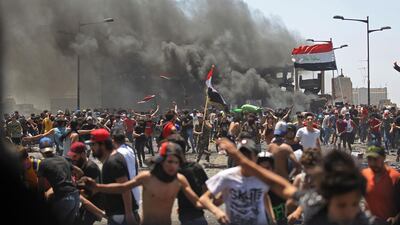
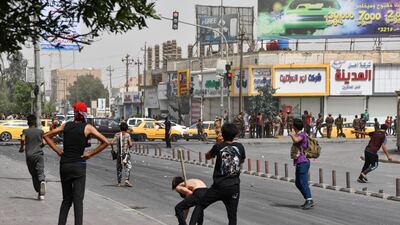
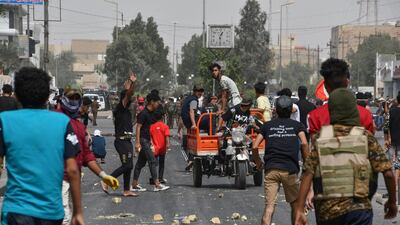
Iraqi protesters run for cover as they clash with security forces on Al Jumhuriyah in the capital Baghdad, following an anti-government demonstration. AFP
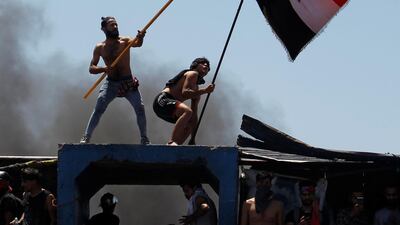
Demonstrators gesture as they take part in the ongoing anti-government protests after newly-appointed Iraqi Prime Minister Mustafa Kadhimi called for the release of all detained protesters, at Al Jumhuriya bridge in Baghdad, Iraq. REUTERS
Demonstrators gesture as they take part in the ongoing anti-government protests after newly-appointed Iraqi Prime Minister Mustafa Kadhimi called for the release of all deatined protesters, at Al Jumhuriya bridge in Baghdad, Iraq. REUTERS
Demonstrators gesture as they take part in the ongoing anti-government protests after newly-appointed Iraqi Prime Minister Mustafa Kadhimi called for the release of all detained protesters, at Al Jumhuriya bridge in Baghdad, Iraq. REUTERS
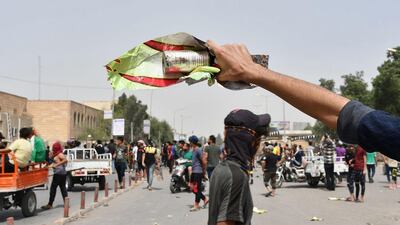
An Iraqi protester holds a smoke grenade fired by security forces amid clashes following an anti-government demonstration in Iraq's southern city of Nasiriyah in Dhi Qar province. AFP
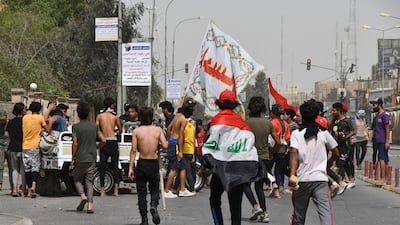
Iraqi protesters gather to block a street during an anti-government demonstration in Iraq's southern city of Nasiriyah in Dhi Qar province. AFP
Iraqi protesters hurl stones at security forces amid clashes following an anti-government demonstration in Iraq's southern city of Nasiriyah in Dhi Qar province. AFP
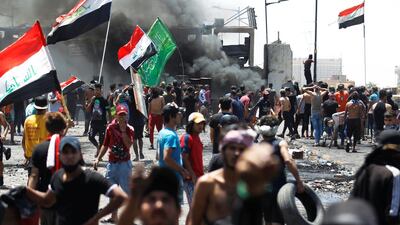
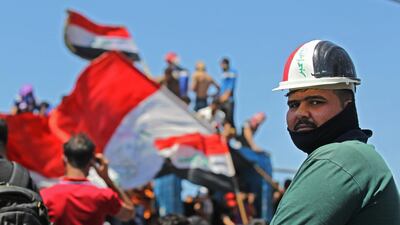
An Iraqi protester looks on as others wave national flags during an anti-government demonstration on Al Jumhuriyah bridge in the capital Baghdad. AFP
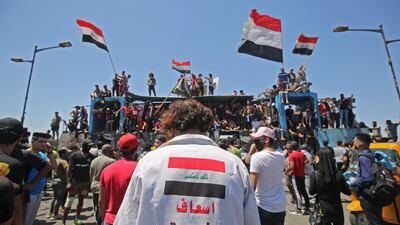
Iraqi protesters wave national flags during an anti-government demonstration on Al Jumhuriyah bridge in the capital Baghdad. AFP
Iraqi protesters gather amid clashes with security forces following an anti-government demonstration in Iraq's southern city of Nasiriyah in Dhi Qar province. AFP
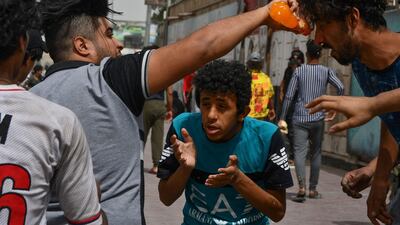
Iraqi protesters affected by smoke grenades receive help amid clashes with security forces following an anti-government demonstration in Iraq's southern city of Nasiriyah in Dhi Qar province. AFP
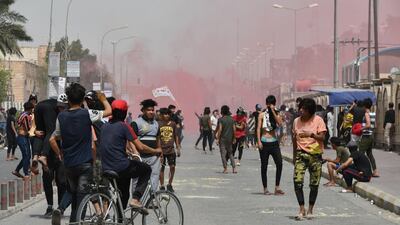
Iraqi protesters flee smoke grenades fired by security forces amid clashes following an anti-government demonstration in Iraq's southern city of Nasiriyah in Dhi Qar province. AFP
An Iraqi demonstrator tries to smash a concrete wall during ongoing anti-government protests after newly-appointed Iraqi Prime Minister Mustafa al-Kadhimi called for the release of all detained protesters, at Jumhuriya bridge in Baghdad, Iraq. REUTERS
In 2020, our vantage point also means we can look at the mistakes made in the past and be a little more forgiving of those who were still determined to do what they thought was best for their people.
If today’s protesters choose to give Mr Al Kadhimi’s government a chance to try to affect change, they will be doing so based on the best available judgment they have, given how uncertain these times are. On the face of things, it does look like the best option – perhaps, much as backing King Faisal during my grandfather’s time must have also seemed the most logical way forward when options were limited.
Eventually, anti-western sentiment would spill over and a fatal coup in 1958 would be the trigger for decades of instability and bloodshed.
Today, Mr Al Kadhimi has pledged to put Iraq’s sovereignty first. This goal will be hard-won and will be challenged often in the weeks, months and years to come. It is still what the people most deserve, especially after more than one hundred years of hoping.
Mustafa Alrawi is an assistant editor-in-chief at The National

Six large-scale objects on show
Concrete wall and windows from the now demolished Robin Hood Gardens housing estate in Poplar
The 17th Century Agra Colonnade, from the bathhouse of the fort of Agra in India
A stagecloth for The Ballet Russes that is 10m high – the largest Picasso in the world
Frank Lloyd Wright’s 1930s Kaufmann Office
A full-scale Frankfurt Kitchen designed by Margarete Schütte-Lihotzky, which transformed kitchen design in the 20th century
Torrijos Palace dome
GAC GS8 Specs
Engine: 2.0-litre 4cyl turbo
Power: 248hp at 5,200rpm
Torque: 400Nm at 1,750-4,000rpm
Transmission: 8-speed auto
Fuel consumption: 9.1L/100km
On sale: Now
Price: From Dh149,900
MATCH INFO
Uefa Champions League final:
Who: Real Madrid v Liverpool Where: NSC Olimpiyskiy Stadium, Kiev, Ukraine When: Saturday, May 26, 10.45pm (UAE) TV: Match on BeIN Sports
The National in Davos
We are bringing you the inside story from the World Economic Forum's Annual Meeting in Davos, a gathering of hundreds of world leaders, top executives and billionaires.
Jeff Buckley: From Hallelujah To The Last Goodbye
By Dave Lory with Jim Irvin
Who's who in Yemen conflict
Houthis: Iran-backed rebels who occupy Sanaa and run unrecognised government
Yemeni government: Exiled government in Aden led by eight-member Presidential Leadership Council
Southern Transitional Council: Faction in Yemeni government that seeks autonomy for the south
Habrish 'rebels': Tribal-backed forces feuding with STC over control of oil in government territory
Fixtures
Opening day Premier League fixtures for August 9-11
August 9
Liverpool v Norwich 11pm
August 10
West Ham v Man City 3.30pm
Bournemouth v Sheffield Utd 6pm
Burnley v Southampton 6pm
C Palace v Everton 6pm
Leicester v Wolves 6pm
Watford v Brighton 6pm
Tottenham v Aston Villa 8.30pm
August 11
Newcastle v Arsenal 5pm
Man United v Chelsea 7.30pm
Western Clubs Champions League:
Friday, Sep 8 - Abu Dhabi Harlequins v Bahrain
Friday, Sep 15 – Kandy v Abu Dhabi Harlequins
Friday, Sep 22 – Kandy v Bahrain
How to get there
Emirates (www.emirates.com) flies directly to Hanoi, Vietnam, with fares starting from around Dh2,725 return, while Etihad (www.etihad.com) fares cost about Dh2,213 return with a stop. Chuong is 25 kilometres south of Hanoi.
Indoor cricket World Cup:
Insportz, Dubai, September 16-23
UAE fixtures:
Men
Saturday, September 16 – 1.45pm, v New Zealand
Sunday, September 17 – 10.30am, v Australia; 3.45pm, v South Africa
Monday, September 18 – 2pm, v England; 7.15pm, v India
Tuesday, September 19 – 12.15pm, v Singapore; 5.30pm, v Sri Lanka
Thursday, September 21 – 2pm v Malaysia
Friday, September 22 – 3.30pm, semi-final
Saturday, September 23 – 3pm, grand final
Women
Saturday, September 16 – 5.15pm, v Australia
Sunday, September 17 – 2pm, v South Africa; 7.15pm, v New Zealand
Monday, September 18 – 5.30pm, v England
Tuesday, September 19 – 10.30am, v New Zealand; 3.45pm, v South Africa
Thursday, September 21 – 12.15pm, v Australia
Friday, September 22 – 1.30pm, semi-final
Saturday, September 23 – 1pm, grand final
What is Financial Fair Play?
Introduced in 2011 by Uefa, European football’s governing body, it demands that clubs live within their means. Chiefly, spend within their income and not make substantial losses.
What the rules dictate?
The second phase of its implementation limits losses to €30 million (Dh136m) over three seasons. Extra expenditure is permitted for investment in sustainable areas (youth academies, stadium development, etc). Money provided by owners is not viewed as income. Revenue from “related parties” to those owners is assessed by Uefa's “financial control body” to be sure it is a fair value, or in line with market prices.
What are the penalties?
There are a number of punishments, including fines, a loss of prize money or having to reduce squad size for European competition – as happened to PSG in 2014. There is even the threat of a competition ban, which could in theory lead to PSG’s suspension from the Uefa Champions League.
New Zealand 153 and 56 for 1 in 22.4 overs at close Pakistan 227
(Babar 62, Asad 43, Boult 4-54, De Grandhomme 2-30, Patel 2-64)
Mercer, the investment consulting arm of US services company Marsh & McLennan, expects its wealth division to at least double its assets under management (AUM) in the Middle East as wealth in the region continues to grow despite economic headwinds, a company official said.
Mercer Wealth, which globally has $160 billion in AUM, plans to boost its AUM in the region to $2-$3bn in the next 2-3 years from the present $1bn, said Yasir AbuShaban, a Dubai-based principal with Mercer Wealth.
“Within the next two to three years, we are looking at reaching $2 to $3 billion as a conservative estimate and we do see an opportunity to do so,” said Mr AbuShaban.
Mercer does not directly make investments, but allocates clients’ money they have discretion to, to professional asset managers. They also provide advice to clients.
“We have buying power. We can negotiate on their (client’s) behalf with asset managers to provide them lower fees than they otherwise would have to get on their own,” he added.
Mercer Wealth’s clients include sovereign wealth funds, family offices, and insurance companies among others.
From its office in Dubai, Mercer also looks after Africa, India and Turkey, where they also see opportunity for growth.
Wealth creation in Middle East and Africa (MEA) grew 8.5 per cent to $8.1 trillion last year from $7.5tn in 2015, higher than last year’s global average of 6 per cent and the second-highest growth in a region after Asia-Pacific which grew 9.9 per cent, according to consultancy Boston Consulting Group (BCG). In the region, where wealth grew just 1.9 per cent in 2015 compared with 2014, a pickup in oil prices has helped in wealth generation.
BCG is forecasting MEA wealth will rise to $12tn by 2021, growing at an annual average of 8 per cent.
Drivers of wealth generation in the region will be split evenly between new wealth creation and growth of performance of existing assets, according to BCG.
Another general trend in the region is clients’ looking for a comprehensive approach to investing, according to Mr AbuShaban.
“Institutional investors or some of the families are seeing a slowdown in the available capital they have to invest and in that sense they are looking at optimizing the way they manage their portfolios and making sure they are not investing haphazardly and different parts of their investment are working together,” said Mr AbuShaban.
Some clients also have a higher appetite for risk, given the low interest-rate environment that does not provide enough yield for some institutional investors. These clients are keen to invest in illiquid assets, such as private equity and infrastructure.
“What we have seen is a desire for higher returns in what has been a low-return environment specifically in various fixed income or bonds,” he said.
“In this environment, we have seen a de facto increase in the risk that clients are taking in things like illiquid investments, private equity investments, infrastructure and private debt, those kind of investments were higher illiquidity results in incrementally higher returns.”
The Abu Dhabi Investment Authority, one of the largest sovereign wealth funds, said in its 2016 report that has gradually increased its exposure in direct private equity and private credit transactions, mainly in Asian markets and especially in China and India. The authority’s private equity department focused on structured equities owing to “their defensive characteristics.”
Hometown: Bogota, Colombia Favourite place to relax in UAE: the desert around Al Mleiha in Sharjah or the eastern mangroves in Abu Dhabi The one book everyone should read: 100 Years of Solitude by Gabriel Garcia Marquez. It will make your mind fly Favourite documentary: Chasing Coral by Jeff Orlowski. It's a good reality check about one of the most valued ecosystems for humanity
Ahmad El Sayed is Senior Associate at Charles Russell Speechlys, a law firm headquartered in London with offices in the UK, Europe, the Middle East and Hong Kong.
Experience: Commercial litigator who has assisted clients with overseas judgments before UAE courts. His specialties are cases related to banking, real estate, shareholder disputes, company liquidations and criminal matters as well as employment related litigation.
Education: Sagesse University, Beirut, Lebanon, in 2005.