

In January 2016, I paid a visit to Diyarbakir, the largest city and de facto capital of Turkey’s Kurdish-majority south-east. The previous month, its ancient centre, known as Sur, and more than a dozen other regional cities had been put under a 24-hour curfew as the Turkish military moved against the urban positions of the Kurdistan Workers’ Party (PKK).
Labelled a terrorist group by the US, EU and Turkey, the PKK has fought an insurgency in the south-east since the mid-1980s. The government of Recep Tayyip Erdogan and his Justice and Development Party (AKP) initiated a peace process with the militant group in 2013, which made considerable progress leading up to the June 2015 parliamentary elections.
But in that vote the AKP lost its parliamentary majority, thanks in large part to the rise of the pro-Kurdish People’s Democratic Party (HDP). Possibly to undermine the HDP and rally its nationalist base, Mr Erdogan’s government soon ended the peace process. By December, the battle lines had been drawn and the curfews put in place as the Turkish military moved in.

Some curfews lasted more than three months. Hundreds of thousands were displaced and more than 5,000 people, including more than 500 civilians, were killed. Parts of Diyarbakir, Silopi, Silvan, Cizre, Mardin, Tunceli and other cities were left looking like the Syrian city of Aleppo after President Bashar Al Assad’s barrel bombs.
What I recall most is the endless stream of families fleeing Sur, lugging their belongings and fearing they might never return. Once outside the city walls – massive, fourth-century stone fortifications recognised by Unesco – many had nowhere to go. Some set their things down to rest in a small park in the shadow of the walls, their children scurrying about as bombs struck their homes not even a kilometre away.
I was shocked to see this in the EU-candidate country in which I lived and had come to love, yet it’s all come rushing back in recent days as Israel has showered Gaza with rocket fire. One journalist posted a video on Twitter showing Gaza children playing beside their parents as bombs explode down the street. “Imagine the psychology of these kids,” he said.
I also wonder about the psychology of children in the Kurdish-majority areas of Turkey. Mr Erdogan had initiated the Kurdish peace process only to end it two years later and begin to eviscerate mainly Kurdish cities. Now he calls for Israel to be taught a lesson for aggression against Palestinians and urges all Muslims to take a stand. This dovetails with the Turkish president’s long-running campaign to claim the leadership mantle of the Muslim world – a leadership few would assign him.
That campaign is now clashing against Ankara's ongoing effort to improve relations with regional powers, including Israel. Turkish-Israeli ties have been troubled since the 2010 Mavi Marmara incident, in which Israeli commandos boarded the Turkey-owned ship as it sought to break the Gaza siege. Ten Turkish activists were killed, and to this day Israel says they were shot in self-defence after mounting an assault with clubs, knives and a gun.
Among the organisers of the Gaza Flotilla was the Foundation for Human Rights and Freedoms and Humanitarian Relief (IHH), a Turkish NGO that delivers aid in more than 100 countries and is known to be close to the Erdogan government. Critics accuse IHH of aiding extremists in Chechnya, Syria and Afghanistan, though Turkey and IHH deny such claims.
Israel banned IHH in 2008, arguing that it raises funds for Hamas, the Muslim Brotherhood-linked group that runs the Gaza Strip and seeks the destruction of Israel. Hamas, labelled a terrorist group by the US, EU, Israel and other states, maintains offices and a cyberwarfare centre in Istanbul. Thus, it would seem clear where Ankara’s loyalties lie in the current dispute.

Indeed, the Turkish aid agency, TIKA, says it has completed more than 600 projects in Palestinian areas since 2005, including the restoration of dozens of Ottoman-era homes and shops in East Jerusalem, where Turkish flags are not uncommon. Turkey runs several schools in the city, where students are taught Turkish language and culture, and a Turkish NGO runs a summer camp at which Arab teens are told they own Israel.
Israel has been pushing back, fearing Ankara’s Islamist agenda. In 2017, Israeli authorities arrested TIKA’s Gaza director, Muhammad Murtaja, and sentenced him to prison for diverting funds and providing intelligence to Hamas. In 2018, Israel’s National Security Council announced plans to curb TIKA’s activities in the country. The next year, then Israeli foreign minister Israel Katz said he had issued instructions to end Turkey’s “incitement and subversion” in East Jerusalem.
Despite all of this, Turkey and Israel had been holding secret talks in recent months and seemed to be heading towards normalisation. No more. Last week, Turkey rescinded its invitation to Israel’s energy minister to attend a June diplomacy conference in Antalya. Days later, an Israeli missile destroyed the Gaza offices of Yardimeli, a Turkish charity.
This column does not intend to equate Turkey’s persecutions and abuses across the region to those of Israel. There are, of course, vast differences – in particular, Israel’s occupation of the Palestinian territories, which is recognised internationally to be illegal.
But Turkey’s assault on Kurdish cities offers several parallels to the latest Israeli-Palestinian violence. Both mark a revival of previous conflicts and underscore the persistence of an almost-intractable dispute. Both involve a powerful state taking on a much weaker foe – the PKK in Turkey’s case, and Hamas for Israel – which does, nonetheless, pose a real threat. Both conflicts are driven by a determination to defeat that foe, but come with a secondary agenda: gaining more land and political and economic might.
The latest clash in Israel was sparked by Israeli efforts to evict six families from East Jerusalem’s Sheikh Jarrah district. “Pro-Israel organisations have sought to change the demographics of East Jerusalem – which is predominantly Arab – for many years, taking their cues from successive Israeli governments,” Steven A Cook, senior fellow at the Council on Foreign Relations, wrote in an explainer last week.
Similarly, Turkey sought to push out Kurds and re-fill these cities with its backers. “This is also an ideological and cultural hegemony project,” Abdullah Demirbas, the former mayor of Sur, told me during my 2016 visit. “They change the demographic profiles of places where the people don’t share their views. They replace them with people who do.”
Israel may be guilty of many offences in Jerusalem and Gaza – killing civilians, forced displacement, a disproportionate response to Hamas attacks – but hypocrisy is not among them. As a self-proclaimed Jewish state its actions are predictable, if deeply unjust.
Mr Erdogan, on the other hand, claims to be a saviour to suffering Muslims everywhere even as his government inflicts considerable suffering on its own citizens.
On Friday, as Israeli missiles rained down on Gaza, hundreds of Arabs gathered at Al Aqsa Mosque. “We are here. We are here,” they chanted. “Where are you, Erdogan?”
David Lepeska is a Turkish and Eastern Mediterranean affairs columnist for The National
-
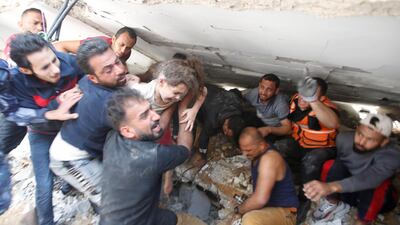
Rescuers pull a girl from the rubble at the site of Israeli air strikes in Gaza City. Reuters -
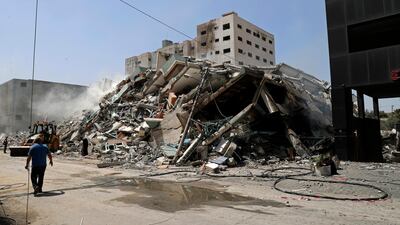
The building that was destroyed by an Israeli air strike on May 16, which housed The Associated Press and other media outlets in Gaza City. AP -
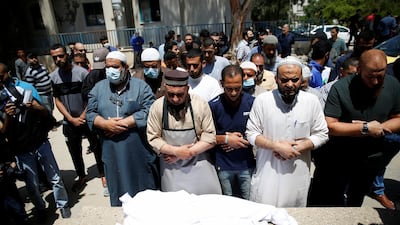
Palestinians mourn deceased relatives, at the site of Israeli air strikes, in Gaza City. Reuters -
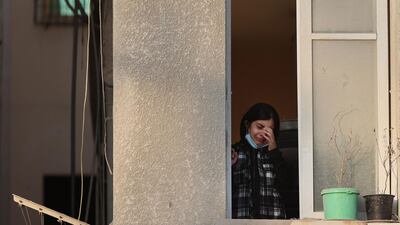
A Palestinian girl cries as she looks out from her home's window at destroyed neighbouring buildings in a residential area of Gaza City, following Israeli air strikes. AFP -
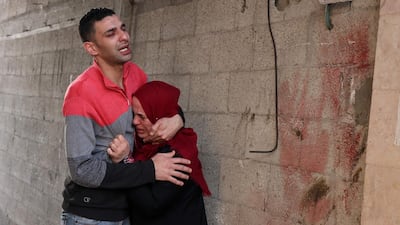
A man and woman cry outside their home after it was destroyed by Israeli air strikes in Gaza City. AFP -
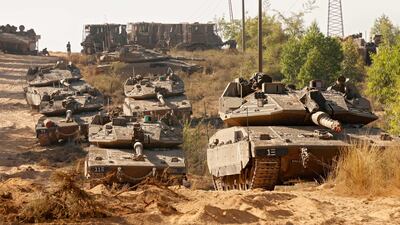
Israeli tanks stationed along the border with the Gaza Strip. AFP -
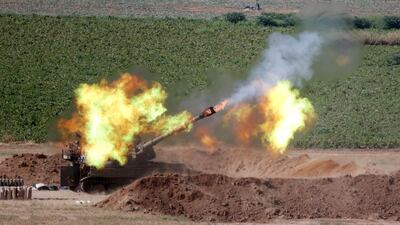
Israeli soldiers fire a 155mm Howitzer towards the Gaza Strip from their position along the border with the Palestinian enclave. AFP -

Palestinians carry a survivor from under the rubble of a building, after it was struck by Israeli strikes, in Gaza City. AFP -
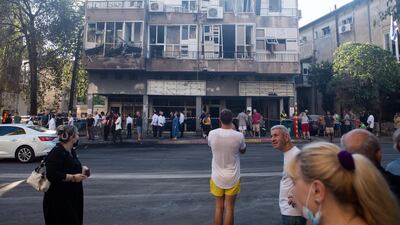
People look at the scene where a rocket fired from the Gaza Strip hit in Ramat Gan, Israel. Getty -
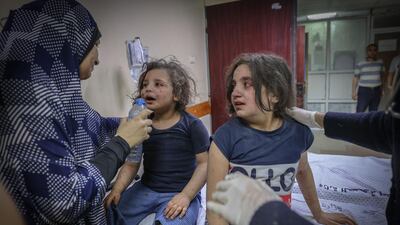
Palestinian children injured during Israeli air strikes on Gaza City are treated at Al Shifa hospital. AFP -
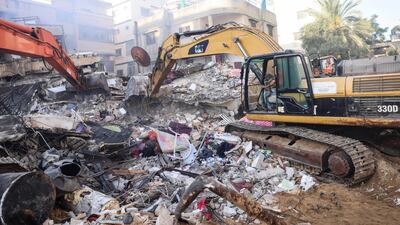
Excavators work to clear the rubble at the site of Israeli air strikes, in Gaza City May 16, 2021. REUTERS/Mohammed Salem -
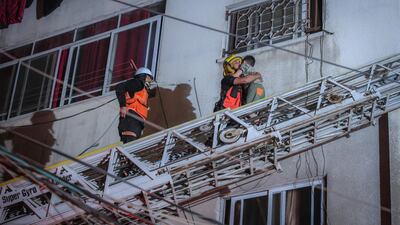
Firefighters move families from a building whose entrance was blocked by rubble after Israeli air strikes on Gaza City. AFP -
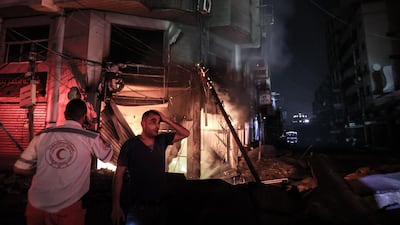
A Palestinian man watches as firefighters search for survivors and bodies under the rubble after Israeli air strikes on Gaza City. AFP -
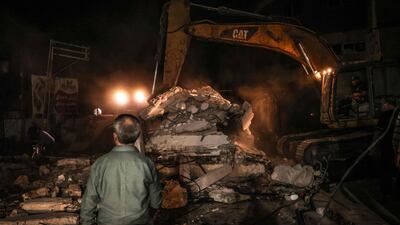
A man watches as a firefighter drives a bulldozer to clear rubble and search for survivors and bodies after the bombing of Gaza City. AFP -
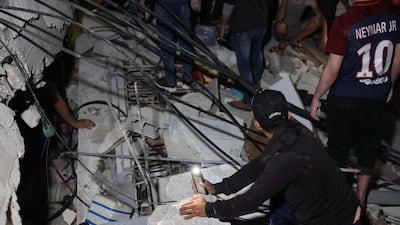
Palestinian firefighters search for survivors and bodies under the rubble. AFP -
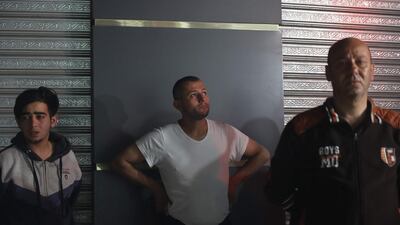
Men watch as rescuers search for survivors and bodies in Gaza City. AFP -
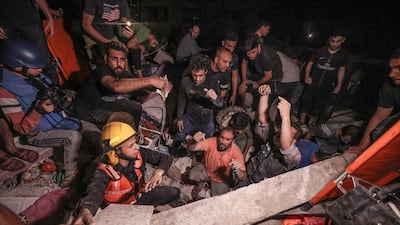
Firefighters race against time to find survivors. AFP -
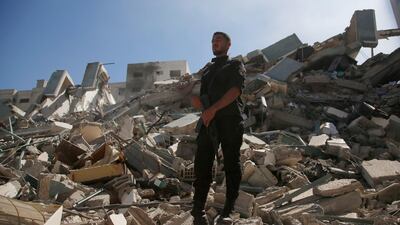
A policeman stands on rubble from a building that housed the office of the Associated Press and other media organisations in Gaza City, which was destroyed by Israeli air strikes. AP -
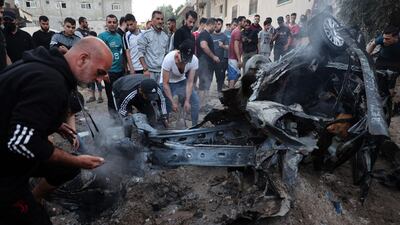
Palestinians gather around a car that burned after being hit by an Israeli missile in Gaza City. AFP -
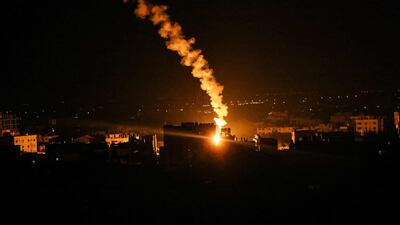
Israeli forces' flares light up the sky in Rafah in the southern Gaza Strip. AFP



