
Cyprus has been effectively partitioned for almost half a century. The north is run by a Turkish Cypriot government while the remaining part of the island is run by the internationally recognised Greek Cypriot administration. Almost half a century after the truce line emerged, the "Green Zone" has become a tranquil wilderness. Still patrolled by UN peacekeepers, it has also served as a backdrop for many rounds of talks over the future of the divided Eastern Mediterranean island.
Antonio Guterres, the UN Secretary General, is poised to launch a fresh round of talks within weeks. But the problem is that he will almost certainly stick to the tried and failed formulas of the past, which means the prospect of failure is high.
If you have heard a bit more about Cyprus in recent times, that is because the region around it has become much more contested.
-
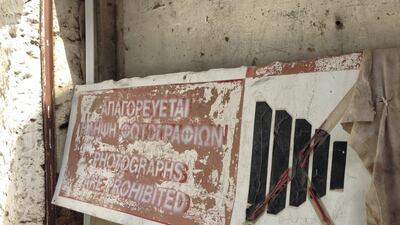
Nicosia in Cyprus is the last divided capital city in Europe. Today marks the date in 1983 when the Turkish Republic of Northern Cyprus declared independence, nine years after Turkish forces landed on the island. The TRNC remains unrecognised by the international community, apart from Turkey. Declan McVeigh / The National -
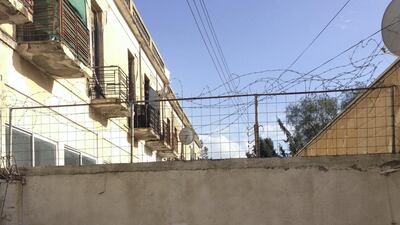
A shot of no-man’s-land in Nicosia from the Turkish side of the divided Cyprus capital. Declan McVeigh / The National -
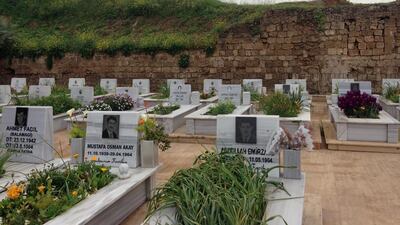
Turkish Cypriot graves near Famagusta on the island's east coast. Declan McVeigh / The National -
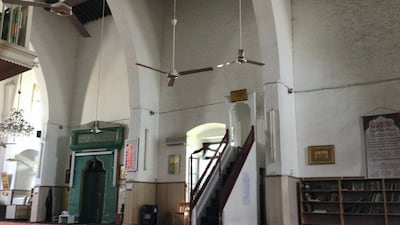
Omeriye Mosque is the only Muslim place of worship open on the Greek side of Nicosia. Declan McVeigh / The National -
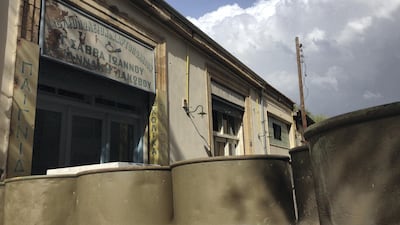
A shot of no-man’s-land, taken from the Greek sector of Nicosia. Local people refer to this UN buffer area - established in 1964 and expanded 10 years later - as the "dead zone". Here ceasefire lines are sometimes just metres apart. Declan McVeigh / The National -
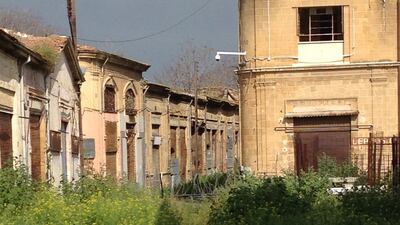
The UN's Green Line cuts 180 kilometres across the island of Cyprus and divides the capital, Nicosia, in two. Cyprus has endured this partition since 1974. Declan McVeigh / The National -
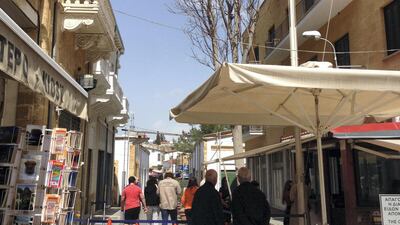
Ledra Street is the only foot crossing between the Turkish and Greek sectors of Nicosia. Visitors will have their passports stamped with 90-day visas by TRNC officials upon entering Northern Cyprus. There is a building nearby that acts as a watchtower for general public and tourists. Declan McVeigh / The National -

Part of the UN's Green Line which cuts 180 kilometres across the island of Cyprus and divides its capital, Nicosia, in two. Visitors can walk down Nicosia's busy shopping streets, take a few turns, and be confronted by barricades dividing north from south. Declan McVeigh / The National -
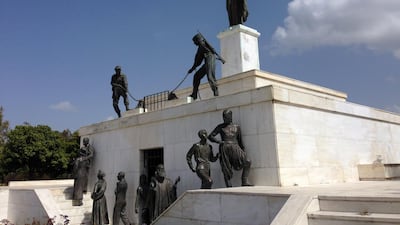
Nicosia is dotted with memorials to past conflicts. The 1973 Liberty Monument in the city's Greek zone honours paramilitary fighters of Ethniki Organosis Kyprion Agoniston, who fought British forces between 1955 and 1959. Declan McVeigh / The National -
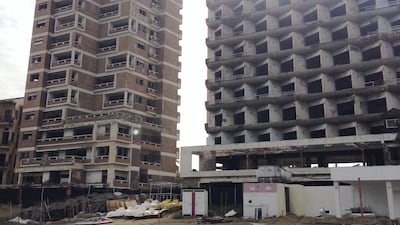
Famagusta beach with abandoned hotels and buildings form a 'ghost town' since Turkish forces landed on the island in 1974. Declan McVeigh / The National -
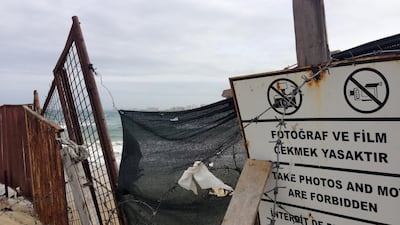
Much of Famagusta beach in eastern Cyprus and its ghost town remain off-limits. Turkey continues to station thousands of troops on the divided island. Declan McVeigh / The National


During the Cold War, the island was referred to as Nato's unsinkable aircraft carrier, acting as a bulwark against any Soviet aggression in the Eastern Mediterranean. These days, the Turkish push into the wider region and its alliance-building in the Libyan city of Misurata is putting Cyprus at the intersection of Ankara's ambitions.
Post-Soviet Russia's skin in the game, meanwhile, involves doggedly ensuring that it will not be displaced from its naval bases around Latakia, the principal port city of nearby Syria. The proven deposits of natural gas across the area have also created a basin in which the interests of a handful of countries are mixed up.
The division of Cyprus in the 1970s raised a brief flurry of high-level diplomacy to stop Nato members going to war against each other. Apart from Greece being in direct competition with Turkey, Britain is heavily involved as well, as a "guarantor power" and the possessor of two sovereign bases on the island. These days Britain cleaves ever closer to the Turkish position with a diminished influence, given that Cyprus seeks to definite itself as a platform to Europe and London no longer has a voice within the 27-nation bloc.
When the next UN-organised talks do begin, the choices boil down to two options.
A federal state that is comprised of two largely autonomous zones, roughly along the Green Zone division but with some map-based concessions, has been favoured for decades. In fact, years of negotiations have been devoted to this goal. Turkey, on the other hand, is pushing for a permanent division of the island. According to Turkish President Recep Tayyip Erdogan, there is only a two-state solution to the island.

The incentive for Mr Erdogan is obvious. Only Turkey recognises the self-declared republic in the north, which is propped up by Ankara's military deployment and Turkish migration from the mainland. The two-state solution would be a boon for Turkey but it is hard to see how it benefits anyone else. It is also hard to see how it would benefit the Turkish-speaking Cypriots living there.
Fresh thinking on the Cyprus crisis is often a chimera. The novelty of new proposals is often promoted cynically just to disrupt the prospect of resolution.
How then to describe the prospects for the latest round of talks?
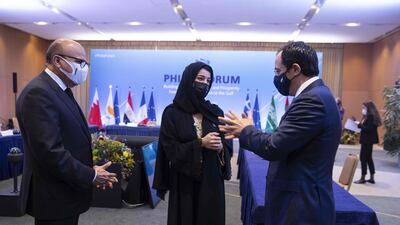
Last week’s "Philia Forum" in Athens was attended by the UAE, Saudi Arabia, Bahrain, Egypt and Iraq. Nikos Christodoulides, the Cypriot Foreign Minister, was also a strong presence in the deliberations. The meeting showed the shared strategic footprint of the attendees.

The orientation of the Philia Forum participants is towards investment and modernisation of the economy to meet demographic demands. The shared emphasis in the dialogue provides a platform for co-operation that would have seemed remote a decade ago. A communique from Mr Christodoulides said that partnership could not only unleash opportunities but also enable the better management of points of instability.
Their message stood in contrast to the narrative of confrontations, problems and conflicts that Cyprus struggles to contain and blunt.
Ultimately the EU provides the Cypriots with the only platform for resolution of the dispute. When Kofi Annan, the former UN secretary general, presented his plan for a federal state in 2004, the Turkish side embraced it but the Greek part of the island said no. Nicosia still entered the EU.
A decade and a half later, the bizonal state would look much like Annan’s team envisaged. There is also a soft version of Mr Erdogan’s two-state plan, which would be a managed separation of the states within the EU. But there is a glitch in this plan.

As the 28-nation bloc’s border and coast guard agency, Frontex, grows in powers, and common policies on immigration are more entrenched, parts of this shared membership would be hard for Turkey to stomach. After all, this would effectively mean the withdrawal of most, if not all, of its 30,000 troops stationed on the island. It would also lead to the demise of the UK's guarantor-ship of the island, which dates back to the 1960s.
The issue, obviously, is that both these countries are non-EU members, with the UK having recently left the bloc and Turkey now destined never to join.
There are other details, such as compensating the Greek Cypriots for the two-thirds of the property in the north that is owned by them and the return of the deserted resort of Varosha as well as other lands beyond the verdant demilitarised zone.
In the event that these issues could be addressed, there would be a round of referendum campaigns with outcomes that are hard to forecast. Then the emphasis would be on the rebuilding of Cyprus. A multi-year transition would almost certainly be set in train. Given the circumstances of the region, particularly the increasing exploration and exploitation of the natural gas deposits, that would need a robust enforcement mechanism.
It is clear that many nations share an incentive for a Cyprus solution. How to get stakeholders to buy into the process and reinforce its momentum needs to be added as a strand to the talks.
Damien McElroy is the London bureau chief at The National

