

Lebanon has sometimes been described as a "volcano of instability". Given the impossibility of forecasting its future, which is for the most part shaped by foreign actors as much as local ones, it is perhaps a fitting label.
Despite being just 10,452 square kilometres in size with a population of under seven million people, this tiny Arab country is an important neighbour for both Syria and Israel. For, it serves as some sort of an unofficial military base for the Iranian regime and its proxies. Major powers, therefore, are forced to take it seriously from a strategic standpoint – despite repeatedly clashing with its intransigent, self-preservative and deeply sectarian political class.
US President-elect Joe Biden is all set to enter the White House on January 20. Expecting a shift in policy vis-a-vis the Middle East, particularly regarding America’s adversarial relationship with Iran, leaders of key countries are focused on improving their own fortunes in the region.
The most notable example is Russia.
Moscow, which views Syria as its gateway to the Middle East, is attempting to close the book on the nine-year-old civil war in the country. Over the past decade, it has offered military support to the Assad regime in Damascus against rebel forces backed by Turkey and other countries. But to bring lasting peace to Syria, Moscow believes it must help bring stability and security in its neighbourhood – which includes Lebanon.
Indeed, establishing political stability in an otherwise politically unstable country is in Moscow’s interest. The reason for this is simple: so long as Lebanon’s political class is weak and divided, the country remains an arena for foreign meddling, which undermines its stability and, in turn, that of the countries around it.
For genuine change, however, Lebanon’s institutions need to be free of the influence of one such foreign meddler: Iran.
There is an understanding in Moscow that Tehran wants Lebanon to remain a wild card in its regional game, and therefore would be uninterested in encouraging an enactment of reforms in that country. Moscow is also all too aware of the influence France, once Lebanon's colonial master, wields there. For months, Paris has been attempting to resolve the political impasse in Lebanon and, in the process, bring it closer to the West. But this has proved an arduous task.
Like France, Russia also seeks to help Lebanon find its feet and become a genuine sovereign player.
-

A Lebanese youth hugs French President Emmanuel Macron during a visit to the Gemmayzeh neighbourhood, which has suffered extensive damage due to a massive explosion in the Lebanese capital. AFP -
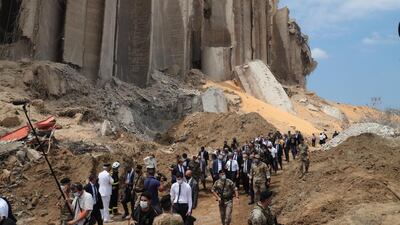
French President Emmanuel Macron (C) visiting the devastated site of the explosion at the port of Beirut, Lebanon. Macron arrived to Lebanon to show support after a massive explosion on 04 August -
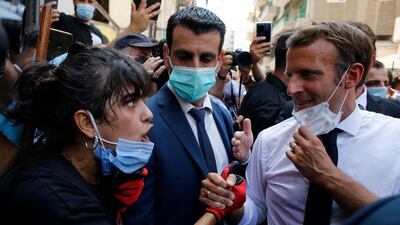
French President Emmanuel Macron listens to a resident as he visits a devastated street of Beirut. AP Photo -
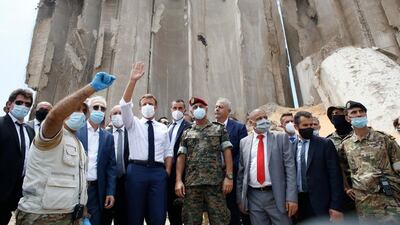
French President Emmanuel Macron gestures as he visits the devastated site of the explosion at the port of Beirut. EPA -
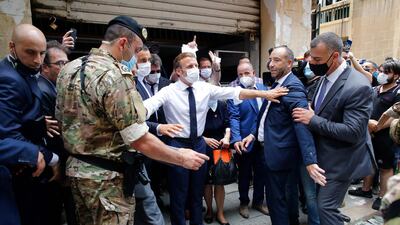
French President Emmanuel Macron gestures as he visits a devastated street of Beirut. AFP -
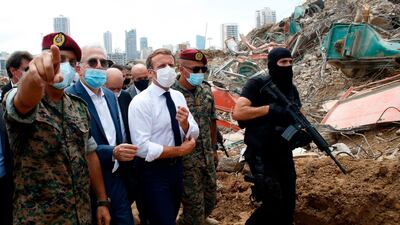
French President Emmanuel Macron surrounded by Lebanese servicemen, visits the devastated site of the explosion at the port of Beirut. AFP -

French President Emmanuel Macron, speaks with a woman as he visits the Gemayzeh neighborhood, which suffered extensive damage from an explosion on Tuesday. AP Photo -
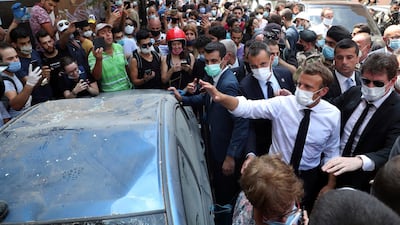
French President Emmanuel Macron visits the Gemayzeh neighborhood, which suffered extensive damage from an explosion on Tuesday that hit the seaport of Beirut. AP Photo -
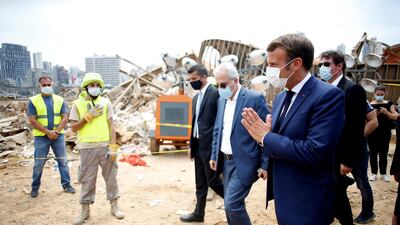
French President Emmanuel Macron gestures as he arrives at the devastated site of the explosion at the port of Beirut. REUTERS -
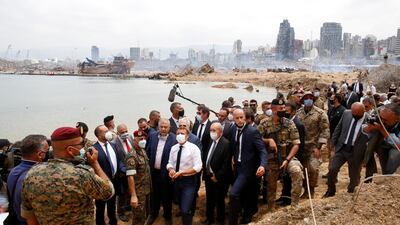
French President Emmanuel Macron visits the devastated site of the explosion at the port of Beirut. REUTERS -
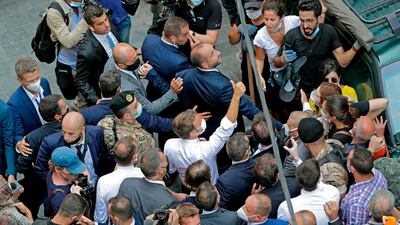
French President Emmanuel Macron greets people during a visit to the Gemmayzeh neighbourhood, which has suffered extensive damage due to a massive explosion in the Lebanese capital. AFP -
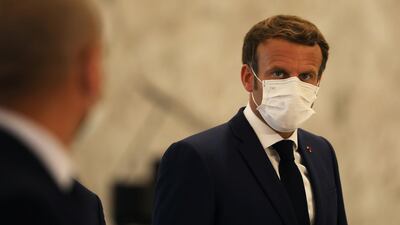
French President Emmanuel Macron wears a protective face mask as he meets Lebanon's President Michel Aoun following Tuesday's blast in Beirut's port area, at the presidential palace in Baabda, Lebanon. Reuters -
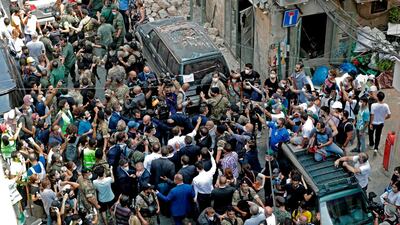
French President Emmanuel Macron greets people during a visit to the Gemmayzeh neighbourhood, which has suffered extensive damage due to a massive explosion in the Lebanese capital, on August 6, 2020. French President Emmanuel Macron visited shell-shocked Beirut, pledging support and urging change after a massive explosion devastated the Lebanese capital in a disaster that has sparked grief and fury. / AFP / ANWAR AMRO -
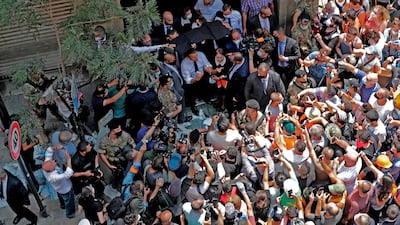
French President Emmanuel Macron speaks to the crowd during a visit to the Gemmayzeh neighbourhood, which has suffered extensive damage due to a massive explosion in the Lebanese capital, on August 6, 2020. French President Emmanuel Macron visited shell-shocked Beirut, pledging support and urging change after a massive explosion devastated the Lebanese capital in a disaster that has sparked grief and fury. / AFP / ANWAR AMRO -
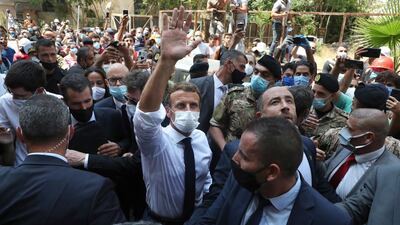
French President Emmanuel Macron, center, gestures as he visits the Gemayzeh neighborhood, which suffered extensive damage from an explosion on Tuesday that hit the seaport of Beirut, Lebanon, Thursday, Aug. 6, 2020. (AP Photo/Bilal Hussein) -

French President Emmanuel Macron gestures as he visits a devastated street of Beirut, Lebanon, on August 6, 2020 a day after a massive explosion devastated the Lebanese capital in a disaster that has sparked grief and fury. French President Emmanuel Macron visited shell-shocked Beirut Thursday, pledging support and urging change after a massive explosion devastated the Lebanese capital in a disaster that has sparked grief and fury. / AFP / POOL / Thibault Camus -
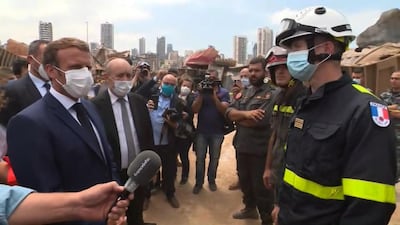
A video grab shows French President Emmmanuel Macron, left, speaking with a member of a French rescue team which arrived overnight to support relief efforts at the port of Lebanon's capital Beirut. AFP -
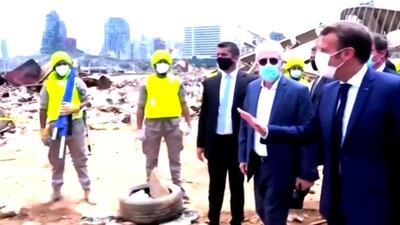
French President Emmanuel Macron visits the site of Tuesday's blast in Beirut. Tele Liban / Reuters -
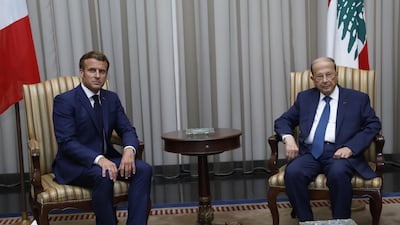
Lebanon's President Michel Aoun meets French President Emmanuel Macron on his arrival at the airport in Beirut. Dalati Nohra/Reuters -
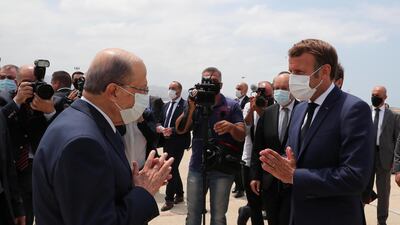
Lebanon's President Michel Aoun welcomes French President Emmanuel Macron on his arrival at the airport in Beirut. Dalati Nohra/Reuters -
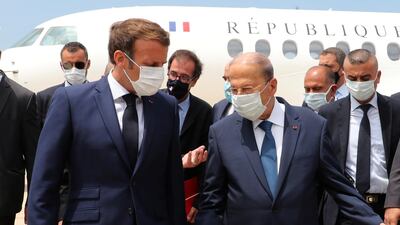
"Lebanon is not alone," Mr Macron tweeted shortly after landing. Dalati Nohra/Reuters -
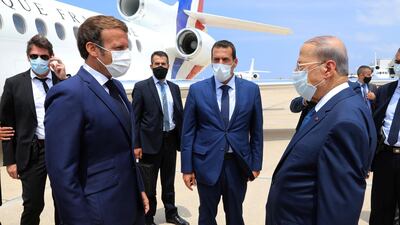
The French president is the first foreign leader to visit the Lebanese capital since an explosion on Tuesday killed at least 137 people. Dalati Nohra / Reuters -
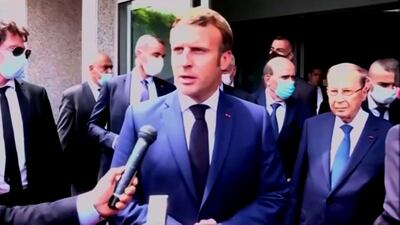
Mr Macron said Lebanon was facing a political and economic crisis, and that it would continue to suffer unless it enacted reforms. Reuters


A report prepared by a task force in Moscow has proposed a number of solutions, which include imposing boundaries on Hezbollah to cease direct intervention and influence; preventing any threat from originating in Lebanon to other countries; securing collective economic aid to rebuild the country; including Lebanon in various regional, political and diplomatic processes; concluding domestic political agreements that strengthen stability – even if those agreements are secret in nature; and pushing leaders to assume personal responsibility for national development.
All this requires removing the causes of instability in Lebanon, according to the report, which stressed the need to transform Lebanon “from an arena of conflict to a state with a future at any price”.
Russia is, meanwhile, working towards bringing Syria, Iran and Israel to the table – as I have previously written in these pages. The hope is that Syria and Israel will reach a deal regarding how much Iranian military presence should be allowed in that part of the region, which the Assad regime relies on for its security – and which Israel sees as a threat to its national security.
In the larger scheme of things, Russia sees Israel as a potential partner in its plan to bring about a radical change in the region – but it will not do so by abandoning Iran, which is its ally in Syria. To gain Israel’s support towards supporting its interests in the region, Moscow will need to find a way to convince Iran to draw down its military presence in Syria.

The upcoming elections in both Iran and Israel will make it harder for Moscow to bring both countries to the table. However, it is reportedly undeterred by this challenge. It is already engaging with Israel on this matter and intends to hold talks with Iran early next year.
Russia has leverage over Iran, given the business they do with one another. Moreover, both countries rely on one another in managing the Syrian conflict. Russia’s plan is to prevent total Iranian domination over the Syrian regime but at the same time ensure it has some influence in the country – and it intends to strike a bargain with the regime in Tehran in this regard.
It must do so in the context of Lebanon as well.
If Moscow has its way, one could expect serious reforms in the Middle East over the next few years. Russia sees itself, the US, France and Israel as the powers that will shape the region’s geopolitical future – without, of course, excluding other regional stakeholders such as Iran and key Arab countries.
The question is, who will bear responsibility for the process of achieving long-term stability in the Middle East? The political and economic costs will be high, and Russia can only bear limited responsibility in such a process.
It is also pertinent to ask whether Lebanon’s politicians, who seem largely unconcerned by their country’s lack of stability and sovereignty, can be convinced to act in the larger interests of their people.
Raghida Dergham is the founder and executive chairwoman of the Beirut Institute and a columnist for The National

