Whether they continue the lockdown and prioritise public health, or ease measures to avoid an economic collapse that will be devastating for their current and future financial and psychological wellbeing, nations and their leaders will be forced to reinvent themselves. Certainly, it will not be possible for them to return to the broad-based policies that had been put in place before Covid-19, with the virus having already altered the globalised landscape and upended nations’ geopolitical plans.
Even as the large, rich and powerful countries currently struggle to contain the coronavirus pandemic, the International Committee of the Red Cross (ICRC) has warned of its dire consequences on the future of vulnerable countries in the Middle East.
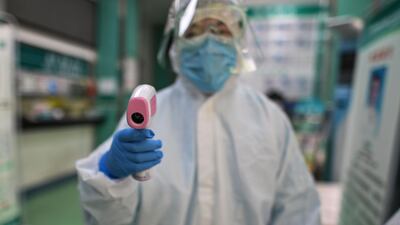
A medical worker prepares to check the temperature of an AFP photojournalist before a COVID-19 coronavirus test in Wuhan in China's central Hubei province. AFP
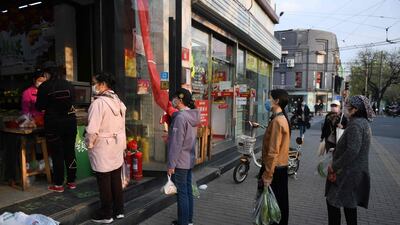
People queue up outside a fruit shop in Beijing. AFP
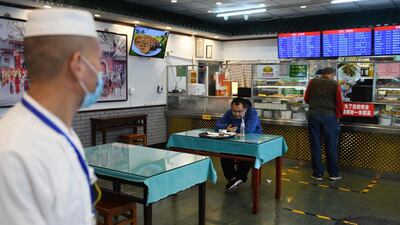
A man eats in a restaurant that has only one seat per table and markings on the floor to enforce social distancing in Beijing. AFP
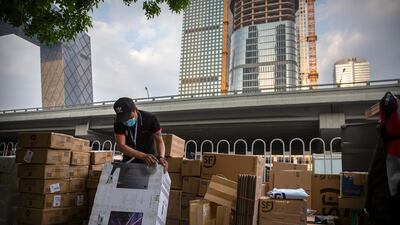
A delivery courier tapes a package along a road in the central business district in Beijing. AP Photo
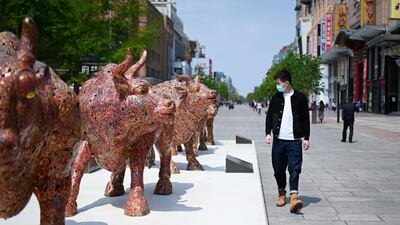
A man walks past bronze bull statues along a business street in Beijing. AFP
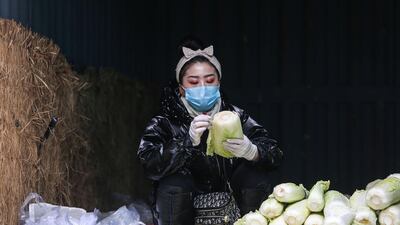
A vendor waits for customers at a market in Shenyang in China's northeastern Liaoning province. AFP
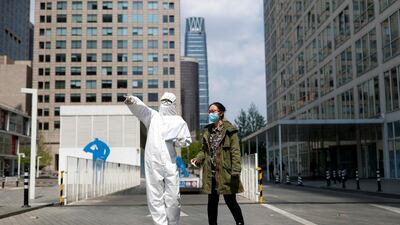
A security guard in Personal Protective Equipment suit gives directions to a passerby during lunch hour in Beijing's Central Business District. Reuters
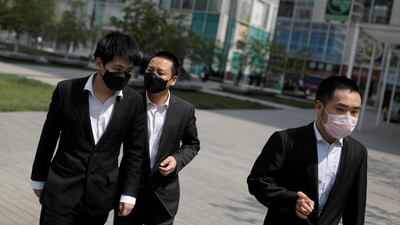
Office workers wear protective during lunch hour near Beijing’s Central Business District. Reuters
Office workers wearing protective masks walk in a park as people practice boxing during lunch hour near Beijing's Central Business District. Reuters
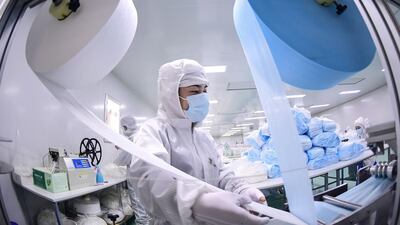
A worker produces face masks at a factory in Shenyang in China's northeastern Liaoning province. AFP
The ICRC has also noted that these nations are vulnerable not just due to their poor health and social infrastructure, but also because they are susceptible to violent social and political unrest as a reaction to their respective governments’ inadequate response to the crisis.
Iran, despite being one of the first countries in the Middle East to be hit by the coronavirus, has discovered that even in these circumstances, the US will not lift sanctions and Europe will not circumvent them. Tehran could well be upset by this reality, but it may also have concluded that unless it changes its regional policies, as well as its nuclear and ballistic missile programmes, the sanctions will remain in place.
The question, therefore, is whether the pandemic will force the region’s countries to reconsider their policies and reinvent themselves in order to save themselves. One problem is that global powers will be less capable of coming to their rescue due to their focus on the devastation in their own backyards.
In the post-Covid-19 brave new era, countries such as China, Russia and the US – as well as members of the EU and the G20 – will be forced to submit to radical reforms, both locally and globally.
Reform could also be waiting to happen within global institutions, such as the United Nations and its various agencies – including the World Health Organisation. President Donald Trump’s decision to suspend US funding for the WHO – in a protest against its alleged bias towards China – has been met with positive and negative responses within that country. The reaction outside the US has mostly been negative – irrespective of whether Mr Trump was justified or not in taking such action – given the realisation that we are all in this together.
Supranational groups such as the European Union have also been seen to be wanting in their ability to deliver solutions. The 27-nation bloc can no longer pretend as if nothing has changed following Brexit and the spread of Covid-19. Few will doubt the EU is facing huge economic, political and social challenges at the moment.
The dynamics that prevailed before the pandemic within the Group of 20, or G20, cannot continue to exist either, while the Gulf Cooperation Council (GCC) will find an opportunity to review some of its policies amid shrinking oil prices – due in large part to the glut in oil supplies, which can be attributed to a collapse in the demand for hydrocarbons in the wake of the global viral outbreak.
GCC ministers met via video link. Wam
Dr Andrei Fedorov, former deputy foreign minister of Russia and chairman of the Fund for Political Research, expects oil reservoirs to be nearly full in Russia, the US and everywhere else in the world – to the extent that these countries will be “obliged to get rid of it at any price even if the oil price goes down to zero” and the reason is that “you cannot stop production in the pipelines”. He added that this could happen in four weeks, and therefore, “by the end or mid-May, there will be a new oil crisis if it is not possible to go back to oil production”. He warned that if we get to the zero-point in May, “there will be no chance to restart the world economy without heavy losses”.
Most world leaders are moving with extreme caution, fearing they could squander a chance to restart the world economy, and expedite collapse.
May seems to be the month when most leaders hope to see a return to work and a gradual reduction in unemployment that has especially been devastating for the US, where more than 20 million people are claiming jobless allowances. The stakes are high, including Mr Trump’s re-election chances later this year. There is also concern of the adverse impact of America’s continued lockdown on other economies around the globe. “If the US economy is not reopened soon, this will kill the world economy,” Dr Fedorov said.
Iranian army commander-in-chief Abdolrahim Mousavi speaking during an army parade in Tehran. AFP
For its part, he added, “Russia is unable to play a role in the global economic agenda because of oil as well as the impact of the global economic crisis”. For this reason, there is talk in Moscow about reformulating the priorities of Russian foreign policy as the global conversation focuses on assessing how the coronavirus has impacted globalisation and the world economy.
There is, of course, an opportunity to restart the economy between the months of May and September – instead of keeping everything on lockdown indefinitely. But with fears of a second wave of the pandemic in China in the autumn season, many world leaders will be expected to formulate plans accordingly but also fearing for the future.
Raghida Dergham is the founder and executive chairwoman of the Beirut Institute

8 traditional Jamaican dishes to try at Kingston 21
Trench Town Rock: Jamaican-style curry goat served in a pastry basket with a carrot and potato garnish
Rock Steady Jerk Chicken: chicken marinated for 24 hours and slow-cooked on the grill
Mento Oxtail: flavoured oxtail stewed for five hours with herbs
Ackee and salt fish: the national dish of Jamaica makes for a hearty breakfast
Jamaican porridge: another breakfast favourite, can be made with peanut, cornmeal, banana and plantain
Jamaican beef patty: a pastry with ground beef filling
Hellshire Pon di Beach: Fresh fish with pickles
Out of Many: traditional sweet potato pudding
Key facilities
Olympic-size swimming pool with a split bulkhead for multi-use configurations, including water polo and 50m/25m training lanes
Premier League-standard football pitch
400m Olympic running track
NBA-spec basketball court with auditorium
600-seat auditorium
Spaces for historical and cultural exploration
An elevated football field that doubles as a helipad
Specialist robotics and science laboratories
AR and VR-enabled learning centres
Disruption Lab and Research Centre for developing entrepreneurial skills
National Bonds unveiled a Golden Pension Scheme in 2022 to help private-sector foreign employees with their financial planning.
In April 2021, Hayah Insurance unveiled a workplace savings plan to help UAE employees save for their retirement.
Lunate, an Abu Dhabi-based investment manager, has launched a fund that will allow UAE private companies to offer employees investment returns on end-of-service benefits.
Duterte Harry: Fire and Fury in the Philippines
Jonathan Miller, Scribe Publications
Welcome back. What was it like to return to RAK and to play for fans out here again?
It’s an amazing feeling to be back in the passionate UAE again. Seeing the fans having a great time that is what it’s all about.
You're currently touring the globe as part of your Legends of the Feels Tour. How important is it to you to include the Middle East in the schedule?
The tour is doing really well and is extensive and intensive at the same time travelling all over the globe. My Middle Eastern fans are very dear to me, it’s good to be back.
You mix tracks that people know and love, but you also have a visually impressive set too (graphics etc). Is that the secret recipe to Dash Berlin's live gigs?
People enjoying the combination of the music and visuals are the key factor in the success of the Legends Of The Feel tour 2018.
Have you had some time to explore Ras al Khaimah too? If so, what have you been up to?
Coming fresh out of Las Vegas where I continue my 7th annual year DJ residency at Marquee, I decided it was a perfect moment to catch some sun rays and enjoy the warm hospitality of Bab Al Bahr.
September to November or March to May; this is when visitors are most likely to see what they’ve come for.
WHERE TO STAY:
Meghauli Serai, A Taj Safari - Chitwan National Park resort (tajhotels.com) is a one-hour drive from Bharatpur Airport with stays costing from Dh1,396 per night, including taxes and breakfast. Return airport transfers cost from Dh661.
HOW TO GET THERE:
Etihad Airways regularly flies from Abu Dhabi to Kathmandu from around Dh1,500 per person return, including taxes. Buddha Air (buddhaair.com) and Yeti Airlines (yetiairlines.com) fly from Kathmandu to Bharatpur several times a day from about Dh660 return and the flight takes just 20 minutes. Driving is possible but the roads are hilly which means it will take you five or six hours to travel 148 kilometres.
Profile
Co-founders of the company: Vilhelm Hedberg and Ravi Bhusari
Launch year: In 2016 ekar launched and signed an agreement with Etihad Airways in Abu Dhabi. In January 2017 ekar launched in Dubai in a partnership with the RTA.
Number of employees: Over 50
Financing stage: Series B currently being finalised
Investors: Series A - Audacia Capital
Sector of operation: Transport
RESULTS
5pm Maiden (PA) Dh70,000 (Dirt) 1,400m
Winner AF Nashrah, Tadhg O’Shea (jockey), Ernst Oertel (trainer)
5.30pm Maiden (PA) Dh70,000 (D) 1,400m
Winner Mutaqadim, Riccardo Iacopini, Ibrahim Al Hadhrami.
6pm Maiden (PA) Dh70,000 (D) 1,600m
Winner Hameem, Jose Santiago, Abdallah Al Hammadi.
6.30pm Maiden (PA) Dh70,000 (D) 1,600m
Winner AF Almomayaz, Sandro Paiva, Ali Rashid Al Raihe.
7pm Handicap (PA) Dh70,000 (D) 1,800m
Winner Dalil Al Carrere, Fernando Jara, Mohamed Daggash.
7.30pm Handicap (TB) Dh70,000 (D) 1,000m
Winner Lahmoom, Royston Ffrench, Salem bin Ghadayer.
8pm Handicap (PA) Dh70,000 (D) 1,000m
Winner Jayide Al Boraq, Bernardo Pinheiro, Khalifa Al Neyadi.
Mercer, the investment consulting arm of US services company Marsh & McLennan, expects its wealth division to at least double its assets under management (AUM) in the Middle East as wealth in the region continues to grow despite economic headwinds, a company official said.
Mercer Wealth, which globally has $160 billion in AUM, plans to boost its AUM in the region to $2-$3bn in the next 2-3 years from the present $1bn, said Yasir AbuShaban, a Dubai-based principal with Mercer Wealth.
“Within the next two to three years, we are looking at reaching $2 to $3 billion as a conservative estimate and we do see an opportunity to do so,” said Mr AbuShaban.
Mercer does not directly make investments, but allocates clients’ money they have discretion to, to professional asset managers. They also provide advice to clients.
“We have buying power. We can negotiate on their (client’s) behalf with asset managers to provide them lower fees than they otherwise would have to get on their own,” he added.
Mercer Wealth’s clients include sovereign wealth funds, family offices, and insurance companies among others.
From its office in Dubai, Mercer also looks after Africa, India and Turkey, where they also see opportunity for growth.
Wealth creation in Middle East and Africa (MEA) grew 8.5 per cent to $8.1 trillion last year from $7.5tn in 2015, higher than last year’s global average of 6 per cent and the second-highest growth in a region after Asia-Pacific which grew 9.9 per cent, according to consultancy Boston Consulting Group (BCG). In the region, where wealth grew just 1.9 per cent in 2015 compared with 2014, a pickup in oil prices has helped in wealth generation.
BCG is forecasting MEA wealth will rise to $12tn by 2021, growing at an annual average of 8 per cent.
Drivers of wealth generation in the region will be split evenly between new wealth creation and growth of performance of existing assets, according to BCG.
Another general trend in the region is clients’ looking for a comprehensive approach to investing, according to Mr AbuShaban.
“Institutional investors or some of the families are seeing a slowdown in the available capital they have to invest and in that sense they are looking at optimizing the way they manage their portfolios and making sure they are not investing haphazardly and different parts of their investment are working together,” said Mr AbuShaban.
Some clients also have a higher appetite for risk, given the low interest-rate environment that does not provide enough yield for some institutional investors. These clients are keen to invest in illiquid assets, such as private equity and infrastructure.
“What we have seen is a desire for higher returns in what has been a low-return environment specifically in various fixed income or bonds,” he said.
“In this environment, we have seen a de facto increase in the risk that clients are taking in things like illiquid investments, private equity investments, infrastructure and private debt, those kind of investments were higher illiquidity results in incrementally higher returns.”
The Abu Dhabi Investment Authority, one of the largest sovereign wealth funds, said in its 2016 report that has gradually increased its exposure in direct private equity and private credit transactions, mainly in Asian markets and especially in China and India. The authority’s private equity department focused on structured equities owing to “their defensive characteristics.”