

On Monday afternoon, Sheikh Mohamed bin Zayed, Crown Prince of Abu Dhabi and Deputy Supreme Commander of the Armed Forces, provided a substantial update on the UAE's response to coronavirus.
“We are racing against time,” he said, to confront the challenges posed by Covid-19.
Sheikh Mohamed said the country was “well geared” and had sophisticated infrastructure to confront the threat posed by the pandemic, adding that the UAE had used the experiences of Singapore, South Korea and China to help formulate this country’s response.
“These hard times will pass,” he said, and the country will emerge stronger once today’s moment of crisis subsides. “We are well prepared to face any challenge that arises."
Earlier, he had reviewed the stimulus package announced this week by the Government of Abu Dhabi, designed to help support the economy, which has been buffeted by the unprecedented international turmoil caused by the pandemic. The measures offer fee reductions, rebates, subsidies and payment holidays for businesses and concessions for consumers.
The Central Bank had also initiated a Dh100 billion package of measures on Sunday to strengthen the country's economy. Last week, Sheikh Hamdan bin Mohammed, Crown Prince of Dubai, unveiled an economic stimulus package for the emirate, aimed at protecting tourism businesses, retail, external trade and logistics services.
Taken together, all these measures demonstrate the country is seeking to win that race and is well prepared to meet the challenges of the months ahead.
-
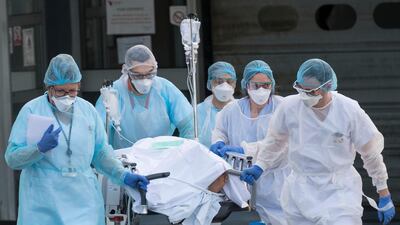
Medical staff push a patient on a gurney to a waiting medical helicopter at the Emile Muller hospital in Mulhouse, eastern France. AFP -
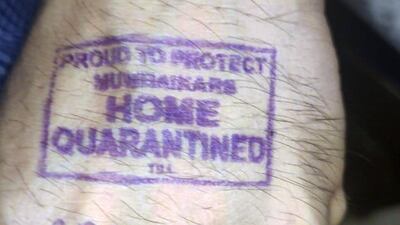
An Indian man shows his stamped hand, indicating that the person is under 'home quarantine', in Mumbai, India. EPA -

Judie Shape, centre, who has tested positive for the coronavirus, but isn't showing symptoms, presses her hand against her window after a visit through the window and on the phone with her daughter Lori Spencer, left, and her son-in-law Michael Spencer, at the Life Care Center in Kirkland. AP Photo -

A single worshipper wearing a surgical mask sits on a pew in Westminster Cathedral in central London. AFP -
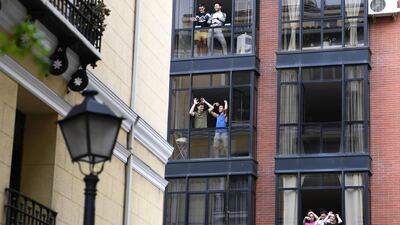
People confined at their homes sing and dance from their windows to bolster themselves up during a lockdown in Madrid. AFP -
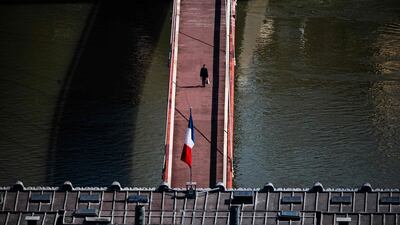
A person walks on the deserted Passerelle du Palais de Justice in Lyon, central eastern France as a strict lockdown comes into in effect. AFP -
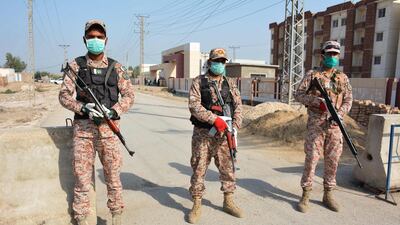
Soldiers stand guard on road leading to a quarantine faciltity for people returning from Iran via the Pakistan-Iran border town of Taftan, in Sukkur in southern Sindh province. AFP -

A passenger wearing protective clothing uses a self check-in machine at Incheon international airport, west of Seoul. AFP -
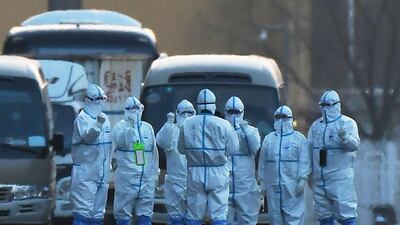
Workers cheer themselves after loading travellers onto buses outside the New China International Exhibition Centre, near Beijing Capital Airport in Beijing. AFP -
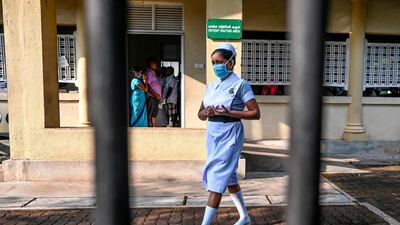
A nurse wearing a facemask walks outside the entrance of Sri Lanka's Infectious Diseases Hospital near Colombo. AFP -
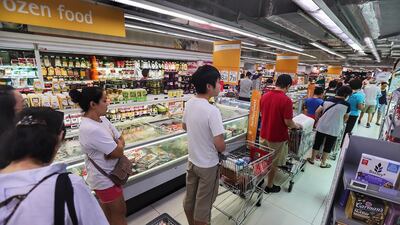
People queue for groceries at a supermarket in Singapore. AFP -
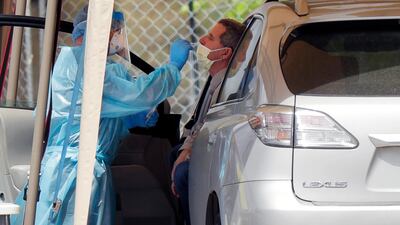
A medical worker tests a person for the coronavirus at a drive-through facility primarily for first responders and medical personnel in San Antonio. AP Photo -
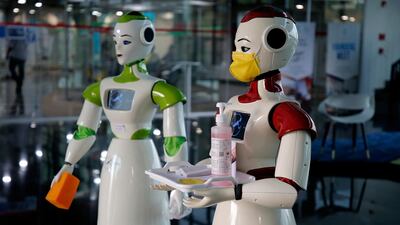
A robot, developed by a start-up firm Asimov Robotics, holds a tray with face masks and sanitiser after the two robots were launched to spread awareness about the coronavirus, in Kochi, India, March 17, 2020. Reuters


It is also certain that a combination of local, national, regional and international action will be required to address this global crisis, but these measures will also need to be matched by personal action. We are all in this together.
The pandemic has introduced new expressions to our daily vocabulary, such as self-isolation and social distancing, which have become guiding principles almost overnight.
The age of disruption, in the form of closures of schools and a range of public venues, isolation and regular screening for citizens and residents, is also now a lived reality.
Even if it is foolish to predict where the outbreak is heading, we know already that globally this will be a long race to contain and control its spread. It will require sustained common purpose. One of the few certainties of today is that the Covid-19 crisis will be with us for weeks and months.
More than 200,000 cases have been diagnosed globally and more than 8,000 people have died from coronavirus worldwide. In the UAE, more than 100 cases have been identified.
But there are a raft of issues to be tackled far beyond the shock of today's news, the threat of infection or the gloom associated with sinking markets and downward pressures upon global economies.
As borders close and our horizons shrink, we must recognise that in all likelihood we are also heading towards a global mental health crisis. The tide will eventually turn on Covid-19, but in all likelihood it will leave behind some deep scars.
Symptoms of anxiety, depression and stress have already spiked in the always-on world we live in, they might yet peak in the thicket of the always-worried coronavirus crisis.
-
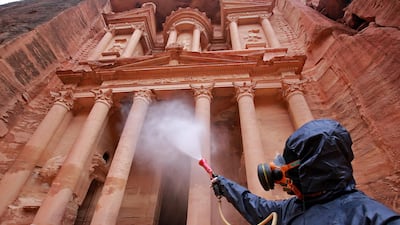
A labourer sprays disinfectant in Jordan's Petra south of the capital Amman to prevent the spread of coronavirus. AFP -
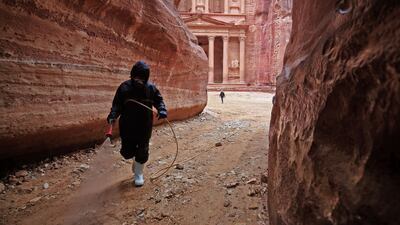
A labourer sprays disinfectant in Jordan's Petra south of the capital Amman to prevent the spread of coronavirus. AFP -

Delivery men wear protective face masks as they deliver food for customers in Riyadh, Saudi Arabia. Reuters -
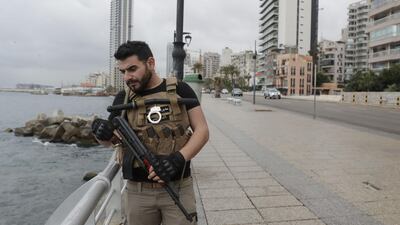
Lebanese intelligence officer patrolling a street in Beirut after authorities ordered shops to close for two weeks to fight COVID-19. AFP -

Lebanese intelligence officers patrolling a street in Beirut after authorities ordered shops to close for two weeks to fight COVID-19. AFP -
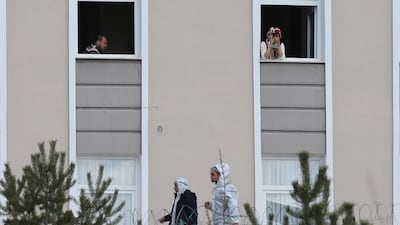
Turkish citizens look out from windows in Ankara after being quarantined to prevent the spread of coronavirus after returning from Saudi Arabia, where they took part in the Umrah pilgrimage. EPA -
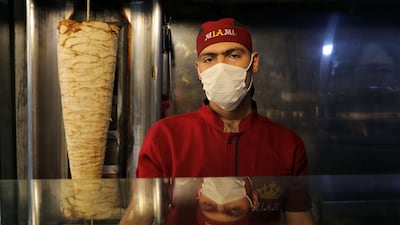
A man wearing a face mask sells food at a street market in Erbil, Iraq. AFP -

A civil defence worker sprays disinfectant in a market in Baghdad, Iraq. AP Photo -
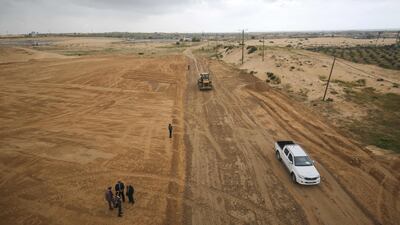
Palestinian municipality workers and Health Ministry personnel stand at the construction site of a field hospital to house coronavirus patients in Rafah in the southern Gaza strip. AFP -
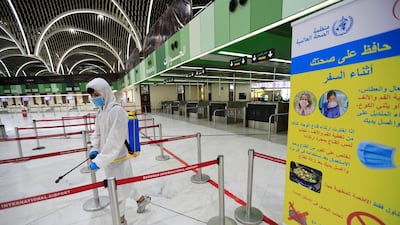
A worker wearing a protective suit sprays interiors departure hall of Baghdad International Airport. REUTERS -
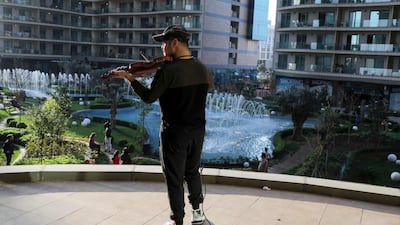
Iraqi Kurdish musician Nujin Hasan plays his violin to residents of his apartment block in Erbil. AFP -
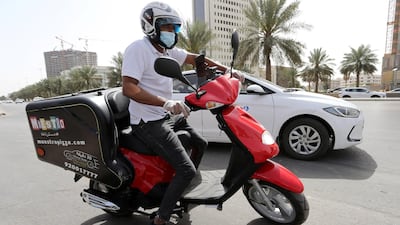
Delivery men wear protective face masks as they deliver food for customers in Riyadh, Saudi Arabia. Reuters -

Heath workers take people's temperatures and inform them about the dangers of the spread of the coronavirus near the camp for displaced Syrians in Deir al-Ballut camp in Afrin, Aleppo. AFP -
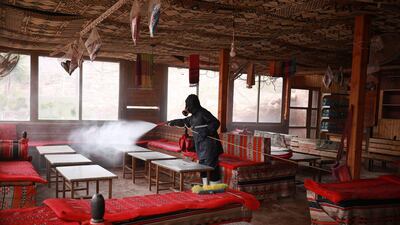
A labourer sprays disinfectant in Jordan's archaeological city of Petra south of the capital Amman. AFP


As Dr Vassiliki Simoglou, a Dubai-based counselling psychologist, wrote earlier this week, coronavirus-related anxiety "triggers our primal fears" and transforms the people around us into threats with the consequence of turning communities against each other.
This outbreak places further obstacles in front of us all, from being unable to see loved ones and friends at home and abroad, to the wider potential complications caused by isolation, withdrawal and loneliness. For those who avoid infection, fatigue will be another damaging fact of our lives in the weeks and months ahead.
We must also recognise that some international containment policies will get things right and some will not.
We know that this crisis is dynamic and we are all learning as we go along. We could not have predicted a week ago that so many countries would be on lockdown, multiple borders would be closed and widespread social restrictions imposed across the globe.
All of those factors indicate change is happening at lightning speed, as indeed is our understanding of the outbreak, but we must also trust leadership and science to find the fixes.
The past few weeks have also underlined what a fragile planet we live on and the brittle nature of globalisation.
The great hope of this crisis is that it will spur further co-operation among communities and nations.
The helping hand extended by the UAE to Iran this week is a state level example of this, the exuberant inhabitants of Europe's balconies lifting each other's spirits under self-isolation is another more local example. There have been, and there will continue to be, plenty of other moments like this.
The Covid-19 crisis and this heightened state of collaboration and common purpose could even eventually drive us towards solving huge global issues, such as ending intractable conflicts and combating climate change, as well as, on a local level, building better communities.
Certainly, our lives are unlikely to return to normal quickly. What we can say is that the UAE is prepared to face any challenge that presents itself.
Nick March is an assistant editor-in-chief at The National

