

As a trainee journalist years ago in Northern Ireland, I was at the bottom of the pecking order when it came to assignments. One morning my editor told me that there was a man with an urgent tip-off on a major story sitting in our Belfast office reception, and I had been selected to talk to him. The man had driven 50 miles from his home in Coleraine because his story was so important.
“Be nice,” my editor advised, as he explained that the man seemed a bit eccentric. “And be warned. Good stories don’t walk in from the street.”
The visitor was well dressed, polite and articulate. We sat drinking tea while he explained, over a file of notes, sketches and calculations, that a new, enormous bridge being constructed over the river Foyle in Londonderry was going to be a disaster. His calculations showed that the bridge would be too short to cross the river without a gap in the middle, a gap large enough for cars and buses to fall into the water. I tried not to laugh. “Are you a structural engineer or an architect?” I asked. No, he said. He owned a high street shop.

The definition of lying is to be deliberately deceitful, and the man, by that definition, was odd and profoundly mistaken, but not actually lying. He clearly believed every word he was spouting, even if it was nonsense.
This shopkeeper’s tale has been in my mind a lot recently. He is not alone in sincerely talking rubbish. The world has plenty of gullible people channelling dangerous falsehoods, which they honestly believe and then repeat with an almost religious passion.
In Germany, for example, there is a dangerous outbreak of Covid-19 denial. In Berlin 20,000 protestors took part in last week’s “end of the pandemic – day of freedom” demonstration. This ragtag group included agitators from the left and the right, peace protesters, gay rights activists and neo-fascist groups carrying flags of the old German Empire.
In Britain, there is a similarly strange coalition of Covid-19 deniers and mask-avoiding vaccination sceptics, including self-described “libertarians”, far-right eccentrics and leftists, including Piers Corbyn. He’s the brother of the former leader of the British Labour party, Jeremy Corbyn.
Some agitators claim British hospitals are empty of Covid-19 cases, when in reality the health system is in crisis and almost at breaking point. On New Year’s Eve, a crowd of demonstrators turned up outside a London hospital chanting “Covid is a hoax”. The head of NHS England, Sir Simon Stevens, responded that the protesters are talking “nonsense” and are responsible for behavioural changes "that will kill people”.
In the US, they have plenty of Covid-19 deniers, and worse. Bill Gates, the co-founder of Microsoft, was asked recently about the strangest lie told about him. He answered: “that I was involved in creating the coronavirus. I don’t think it gets much stranger than that.” And as Washington prepares somewhat nervously for the inauguration of President-elect Joe Biden after the riot inspired by the incumbent president, Donald Trump, two thirds of Republican voters tell pollsters that they “strongly agree” or “somewhat agree” that the presidential election was rigged, despite all the evidence to the contrary.
-
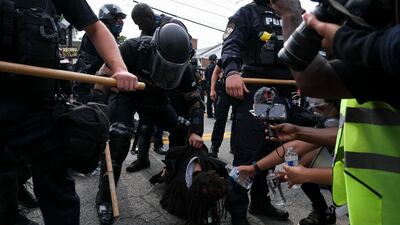
A protestor is detained while bleeding from the head in downtown Louisville, Kentucky, on September 23, 2020, after a judge announced the charges brought by a grand jury against Detective Brett Hankison, one of three police officers involved in the fatal shooting of Breonna Taylor in March. AFP -
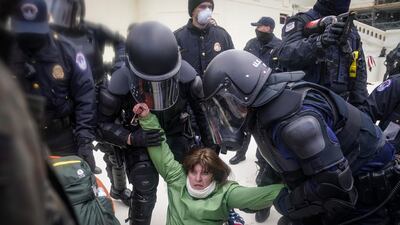
A woman is helped up by police during a rally Wednesday, Jan. 6, 2021, at the Capitol in Washington. AP Photo -
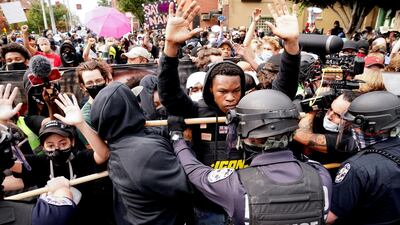
Protestors raise hands during a demonstration, Wednesday, Sept. 23, 2020, in Louisville, Kentucky. AP photo -
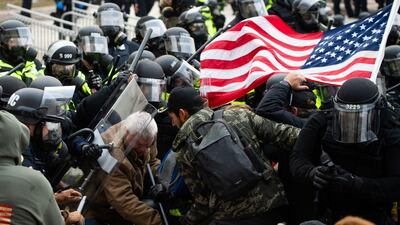
Supporters of US President Donald Trump fight with riot police outside the Capitol building on January 6, 2021 in Washington, DC. Donald Trump's supporters stormed a session of Congress held today, January 6, to certify Joe Biden's election win, triggering unprecedented chaos and violence at the heart of American democracy and accusations the president was attempting a coup. AFP -

Louisville, KY, USA; Protestors surround Louisville Metro Police officer Galen Hinshaw in front of Bearno s restaurant on Thursday, May 28, 2020, Louisville, Kentucky. Five strangers linked arms to protect Hinshaw. Reuters -
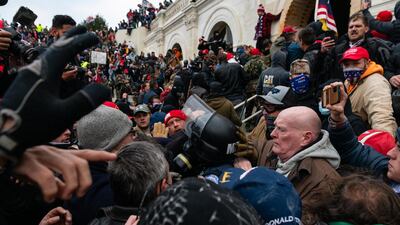
Demonstrators drag and capture a Metropolitan Police officer, while attempting to enter the U.S. Capitol building, during a protest in Washington, D.C., U.S., on Wednesday, Jan. 6, 2021. Bloomberg -
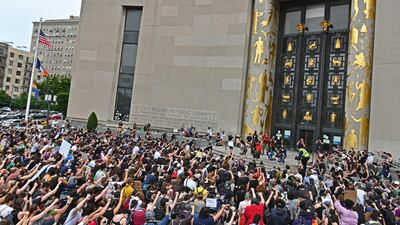
Protesters take a knee and raise their fists during a "Black Lives Matter" demonstration in front of the Brooklyn Library and Grand Army Plaza on June 5, 2020 in Brooklyn, New York, amid ongoing protests over the death in police custody of George Floyd. AFP -
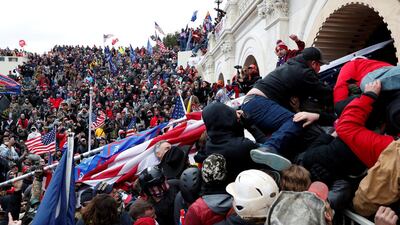
Pro-Trump protesters storm into the U.S. Capitol during clashes with police, during a rally to contest the certification of the 2020 U.S. presidential election results by the U.S. Congress, in Washington, U.S, January 6, 2021. Reuters


While all these conspiracy theories are based on lies, the many people who spread the stories are generally true believers rather than deliberate liars. And that’s what makes dealing with them so difficult. Conspiracies are matters of belief, of faith rather than reason, even if it is bad faith maliciously inspired by others.
When challenged, anti-vaxxers and Trump’s faithful diehard supporters appear astonished and angry that the rest of us cannot understand the great truths that they believe are obvious. They do not see our scepticism as being rooted in facts. Quite the reverse. They see criticisms of their beliefs and actions as our own foolishness and stupidity or – worse – that we are part of “the great conspiracy” of the “deep state”.
This creates is an urgent problem for policymakers, health experts and governments. What can scientists, healthcare workers and political leaders do to prevent the obvious harm caused by Covid-19 deniers and violent Trump activists? What can anyone do to persuade a group of determined people who refuse to accept the world of facts and reason? How can we destroy the lies by persuading the deluded believers that they are wrong? It’s not easy, but facts, eventually, do matter. The novel coronavirus – like gravity – really does exist.
Ironically, some Covid-19 deniers will undoubtedly catch the virus they do not believe is real. Vaccinations generally do work, and some sceptics will eventually see sense and get the jab. Mr Trump, in the end, is losing support and will lose power. And the Coleraine shopkeeper, if he is still alive, must eventually have recognised that, despite his calculations of doom, the new bridge connecting the two sides of the River Foyle in Londonderry has no gap in the middle. I sometimes hope optimistically that he has driven across the bridge he said would be a disaster and survived long enough to accept reality. We can hope.
Gavin Esler is a broadcaster and UK columnist for The National

