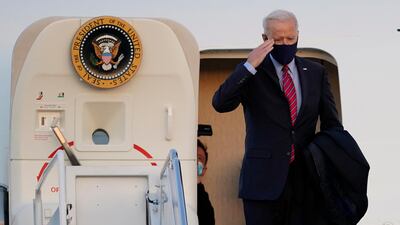

Donald Trump's foreign policy was among the most unorthodox features of his disruptive presidency. Last week, new US President Joe Biden announced at the State Department that "America is back". Perhaps, but it isn't going to be easy.
Mr Biden is trying to revive a bipartisan foreign policy consensus shaped by the Second World War, the Cold War and the post-Cold War era. It emphasised fixed or long-standing alliances; fostering international order based on rules or at least understandings; and trying to balance, when possible, American values with national interests, with the understanding that, over the long run, that adds to the US competitive advantage against undemocratic rivals.
Mr Trump wanted none of it. He cast this as a suckers’ game, with Americans being exploited, especially financially, by putative partners. Instead, he embraced an effectively mercantilist approach, seeking to extract maximum short-term, especially financial, advantage. He had no interest in promoting traditional US values, which he doesn't seem to share.
Moreover, he regarded fixed and long-standing alliances as suspect, burdensome and even destructive. He made no secret of even wanting to withdraw the US from Nato.
Mr Biden campaigned as Mr Trump’s antithesis in many ways. The watchword of his presidency, thus far at least, is the restoration of "regular order", both at home and abroad.
On January 22, new Defence Secretary Lloyd Austin became Mr Biden’s second confirmed cabinet member. He immediately telephoned Nato Secretary General Jens Stoltenberg to reiterate Washington's commitment to the alliance. Nato has committed to increasing participation in the missions in Afghanistan and, especially, Iraq, in a manner that is yet to be defined. So, there’s positive outreach in both directions.
Yet Nato remains a regrettably representative anachronism.
It was established as an anti-Soviet alliance, but the USSR is long gone. The lack of an ongoing consensus raison d'etre makes the organisation vulnerable to internal discord, with at least one member state, Turkey, pursuing a highly aggressive agenda at the expense of other members' interests and international stability. The absence of a clear mission leaves Nato vulnerable to criticism like Mr Trump's, who treated it as an unprofitable protection racket.
Even if Mr Trump had secured a second term, he probably couldn't have fully withdrawn from or dismantled Nato. But Mr Biden probably won't be able to fully repair the damage done over the past four years, or, even more seriously, paper over the actually existing flaws glaringly exposed by Mr Trump's attitude.
The end of the Cold War not only stripped Nato of its foundational purpose, it yanked away the external threat that informed all post-Second World War iterations of US internationalism and that ensured the unbroken primacy of such policies.
-
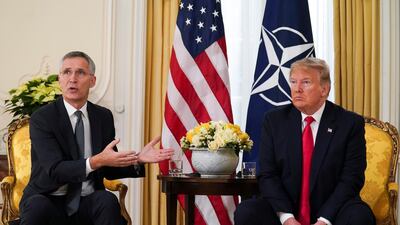
US President Donald Trump meets with NATO Secretary General Jens Stoltenberg, ahead of the NATO summit in Watford, in London. Reuters -
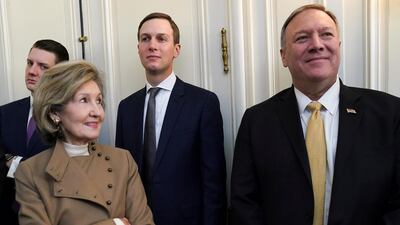
US Ambassador to NATO Kay Bailey Hutchison looks at US Secretary of State Mike Pompeo next to White House senior advisor Jared Kushner during the meeting of US President Donald Trump and NATO Secretary General Jens Stoltenberg, ahead of the NATO summit in Watford, in London. Reuters -

A fire brigade truck parks outside Central Hall Westminster during an evacuation in the early morning hours in London. The venue is set to host the NATO Summit on 03-04 December 2019. Central Hall Westminster was reopened after one hour. EPA -
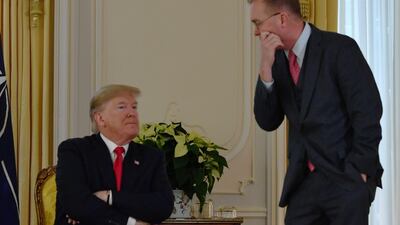
US President Donald Trump speaks with US acting Chief of Staff Mick Mulvaney after his meeting with Nato Secretary General Jens Stoltenberg at Winfield House, London. AFP -
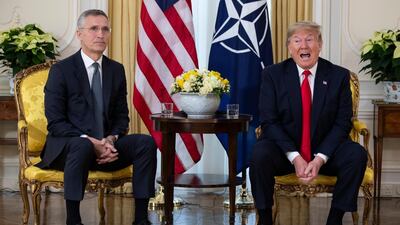
US President Donald Trump speaks during a meeting with NATO Secretary General, Jens Stoltenberg at Winfield House in London. AP Photo -
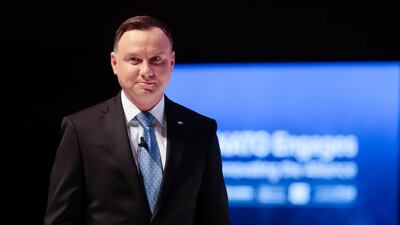
Polish President Andrzej Duda attends the Nato Engages conference ahead to the NATO Summit in London. EPA -
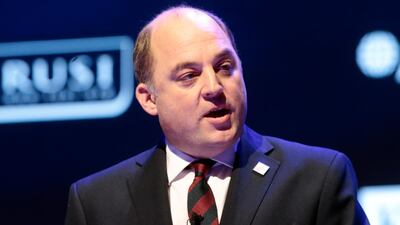
British Secretary of State for Defence Ben Wallace speaks during Nato Engages conference ahead to the NATO Summit in London. EPA -
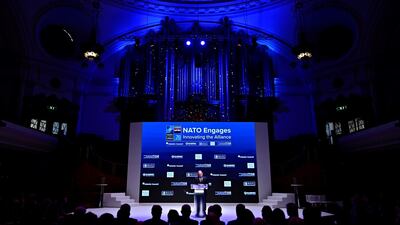
Britain's Defence Secretary Ben Wallace speaks at the official NATO outreach event, 'Nato Engages' in central London. AFP -
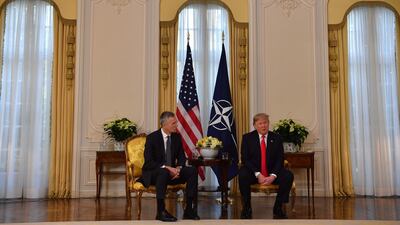
US President Donald Trump meets Nato Secretary General Jens Stoltenberg at Winfield House, London. AFP


It took many years and the radical over-extension, informed by neoconservative hubris, of the first George W Bush term, but eventually the absence of a "Soviet menace" led to the re-emergence of isolationism in US foreign policy. It finally arrived in the modified form of Mr Trump's "America First" quasi-mercantile agenda.
That stance remains popular among right-wing Republican voters. And there is an analogous neo-isolationist orientation growing among left-wing Democrats. The two often find themselves incongruously aligned, and they have joined forces in a relatively new Washington foreign policy think tank.
Some aspects of the Trump approach in fact have roots in Barack Obama’s administration. But they developed considerable momentum under Mr Trump.
Not entirely dissimilarly to his predecessor, Mr Biden’s foreign policy promises to secure tangible benefits to ordinary Americans. But, unlike Mr Trump, it intends be seen as delivering them.
In essence, Mr Biden has outlined a modified version of "America First", especially since he has little choice but to focus on American domestic crises. Only a remarkable series of foreign policy successes could fully restore traditional US internationalism, but Mr Biden wants to take it as far as possible.
His opening agenda reflects this emerging paradigm.
-
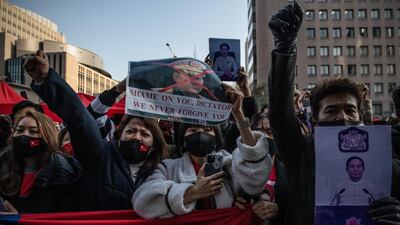
Myanmar nationals in Japan demonstrate against the military coup that took place in their home country on Monday, February 1, 2021. Getty Images -

A Myanmar national in Japan holds up a portrait of Aung San Suu Kyi during a protest held in front of the United Nations University in Tokyo. EPA -
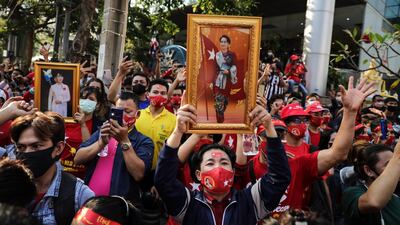
People hold up images of Myanmar's de-facto leader Aung San Suu Kyi at a protest outside Maynmar's embassy in Bangkok, Thailand. Getty Images -
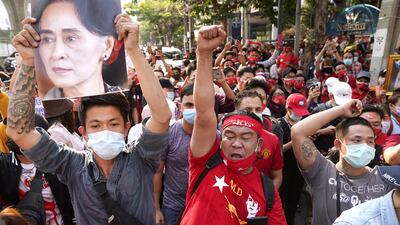
NLD supporters shout slogans outside Myanmar's embassy during a rally after the military seized power from a democratically elected civilian government and arrested its leader Aung San Suu Kyi, in Bangkok, Thailand. Reuters -
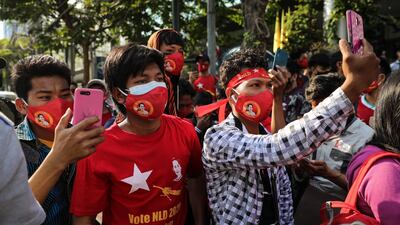
People use their smartphones to live stream a protest outside Myanmar's embassy in Bangkok, Thailand. Getty Images -

This screengrab provided via AFPTV and taken from a broadcast by Myanmar Radio and Television (MRTV) in Myanmar shows the announcement of a one-year state of emergency in the country. AFP -

A screen grab from Myanmar state television footage shows Myanmar Acting President Myint Swe (R) and General Min Aung Hlaing (L) as they attend a meeting. Reuters -

A military helicopter flies in Naypyitaw, Myanmar. EPA -

Cars pass police sitting in trucks along a road in Yangon, as Myanmar's military detained the country's de facto leader Aung San Suu Kyi and the country's president in a coup. AFP -
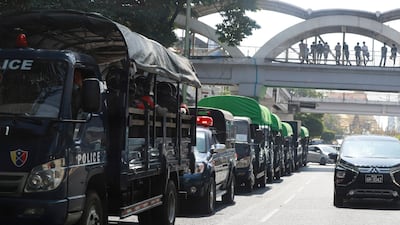
Policemen sit inside trucks parked on a road in the downtown area of Yangon, Myanmar. AP -

Myanmar military supporters riding a vehicle wave a military flag as they go around Yangon, Myanmar. AP -

People wave flags as they ride on a vehicle in Yangon, Myanmar. Reuters -

A view of Shwedagon Pagoda, a Buddhist religious landmark in Yangon, as Myanmar's military detained the country's de facto leader Aung San Suu Kyi and the country's president in a coup. AFP -
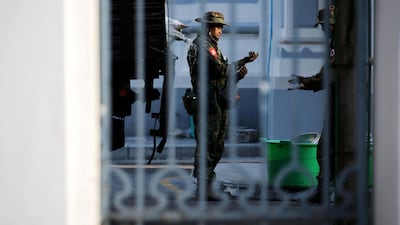
Myanmar soldiers are seen inside City Hall in Yangon, Myanmar. Reuters -

A woman leaves her house while being escorted by soldiers (unseen) at an unidentified location in Myanmar, in this picture obtained from social media. Reuters -
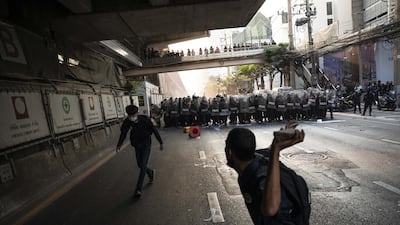
A demonstrator prepares to throw a rock towards riot police during a protest outside the Embassy of Myanmar in Bangkok, Thailand. Andre Malerba/Bloomberg -
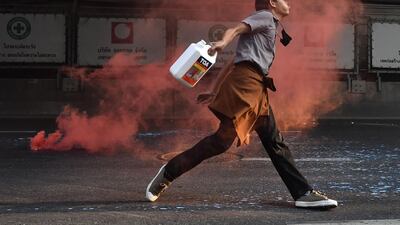
A Thai pro-democracy protestor confronts riot police in Bangkok, in the area where Myanmar migrants were demonstrating after Myanmar's military detained the country's de facto leader Aung San Suu Kyi and the country's president in a coup. AFP -
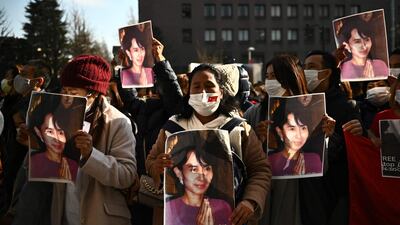
A group of Myanmar activists hold the portrait of Aung San Suu Kyi during a protest outside the United Nation university in Tokyo following a military coup in the country by a general after arresting civilian leader Aung San Suu Kyi and other senior officials. AFP -
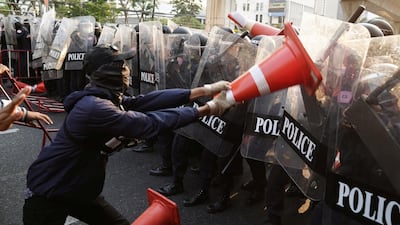
Anti-Thai government protester wields a traffic cone at riot police during a clash at a rally for Myanmar's democracy outside the embassy, in Bangkok, Thailand. Reuters


The reassertion of values includes objecting strongly to the coup in Myanmar, taking a far stronger rhetorical line with Russia (while simultaneously extending the New Start treaty with Moscow for an additional five years), and reopening US immigration.
The recommitment to multilateralism involves rejoining the World Health Organisation and the Paris climate accord.
Conflict resolution will be a key theme, including a major push already under way to help end the war in Yemen. Many Democrats will support this as a supposed repudiation of Mr Trump and step towards restoring international order, but it is much easier said than done.
The key will be somehow convincing the Houthis to make the political and security commitments necessary to arrive at a political settlement. Although Secretary of State Antony Blinken acknowledged in his Senate confirmation testimony that the Houthis are clearly responsible for the conflict, few in Washington seem to comprehend the immense difficulties in trying to negotiate with them.
Rebuilding a nuclear dialogue with Iran is a key priority, but the administration hasn't gone further than hinting at a possible "freeze" whereby both sides do nothing to further violate the nuclear deal. Progress will be much slower and more difficult than many hoped.
-

Educator John Cormier receives a shot from LPN Lizmary Reyes in East Hartford, Connecticut. AP Photo -
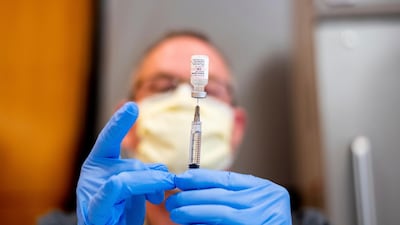
A pharmacist draws saline while preparing a dose of Pfizer's Covid-19 vaccine in Sacramento, California. AP Photo -
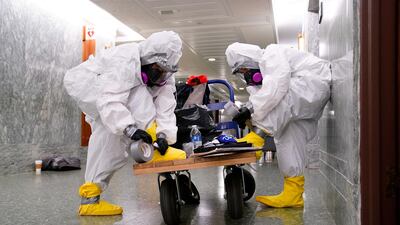
Workers seal their feet into hazmat suits as they prepare to clean the Senate Special Committee on Aging offices after a person reportedly tested positive for coronavirus. Reuters -

Chaplain Kristin Michealsen leaves a Covid-19 unit after talking to a family member of a deceased patient at Providence Holy Cross Medical Center in the Mission Hills section of Los Angeles. AP Photo -

People receive Covid-19 antibody tests during a free testing session in honour of Dr. Martin Luther King, Jr. at Southside Church of Christ in Los Angeles. AP Photo -

Daisy Ozaeta, 25, of Los Angeles, waits for Dr. Nana Afoh-Manina, co-founder of myCovidMD, to collect a blood sample from her for a Covid-19 antibody test. AP Photo -
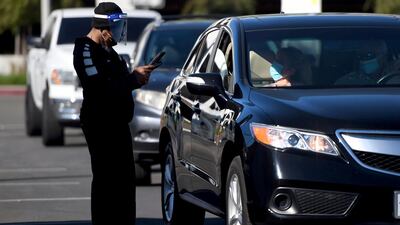
A Covid-19 testing site at Long Beach Airport, available exclusively for Hawaiian Airlines' guests travelling to the Hawaiian Island, in Long Beach, California. AP Photo -

A nurse administers a coronavirus test at a drive-through centre targeting underserved communities on Martin Luther King Day in Philadelphia, Pennsylvania. Reuters -
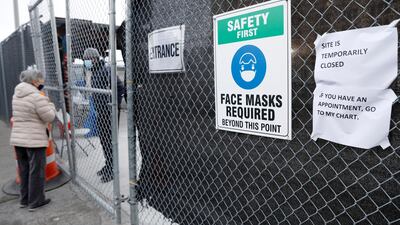
A woman talks to a worker behind a locked gate at the 24-hour coronavirus mass vaccination site at the Brooklyn Army Terminal in Brooklyn, New York. Reuters -

Nursing home residents line up for the coronavirus vaccine at Harlem Center for Nursing and Rehabilitation, a nursing home facility in New York. AP Photo -

Firefighter/paramedic John Kostyo Jr., administers a Covid-19 vaccination at the Tequesta Fire Department in Tequesta, Florida. AP Photo -

A medical worker talks to a person in a car as people line up at a coronavirus vaccination site at Strawberry Festival Fairgrounds in Plant City, Florida, US. Reuters -

People wait in line to receive a Covid-19 vaccine in Tucson, Arizona. Bloomberg -
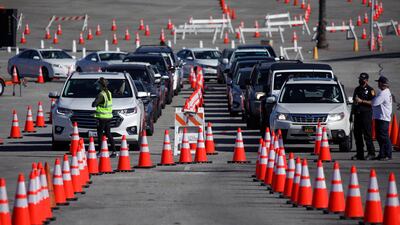
A mass-vaccination of healthcare workers takes place at Dodger Stadium, in Los Angeles. AP Photo


The philosophical core of Mr Biden’s speech was: "There’s no longer a bright line between foreign and domestic policy.”
This sentence reflects his two guiding concepts. First is a return to "regular order" both in the US system and in international relations. Second is the commitment to ensure American "working families" experience the benefits of robust international engagement, effectively his own version of “America First".
It is an overdue recognition that internationalists failed to convince ordinary Americans that they indeed benefit from global engagement. That failure made it possible for Mr Trump and others to paint international commitments as an intolerable burden or worse.
In addition to facing enormous challenges at home, including the coronavirus and economic crises and poisonous political divisions and mistrust, Mr Biden seems to be embracing the task of reconstructing an American consensus for internationalist engagement. It might be his most ambitious undertaking of all.
Hussein Ibish is a senior resident scholar at the Arab Gulf States Institute and a US affairs columnist for The National

