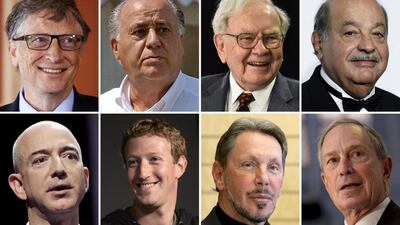
The question is whether a wealth tax on the richest people in the world is a good idea. EPA

Biden should avoid copying the Swiss wealth tax model


  • English
  • Arabic

Why isn't Switzerland progressively closing its wealth gap? The question is important in the context of the intense ongoing debate from Washington to London about a wealth tax.

The coronavirus pandemic has caused government debt to soar and led to calls for substantial new levies on the rich. The argument goes that the wealthy should pay their fair share and growing inequality must be addressed.

Switzerland is supposed to offer a template. Not only does it have the highest density of millionaires in the world, it has a recurring annual wealth tax, which goes back 181 years. It consistently generates more income than the other three European countries that also have a wealth tax or some version of it. In 2017, the Swiss wealth tax contributed 3.6 per cent to the total tax takings. That’s respectable, compared to the 1.1 per cent generated by Norway’s wealth tax, the 0.55 per cent raised by Spain’s and the even lower sum brought in by Belgium’s limited wealth tax on security holdings.

Eastern Swiss Alps are seen in the background as people cross the Limmat River on the Muensterbruecke bridge in Zurich. Switzerland imposes a wealth tax on its richest few. Reuters

And yet, the Swiss Trade Union Federation, Switzerland's largest trades union, is scathing about the country’s widening wealth gap. Its 2016 report said the wealthiest 2.1 per cent of Swiss taxpayers hold assets equal in value to the remaining 97.9 per cent. Ueli Mader, a Swiss sociologist who specialises in social and wealth inequality, recently noted that “10 per cent of Swiss heirs own three-quarters of the country’s total inherited assets”.

So is a wealth tax even worth it? After all, it exacts an administrative cost, there is a political price to pay for its imposition and it could distort behaviour in terms of rich people holding more of their wealth overseas or simply bailing out of a country. In fact, France suffered an exodus of millionaires between 2000 and 2016 and an annual fiscal shortfall of billions of euros, according to some estimates, because of its "impot sur la fortune". That wealth tax was abolished in 2017 by President Emmanuel Macron.

Even so, in the US, the world’s richest but also increasingly unequal country, the issue is rising to the top of the political agenda. Just days ago, Senator Elizabeth Warren proposed the Ultra-Millionaire Tax Act. It may be hard to pass into law but there is a chance some elements may be included in another budget bill later in the year for President Joe Biden’s planned infrastructure package. On the presidential campaign trail, Mr Biden championed a different way to Ms Warren to raise money from America’s richest. This included taxing unrealised gains on assets after death and doubling the income tax rate to 40 per cent on capital gains for taxpayers with incomes of at least $1 million. But the Biden White House has still responded encouragingly to Ms Warren’s bill. Jen Psaki, the White House press secretary, recently said that Mr Biden “strongly believes that the ultra-wealthy and corporations need to finally start paying their fair share”.

US President Joe Biden is said to be open to the idea of a wealth tax. Reuters
US Senator Elizabeth Warren, centre, is pushing for a wealth tax targeting millionaires. EPA

Ms Warren’s proposed legislation would do that in spades. It would exempt the first $50m of wealth for everyone, impose a two per cent annual levy on households and trusts valued at between $50m and $1 billion and slap an extra one per cent surcharge on billionaires. The senator has said the proposed wealth tax would raise at least $3 trillion over a decade, thus helping to pay for badly needed investments in America’s infrastructure, child care and health reforms. What’s more, she claims, it will create a “fairer” economy.

That argument has powerful appeal, especially because only small numbers of people – just 75,000 households – would have to pay more towards a project of national renewal. A wealth tax would also address the perception – and reality – of inter-generational inequality in America.

In 2019, data from the Federal Reserve showed that the top one per cent owned nearly one-third of all US household wealth, compared to nearly one-quarter about 30 years ago. In that timespan, the bottom 50 per cent went from owning 3.7 per cent of the wealth to just 1.9 per cent. According to the two economists who have done significant work on the issue – Emmanuel Saez and Gabriel Zucman of the University of California, Berkeley – the top 0.1 per cent of American taxpayers accounted for about 20 per cent of wealth in 2012, up from seven per cent in 1978.

In 2019, data from the Federal Reserve showed that the top one per cent owned nearly one-third of all US household wealth, compared to nearly one-quarter about 30 years ago. Reuters
Many economists question the wisdom of taxing wealth every year it is kept, rather than taxing all sources of wealth once they are received or used

There is broad bipartisan approval among ordinary Americans for taxing the very rich. A January 2020 Reuters/Ipsos poll found nearly two-thirds of respondents – 77 per cent of Democrats and 53 per cent of Republicans – in agreement.

The sentiment is mirrored across the Atlantic. Three-quarters of the people polled by Ipsos Mori in Britain in October supported a wealth tax. Everyone said it was better than a rise in income tax, VAT, council tax or capital gains tax. The survey was conducted right before leading UK tax experts and economists issued a report on the fairness and efficiency of a one per cent levy on millionaire households. The report said a one-off tax on a person's total wealth could raise £260bn ($362bn) over five years if the threshold was set at £1m. It would affect just six per cent of Britain's adult population.

The idea of a one-off tax contrasts with the Swiss model, which has obvious problems. Switzerland’s wealth tax is relatively low, varying by canton between about 0.3 and one per cent a year of taxpayers’ total net worth. Also, foreign residents are only taxed on the portion of their fortune deemed related to their living expenses in the country. This means, as Professor Mader has pointed out, that “the Swiss tax system is very favourable” to multi-millionaires, about half of whom come from abroad. Taken together, these aspects help explain why Switzerland might be becoming less equal despite its annual wealth tax.

Elyas Ismail, founder of the Newham Community Project food bank, organises food packages ahead of their collection by international students in east London. AFP

Finally, there are the doubts raised by some about the very idea of an annual tax on wealth. A November study from the UK’s Institute for Fiscal Studies said “the case for a one-off wealth tax is simple” but it’s harder to explain why “it is better to tax the same wealth every year – penalising those who save”. Many economists question the wisdom of taxing wealth every year it is kept, rather than taxing all sources of wealth once they are received or used. In other words, they advocate tax reform rather than the introduction of a new annual wealth tax.

Overall, it seems that one big levy is the way to go. There is precedent. In the throes of the First World War, British economist AC Pigou called for a one-time wealth tax to allow the very wealthy to share more equitably in the burden of an exceptional disaster. He saw it as analogous to a draft – necessary, painful, but sorely needed.

There is resonance today.

Rashmee Roshan Lall is a columnist for The National

Islamophobia definition

A widely accepted definition was made by the All Party Parliamentary Group on British Muslims in 2019: “Islamophobia is rooted in racism and is a type of racism that targets expressions of Muslimness or perceived Muslimness.” It further defines it as “inciting hatred or violence against Muslims”.

THE BIO:

Favourite holiday destination: Thailand. I go every year and I’m obsessed with the fitness camps there.

Favourite book: Born to Run by Christopher McDougall. It’s an amazing story about barefoot running.

Favourite film: A League of their Own. I used to love watching it in my granny’s house when I was seven.

Personal motto: Believe it and you can achieve it.

Key facilities
  • Olympic-size swimming pool with a split bulkhead for multi-use configurations, including water polo and 50m/25m training lanes
  • Premier League-standard football pitch
  • 400m Olympic running track
  • NBA-spec basketball court with auditorium
  • 600-seat auditorium
  • Spaces for historical and cultural exploration
  • An elevated football field that doubles as a helipad
  • Specialist robotics and science laboratories
  • AR and VR-enabled learning centres
  • Disruption Lab and Research Centre for developing entrepreneurial skills
Multitasking pays off for money goals

Tackling money goals one at a time cost financial literacy expert Barbara O'Neill at least $1 million.

That's how much Ms O'Neill, a distinguished professor at Rutgers University in the US, figures she lost by starting saving for retirement only after she had created an emergency fund, bought a car with cash and purchased a home.

"I tell students that eventually, 30 years later, I hit the million-dollar mark, but I could've had $2 million," Ms O'Neill says.

Too often, financial experts say, people want to attack their money goals one at a time: "As soon as I pay off my credit card debt, then I'll start saving for a home," or, "As soon as I pay off my student loan debt, then I'll start saving for retirement"."

People do not realise how costly the words "as soon as" can be. Paying off debt is a worthy goal, but it should not come at the expense of other goals, particularly saving for retirement. The sooner money is contributed, the longer it can benefit from compounded returns. Compounded returns are when your investment gains earn their own gains, which can dramatically increase your balances over time.

"By putting off saving for the future, you are really inhibiting yourself from benefiting from that wonderful magic," says Kimberly Zimmerman Rand , an accredited financial counsellor and principal at Dragonfly Financial Solutions in Boston. "If you can start saving today ... you are going to have a lot more five years from now than if you decide to pay off debt for three years and start saving in year four."

T10 Cricket League
Sharjah Cricket Stadium
December 14- 17
6pm, Opening ceremony, followed by:
Bengal Tigers v Kerala Kings 
Maratha Arabians v Pakhtoons
Tickets available online at q-tickets.com/t10

360Vuz PROFILE

Date started: January 2017
Founder: Khaled Zaatarah 
Based: Dubai and Los Angeles
Sector: Technology 
Size: 21 employees
Funding: $7 million 
Investors: Shorooq Partners, KBW Ventures, Vision Ventures, Hala Ventures, 500Startups, Plug and Play, Magnus Olsson, Samih Toukan, Jonathan Labin

Blue%20Beetle
%3Cp%3E%3Cstrong%3EDirector%3A%3C%2Fstrong%3E%20Angel%20Manuel%20Soto%3Cbr%3E%3Cstrong%3EStars%3A%20%3C%2Fstrong%3EXolo%20Mariduena%2C%20Adriana%20Barraza%2C%20Damian%20Alcazar%2C%20Raoul%20Max%20Trujillo%2C%20Susan%20Sarandon%2C%20George%20Lopez%3Cbr%3E%3Cstrong%3ERating%3A%20%3C%2Fstrong%3E4%2F5%C2%A0%3C%2Fp%3E%0A

Mercer, the investment consulting arm of US services company Marsh & McLennan, expects its wealth division to at least double its assets under management (AUM) in the Middle East as wealth in the region continues to grow despite economic headwinds, a company official said.

Mercer Wealth, which globally has $160 billion in AUM, plans to boost its AUM in the region to $2-$3bn in the next 2-3 years from the present $1bn, said Yasir AbuShaban, a Dubai-based principal with Mercer Wealth.

Within the next two to three years, we are looking at reaching $2 to $3 billion as a conservative estimate and we do see an opportunity to do so,” said Mr AbuShaban.

Mercer does not directly make investments, but allocates clients’ money they have discretion to, to professional asset managers. They also provide advice to clients.

“We have buying power. We can negotiate on their (client’s) behalf with asset managers to provide them lower fees than they otherwise would have to get on their own,” he added.

Mercer Wealth’s clients include sovereign wealth funds, family offices, and insurance companies among others.

From its office in Dubai, Mercer also looks after Africa, India and Turkey, where they also see opportunity for growth.

Wealth creation in Middle East and Africa (MEA) grew 8.5 per cent to $8.1 trillion last year from $7.5tn in 2015, higher than last year’s global average of 6 per cent and the second-highest growth in a region after Asia-Pacific which grew 9.9 per cent, according to consultancy Boston Consulting Group (BCG). In the region, where wealth grew just 1.9 per cent in 2015 compared with 2014, a pickup in oil prices has helped in wealth generation.

BCG is forecasting MEA wealth will rise to $12tn by 2021, growing at an annual average of 8 per cent.

Drivers of wealth generation in the region will be split evenly between new wealth creation and growth of performance of existing assets, according to BCG.

Another general trend in the region is clients’ looking for a comprehensive approach to investing, according to Mr AbuShaban.

“Institutional investors or some of the families are seeing a slowdown in the available capital they have to invest and in that sense they are looking at optimizing the way they manage their portfolios and making sure they are not investing haphazardly and different parts of their investment are working together,” said Mr AbuShaban.

Some clients also have a higher appetite for risk, given the low interest-rate environment that does not provide enough yield for some institutional investors. These clients are keen to invest in illiquid assets, such as private equity and infrastructure.

“What we have seen is a desire for higher returns in what has been a low-return environment specifically in various fixed income or bonds,” he said.

“In this environment, we have seen a de facto increase in the risk that clients are taking in things like illiquid investments, private equity investments, infrastructure and private debt, those kind of investments were higher illiquidity results in incrementally higher returns.”

The Abu Dhabi Investment Authority, one of the largest sovereign wealth funds, said in its 2016 report that has gradually increased its exposure in direct private equity and private credit transactions, mainly in Asian markets and especially in China and India. The authority’s private equity department focused on structured equities owing to “their defensive characteristics.”

The Voice of Hind Rajab

Starring: Saja Kilani, Clara Khoury, Motaz Malhees

Director: Kaouther Ben Hania

Rating: 4/5

HIJRA

Starring: Lamar Faden, Khairiah Nathmy, Nawaf Al-Dhufairy

Director: Shahad Ameen

Rating: 3/5

Honeymoonish
%3Cp%3E%3Cstrong%3EDirector%3A%3C%2Fstrong%3E%20Elie%20El%20Samaan%3C%2Fp%3E%0A%3Cp%3E%3Cstrong%3EStarring%3A%20%3C%2Fstrong%3ENour%20Al%20Ghandour%2C%20Mahmoud%20Boushahri%3C%2Fp%3E%0A%3Cp%3E%3Cstrong%3ERating%3A%3C%2Fstrong%3E%203%2F5%3C%2Fp%3E%0A
MATCH INFO

Tottenham Hotspur 0 Everton 1 (Calvert-Lewin 55')

Man of the Match Allan (Everton)

Profile of Hala Insurance

Date Started: September 2018

Founders: Walid and Karim Dib

Based: Abu Dhabi

Employees: Nine

Amount raised: $1.2 million

Funders: Oman Technology Fund, AB Accelerator, 500 Startups, private backers


Set-jetting on the Emerald Isle

Other shows filmed in Ireland include: Vikings (County Wicklow), The Fall (Belfast), Line of Duty (Belfast), Penny Dreadful (Dublin), Ripper Street (Dublin), Krypton (Belfast)

Infiniti QX80 specs

Engine: twin-turbocharged 3.5-liter V6

Power: 450hp

Torque: 700Nm

Price: From Dh450,000, Autograph model from Dh510,000

Available: Now

Key figures in the life of the fort

Sheikh Dhiyab bin Isa (ruled 1761-1793) Built Qasr Al Hosn as a watchtower to guard over the only freshwater well on Abu Dhabi island.

Sheikh Shakhbut bin Dhiyab (ruled 1793-1816) Expanded the tower into a small fort and transferred his ruling place of residence from Liwa Oasis to the fort on the island.

Sheikh Tahnoon bin Shakhbut (ruled 1818-1833) Expanded Qasr Al Hosn further as Abu Dhabi grew from a small village of palm huts to a town of more than 5,000 inhabitants.

Sheikh Khalifa bin Shakhbut (ruled 1833-1845) Repaired and fortified the fort.

Sheikh Saeed bin Tahnoon (ruled 1845-1855) Turned Qasr Al Hosn into a strong two-storied structure.

Sheikh Zayed bin Khalifa (ruled 1855-1909) Expanded Qasr Al Hosn further to reflect the emirate's increasing prominence.

Sheikh Shakhbut bin Sultan (ruled 1928-1966) Renovated and enlarged Qasr Al Hosn, adding a decorative arch and two new villas.

Sheikh Zayed bin Sultan (ruled 1966-2004) Moved the royal residence to Al Manhal palace and kept his diwan at Qasr Al Hosn.

Sources: Jayanti Maitra, www.adach.ae

Details

Through Her Lens: The stories behind the photography of Eva Sereny

Forewords by Jacqueline Bisset and Charlotte Rampling, ACC Art Books

Gulf Under 19s final

Dubai College A 50-12 Dubai College B
