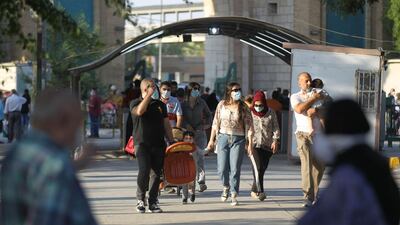
Iraqi families walk in Baghdad's Zawraa Park on October 9, 2020, after the government lifted restrictions imposed by the coronavirus pandemic. Ahmad Al -Rubaye / AFP

Arab youths must be given access to opportunity, especially during Covid-19


  • English
  • Arabic

The managing director of the International Monetary Fund, Kristalina Georgieva – whom I once heard quote Tolstoy at a press conference – last week offered the Arabic proverb "do not delay the work of today for tomorrow". She was urging governments in the region to do everything possible to give their people more economic opportunity.

In her speech to open the Saudi G20 Presidency-IMF Forum, she warned: "Access to opportunity is an issue of deep importance... and it is even more important during the Covid-19 crisis, which is hitting those who already lacked opportunity the hardest."

Decisions made now will affect the lives of more than 420 million Arabs for years and decades to come, she warned. “Preparing them for a rapidly changing global economy is the work of today, and it must not be delayed.”

Ms Georgieva has more to offer than just a wonderful turn of phrase. Her prescience is a blueprint for how government spending across the region could be prioritised for maximum effect, overcoming issues such as cronyism, corruption and waste.

In her speech, she outlined key areas such as social spending, youth and women’s employment and human and physical digital infrastructure – training coders and engineers, in addition to installing fiber cables and towers.

"The region and the world are at a transformative moment – while we face headwinds from the pandemic, we have at least some tailwinds from continued spending to fight the pandemic and the accelerated digital transformation taking place worldwide.”

Internet access for all is a priority, she said.

There is an “efficiency gap” for Arab countries but a third of that could be closed with smarter spending.

Kristalina Georgieva, IMF managing director, in Washington, DC on 4 March. Nicholas Kamm/ AFP

Ms Georgieva did, however, highlight the bright spots of today. For example, in Morocco, cash benefits are being provided to casual workers using mobile phones; Jordan’s initial Covid-19 response included tax relief for companies and cash support for vulnerable workers; Saudi Arabia has made good progress in the last two years in increasing the percentage of women working or seeking work; and the UAE and Bahrain are among the very best in the world in terms of coronavirus testing.

All sections of society, not just the young, will rally around the policies if countries prioritise opportunities for jobseekers

Also, activity in the non-oil private sectors of the Arab world's three largest economies – Saudi Arabia, the UAE and Egypt – bounced back in September, as movement restrictions related to Covid-19 eased and businesses continued to recover.

This provided respite from what has been, to put it mildly, an incredibly challenging year. There is though hope that by the end of next year we will see a more sustained economic recovery. This is all good news and we are in need of it. But to deliver on tomorrow’s promises, all economies in the region must experience a significant surge in growth.

Lebanese artist Raida Al Mourad works on a painting at the Al Sanayeh Park in Beirut, Lebanon, on 10 October. The proceeds of the exhibition will be used to help families affected by the Beirut port blasts. Nabil Mounzer / EPA

Policymakers have been thinking for years now of the bigger, long-term and frustrating goal: of providing economic opportunities to those in the Arab world who need it most. But trying to create millions of jobs for a young and aspirational population and fuel the continuing development of Arab countries – while fighting a pandemic – is like searching for nirvana in a sandstorm.

Yet as Ms Georgieva said, there could be no better time to make a huge leap towards achieving this goal. As protesters in Iraq and Lebanon have shown in recent months, frustration is at a tipping point.

The results of the Arab Youth Survey last week also laid this bare. As reported in The Nationalnearly half of young Arabs have considered leaving their home country because of their dismay at corruption, poor leadership and widespread economic failure, according to the study.

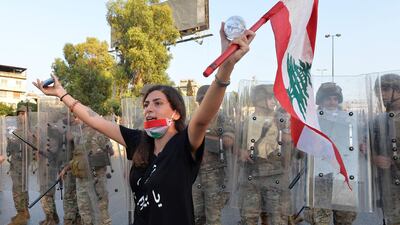
  • An anti-government protester carries a national flag as she shouts slogans in front of the Lebanese army soldiers during a protest on the road leading to the Presidential palace in Baabda, east Beirut, Lebanon. EPA
    An anti-government protester carries a national flag as she shouts slogans in front of the Lebanese army soldiers during a protest on the road leading to the Presidential palace in Baabda, east Beirut, Lebanon. EPA
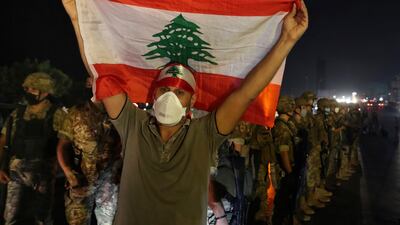
  • An anti-government protester holds up a Lebanese flag as army soldiers stand guard during a demonstration against deteriorating economic conditions as politicians are deadlocked over forming a new government, in the town of Jal el-Dib, north of Beirut, Lebanon. AP
    An anti-government protester holds up a Lebanese flag as army soldiers stand guard during a demonstration against deteriorating economic conditions as politicians are deadlocked over forming a new government, in the town of Jal el-Dib, north of Beirut, Lebanon. AP
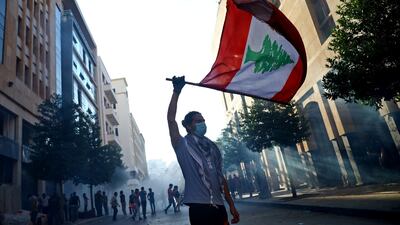
  • A demonstrator waves a Lebanese flag during anti-government protests on August 8, which were ignited by a massive explosion in Beirut's port. Lebanon's economy was already tanking due to a currency crisis, economic mismanagement and politicial turmoil when the blast hit. Reuters
    A demonstrator waves a Lebanese flag during anti-government protests on August 8, which were ignited by a massive explosion in Beirut's port. Lebanon's economy was already tanking due to a currency crisis, economic mismanagement and politicial turmoil when the blast hit. Reuters
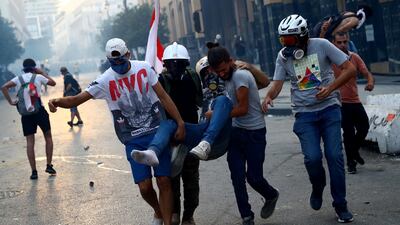
  • Demonstrators carry an injured man during anti-government protests that were ignited by a massive explosion in Beirut, Lebanon. Reuters
    Demonstrators carry an injured man during anti-government protests that were ignited by a massive explosion in Beirut, Lebanon. Reuters
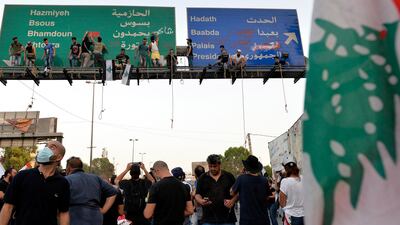
  • nti-government protesters write on a road sign as they hang mock gallows symbol to execute Lebanese politicians during a protest on the road leading to the Presidential palace in Baabda, east Beirut, Lebanon. EPA
    nti-government protesters write on a road sign as they hang mock gallows symbol to execute Lebanese politicians during a protest on the road leading to the Presidential palace in Baabda, east Beirut, Lebanon. EPA
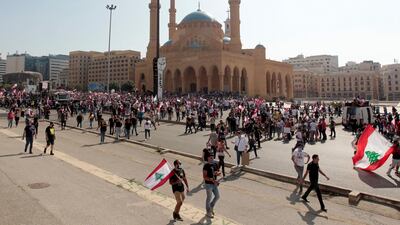
  • Demonstrators gather as they hold Lebanese flags during a protest against the government performance and worsening economic conditions, in Beirut, Lebanon. Reuters
    Demonstrators gather as they hold Lebanese flags during a protest against the government performance and worsening economic conditions, in Beirut, Lebanon. Reuters
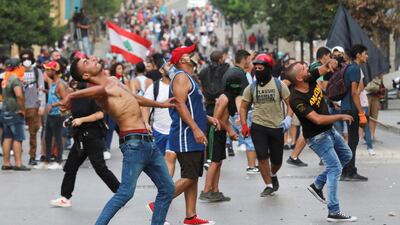
  • Demonstrators throw stones during anti-government protests in Beirut. A perfect storm of economic woes and political turmoil has given the country's well-educated, often multilingual, young people little hope of a viable future there. Reuters
    Demonstrators throw stones during anti-government protests in Beirut. A perfect storm of economic woes and political turmoil has given the country's well-educated, often multilingual, young people little hope of a viable future there. Reuters
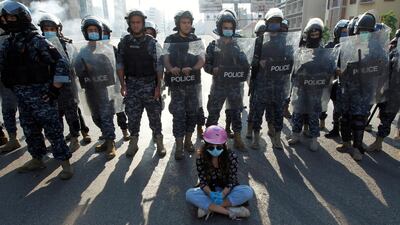
  • A demonstrator sits on the ground in front of Lebanese police officers during a protest against growing economic hardship in Beirut, Lebanon. Reuters
    A demonstrator sits on the ground in front of Lebanese police officers during a protest against growing economic hardship in Beirut, Lebanon. Reuters
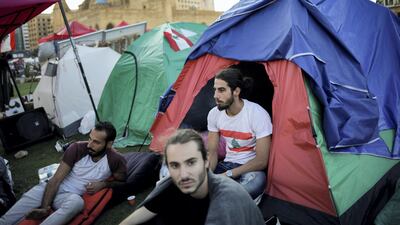
  • Protesters sit outside tents at Martyr's square in downtown Beirut in August. The Arab Youth Survey found 77 per cent of Lebanese 18 to 24-year-old's had considered or were actively trying to emigrate in hope of a better life. Reuters
    Protesters sit outside tents at Martyr's square in downtown Beirut in August. The Arab Youth Survey found 77 per cent of Lebanese 18 to 24-year-old's had considered or were actively trying to emigrate in hope of a better life. Reuters

For governments, it is now or never. Change is coming one way or another. And as a result, they have full licence to make courageous and difficult decisions. Because if it is made clear that countries are prioritising opportunity for young jobseekers, all sections of society, not just the young, will rally around these policies.

This will create a counter-balance to the groups or elements that wish to maintain the current situation in many countries in the Arab world that are struggling to engineer real change.

Institutions such as the IMF and the World Bank will also step in to help during the current crisis if they see governments taking the right steps for the future.

As the literary Ms Georgieva concluded, promoting an economic recovery that is more inclusive, and also greener, fairer, and smarter, is the work of today and we cannot afford to delay it.

Mustafa Alrawi is an assistant editor-in-chief at The National

Mercer, the investment consulting arm of US services company Marsh & McLennan, expects its wealth division to at least double its assets under management (AUM) in the Middle East as wealth in the region continues to grow despite economic headwinds, a company official said.

Mercer Wealth, which globally has $160 billion in AUM, plans to boost its AUM in the region to $2-$3bn in the next 2-3 years from the present $1bn, said Yasir AbuShaban, a Dubai-based principal with Mercer Wealth.

Within the next two to three years, we are looking at reaching $2 to $3 billion as a conservative estimate and we do see an opportunity to do so,” said Mr AbuShaban.

Mercer does not directly make investments, but allocates clients’ money they have discretion to, to professional asset managers. They also provide advice to clients.

“We have buying power. We can negotiate on their (client’s) behalf with asset managers to provide them lower fees than they otherwise would have to get on their own,” he added.

Mercer Wealth’s clients include sovereign wealth funds, family offices, and insurance companies among others.

From its office in Dubai, Mercer also looks after Africa, India and Turkey, where they also see opportunity for growth.

Wealth creation in Middle East and Africa (MEA) grew 8.5 per cent to $8.1 trillion last year from $7.5tn in 2015, higher than last year’s global average of 6 per cent and the second-highest growth in a region after Asia-Pacific which grew 9.9 per cent, according to consultancy Boston Consulting Group (BCG). In the region, where wealth grew just 1.9 per cent in 2015 compared with 2014, a pickup in oil prices has helped in wealth generation.

BCG is forecasting MEA wealth will rise to $12tn by 2021, growing at an annual average of 8 per cent.

Drivers of wealth generation in the region will be split evenly between new wealth creation and growth of performance of existing assets, according to BCG.

Another general trend in the region is clients’ looking for a comprehensive approach to investing, according to Mr AbuShaban.

“Institutional investors or some of the families are seeing a slowdown in the available capital they have to invest and in that sense they are looking at optimizing the way they manage their portfolios and making sure they are not investing haphazardly and different parts of their investment are working together,” said Mr AbuShaban.

Some clients also have a higher appetite for risk, given the low interest-rate environment that does not provide enough yield for some institutional investors. These clients are keen to invest in illiquid assets, such as private equity and infrastructure.

“What we have seen is a desire for higher returns in what has been a low-return environment specifically in various fixed income or bonds,” he said.

“In this environment, we have seen a de facto increase in the risk that clients are taking in things like illiquid investments, private equity investments, infrastructure and private debt, those kind of investments were higher illiquidity results in incrementally higher returns.”

The Abu Dhabi Investment Authority, one of the largest sovereign wealth funds, said in its 2016 report that has gradually increased its exposure in direct private equity and private credit transactions, mainly in Asian markets and especially in China and India. The authority’s private equity department focused on structured equities owing to “their defensive characteristics.”

How it works

Each player begins with one of the great empires of history, from Julius Caesar's Rome to Ramses of Egypt, spread over Europe and the Middle East.

Round by round, the player expands their empire. The more land they have, the more money they can take from their coffers for each go.

As unruled land and soldiers are acquired, players must feed them. When a player comes up against land held by another army, they can choose to battle for supremacy.

A dice-based battle system is used and players can get the edge on their enemy with by deploying a renowned hero on the battlefield.

Players that lose battles and land will find their coffers dwindle and troops go hungry. The end goal? Global domination of course.

Red flags
  • Promises of high, fixed or 'guaranteed' returns.
  • Unregulated structured products or complex investments often used to bypass traditional safeguards.
  • Lack of clear information, vague language, no access to audited financials.
  • Overseas companies targeting investors in other jurisdictions - this can make legal recovery difficult.
  • Hard-selling tactics - creating urgency, offering 'exclusive' deals.

Courtesy: Carol Glynn, founder of Conscious Finance Coaching

The specs

Engine: 2-litre 4-cylinder and 3.6-litre 6-cylinder

Power: 220 and 280 horsepower

Torque: 350 and 360Nm

Transmission: eight-speed automatic

Price: from Dh136,521 VAT and Dh166,464 VAT 

On sale: now

The five pillars of Islam

1. Fasting 

2. Prayer 

3. Hajj 

4. Shahada 

5. Zakat 

Avatar: Fire and Ash

Director: James Cameron

Starring: Sam Worthington, Sigourney Weaver, Zoe Saldana

Rating: 4.5/5

Desert Warrior

Starring: Anthony Mackie, Aiysha Hart, Ben Kingsley

Director: Rupert Wyatt

Rating: 3/5

MATCH INFO

Tottenham Hotspur 3 (Son 1', Kane 8' & 16') West Ham United 3 (Balbuena 82', Sanchez og 85', Lanzini 90' 4)

Man of the match Harry Kane