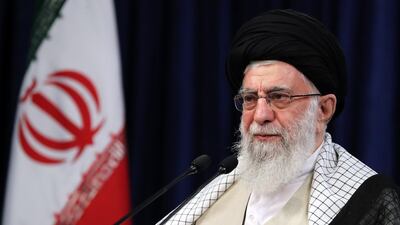

The Iranian regime may be feeling cautiously optimistic about a possible shift in relations with America after Joe Biden succeeds Donald Trump as US president in January. This feeling may well be stemming from backchannel talks apparently going on between the leadership in Tehran and members of the Biden team.
Tehran’s hope of seeing a more sympathetic government in Washington, however, could be short-lived if the Trump administration slaps more sanctions on the regime between now and inauguration day. The regime will also watch to see if Mr Trump decides to punish China and Russia with the same economic weapon, should they try to secure arms deals with Iran during this period.
Mr Biden’s Democrats, moreover, are currently locked in a fierce electoral battle with Mr Trump’s Republicans over two Senate seats – both in the state of Georgia – that will decide which party has a majority in the upper house of the US Congress. The outcomes would, in turn, have an impact on Mr Biden’s foreign policy going forward.
With a majority, however razor-thin it may be, the Republican Party will be able to obstruct Mr Biden’s appointments both in the Department of State and the Department of Defence. This will have a detrimental effect on, say, the new administration’s ability to lift sanctions on Iran in exchange for re-entering negotiations with its leadership to revive the 2015 nuclear deal. This could also have broader implications on US-Iran relations over the next four years.
The supposed rush on the part of the Biden team to seek to revive the Joint Comprehensive Plan of Action (JCPOA), which Mr Trump withdrew the US from in 2018, is likely to have unwelcome ripple effects across the Middle East. For it will embolden Tehran to increase its destablising activities in the region, especially in countries where its influence is strong, such as Iraq, Lebanon, Syria and Yemen. Also, in light of political repression inside Iran, it will not be easy for the incoming administration to reconcile its enthusiasm to thaw the ice with Iran, with its stated claim that human rights will be at the heart of Mr Biden’s foreign policy.
Furthermore, negotiations on the JCPOA and on Iran’s ballistic missile programme will be difficult and complicated.
The most dangerous thing the Biden team can do, therefore, is conclude secret deals with the regime and turn a blind eye to its expansionist agenda. In other words it could repeat the same mistake committed by the Obama administration, of which Mr Biden was an integral part, when it bent over backwards to secure the JCPOA five years ago.
Hardline supporters of the JCPOA in the US refuse to take the threat that the Islamic Revolutionary Guard Corps – the Iranian armed forces’ powerful militia arm – poses to the region. Reining in the regime’s nuclear programme is of greater priority to these supporters than its regional adventurism and support for militia groups such as Kataeb Hezbollah in Iraq and Hezbollah in Lebanon. This sort of thinking overlooks and, in turn, undermines the sovereignty and human rights of the Arab world and its people.

Speaking of Arab countries, one mistake that the international community is likely to repeat is the exclusion of Arab representation in upcoming talks between the five permanent members of the all-powerful United Nations Security Council and Germany on the one side and Iran on the other. It was wrong not to allow major Arab states in a dialogue with Iran when similar talks took place in 2015, because, after all, Iran’s activities affect their national security. To this end, these states must move immediately to craft a pre-emptive strategy comprised of two essential objectives: to have a seat at the table in future negotiations and to include Iran’s regional role in any talks.
This week, French President Emmanuel Macron insisted on the need to broaden the scope of the talks with Iran to include its expansionist activities and ballistic missile programme. Additionally, as the current president of the European Union, Germany should endorse this position. While Europe's role is not decisive, the Biden administration will need its support over the Iran question. This presents an opportunity for Britain, France and Germany to make up for the damage they caused to the Arab countries five years ago, when they acceded to Iran’s demand to exclude its regional policies from the nuclear negotiations.

Indeed, there is no better time than now to double down on Iran's funding and support of proxies across the Middle East. As Mina Al-Oraibi, The National's editor-in-chief, told me at the 24th e-policy circle of the Beirut Institute Summit in Abu Dhabi, Tehran is in a considerably weaker position today than the last few years – particularly after the killing of IRGC commander Qassem Suleimani by an American drone in Baghdad this year. "Iran would not have been able to survive through these sanctions without its ability to milk Iraq at every single level," Ms Al-Oraibi pointed out.
“Iranians are weaker at this point and the repercussions of the killing of Qassem Suleimani are still felt. The militias inside of Iraq, and to a certain extent also Hezbollah, are weaker today than they were a year ago or four years ago,” she added. “So actually putting more pressure on those proxies and putting pressure outside of Iran on those elements that are backed by Iran are probably the ways that Americans will go to show that, ‘we're not just going to talk about the nuclear element, we are going to care about what the Iranians are doing inside these various countries’.”
If and when Washington and Tehran do resume negotiations, there will no doubt be room to manoeuvre for both sides. Tehran may pledge to curb its nuclear and ballistic missile programmes, which might be enough for the Biden administration to ignore its expansionist projects and human rights violations. Or maybe the Biden administration will surprise everyone and put the sovereignty of Iran’s neighbours and human rights front and centre of the talks. We shall see.
While it is too soon to determine what path the Biden team will eventually follow, I am not overly optimistic – and certainly not as optimistic as the Iranian regime may be feeling now. What I do expect will happen is a high-stakes clash between the outgoing and incoming administrations, with the question of Tehran’s immediate future at the centre of it.
Raghida Dergham is the founder and executive chairwoman of the Beirut Institute and a columnist for The National

