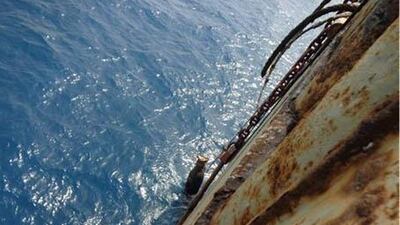
The crisis of the FSO Safer will be familiar to many readers of The National. The 45-year-old, 1,200-foot tanker off the Red Sea coast of Yemen, containing over 1 million barrels of crude oil, is falling apart.
In the absence of dramatic intervention, the tanker’s disintegration is a question of “when”, not “if”. At that point, it will shed its load, not only devastating the world’s last known temperature-resilient coral reef and the global ecosystems that depend upon it, but also preventing aid reaching the stricken humanitarian disaster zone of Yemen. There is also a risk of the disaster disabling desalination plants along the Red Sea, leaving the states that surround it with only three days’ supply of locally produced drinking water.
And while the background to the Safer's plight may be complex, the consequences are not. None will win, everyone will lose. Yemen's Houthi rebel group, who control the waters in which the Safer sits, will suffer. Yemen's internationally recognised government and the neighbouring states of the Saudi-led coalition defending it will also suffer. And most of all, the loss will be felt by the stricken people of Yemen, who could see drought and further starvation.
But international experts say that solving the situation ought not to be difficult, and that the most straightforward solution for all sides is to transfer the oil onto a new, safe tanker. In practical terms, they say, this is a relatively simple operation.
So why is there relative silence from international politicians, media and campaigners over this imminent catastrophe? Why is there little popular outcry? Why are there so few statements from world leaders outside of the region assuring us that they are doing everything to resolve this imminent humanitarian and global environmental disaster?
Equally bewildering is the relative silence of humanitarian NGOs. It is hard to think of any other circumstance where an imminent oil spill, four times the size of the devastating Exxon Valdez spill in 1989, is not the headline news of all the major environmental charities and campaigners.
In a recent podcast, I interviewed former UN adviser Dr Ian Ralby, an international expert on maritime security. He gave a chilling overview of the issue, outlining the delicacy of negotiations. He left listeners in no doubt as to the urgency in resolving it.
"At the moment, millions of Yemenis are living on the brink of famine," he explained. "And an entire generation of Yemenis stand to be lost to that famine. A spill [from the Safer] would deny them access to aid delivered through the port of Hodeida, and to clean drinking water from the desalination plants. This spill would be the quickest way to seal their fate."
Given the ecological and humanitarian impacts of the impending catastrophe, the Safer's situation ought to be a matter of global – not just regional – concern. The fact that international awareness of this issue does not match what is at stake poses an important question: does the challenge of the Safer reveal something lacking in our entire global law enforcement structure and media?
Perhaps the first problem is invisibility. The majority of our international legal structures that hold international players to account are based on state actors. They do so through the traditional measures of formal diplomatic relations, negotiations and sanctions. Non-state actors, including terrorists and rebel groups, even when backed by states, can be motivated by tribal links, ideology and a host of other incentives unrelated to the nation-state. In certain parts of the world, including Yemen, they may in practice hold as much influence and power as the state – or even more.
The State, as an internationally recognised entity, has certain responsibilities, is signed up to certain treaties and trade agreements, all of which can be leveraged to ensure the State is a responsible global state-citizen. Non-state actors are not. While scholars debate intensely how international law should be applied to these relatively new forces on the global stage, they do agree that lawmakers have fallen behind the curve. As lawyer and academic Vladyslav Lanovoy notes in the European Journal of International Law: “There persists a gap in the regulation of the use of force by non-state actors and the consequences, if any, for the states that facilitate it.”
You could call that an asymmetry of accountability.
The State is signed up to treaties - non-state actors are not
To illustrate the extent of the problem, imagine a scenario in which the Safer was in state-controlled waters, instead of waters controlled by the Houthis, who are non-state actors. If this were the case, and it was a state that was responsible for allowing or denying secure access to the tanker to replace it and make it safe, there would be levers to hold this state to account. The state would be a legal entity, subject to international diplomacy. It could be lobbied and punished with sanctions.
And perhaps here is the second problem: if there is no legal entity which is responsible, the public response is more confused. If the Safer were sitting in waters controlled by a state, the public outside of the region might feel that there was a "someone" who was "responsible". Campaigns might spring up all over social media. Students in European universities may call for boycotts of goods from that state. Extinction Rebellion protesters may march through London with "MAKE THE SAFER SAFER" placards. Greta Thunberg might denounce the offending state and its leaders from her platform at the UN. The problem is that if there is no formal entity to lobby –only an informally self-declared authority – protests become less focussed and less satisfying, and ultimately just don't happen.
If the disproportionate silence over the Safer is an anomaly, then it is perhaps just a one-off tragedy. But if it is in fact a symptom and a warning of an outdated international accountability system, it is more serious.
As the international arena becomes ever more complex, and non-state, quasi-state and proxy-state actors drive events through different kinds of offensives, the failure of our international accountability system to keep up will result in an even more dangerous world.
There is another question to be asked, about how NGOs, charities and the media respond to such issues. What is it about the case of the Safer that has led to such a notable lack of activity from these effective and usually so vocal campaigners?
Maybe they would argue that nothing can grab public attention until there are pictures. How can the image of a steadily rusting ship compete for our attention with the harrowing video of rampant forest fires? It is far easier to lament a tragedy than to prevent it, and it is easier to publicise and fundraise for something lamentable than it is for something preventable.
The issue of The Safer is more than just a looming tragedy. It is an illustration of the shortfalls of systems of international accountability and rule of law. It is also a test of our determination to update our international response to non-state actors to reflect our new reality, and to prevent disasters before future generations are left to lament them.
Charlotte Leslie is head of the UK Conservative Middle East Council

Analysis
Members of Syria's Alawite minority community face threat in their heartland after one of the deadliest days in country’s recent history. Read more
SPECS
%3Cp%3E%3Cstrong%3EEngine%3A%20%3C%2Fstrong%3E2.4-litre%204-cylinder%20turbo%20hybrid%0D%3Cbr%3E%3Cstrong%3EPower%3A%3C%2Fstrong%3E%20366hp%0D%3Cbr%3E%3Cstrong%3ETorque%3A%20%3C%2Fstrong%3E550Nm%0D%3Cbr%3E%3Cstrong%3ETransmission%3A%20%3C%2Fstrong%3ESix-speed%20auto%0D%3Cbr%3E%3Cstrong%3EPrice%3A%3C%2Fstrong%3E%20From%20Dh360%2C000%0D%3Cbr%3E%3Cstrong%3EAvailable%3A%20%3C%2Fstrong%3ENow%0D%3C%2Fp%3E%0A
Barbie
%3Cp%3E%3Cstrong%3EDirector%3A%3C%2Fstrong%3E%20Greta%20Gerwig%3Cbr%3E%3Cstrong%3EStars%3A%3C%2Fstrong%3E%20Margot%20Robbie%2C%20Ryan%20Gosling%2C%20Will%20Ferrell%2C%20America%20Ferrera%3Cbr%3E%3Cstrong%3ERating%3A%3C%2Fstrong%3E%204%2F5%3Cbr%3E%3C%2Fp%3E%0A
New UK refugee system
- A new “core protection” for refugees moving from permanent to a more basic, temporary protection
- Shortened leave to remain - refugees will receive 30 months instead of five years
- A longer path to settlement with no indefinite settled status until a refugee has spent 20 years in Britain
- To encourage refugees to integrate the government will encourage them to out of the core protection route wherever possible.
- Under core protection there will be no automatic right to family reunion
- Refugees will have a reduced right to public funds
What is the FNC?
The Federal National Council is one of five federal authorities established by the UAE constitution. It held its first session on December 2, 1972, a year to the day after Federation.
It has 40 members, eight of whom are women. The members represent the UAE population through each of the emirates. Abu Dhabi and Dubai have eight members each, Sharjah and Ras al Khaimah six, and Ajman, Fujairah and Umm Al Quwain have four.
They bring Emirati issues to the council for debate and put those concerns to ministers summoned for questioning.
The FNC’s main functions include passing, amending or rejecting federal draft laws, discussing international treaties and agreements, and offering recommendations on general subjects raised during sessions.
Federal draft laws must first pass through the FNC for recommendations when members can amend the laws to suit the needs of citizens. The draft laws are then forwarded to the Cabinet for consideration and approval.
Since 2006, half of the members have been elected by UAE citizens to serve four-year terms and the other half are appointed by the Ruler’s Courts of the seven emirates.
In the 2015 elections, 78 of the 252 candidates were women. Women also represented 48 per cent of all voters and 67 per cent of the voters were under the age of 40.
What is tokenisation?
Tokenisation refers to the issuance of a blockchain token, which represents a virtually tradable real, tangible asset. A tokenised asset is easily transferable, offers good liquidity, returns and is easily traded on the secondary markets.
The National Archives, Abu Dhabi
Founded over 50 years ago, the National Archives collects valuable historical material relating to the UAE, and is the oldest and richest archive relating to the Arabian Gulf.
Much of the material can be viewed on line at the Arabian Gulf Digital Archive - https://www.agda.ae/en
Brief scores:
Day 1
Toss: South Africa, field first
Pakistan (1st innings) 177: Sarfraz 56, Masood 44; Olivier 4-48
South Africa (1st innings) 123-2: Markram 78; Masood 1-4
Brief scores:
Toss: South Africa, chose to field
Pakistan: 177 & 294
South Africa: 431 & 43-1
Man of the Match: Faf du Plessis (South Africa)
Series: South Africa lead three-match series 2-0
UAE currency: the story behind the money in your pockets
Jetour T1 specs
Engine: 2-litre turbocharged
Power: 254hp
Torque: 390Nm
Price: From Dh126,000
Available: Now
UAE%20SQUAD
%3Cp%3E%0D%3Cstrong%3EMen%3A%3C%2Fstrong%3E%20Saif%20Al%20Zaabi%2C%20Salem%20Al%20Marzooqi%2C%20Zayed%20Al%20Ansaari%2C%20Saud%20Abdulaziz%20Rahmatalla%2C%20Adel%20Shanbih%2C%20Ahmed%20Khamis%20Al%20Blooshi%2C%20Abdalla%20Al%20Naqbi%2C%20Khaled%20Al%20Hammadi%2C%20Mohammed%20Khamis%20Khalaf%2C%20Mohammad%20Fahad%2C%20Abdulla%20Al%20Arimi.%0D%3Cbr%3E%3Cstrong%3EWomen%3A%3C%2Fstrong%3E%20Mozah%20Al%20Zeyoudi%2C%20Haifa%20Al%20Naqbi%2C%20Ayesha%20Al%20Mutaiwei.%3C%2Fp%3E%0A
Pakistanis%20at%20the%20ILT20%20
%3Cp%3EThe%20new%20UAE%20league%20has%20been%20boosted%20this%20season%20by%20the%20arrival%20of%20five%20Pakistanis%2C%20who%20were%20not%20released%20to%20play%20last%20year.%20%0D%3Cbr%3E%0D%0D%0D%3Cbr%3E%3Cstrong%3EShaheen%20Afridi%20(Desert%20Vipers)%20%3C%2Fstrong%3E%0D%3Cbr%3ESet%20for%20at%20least%20four%20matches%2C%20having%20arrived%20from%20New%20Zealand%20where%20he%20captained%20Pakistan%20in%20a%20series%20loss.%20%0D%3C%2Fp%3E%0A%3Cp%3E%3Cstrong%3EShadab%20Khan%20(Desert%20Vipers)%20%3C%2Fstrong%3E%0D%3Cbr%3E%0DThe%20leg-spin%20bowling%20allrounder%20missed%20the%20tour%20of%20New%20Zealand%20after%20injuring%20an%20ankle%20when%20stepping%20on%20a%20ball.%20%0D%3C%2Fp%3E%0A%3Cp%3E%3Cstrong%3EAzam%20Khan%20(Desert%20Vipers)%20%3C%2Fstrong%3E%0D%3Cbr%3EPowerhouse%20wicketkeeper%20played%20three%20games%20for%20Pakistan%20on%20tour%20in%20New%20Zealand.%20He%20was%20the%20first%20Pakistani%20recruited%20to%20the%20ILT20.%20%0D%3C%2Fp%3E%0A%3Cp%3E%3Cstrong%3EMohammed%20Amir%20(Desert%20Vipers)%20%3C%2Fstrong%3E%0D%3Cbr%3EHas%20made%20himself%20unavailable%20for%20national%20duty%2C%20meaning%20he%20will%20be%20available%20for%20the%20entire%20ILT20%20campaign.%20%0D%3C%2Fp%3E%0A%3Cp%3E%3Cstrong%3EImad%20Wasim%20(Abu%20Dhabi%20Knight%20Riders)%20%3C%2Fstrong%3E%0D%3Cbr%3EThe%20left-handed%20allrounder%2C%2035%2C%20retired%20from%20international%20cricket%20in%20November%20and%20was%20subsequently%20recruited%20by%20the%20Knight%20Riders.%26nbsp%3B%3C%2Fp%3E%0A
Who's who in Yemen conflict
Houthis: Iran-backed rebels who occupy Sanaa and run unrecognised government
Yemeni government: Exiled government in Aden led by eight-member Presidential Leadership Council
Southern Transitional Council: Faction in Yemeni government that seeks autonomy for the south
Habrish 'rebels': Tribal-backed forces feuding with STC over control of oil in government territory
How%20I%20connect%20with%20my%20kids%20when%20working%20or%20travelling
%3Cp%3E%0D%3Cstrong%3ELittle%20notes%3A%20%3C%2Fstrong%3EMy%20girls%20often%20find%20a%20letter%20from%20me%2C%20with%20a%20joke%2C%20task%20or%20some%20instructions%20for%20the%20afternoon%2C%20and%20saying%20what%20I%E2%80%99m%20excited%20for%20when%20I%20get%20home.%0D%3Cbr%3E%3Cstrong%3EPhone%20call%20check-in%3A%20%3C%2Fstrong%3EMy%20kids%20know%20that%20at%203.30pm%20I%E2%80%99ll%20be%20free%20for%20a%20quick%20chat.%0D%3Cbr%3E%3Cstrong%3EHighs%20and%20lows%3A%20%3C%2Fstrong%3EInstead%20of%20a%20%E2%80%9Chow%20was%20your%20day%3F%E2%80%9D%2C%20at%20dinner%20or%20at%20bathtime%20we%20share%20three%20highlights%3B%20one%20thing%20that%20didn%E2%80%99t%20go%20so%20well%3B%20and%20something%20we%E2%80%99re%20looking%20forward%20to.%0D%3Cbr%3E%3Cstrong%3EI%20start%2C%20you%20next%3A%20%3C%2Fstrong%3EIn%20the%20morning%2C%20I%20often%20start%20a%20little%20Lego%20project%20or%20drawing%2C%20and%20ask%20them%20to%20work%20on%20it%20while%20I%E2%80%99m%20gone%2C%20then%20we%E2%80%99ll%20finish%20it%20together.%0D%3Cbr%3E%3Cstrong%3EBedtime%20connection%3A%20%3C%2Fstrong%3EWake%20up%20and%20sleep%20time%20are%20important%20moments.%20A%20snuggle%2C%20some%20proud%20words%2C%20listening%2C%20a%20story.%20I%20can%E2%80%99t%20be%20there%20every%20night%2C%20but%20I%20can%20start%20the%20day%20with%20them.%0D%3Cbr%3E%3Cstrong%3EUndivided%20attention%3A%20%3C%2Fstrong%3EPutting%20the%20phone%20away%20when%20I%20get%20home%20often%20means%20sitting%20in%20the%20car%20to%20send%20a%20last%20email%2C%20but%20leaving%20it%20out%20of%20sight%20between%20home%20time%20and%20bedtime%20means%20you%20can%20connect%20properly.%0D%3Cbr%3E%3Cstrong%3EDemystify%2C%20don%E2%80%99t%20demonise%20your%20job%3A%20%3C%2Fstrong%3EHelp%20them%20understand%20what%20you%20do%2C%20where%20and%20why.%20Show%20them%20your%20workplace%20if%20you%20can%2C%20then%20it%E2%80%99s%20not%20so%20abstract%20when%20you%E2%80%99re%20away%20-%20they%E2%80%99ll%20picture%20you%20there.%20Invite%20them%20into%20your%20%E2%80%9Cother%E2%80%9D%20world%20so%20they%20know%20more%20about%20the%20different%20roles%20you%20have.%3C%2Fp%3E%0A
KILLING OF QASSEM SULEIMANI
Match info
Uefa Nations League Group B:
England v Spain, Saturday, 11.45pm (UAE)
UAE currency: the story behind the money in your pockets
Kandahar%20
%3Cp%3E%3Cstrong%3EDirector%3A%3C%2Fstrong%3E%20Ric%20Roman%20Waugh%3C%2Fp%3E%0A%3Cp%3E%3Cstrong%3EStars%3A%C2%A0%3C%2Fstrong%3EGerard%20Butler%2C%20Navid%20Negahban%2C%20Ali%20Fazal%3C%2Fp%3E%0A%3Cp%3E%3Cstrong%3ERating%3A%3C%2Fstrong%3E%202.5%2F5%3C%2Fp%3E%0A
Our family matters legal consultant
Name: Hassan Mohsen Elhais
Position: legal consultant with Al Rowaad Advocates and Legal Consultants.
The five stages of early child’s play
From Dubai-based clinical psychologist Daniella Salazar:
1. Solitary Play: This is where Infants and toddlers start to play on their own without seeming to notice the people around them. This is the beginning of play.
2. Onlooker play: This occurs where the toddler enjoys watching other people play. There doesn’t necessarily need to be any effort to begin play. They are learning how to imitate behaviours from others. This type of play may also appear in children who are more shy and introverted.
3. Parallel Play: This generally starts when children begin playing side-by-side without any interaction. Even though they aren’t physically interacting they are paying attention to each other. This is the beginning of the desire to be with other children.
4. Associative Play: At around age four or five, children become more interested in each other than in toys and begin to interact more. In this stage children start asking questions and talking about the different activities they are engaging in. They realise they have similar goals in play such as building a tower or playing with cars.
5. Social Play: In this stage children are starting to socialise more. They begin to share ideas and follow certain rules in a game. They slowly learn the definition of teamwork. They get to engage in basic social skills and interests begin to lead social interactions.
Results:
6.30pm: Al Maktoum Challenge Round-2 (PA) | Group 1 US$75,000 (Dirt) | 2,200 metres
Winner: Goshawke, Fernando Jara (jockey), Ali Rashid Al Raihe (trainer)
7.05pm: UAE 1000 Guineas (TB) | Listed $250,000 (D) | 1,600m
Winner: Silva, Oisin Murphy, Pia Brendt
7.40pm: Meydan Classic Trial (TB) | Conditions $100,000 (Turf) | 1,400m
Winner: Golden Jaguar, Connor Beasley, Ahmad bin Harmash
8.15pm: Al Shindagha Sprint (TB) | Group 3 $200,000 (D) | 1,200m
Winner: Drafted, Pat Dobbs, Doug Watson
8.50pm: Handicap (TB) | $175,000 (D) | 1,600m
Winner: Capezzano, Mickael Barzalona, Sandeep Jadhav
9.25pm: Handicap (TB) | $175,000 (T) | 2,000m
Winner: Oasis Charm, William Buick, Charlie Appleby
10pm: Handicap (TB) | $135,000 (T) | 1,600m
Winner: Escalator, Christopher Hayes, Charlie Fellowes
Abaya trends
The utilitarian robe held dear by Arab women is undergoing a change that reveals it as an elegant and graceful garment available in a range of colours and fabrics, while retaining its traditional appeal.
The candidates
Dr Ayham Ammora, scientist and business executive
Ali Azeem, business leader
Tony Booth, professor of education
Lord Browne, former BP chief executive
Dr Mohamed El-Erian, economist
Professor Wyn Evans, astrophysicist
Dr Mark Mann, scientist
Gina MIller, anti-Brexit campaigner
Lord Smith, former Cabinet minister
Sandi Toksvig, broadcaster
The view from The National
Islamic%20Architecture%3A%20A%20World%20History
%3Cp%3E%3Cstrong%3EAuthor%3A%3C%2Fstrong%3E%20Eric%20Broug%3Cbr%3E%3Cstrong%3EPublisher%3A%3C%2Fstrong%3E%20Thames%20%26amp%3B%20Hudson%3Cbr%3E%3Cstrong%3EPages%3A%3C%2Fstrong%3E%20336%3Cbr%3E%3Cstrong%3EAvailable%3A%3C%2Fstrong%3E%20September%3C%2Fp%3E%0A
How to register as a donor
1) Organ donors can register on the Hayat app, run by the Ministry of Health and Prevention
2) There are about 11,000 patients in the country in need of organ transplants
3) People must be over 21. Emiratis and residents can register.
4) The campaign uses the hashtag #donate_hope
Electric scooters: some rules to remember
- Riders must be 14-years-old or over
- Wear a protective helmet
- Park the electric scooter in designated parking lots (if any)
- Do not leave electric scooter in locations that obstruct traffic or pedestrians
- Solo riders only, no passengers allowed
- Do not drive outside designated lanes
