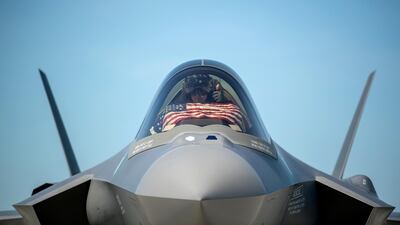
An F-35 pilot prepares for take off from the Vermont Air National Guard Base in the United States. US Air National Guard via Reuters

Air forces can't train pilots fast enough – VR will change that


  • English
  • Arabic

This week, the world's militaries and defence companies have descended on Abu Dhabi for the International Defence Exhibition and Conference. In many ways, the event has presented a unique opportunity for the top brass to explore, discuss and adopt the latest trends in the sector, and for innovative companies to showcase their products and solutions.

Innovative and cutting-edge technologies have taken centre stage with use-cases for solving some of the biggest issues that currently shroud the world of defence, security and aerospace. A prime example of this has emerged when looking at how militaries produce pilots.

The training of military aviators is undeniably complex and expensive, and so is the management of pilot inventory. If an air force turns out too many or too few pilots, its operational readiness can be hindered. In some cases, this imbalance can take years to rectify.

Since the end of the Cold War, air forces have found it difficult to hit that sweet spot of having the optimum number of airmen and airwomen that they actually need. During the Cold War, many air forces were able to balance the optimum number due to the size and scale of the militaries they were required to maintain. But when the collapse of the Soviet Union led to a period of relative peace and stability, global priorities shifted from collective security to international co-operation. Many militaries faced budget cuts and restructuring, which caused an imbalance in pilot numbers that has ever since been difficult to rectify.

In recent years, the production and retention of pilots have become critical issues. The industry outlook for commercial pilot demand for 2020-2029 estimates that there will need to be more than 260,000 new personnel over the next 10 years. Airlines have traditionally sought military pilots because of their high-quality training and reduced flight time requirements. And even though the Covid-19 pandemic has stalled their exodus from the military to civil aviation sector, this will be a short-term pause. In the not-too-distant future, militaries will again find that pilots are leaving faster than they can be replaced.

A 2018 report by the Government Accountability Office in Washington noted that the US Air Force, Navy and Marine Corps had fewer pilots than available positions. This gap was largely attributed to reduced training opportunities and increased attrition of fighter pilots, but also other factors, such as the lack of availability, serviceability and sustainability of aircraft. This has been the case with other large militaries as well, including in Europe and Asia.

To plug this gap, these militaries need to drastically curb the time it takes to train their pilots. Thankfully, cutting-edge technologies, such as virtual and augmented reality and adaptive learning systems, can provide a tangible solution. How? Well, these technologies allow aspiring pilots to practise and perform in a virtual world with greater frequency, thereby shortening the traditional training time.

Operators must therefore be willing to embrace these new technologies if they want to produce pilots faster, better and more efficiently. This is exactly what the US Air Force is doing as part of its Pilot Training Transformation initiative.

Another sore point is that existing pilot training techniques are no longer adequate for today’s needs. Decades ago, flight simulators helped revolutionise pilot training. Today, virtual and augmented reality (VR/AR) has emerged as the next big technological breakthrough.

The past few years have seen VR/AR applications and immersive training devices becoming increasingly more powerful and considerably better at advancing proficiency much earlier in the pilot-training process. The latest generation VR/AR headsets, for instance, enable aspiring pilots to fully immerse themselves in a cockpit of an aircraft and the high-fidelity virtual world around them. In fact, students sometimes get so absorbed that they reach out and try to grab something in the virtual cockpit, forgetting that it is not actually there.

VR/AR has come a long way. Combined with other digital technologies, such as data analytics and VR-enhanced courseware, it can streamline a pilot's training journey from day one until they earn their wings. Students are afforded the opportunity to practise with greater frequency and do so in a much more engaging virtual environment. The obvious benefit of immersive training – one built on a foundation of data analytics and supported by AI – is that the timeline for producing pilots can be much shorter while the output is better prepared pilots.

This Handout photo made avaiable by the Norwegian Armed Forces shows US Air Force B-1B bombers along with Norwegian Air Force F-35A while training in the Norwegian air space on May 20, 2020. The United States is deploying long-range B-1 bombers to Norway to train in the strategically important High North, a new show of force in an ongoing military build-up unseen in the region since the Cold War. - RESTRICTED TO EDITORIAL USE - MANDATORY CREDIT "AFP PHOTO / Norwegian Armed forces " - NO MARKETING - NO ADVERTISING CAMPAIGNS - DISTRIBUTED AS A SERVICE TO CLIENTS / AFP / Norwegian Armed Forces / - / RESTRICTED TO EDITORIAL USE - MANDATORY CREDIT "AFP PHOTO / Norwegian Armed forces " - NO MARKETING - NO ADVERTISING CAMPAIGNS - DISTRIBUTED AS A SERVICE TO CLIENTS
Virtual reality is here to stay, and as it further matures, it will become a fundamental part of the pilot training experience

When it was originally proposed, many in the industry denounced VR/AR as nothing more than video games on steroids. However, the technology is gaining mainstream acceptance as a credible part of next-generation military pilot training, as evidenced by the US Air Force’s programmes. The Royal Air Force in the UK is also in the early stages of trials with these systems.

While we must acknowledge that VR/AR should not replace simulators or actually piloting an aircraft, its effectiveness has already been proven. The technology is here to stay, and as it further matures, it will become a fundamental part of the pilot training experience. Military operators should be willing to embrace it because an investment in VR/AR is an investment in the future of aviation and the next-generation military aviators.

Thibaut Trancart is the CAE's Middle East managing director

THE DETAILS

Solo: A Star Wars Story

Director: Ron Howard

2/5

Barbie
%3Cp%3E%3Cstrong%3EDirector%3A%3C%2Fstrong%3E%20Greta%20Gerwig%3Cbr%3E%3Cstrong%3EStars%3A%3C%2Fstrong%3E%20Margot%20Robbie%2C%20Ryan%20Gosling%2C%20Will%20Ferrell%2C%20America%20Ferrera%3Cbr%3E%3Cstrong%3ERating%3A%3C%2Fstrong%3E%204%2F5%3Cbr%3E%3C%2Fp%3E%0A
The burning issue

The internal combustion engine is facing a watershed moment – major manufacturer Volvo is to stop producing petroleum-powered vehicles by 2021 and countries in Europe, including the UK, have vowed to ban their sale before 2040. The National takes a look at the story of one of the most successful technologies of the last 100 years and how it has impacted life in the UAE. 

Read part four: an affection for classic cars lives on

Read part three: the age of the electric vehicle begins

Read part one: how cars came to the UAE


Company Profile 

Founder: Omar Onsi

Launched: 2018

Employees: 35

Financing stage: Seed round ($12 million)

Investors: B&Y, Phoenician Funds, M1 Group, Shorooq Partners

Three tips from La Perle's performers

1 The kind of water athletes drink is important. Gwilym Hooson, a 28-year-old British performer who is currently recovering from knee surgery, found that out when the company was still in Studio City, training for 12 hours a day. “The physio team was like: ‘Why is everyone getting cramps?’ And then they realised we had to add salt and sugar to the water,” he says.

2 A little chocolate is a good thing. “It’s emergency energy,” says Craig Paul Smith, La Perle’s head coach and former Cirque du Soleil performer, gesturing to an almost-empty open box of mini chocolate bars on his desk backstage.

3 Take chances, says Young, who has worked all over the world, including most recently at Dragone’s show in China. “Every time we go out of our comfort zone, we learn a lot about ourselves,” she says.

Fifa%20World%20Cup%20Qatar%202022%20
%3Cp%3E%3Cstrong%3EFirst%20match%3A%20%3C%2Fstrong%3ENovember%2020%0D%3Cbr%3E%3Cstrong%3EFinal%2016%20round%3A%20%3C%2Fstrong%3EDecember%203%20to%206%0D%3Cbr%3E%3Cstrong%3EQuarter-finals%3A%20%3C%2Fstrong%3EDecember%209%20and%2010%0D%3Cbr%3E%3Cstrong%3ESemi-finals%3A%20%3C%2Fstrong%3EDecember%2013%20and%2014%0D%3Cbr%3E%3Cstrong%3EFinal%3A%20%3C%2Fstrong%3EDecember%2018%3C%2Fp%3E%0A
3%20Body%20Problem
%3Cp%3E%3Cstrong%3ECreators%3A%3C%2Fstrong%3E%20David%20Benioff%2C%20D%20B%20Weiss%2C%20Alexander%20Woo%3C%2Fp%3E%0A%3Cp%3E%3Cstrong%3EStarring%3A%20%3C%2Fstrong%3EBenedict%20Wong%2C%20Jess%20Hong%2C%20Jovan%20Adepo%2C%20Eiza%20Gonzalez%2C%20John%20Bradley%2C%20Alex%20Sharp%3C%2Fp%3E%0A%3Cp%3E%3Cstrong%3ERating%3A%3C%2Fstrong%3E%203%2F5%3C%2Fp%3E%0A

Founders: Abdulmajeed Alsukhan, Turki Bin Zarah and Abdulmohsen Albabtain.

Based: Riyadh

Offices: UAE, Vietnam and Germany

Founded: September, 2020

Number of employees: 70

Sector: FinTech, online payment solutions

Funding to date: $116m in two funding rounds  

Investors: Checkout.com, Impact46, Vision Ventures, Wealth Well, Seedra, Khwarizmi, Hala Ventures, Nama Ventures and family offices

The%20specs%3A%20Taycan%20Turbo%20GT
%3Cp%3E%3Cstrong%3EEngine%3A%20%3C%2Fstrong%3EDual%20synchronous%20electric%20motors%0D%3Cbr%3E%3Cstrong%3EPower%3A%20%3C%2Fstrong%3E1%2C108hp%0D%3Cbr%3E%3Cstrong%3ETorque%3A%20%3C%2Fstrong%3E1%2C340Nm%0D%3Cbr%3E%3Cstrong%3ETransmission%3A%20%3C%2Fstrong%3ESingle-speed%20automatic%20(front%20axle)%3B%20two-speed%20transmission%20(rear%20axle)%0D%3Cbr%3E%3Cstrong%3ETouring%20range%3A%20%3C%2Fstrong%3E488-560km%0D%3Cbr%3E%3Cstrong%3EPrice%3A%20%3C%2Fstrong%3EFrom%20Dh928%2C400%0D%3Cbr%3E%3Cstrong%3EOn%20sale%3A%20%3C%2Fstrong%3EOrders%20open%3C%2Fp%3E%0A
Company profile

Date started: 2015

Founder: John Tsioris and Ioanna Angelidaki

Based: Dubai

Sector: Online grocery delivery

Staff: 200

Funding: Undisclosed, but investors include the Jabbar Internet Group and Venture Friends

Desert Warrior

Starring: Anthony Mackie, Aiysha Hart, Ben Kingsley

Director: Rupert Wyatt

Rating: 3/5

SPECS
%3Cp%3E%3Cstrong%3EEngine%3A%3C%2Fstrong%3E%201.5-litre%204-cylinder%3Cbr%3E%3Cstrong%3EPower%3A%3C%2Fstrong%3E%20101hp%3Cbr%3E%3Cstrong%3ETorque%3A%3C%2Fstrong%3E%20135Nm%3Cbr%3E%3Cstrong%3ETransmission%3C%2Fstrong%3E%3A%20Six-speed%20auto%3Cbr%3E%3Cstrong%3EPrice%3A%3C%2Fstrong%3E%20From%20Dh79%2C900%3Cbr%3E%3Cstrong%3EOn%20sale%3A%3C%2Fstrong%3E%20Now%3C%2Fp%3E%0A
if you go

The flights
Fly direct to Kutaisi with Flydubai from Dh925 return, including taxes. The flight takes 3.5 hours. From there, Svaneti is a four-hour drive. The driving time from Tbilisi is eight hours.
The trip
The cost of the Svaneti trip is US$2,000 (Dh7,345) for 10 days, including food, guiding, accommodation and transfers from and to ­Tbilisi or Kutaisi. This summer the TCT is also offering a 5-day hike in Armenia for $1,200 (Dh4,407) per person. For further information, visit www.transcaucasiantrail.org/en/hike/


Rock in a Hard Place: Music and Mayhem in the Middle East
Orlando Crowcroft
Zed Books

COMPANY%20PROFILE
%3Cp%3E%3Cstrong%3EName%3A%20%3C%2Fstrong%3EEjari%3Cbr%3E%3Cstrong%3EBased%3A%20%3C%2Fstrong%3ERiyadh%2C%20Saudi%20Arabia%3Cbr%3E%3Cstrong%3EFounders%3A%20%3C%2Fstrong%3EYazeed%20Al%20Shamsi%2C%20Fahad%20Albedah%2C%20Mohammed%20Alkhelewy%20and%20Khalid%20Almunif%3Cbr%3E%3Cstrong%3ESector%3A%20%3C%2Fstrong%3EPropTech%3Cbr%3E%3Cstrong%3ETotal%20funding%3A%20%3C%2Fstrong%3E%241%20million%3Cbr%3E%3Cstrong%3EInvestors%3A%20%3C%2Fstrong%3ESanabil%20500%20Mena%2C%20Hambro%20Perks'%20Oryx%20Fund%20and%20angel%20investors%3Cbr%3E%3Cstrong%3ENumber%20of%20employees%3A%20%3C%2Fstrong%3E8%3C%2Fp%3E%0A
