

"The pandemic is accelerating. It took 67 days from the beginning of the outbreak in China in December 2019 for the virus to infect the first 100,000 people worldwide. In comparison, it took 11 days for the second 100,000 cases and just four days for the third 100,000 cases." – Dr Tedros Adhanom Ghebreyesus, Director General, World Health Organisation
The coronavirus pandemic is leaving a trail of devastation across the world, with the continents of Asia, Australia, Europe and North America particularly affected. And now Africa is increasingly finding itself in the cross-hairs of Covid-19.
As of now, a handful of countries in the "Mother Continent" have ordered total lockdowns, such as Rwanda and South Africa, while others are closely monitoring the situation within their borders, having announced partial measures, including travel bans, quarantine orders and the promotion of social distancing.
There are a number of very serious concerns if the virus spreads across a landmass that is home to more than 1.3 billion people. These include dense population clusters, weak public health infrastructure, deeply ingrained social and cultural norms, issues of governance and a lack of funds.

Yet, in the field of biotechnology, there appears to be a sliver of hope that the continent – particularly the eastern region – could actually be better-positioned to cope with the pandemic than prophesied by the doomsayers. It is a sector that began shaping up at the turn of the 21st century, and which, two decades later, has become of fundamental importance. After all, we live in a time of ecological armageddon and frightening pandemics, sparked by unheard of viruses and widening socio-economic disparities.
Indeed, the biotech industry is leading the way in taking on these challenges. On the front lines are companies such as Africa Biosystems, Thermo Fisher Scientific, Roche and Qiagen, which are assisting with testing and research for the Covid-19 pandemic.
But even before reaching their current status as "front-liners" in battling the spread of the coronavirus, these entities have been chalking up several milestones. For instance, they have revolutionised how DNA technology is applied in various fields across Africa today.

Health care is a case in point, with the technology being used to identify and treat infectious diseases besides benefiting research into HIV, tuberculosis, malaria – and now Covid-19. It is also helping many African nations cope with the rise of non-communicable diseases, including cancer, hypertension, diabetes and renal disease. Life science technology is being used to test for anti-microbial resistance, which improves patient management. In addition, technology delivered to fertility clinics has been something of a boon for those set back by reproductive health challenges.
To be sure, the benefits are not restricted to health care alone.
DNA forensic applications have helped security forces in combating terrorism and other crimes. State-of-the-art DNA extraction and analysis systems have helped to identify and convict terrorists and criminals. In fact, one area where DNA science has made a major impact is in producing indisputable evidence used by prosecutors in court to deliver justice in rape cases. It is notable that even Somaliland has recently acquired technologies to identify and convict rapists, joining the rest of the region’s biotechnology push.
-

This picture taken on March 23, 2020 shows a homeless person walking down the deserted Champs Elysees in Paris, during the strict lockdown in France to stop the spread of the COVID-19 novel coronavirus. / AFP / Philippe LOPEZ -
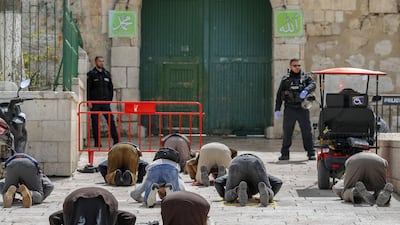
This picture taken on March 23, 2020 shows Palestinian Muslim men prostrate in prayer as Israeli security forces watch near the closed gate of the Aqsa mosque compound, which was closed by the Jordan Waqf religious authority administering the site as part of preventive measures against the spread of the COVID-19 novel coronavirus, in Jerusalem. / AFP / Ahmad GHARABLI -

This picture taken on March 23, 2020 shows a woman taking part in an online pilates class at home, as her dog Elvis stretches next to her, in Nicosia, as restrictions on movement and social distancing were imposed across Cyprus to contain the spread of the COVID-19 novel coronavirus. / AFP / Christina ASSI -

This picture taken on March 23, 2020 shows a pallbearer taking a picture of a coffin for the relatives of a deceased person at the cemetery of Grassobbio in the province of Bergamo, as they could not attend the ceremony because they are in quarantine as a result of the COVID-19 novel coronavirus. / AFP / Piero CRUCIATTI -

This picture taken on March 23, 2020 shows Uruguayan cellist Karina Nunez playing on the balcony of her apartment in Panama City, during the mandatory isolation from 5pm to 5am as a preventive measure against the spread of the COVID-19 novel coronavirus. / AFP / Luis ACOSTA -
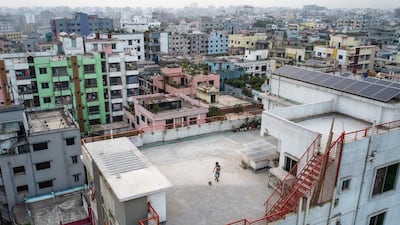
This picture taken on March 23, 2020 shows Samin Sharar, 9, playing on the rooftop of his building in Dhaka, as he avoids going out due to fears over the COVID-19 novel coronavirus. / AFP / Munir UZ ZAMAN -

This picture taken on March 23, 2020 shows Norwegian Cruise Line employees cleaning a cruise ship in Miami, amid fears over the spread of the COVID-19 novel coronavirus. / AFP / Chandan KHANNA -

This picture taken on March 23, 2020 shows people in their apartments, amid fears over the spread of the COVID-19 novel coronavirus, in central Bangkok. / AFP / Mladen ANTONOV -

TOPSHOT - Auxiliary bishop of Lyon Emmanuel Gobilliard holds a streamed live Mass in the empty Saint-Irenee church, in Lyon, on March 24, 2020, on the eighth day of a lockdown aimed at curbing the spread of the virus. / AFP / JEFF PACHOUD -

This picture taken on March 23, 2020 shows Lookslikeavido fashion designer David Avido (C), 24, who makes face masks from remnants of cloth he uses and distributes them to the public for free almost everyday, giving his handmade face masks to people at a butcher shop in Kibera as a preventive measure against the spread of the COVID-19 novel coronavirus. / AFP / Yasuyoshi CHIBA -
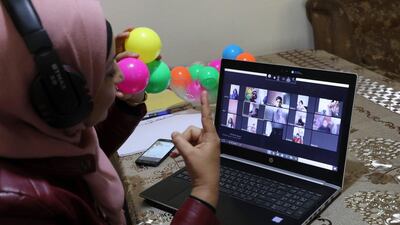
This picture taken on March 23, 2020 shows Palestinian teacher Jihad Abu Sharar presenting an online class from her home in the village of Dura near Hebron in the occupied West Bank, after schools were closed as a preventive measure against the spread of the COVID-19 novel coronavirus. / AFP / Hazem BADER -
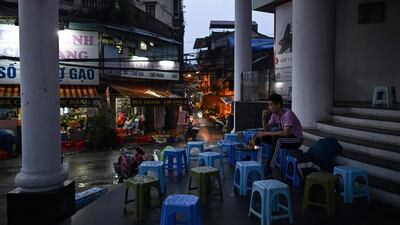
This picture taken on March 23, 2020 shows a man sitting alone at a street-cafe, amid concerns over the spread of the COVID-19 novel coronavirus, in Hanoi. / AFP / Manan VATSYAYANA -

This picture taken on March 23, 2020 shows saxophonist Yarden Klayman performing on a rooftop for residents of Basel Square in Tel Aviv after her concert was cancelled due to the COVID-19 novel coronavirus. / AFP / Jack GUEZ -
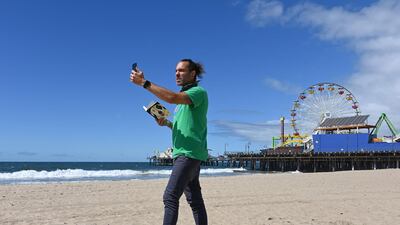
This picture taken on March 23, 2020 shows Adam Duford, owner of Surf City Tours, describing iconic sites in Santa Monica, California as part of a "virtual tour" via his Instagram feed, as the COVID-19 novel coronavirus situation forced his normal tour bus business to come to a halt. / AFP / Robyn Beck -

This picture taken on March 23, 2020 shows human resources professional Diya RoyChowdhury listening to music on her mobile phone while working from home in Mumbai, during a partial lockdown as a preventive measure against the spread of the COVID-19 novel coronavirus. / AFP / Indranil MUKHERJEE -

This picture taken on March 23, 2020 shows Yuki Sato, an employee in a startup company, working from home as a result of the COVID-19 novel coronavirus in Tokyo, as his daughters Yurina (L) and Hinano play and his wife Hitomi uses a mobile phone. / AFP / Behrouz MEHRI -

This picture taken on March 23, 2020 shows food delivery rider Dixon Abreu on a bicycle along the 9 de Julio Avenue in Buenos Aires, as he delivers meals due to an increase in orders as a result of the COVID-19 novel coronavirus. / AFP / Ronaldo SCHEMIDT -

This picture taken on March 23, 2020 shows a runner crossing a road closed to traffic as she exercises in Greenwich Park in south London, as people come to terms with the government's request for social distancing as a preventive measure against the spread of the COVID-19 novel coronavirus. / AFP / Ben STANSALL -

This picture taken on March 23, 2020 shows a member of the Layenne community praying in the sacred Cave of Almadies, where the community's upcoming annual pilgrimage has been cancelled due to the COVID-19 novel coronavirus, in Dakar. / AFP / John WESSELS -

This photo taken on March 23, 2020 shows Kwok Lam-sang, 67, who has been performing covers of Elvis Presley songs under the name of "Melvis" since 1992, walking with his guitar past closed bars in the usually busy drinking area of Lan Kwai Fong in Hong Kong, after restaurants and bars in the city were banned from selling alcohol as a preventive measure against the spread of the COVID-19 novel coronavirus. / AFP / Anthony WALLACE -

This picture taken on March 23, 2020 shows Bambang Soetono (C) and his relatives taking part in noon Islamic prayers at his home in Tangerang, after the government called on Muslims to avoid religious gatherings and practise social distancing as a preventive measure against the spread of the COVID-19 novel coronavirus. / AFP / Adek BERRY -

This picture taken on March 23, 2020 shows artist S.F., 16, spraypainting graffiti inspired by the COVID-19 novel coronavirus on the roof of his apartment building in Athens. - RESTRICTED TO EDITORIAL USE - MANDATORY MENTION OF THE ARTIST UPON PUBLICATION - TO ILLUSTRATE THE EVENT AS SPECIFIED IN THE CAPTION / AFP / Aris Messinis / RESTRICTED TO EDITORIAL USE - MANDATORY MENTION OF THE ARTIST UPON PUBLICATION - TO ILLUSTRATE THE EVENT AS SPECIFIED IN THE CAPTION -

This picture taken on March 23, 2020 shows members of a family studying together at home in Khartoum, as schools and universities close as a preventive measure against the spread of the COVID-19 novel coronavirus. / AFP / Ashraf SHAZLY -
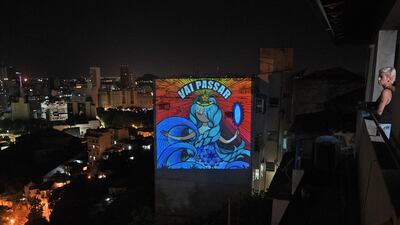
This picture taken on March 23, 2020 shows graffiti artist Rafamon projecting her artwork with a message that reads, "Vai Passar" (It will pass) onto a building near her home in Rio de Janeiro, after she decided to self-isolate as a preventive measure against the COVID-19 novel coronavirus. - RESTRICTED TO EDITORIAL USE - MANDATORY MENTION OF THE ARTIST UPON PUBLICATION - TO ILLUSTRATE THE EVENT AS SPECIFIED IN THE CAPTION / AFP / Carl DE SOUZA / RESTRICTED TO EDITORIAL USE - MANDATORY MENTION OF THE ARTIST UPON PUBLICATION - TO ILLUSTRATE THE EVENT AS SPECIFIED IN THE CAPTION


In the field of environment and wildlife conservation, too, DNA technology has helped identify poachers who leave genetic identifiers at scenes of crime but, more important, help trace gem trophies to countries of origin at advanced application. This has greatly improved rates of convictions of poachers and curbed the illegal game trade.
East Africa, like much of the continent, is primarily dependent on an agricultural economy. The new technology has helped improve food security, specifically in crop sciences and animal health. DNA technologies are useful in trait selection, such as milk production, beef content and disease resistance. Genome-sequencing is helping plant breeders re-establish and enrich traditional food crops with boosted nutritional values such as the indigenous cassava or baobab tree.
It is increasingly apparent that these efforts, successful as they have been and continue to be, are now likely to be perceived as mere tutorials as these companies now take on the Kilimanjaro-size challenge of “testing, testing, testing” – in the words of Mr Ghebreyesus – to contain Covid-19.
To do this effectively, they need the removal of certain barriers and hurdles.
Cost is one. Institutions wanting to adopt this biotechnology in East Africa have had to spend as much as five times more than their counterparts in the developed world. This is because of taxes and duties, high costs of clearance and transportation, as well as constant changes to import regulations, which create delays in the supply chain.
African governments should swiftly waive the stringent regulatory tax charged on imported equipment to help lower these costs and make the equipment more affordable to those who need it. Orders need to be fast-tracked for all biotech firms – instead of the six to eight weeks that it usually takes to arrive at user sites.
New labs need to be set up outside of capital cities to decentralise testing hubs so that sample collection, and DNA extraction and analysis can occur in multiple locations. Perhaps, molecular labs with testing capacity can be set up in hospitals currently in existence.
To cover these set-up costs in economically challenged countries, global biotech companies could pay for them or offer them at highly subsidised rates. It is an opportunity for these firms to earn goodwill and build partnerships in a sector posed for exponential growth in the continent.
According to informed estimates, biotechnology is currently a $500 million industry in Africa. The sector is projected to grow tenfold in the coming years. According to the United Nations Economic Commission for Africa, the economic gain from biotech in agriculture has been more than $2 billion over the past 20 years.
"In addition to South Africa, the industry is growing in Ethiopia, Kenya, Mozambique, Nigeria, Tanzania, and Uganda," the commissioned pointed out. "Biotech represents both a major growth potential, as well as a significant opportunity for productivity improvement and breakthroughs in agriculture, pharma, and health.”
Another immediate solution is to allocate grant money to setting up full work-flow labs or supporting mobile clinics. The kits themselves have been made affordable: between $18-25.
In terms of local expertise, there are many young African scientists who want to contribute to the well-being of their brethren. African countries should, therefore, be reaching out to molecular biologists at post-graduate level at universities to jump in and support this effort. Investing in African talent is always going to be a smart idea. Already, a Senegalese start-up is working with a UK-based company to develop 10-minute coronavirus detection kits. Many other “home-brew” solutions are in the pipeline, being worked on by talented, innovative and creative local scientists.
There is little doubt that supporting biotechnology in Africa is critical. It will give scientists, laboratories and governments a powerful and essential weapon in facing down this terrible scourge.
Zain Verjee is a former CNN anchor and US State Department correspondent. She is founder and CEO of the Zain Verjee Group

