

For over a decade, US presidents have been vowing to end "forever wars," especially by – at last – completely withdrawing American forces from Afghanistan.
Joe Biden has finally taken the plunge, announcing that the remaining 2,500 US troops in the country will be removed between May 1 and the symbolically resonant date of September 11.
This is obviously a US defeat, but of what kind exactly is ambiguous because the overriding US policy was never clearly defined or agreed upon.
This war, which began as a striking success but degenerated into an interminable debacle, reveals much about what has gone wrong with American national security policy-making.
Unlike the US invasion of Iraq in 2003, the Afghan war was necessary. It cannot be written off as a misbegotten adventure that was avoidable and likely to backfire.
Following the 9/11 terrorist attacks in the US by Al Qaeda, which were headquartered in Afghanistan and harboured by the Taliban, a military response was imperative.
No self-respecting power could allow such a deadly and ruthless threat to operate with impunity on the other side of the world, particularly when eliminating it was well within US capability.
Consequently, the Afghanistan mission was relatively non-controversial when it began, as opposed to the invasion of Iraq.
-
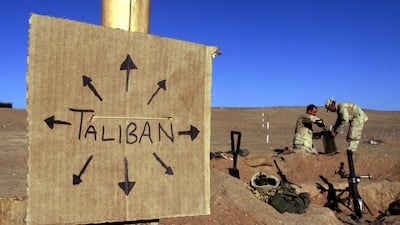
US Marines on the frontlines of a US Marine Corps base, near a cardboard sign reminding everyone that Taliban forces could be anywhere, in southern Afghanistan, December 1, 2001. Reuters -

Afghan Army soldiers break the fast at their military base, during Ramadan, amid the coronavirus pandemic in Herat, Afghanistan, April 17. EPA -

A man waits for customers at his shop in Kandahar, Afghanistan, April 15. EPA -
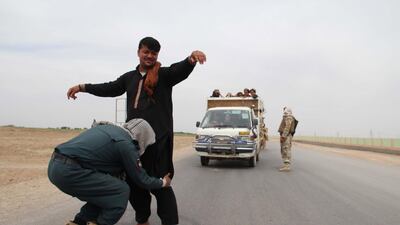
Afghan security officials pat down vistors at a roadside checkpoint in Helmand, Afghanistan, April 15. EPA -

Children collect recycleable waste to be sold for a living, in Jalalabad, Afghanistan, April 15. EPA -

An Afghan man who was injured in a bomb blast, receives medical treatment at a hospital in Arghandab district of Kandahar, Afghanistan, April 15. EPA -
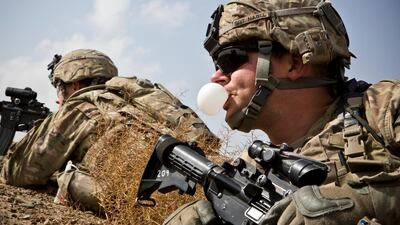
A US Army soldier near Command Outpost Pa'in Kalay in Maiwand District, Kandahar Province, Afghanistan, February 3, 2013. Reuters -
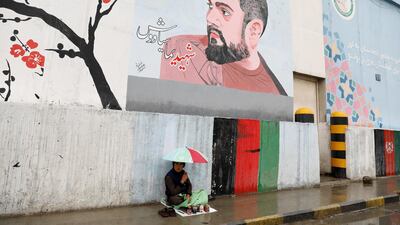
A shoe polisher boy holds an umbrella as he waits for customers under graffiti on a wall in Kabul, Afghanistan April 15. Reuters -

Captain Melvin Cabebe with the US Army's 1-320 Field Artillery Regiment, 101st Airborne Division stands near a burning M-ATV armored vehicle after it struck an improvised explosive device near Combat Outpost Nolen in the Arghandab Valley north of Kandahar, Afghanistan, July 23, 2010. Reuters -
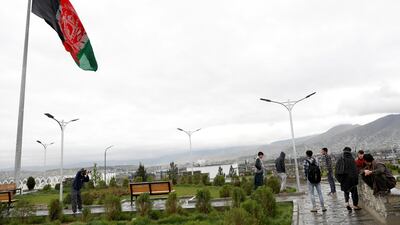
Youths take pictures near an Afghan flag on a hilltop overlooking Kabul, Afghanistan, April 15. Reuters -
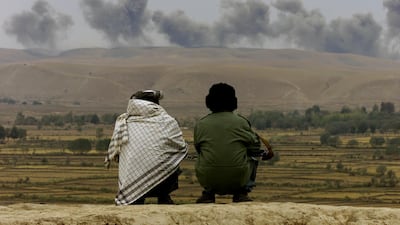
Two Northern Alliance soldiers watch as dust and smoke rise after explosions at Taliban positions on Kalakata hill, near the village of Ai Khanum in northern Afghanistan, November 1, 2001. Reuters -
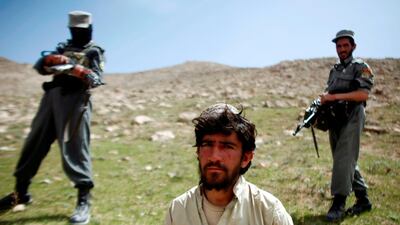
Afghan policemen stand next to a captured Taliban fighter after a gun battle near the village of Shajoy in Zabol province, Afghanistan March 22, 2008. Reuters -
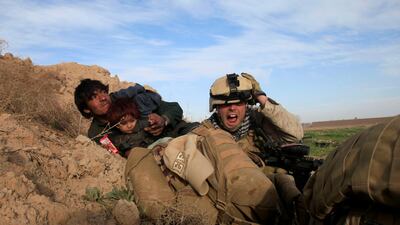
US Marine Lance Corporal Chris Sanderson, from Flemington, New Jersey shouts as he tries to protect an Afghan man and his child after Taliban fighters opened fire in the town of Marjah, in Nad Ali district, Helmand province, Afghanistan, February 13, 2010. Reuters -
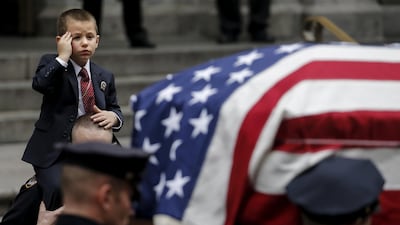
Ryan Lemm salutes the casket of his father, NYPD officer Joseph Lemm, who was killed on duty in Afghanistan. New York, US, December 30, 2015. Reuters -
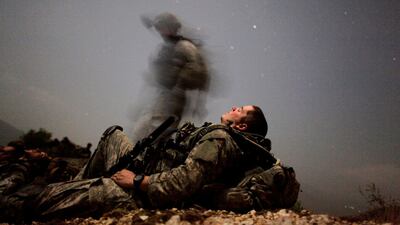
A US soldier of 2-12 Infantry 4BCT-4ID Task Force Mountain Warrior takes a break during a night mission near Honaker Miracle camp at the Pesh valley of Kunar Province, Afghanistan, August 12, 2009. Reuters -
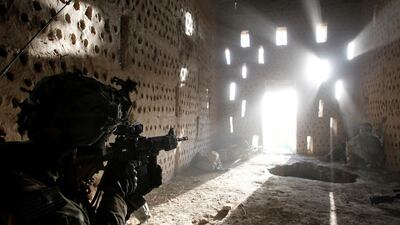
US soldier Nicholas Dickhut, from 5-20 infantry Regiment, attached to 82nd Airborne, points his rifle at a doorway after coming under fire by the Taliban while on patrol in Zharay district in Kandahar province, Afghanistan April 26, 2012. Reuters -
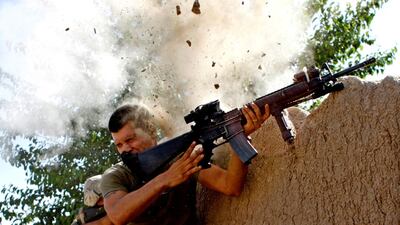
Sgt William Olas Bee, a US Marine from the 24th Marine Expeditionary Unit, has a close call after Taliban fighters opened fire near Garmsir in Helmand Province of Afghanistan, May 18, 2008. Reuters -
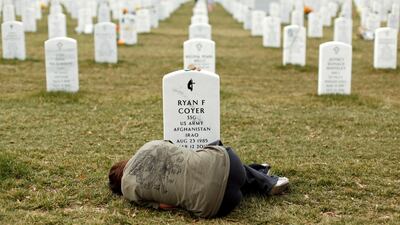
Lesleigh Coyer, of Saginaw, Michigan, lies down in front of the grave of her brother, Ryan Coyer, who served with the US Army in both Iraq and Afghanistan, at Arlington National Cemetery in Virginia, US, March 11, 2013. Reuters -
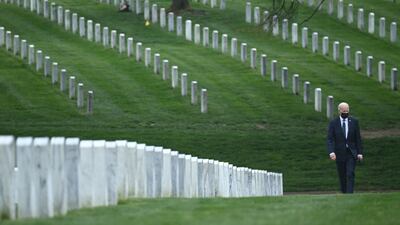
US President Joe Biden walks through Arlington National cemetary to honour fallen veterans of the Afghan conflict in Arlington, Virginia on April 14. AFP


Yet time and again, even when there is a consensus for a major American foreign policy initiative, there is an evident lack of agreement about what is the goal. As a consequence, it is often impossible to seriously measure the progress of a major initiative, not only "objectively" but on its own terms, simply because fundamental aims are not defined.
Any policy initiative that lacks clear goals and which can therefore be subjected to a systematic measure of success or failure, is destined to fail. Short of an implausible and almost miraculous total victory, it cannot succeed because Washington does not agree on what would constitute success in the first place. If no one agrees what success would look like, it cannot be achieved.
This was obviously true of the Iraq invasion from the outset, but it became quickly and increasingly true in Afghanistan as well. The initial US thrust into Afghanistan, led at first by the CIA and other irregular forces, in conjunction with anti-Taliban Afghan groups, was remarkably successful. Within a few weeks the Taliban were negotiating the terms of a de facto surrender.
That is precisely when the policy lost its initial coherence.
It made sense for the US to act forcefully in Afghanistan to eliminate the threat of Al Qaeda and deliver the Taliban such a blow that the organisation would never again harbour anti-American international terrorists.
But having achieved that, almost immediately the US abandoned this clear, limited and achievable aim in favour of a quixotic effort to arbitrarily reshape Afghani governance.
Over the next two decades, Washington attempted to build a new, centralised and unified state based in Kabul that corresponded to American ideas of how Afghanistan ought to be governed. But these ideas had nothing to do with realities on the ground – what is possible, and what makes sense for the people of Afghanistan.
Worse, there was never any honest debate about why the US would seek, in effect, to rule Afghanistan from the other side of the world.
Why would any American cherish such an ambition?
And why would any Afghan be tempted to embrace such a project, other than for immediate self-interest?
The state-building agenda in Afghanistan was irrational, insofar as it offered few, if any, major strategic benefits. Worse, it never stood any chance of success. The whole project therefore made no sense.
The US position in Afghanistan has ebbed and flowed, but there has been a consistent deterioration in relative American power and leverage since the early crushing victory in November and December 2001.
The tragedy is that Washington could have secured favourable terms with the Taliban and other Afghan forces at that time and at a low cost regarding the imperative issue of international terrorism and other limited, focused and necessary demands.
Yet over far too many years and at a vast cost, US policy has consistently eroded Washington's ability to secure such terms. The US is now leaving Afghanistan without any real, serious or enforceable commitments by the Taliban. It is a sorry tale that begins with an overwhelming victory at the end of 2001 and will end, later this year, in an ignominious strategic defeat.
Mr Biden is probably doing the right thing by swallowing this bitter pill, because after so many blunders, there is likely no cost-effective way to salvage US policy in Afghanistan.
Better, as in the case of Vietnam, to accept reality: that a conceptually flawed project, which could never succeed, has inevitably failed.
The biggest tragedy for Americans is not that what amounts to a Taliban victory in Afghanistan means that country will again become a major hotbed of anti-American terrorism. It probably won't. It is that the lessons of this fiasco will almost certainly remain unlearnt.
As with so many other post-Cold War policy failures, this again illustrates that Americans need focused and limited consensus goals, to which they need to apply precise leverage, pressure and, if necessary, force required to achieve them – but no more.
The last time a major US success like that occurred was in Kuwait in 1991. And that was before it became clear that what had been a relative US foreign policy consensus had effectively collapsed along with the Soviet Union, not long after the USSR’s own Afghanistan fiasco.
What is needed is the kind of honest, serious policy conversation that is not rewarded in the American system, and which instead mostly incentivises the avoidance of blame which then hinders bold decision-making.
Most of all, it would require something that may not be possible: the restoration of a shared American vision. But even without that, major policies must have reasonable and shared aims.
Having clear, limited and achievable goals is not a guarantee of success. But without them, failure is virtually certain.
Hussein Ibish is a senior resident scholar at the Arab Gulf States Institute and a US affairs columnist for The National

