
When football results elsewhere confirmed Manchester City as English Premier League champions for the third time in four years earlier this month, club staff gathered at the side’s training complex that evening for an impromptu celebration. It turned out to be quite the night, with manager Pep Guardiola later saying that “the unexpected parties are the nicest ones”.
A video clip from the celebrations later showed Guardiola miming along to the lyrics of Don't Look Back in Anger by the Mancunian band Oasis, while puffing on a large victory cigar.
Days after that joyous occasion he was reduced to tears as he paid tribute to Sergio Aguero, his side’s long-serving and record-breaking striker, after the Argentine played at the Etihad stadium for the final time. This weekend Pep’s team lines up in Porto for the Champions League final on Saturday in what will be a nerve-jangling occasion. This is a period of emotional extremes for Guardiola, but that's often what chasing success brings.
It has been 51 years since City last reached a European final, the longest gap between European final appearances by any football club in history. The weight of expectation is upon them, just as the burden of history has been lifted by finally arriving in the sport’s biggest club fixture.
The party footage provided the perfect encapsulation of the strong bonds that bind the club together, featuring as it did the world’s most intensely focused football manager in a carefree moment that also involved the Manchester band whose story is thoroughly stitched into the fabric of the team’s modern history.
At the height of their fame, Oasis were the biggest band in the world, capable of selling 250,000 tickets in minutes for back-to-back shows in the grounds of Knebworth country house in southern England in August 1996. The album they were touring at the time – (What's the Story) Morning Glory? – became one of the best-selling releases in music history.
More than that, Noel and Liam Gallagher, the band's songwriter and singer, were City fans and proud of it. In a 1994 cover story for the music newspaper NME, the pair were pictured wearing club replica shirts in the Manchester streets where they grew up. The cover for their first album, Definitely Maybe, featured a picture of the maverick forward Rodney Marsh on it, who had played for City in the 1970s.
Noel once talked, probably tongue-in-cheek, of buying the club in the years before the 2008 purchase by Abu Dhabi United Group transformed the organisation’s fortunes. Even today, Oasis songs are still as much a part of the matchday experience at the Etihad stadium as buying a programme or a half-time drink.
A few months before the 1996 Knebworth concerts, the band had also played two sold out appearances at Maine Road in April, City’s home ground until 2003.
When the Gallagher brothers bounded on stage for the first of the shows, Oasis frontman Liam wore a club training top he was reported to have found abandoned backstage at the ground, while Noel repeatedly greeted the crowd with the words “never going down” in reference to City’s away victory at Aston Villa earlier on that same Saturday, part of the club’s late season flourish in form that ultimately proved unsuccessful.
Liam later said the Maine Road weekend was the stuff that dreams were made of. It was, and not just those of the brothers, but City fans everywhere.
-
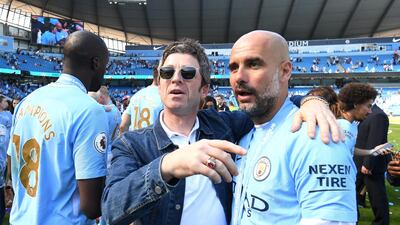
Musician Noel Gallagher, of the band Oasis, speaks to Josep Guardiola, manager of Manchester City, after the Premier League match between Manchester City and Huddersfield Town at Etihad Stadium on May 6, 2018 in Manchester, England. Getty -
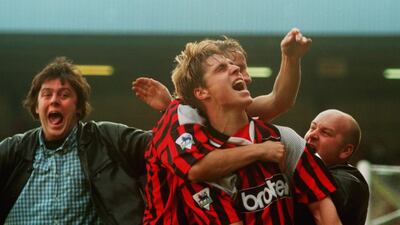
Gary Flitcroft of Manchester City is mobbed by a teammate and two fans as he celebrates after scoring the opening goal against Queens Park Rangers in their Premier League match in London, Oct 15,1994. Allsport -

Oasis perform on stage in 1996 at Manchester City's football ground, Maine Road. Getty -
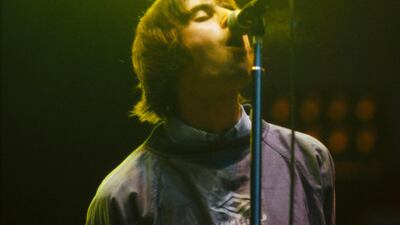
Liam Gallagher of Oasis performs on stage in the UK. Redferns -

Noel Gallagher performs on stage at Maine Road in the UK. Redferns -

Manchester City fans wave flags and a banner saying Definitely Manchester in similar style to the Oasis album Definitely Maybe before the UEFA Champions League Quarter Final between Manchester City and Tottenham Hotspur at Etihad Stadium on April 17, 2019, Manchester, England. Getty -
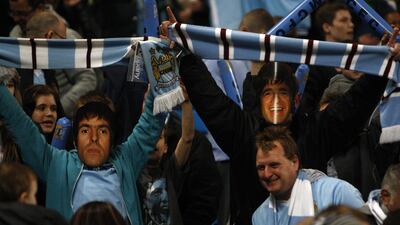
Oasis celebrate a win at The Etihad Stadium on April 30, 2012. Football Premier League: Manchester City vs Manchester United – Man City 1, Man Utd 0. Shutterstock -

Manchester City manager Pep Guardiola celebrates with goal scorer Phil Foden and Kyle Walker (right) after their second goal during the UEFA Champions League, quarter final, in Dortmund, Germany, April 14, 2021. PA Wire -
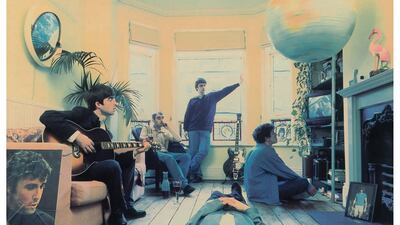
The album cover for the 1994 Oasis debut, 'Definitely Maybe'. -

Manchester City owner Sheikh Mansour with chairman Khaldoon Al Mubarak (left), 23 August 2010. PA Wire


There were nightmares in those days, too. City were relegated from the Premier League the weekend after the homecoming concerts, in spite of Noel’s onstage prediction.
Some pessimistic followers of the club blamed the staging of the concerts for damaging the normally immaculate Maine Road pitch ahead of a match against Liverpool that the side had to win. They only drew and the result precipitated a period of decline for the club.
The lyrical sentiment of Don't Look Back in Anger, the song Guardiola lip-synced to, could easily summarise how it felt to be a City fan back then. Annoyance, regret and exasperation were rarely far away.
To make matters worse, rivals Manchester United secured the title, their third in four years, on the same day in May 1996. A quarter of a century later, it is City who are the trophy rainmakers of their day, winning 13 major trophies in the past decade.
In an interview on the Manchester City website last year, Liam Gallagher made the point that the band were selling out stadiums in the ’90s, while the team was “going down the pan” and that somehow fate made it impossible to have both succeeding at the same time. Oasis split in 2009, two years before City started winning trophies in the modern era, so Gallagher has a point.
Some pundits falsely suggest that City fans tend to eulogise the old days because they were more comfortable with the club’s catastrophic years than the near constant state of celebration that has been delivered over the past decade.
What might be true to say is that the Gallagher brothers helped give supporters something to cling onto in an era when the football on the pitch was dire. The music has lived on, while the visceral pain of those years of sporting underachievement has been eased by the sheer joy the team’s recent success has delivered.
The ’90s also did something else for City supporters, as Guardiola referenced recently, reminding the world that “the history of Manchester City didn’t start 10 years ago, it started at Maine Road in Division Two when 30,000 fans were taking the bus or the train to go away and support the team. This is our history.”
The club’s appearance in the Champions League final this weekend and that of their neighbours Manchester United in the Europa League final this week also harks back to an earlier period when City were domestic league champions in the late ’60s, United were European champions at the time and the fifth Beatle, also known as George Best, plied his trade at Old Trafford. Music and football are often intertwined. The songs have often fed terrace culture and vice-versa.
Despite the wonder years of the late ’60s, which delivered four major trophies in three years, for many City fans the ’90s have become the defining moment when allegiances were tested and reaffirmed.
Those torrid times were followed by a rebuild to get back to the Premier League – it is now 20 years since the club was last relegated – and then upgraded by the new build that was undertaken under the new owners after 2008.
To borrow Oasis parlance, City fans don’t need to look back in anger any more. They are too busy looking forward to Porto. Like the Maine Road concerts 25 years ago, this weekend is the stuff that dreams are made of.
Nick March is an assistant editor-in-chief at The National

