

When the tectonic plates shift in geopolitics, sometimes it’s rapid and noticeable: think how swiftly the communist regimes in Eastern Europe fell in 1989 and 1990 with the ending of the Cold War. At other times, it’s slower but still inexorable.
We are seeing another, equally dramatic, shift occurring now – the decline of the old world order, and the emergence of the new – illustrated by a series of recent events.
The joint communique issued at the end of the Ukraine peace conference in Switzerland last weekend was signed by 78 countries, but just as much attention was paid to those attending that didn’t do so. Those “key global powers” included Brazil, India, Indonesia, Mexico, Saudi Arabia, South Africa, Thailand and the UAE.
I discussed why Ukrainian President Volodymyr Zelenskyy has failed to gain greater traction with many Global South countries with one of South-East Asia’s top security officials last week. “The West thinks its problems are the world’s, but the world’s problems are not theirs,” he told me.
The official also pointed to the answer a former Indonesian foreign minister had given at a private meeting recently, when asked why Jakarta wasn’t more supportive of Ukraine. “Well,” he began, “it’s a long way away.”
It’s not that people in the region don’t care; but they don’t see any reason to give in to American or European pressure to take sides in a dispute in another continent that they view as none of their business.
A majority of countries in South-East Asia are more interested in the prospect of joining the Brics group – named after Brazil, Russia, India, China and South Africa – which now has nine members, including the UAE and Egypt, and which aims to promote a more multipolar world order.

The latest to announce their intention to join was Malaysian Prime Minister Anwar Ibrahim. “We have made our policy clear and we have made our decision. We will start the formal procedures soon. As far as the Global South is concerned, we are fully supportive,” he said in an interview on Sunday. About 40 countries want to follow suit, according to officials in Russia, the current Brics chair.
Robert O’Brien, who served as former US president Donald Trump’s national security adviser, has just published an essay in which he recommends that the US decouple from China and consider sending the entire Marine Corps to the Asia-Pacific. But Australian Prime Minister Anthony Albanese and his New Zealand counterpart, Christopher Luxon, appear not to have read it – going by the friendly smiles they displayed during Chinese Premier Li Qiang’s visits to their countries in the past few days.
New agreements on trade and the environment were signed in New Zealand, while Mr Li said relations with Australia were “back on track” and Mr Albanese hailed “constructive” talks and a “revitalised” bilateral engagement.
Contrast this with the recent G7 summit in Italy, where all the leaders – bar one – of what are supposed to be the developed world’s most important countries are facing mammoth challenges domestically.
The host, Giorgia Meloni, was the only western leader present riding high, after her party topped Italy’s polls in the European Parliament elections this month. Ms Meloni’s Brothers of Italy are variously described as “far right”, or more politely, “arch-conservative”. Are theirs the values that the West now regards as universal and wishes to export to the rest of the world?
This was presumably not what US President Joe Biden had in mind when he convened his “Summits for Democracy”. But we haven’t heard much about them recently, which is unsurprising considering how US support for Israel in Gaza has polarised world opinion and the chorus of those declaring an end to American exceptionalism continues to swell.
-
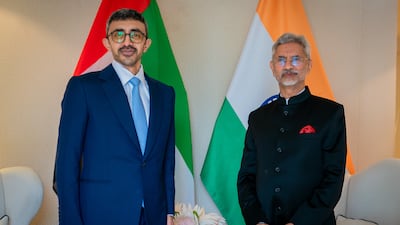
Sheikh Abdullah bin Zayed, Minister of Foreign Affairs, meets India's External Affairs Minister Subramanyam Jaishankar on the sidelines of the 'Friends of Brics' meeting in Cape Town, South Africa. All photos: Wam -
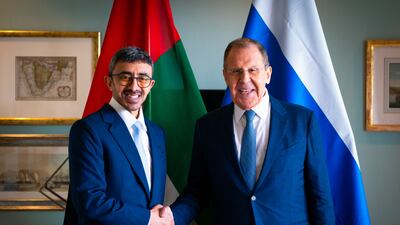
Sheikh Abdullah with Russian Foreign Minister Sergey Lavrov -
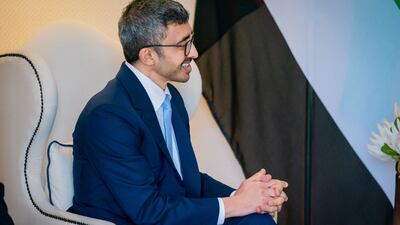
Sheikh Abdullah represented the Emirates during talks with foreign ministers from the Brics group of nations -
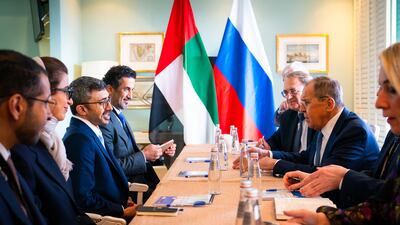
Sheikh Abdullah with Mr Lavrov and other ministers -
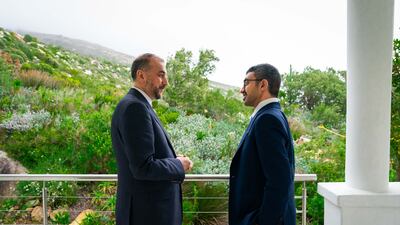
Sheikh Abdullah speaks with Hossein Amirabdollahian, Iran's Minister of Foreign Affairs, on the sidelines of the Brics meeting


From now on, whoever wins the next US presidential election, wrote one Bloomberg contributor this week, America will “behave as just another Great Power using its awe-inspiring might to serve a narrow self-interest”.
This is a highly significant change in itself. Still more remarkable was an essay published on Tuesday by the highly respected Scottish-American historian Niall Ferguson. Mr Ferguson has been describing the relationship between America and China as “Cold War II” since 2018. Naturally, he wants the US to triumph, just as it did over the Soviet Union in 1989.
“But it only recently struck me that in this new Cold War, we – and not the Chinese – might be the Soviets,” he wrote.
He singles out what he sees as an excessive budget deficit, too much government intervention in the economy, “a military that is simultaneously expensive and unequal to the tasks it confronts”, “gerontocratic leadership”, which he says was one of the “hallmarks of late Soviet leadership”, “total public cynicism about nearly all institutions”, mass deaths from addiction and a healthcare system that has become bloated and dysfunctional “even as the political and cultural elite double down on a bizarre ideology that no one really believes in”, and “a population that no longer regards patriotism, religion, having children, or community involvement as important”.
“Are we the Soviets?” he concludes. “Look around you.”
Is this the way US hegemony ends, to paraphrase TS Eliot, not with a bang, but a long drawn-out whimper? It’s interesting to note that Mr Ferguson, a conservative, uses the term “degenerate” to diagnose America’s condition, a word just as likely to spring from the lips of former Russian president Dmitry Medvedev as an accusation against the West in general.
I’m not going to make any moral judgement. But if Mr Ferguson and his allies don’t want the US – or the West more broadly – to lose “Cold War II”, they should reflect that there’s still time to chart a new course.
They could reject that very framing, and instead of railing at their loss of influence they could work with Brics and the Global South. Just because the old order they dominated is palpably fading, as recent events show, that doesn’t mean they can’t be part of the new emerging one.
The world lost a chance to unite after the disintegration of the Eastern Bloc. As the tectonic plates shift once more, let’s try not to lose another.

