

Tomorrow is World Refugee Day, instituted in 2001 to commemorate and remember the 117.3 million refugees around the world: their journey, plight and pain but also their resilience and triumphs.
It is also a day when everyone who is not a refugee should pause and reflect on the sheer randomness that some are born into war and political unrest.
I’ve worked with refugees in Palestine, Bosnia and most wars since then, including the Syrian refugee crisis. What I learnt from the thousands of testimonies I have taken from those fleeing their country is that no one ever really wants to leave their home.
To be put on a road where you often take one bag, if you are lucky, your documents and maybe a photograph or memento of your former life is a painful journey. Leaving your roots and often other family members is something every anti-immigration politician should remember when they try to close doors, or worse – as former US president Donald Trump promised – to send them back.
When I push back against the anti-immigration camp, I tell them to just listen to the stories of those who are fleeing. Their motives aren’t free health care in France. It’s usually war, poverty, desperation, gang violence or starvation.
In the case of Gaza, where already 80 per cent are descendants of those displaced by the Nakba in 1948, they are running for their lives from Israel’s constant attacks and forced starvation.
When I think back of the people I met over the decades, there are many poignant stories.
The 12-year-old boy fleeing the Bosnian town of Jajce and hit by shrapnel in the gut when the human corridor of frightened refugees was deliberately shelled by Bosnian Serbs. He was being operated on in a field hospital with no anaesthetic. I think of South Sudanese civilians trying to flee a brutal tribal war and cowering behind a UN compound fence in 2014. Or Sierra Leoneans trying to escape advancing rebel armies that chopped off limbs as symbols of their grotesque power. Or the Kosovar Albanian woman who gave birth in a forest as she was fleeing Peja.
-
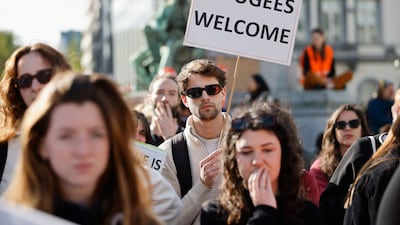
Human rights activists protest outside the European Parliament ahead of a vote on the Pact on Asylum and Migration in Brussels, Belgium. Reuters -
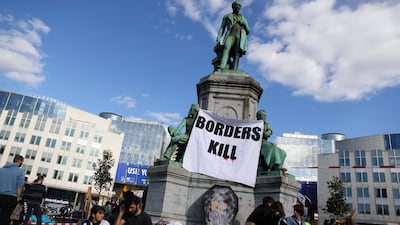
Demonstrators protest out the European Parliament. Reuters -
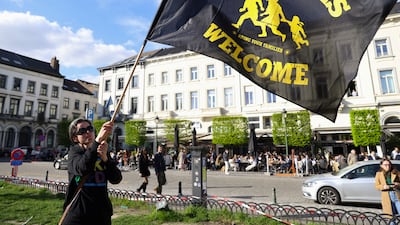
A woman waves a flag in support of refugees in Brussels. Reuters -

Despite opposition from far-right and far-left parties, the parliament passed the new migration and asylum pact, enshrining a difficult overhaul nearly a decade in the making. Reuters -

Migrant charities slammed the pact, which includes building border centres to hold asylum seekers and sending some to outside 'safe' countries. Reuters -

The vote was initially disrupted by protesters. Reuters -
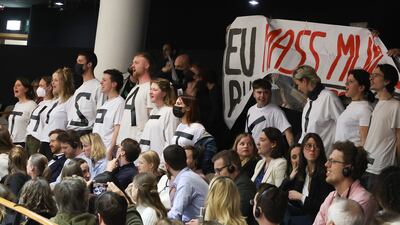
The pact's measures are due to come into force in 2026, after the European Commission sets out in the coming months how it would be enacted. EPA


I remember the cold of that March day in 1999, when the young mother handed me her newborn wrapped in rags with a pleading look. She wanted me to take the baby with me, knowing that an uncertain life lay ahead of her. In Ukraine, where I now work, there are almost six million scattered refugees who may never go home. One quarter of the population remains displaced. Most of these people yearn for their familiar surroundings.
In Venezuela, 5.6 million people fled economic and political instability. Often their crossing was through perilous forests, deserts and swamps. Often people died while trying to get out. In Afghanistan, where the refugee crisis has been ongoing for decades as the governments flipped and shifted, 6.1 million people roam, looking for a home.
When I worked for the UNHCR, I was told to always look for “stories of resilience”. This is often hard to find in refugee camps when people live in mud and sleep in tents, where they search for family members they were separated from.
But I do remember Yusra Mardini, a young Syrian swimmer training for the 2016 Olympics in Rio de Janeiro. Small, determined and highly intelligent, Yusra had escaped Syria with her older sister on a boat that had capsized.
Trained as competitive swimmers in Damascus by their father, the two leapt into the cold water and pulled the boat full of frightened refugees to safety. I remember how proud she was to go to Rio and carry the Olympic flag for her refugee team.
I think of my friend, Ahmed Al Nouiq, who was part of a writers’ collective in pre-war Gaza, who went through incredible hardship to get to London to take up a prestigious scholarship to complete his MA.
Last autumn, Ahmed woke up to the news that 20 members of his family were wiped out from Israeli bombs in a single afternoon. Parent, siblings, nieces and nephews. In this case, does “resilience” apply? I think most of us would find it hard to go through another day after enduring such agony. Those stories, plus displacement and being a stranger in a strange land.
When refugees or people living in a warzone like Gaza tell me they want to leave their country, I always ask them to think of the life they will have when they get to a “safer” place. The life of a refugee, even if they reach a destination that they dream of, is unbearably hard.
About 6.5 million Syrians walked or took buses or cars to Lebanon, Jordan, Iraq, Egypt and Turkey. Others got farther afield in “Fortress Europe”, or if they could get in, the US or Canada.

But for many of them, arriving was painful. Often shunted to parts of the country that were less inhabited, they were not always welcomed warmly. Their new homes had different climates, food and culture. Many I spoke to faced racism, bullying and cruelty. Ken Loach’s excellent new film, The Old Oak, about a group of Syrian refugees arriving in a small town in England, is an excellent depiction.
“Sometimes I am not sure why I came here,” a young Kurdish lawyer I met in Finland recently told me. “Yes, there is no war, but I cannot find my place.” I’ve often heard professionals – doctors, lawyers and journalists – who had to flee tell me that the hardest thing is losing a sense of identity and status.
In 2015, I worked on a project for the UNHCR called “Women Alone”. It was about the plight of Syrian refugee women who were fending for themselves outside their country. Their husbands were often dead or fighting. They mostly had large families, tiny babies, and were living in terrible conditions. Many reported to me that they were preyed upon by men in the local community.
To them, the dream of Germany or Sweden was a vision of a golden place where they would be safe, their children in good schools, a warm home with plenty to eat. Yet even if they managed to get a visa, and even once they actually got there, life would never be easy. In one cruel sense, they would never fit in.
“I grew up constantly knowing I was different. I was dark-skinned and dark-haired. I ate different food, we were poor,” one young woman, who arrived in Sweden from a former post-Soviet country when she was five, told me. “I was told I was Swedish, but it was so obvious they really didn’t want us to be there at all.”
As a Muslim in a Christian country, she said she felt branded. It was worse during the height of ISIS, when she said people looked at her with a kind of fear.
I hope that those who read this column will try to open their own door in some way to someone who is a stranger, a refugee or a displaced person, and trying to adapt to a new life. There was an unprecedented number of host families in France during the Ukrainian crisis who took them into their homes. Unfortunately, I don’t see that same kind of warmth and humanity for Gazan refugees. I don’t have to remind you why.
But I do have to remind all of us that it is only an act of fate that we were born where we were – and not in a refugee community, not in a forest on a cold winter day, alone, vulnerable and struggling to find a bed for the night.

