
Earlier this month, Indian navy operations in the waters between Yemen and Somalia struck a blow against the disruptors of shipping on the high seas.
A combined naval, air and special forces raid, carried out 2,500 kilometres from its own shores, saw the release of the MV Ruen, a vessel held by pirates and used as a mastership to menace other boats.
The descent into lawlessness in this part of the Indian Ocean has posed the most severe threat to the world economy since the onset of Covid-19. India’s takedown of the pirates, therefore, marked a rare good-news development that the UN’s International Maritime Organisation, the global governing body of shipping, could take some comfort from during last week’s important meeting on the industry’s climate agenda.
Shipping’s commitment to Net Zero has been a hard-won prize that was formally achieved at a historic meeting last year in the run-up to Cop28. How unpleasant, then, that the IMO delegates had to assemble in London last week under a cloud cast by the chaos in the Red Sea and Indian Ocean.
In a tense opening session, delegate after delegate condemned the Houthi attacks on international trade lanes that have seen the biggest navies, including India’s, undertake patrols to safeguard cargo ships. Officials who oversee maritime trade conceded that the Houthi escalation has disrupted the IMO’s efforts to align the shipping industry with the goal of Net Zero by the mid-century.
Delegates demanded an end to the dangers posed by the Iranian-backed group, which has fired missiles and drones at dozens of ships in the area, claiming to be retaliating for the Israel-Gaza war. IMO Secretary General Arsenio Dominguez referred to the effects of the Houthi campaign, when he said: “The continued attacks by the Houthis against seafarers in the Red Sea are categorically unacceptable.”

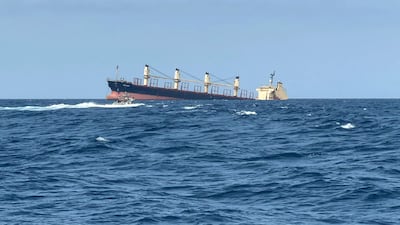
Mr Dominguez pointed out that the industry must guarantee the safety of seafarers and maintain the global distribution of essential goods for the benefit of the world’s population. He also noted that modern cargos can affect the sea environment if there is a catastrophic attack, like in the case of the vessel Rubymar.
“The pollution caused by the sinking of the Rubymar [in the Red Sea] after it was attacked [by the Houthis] is another example of the negative and unnecessary effects,” he said. “And whilst we work tirelessly in reducing emissions from international maritime transport, ships are being forced to navigate longer routes, thereby increasing such emissions.”
The IMO delegates were in London to agree a framework for carbon pricing, so I asked Mr Dominguez how the squeeze on the industry had affected the preparations for this ground-breaking step; no other industry has, after all, taken this leap.
“Shipping should not be penalised for having to emit more by having to travel around the Cape of Good Hope to protect the lives of seafarers,” he responded. As one Bahamas delegate noted, emissions of greenhouse gases on the voyages now significantly increase by thousands of tons for every ship.
And yet by the end of the week, the crisis not-withstanding, the body was able to adopt a draft outline for an “IMO net-zero framework” for cutting greenhouse gas emissions.
Some delegates are worried, of course, that this framework would mean a charge of $150 for every ton of CO2-equivalent emissions, so the impact of the longer voyages would be a significant burden. It is admirable, then, for the IMO to keep on track with a world-first, global, mandatory charge on greenhouse gas emissions.
It is still more significant for an industry grappling with the additional security challenge. Admiral James Stavridis, a former Nato commander, told Goldman Sachs last week that he has not seen a higher level of maritime risk in his 45-year experience.
-
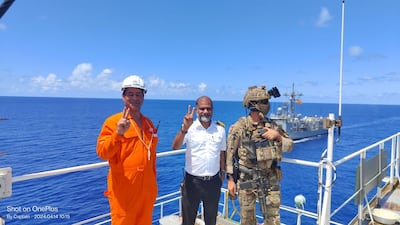
Naval ships escort cargo ship MV Abdullah out of the high risk zone after the vessel with 23 crew was released by Somali pirates. Photo: SR Shipping -
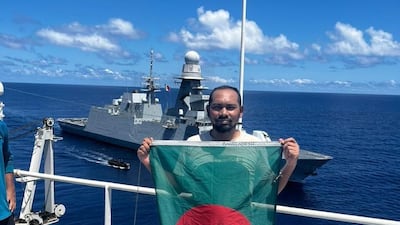
Mohammad Nooruddin is among 23 men who have been released from captivity by Somali pirates who captured the cargo ship that was headed to Dubai from Maputo, Mozambique. Photo: SR Shipping -

The 23 sailors from Bangladesh are safe, the ship is being escorted by naval vessels out of the high risk zone and will reach Dubai’s Al Hamriya port next week. Photo: SR Shipping -

Sailors who were held hostage by Somali pirates for more than a month on the Bangladesh-flagged MV Abdullah celebrate after the cargo ship was released by the pirates. photo: SR Shipping -

Mohammad Nooruddin with his wife and young son before boarding the cargo ship MV Abdullah that was seized by Somali pirates last month. Photo: SR Shipping -

Ainul Hoque (centre), from Chittagong, is among 22 Bangladeshi sailors who were taken hostage by Somali pirates for over a month. His younger brother Mainul Hoque and his mother Lutfi Ara (pictured) are relieved the crew has been released. Photo: The Hoque family -

A group of about 20 pirates took control of the MV Abdullah as it carried coal from Maputo, Mozambique, to Al Hamriya port, UAE, on March 12. Ainul Hoque (pictured) is among those on board who were held hostage and released on Sunday. Photo: The Hoque family -

Ainul Hoque's brother Mainul and mother, Lutfa Ara, hold photos of him and await his return to Bangladesh. Photo: The Hoque family -

A small boat sails next to the MV Abdullah in a screengrab from a social media video released on March 12. Photo: Reuters -

An Indian Navy warship and a long range maritime patrol vessel responded after the Bangladeshi-flagged MV Abdullah (pictured) was seized by the pirates. Photo: Indian Navy -

The family of Mohammed Atikullah, chief officer of the MV Abdullah, were relieved to speak to him and learn that all crew members are safe after being held hostage for over a month. Photo: The Asif family -

Warships escort the Bangladesh-flagged MV Abdullah after it was released by Somali pirates. Photo: EUNAVFOR


Bruce Jones, a senior fellow at the Brookings Institution, told the bank that the conflict off Yemen highlighted how dependent the global economy is on the seas. “The importance of the oceans hasn’t diminished; if anything, it has grown,” he said. Nine tenths of global trade, 70 per cent of global oil and gas supplies, plus almost two thirds of global food supplies, move by sea.
“And while technology and data seem to operate in a different realm, they don’t, because 95 per cent of the world’s data flows on undersea cables lining the seabed floor,” Mr Jones added in the bank report.
For an insight into the real-world impact, Goldman Sachs tapped Tobias Meyer, the chief executive of logistics company DHL Group, who cited excess capacity as a buffer to the dislocation. “Even though the extended voyage around the Cape of Good Hope requires several percentage points of global capacity, and global supply is absorbed in that, this overall demand-supply balance is relaxed enough to absorb that.”
For now, the maritime industry is coping with the strains of the Houthi offensive and revival of Somalian piracy coming in its wake. We heard last week from the Bangladeshi crew of the MV Abdullah held by Somali pirates, who warned their families that food was running out and they were under constant armed threat.
These are the stakes for an industry focused on the first principle of preventing loss of life at sea. It is commendable that it can also advance its long-term goal of Net Zero under the circumstances.

